
Startup Financial Risk Planning: Anticipate and Mitigate for Growth
Anticipate financial risks in your startup with practical strategies to protect cash flow, manage debt, and build sustainable growth.
You have a great idea for a startup. But without solid financial planning for startups, even the best concept will struggle to survive.
At Sager CPA, we’ve seen firsthand how startups with strong financial foundations grow faster and weather challenges better than those flying blind. This guide walks you through the financial essentials you need to build a profitable business.
Most startups fail not because their ideas are bad, but because founders run out of cash. According to Global Entrepreneurship Monitor data, startup rates are at record levels in many regions. The difference between those who survive and those who don’t comes down to one thing: understanding where money goes and where it comes from. Without financial planning, you’re operating in the dark. You don’t know if you’re burning cash too fast, if your pricing covers your costs, or when you’ll hit a wall.
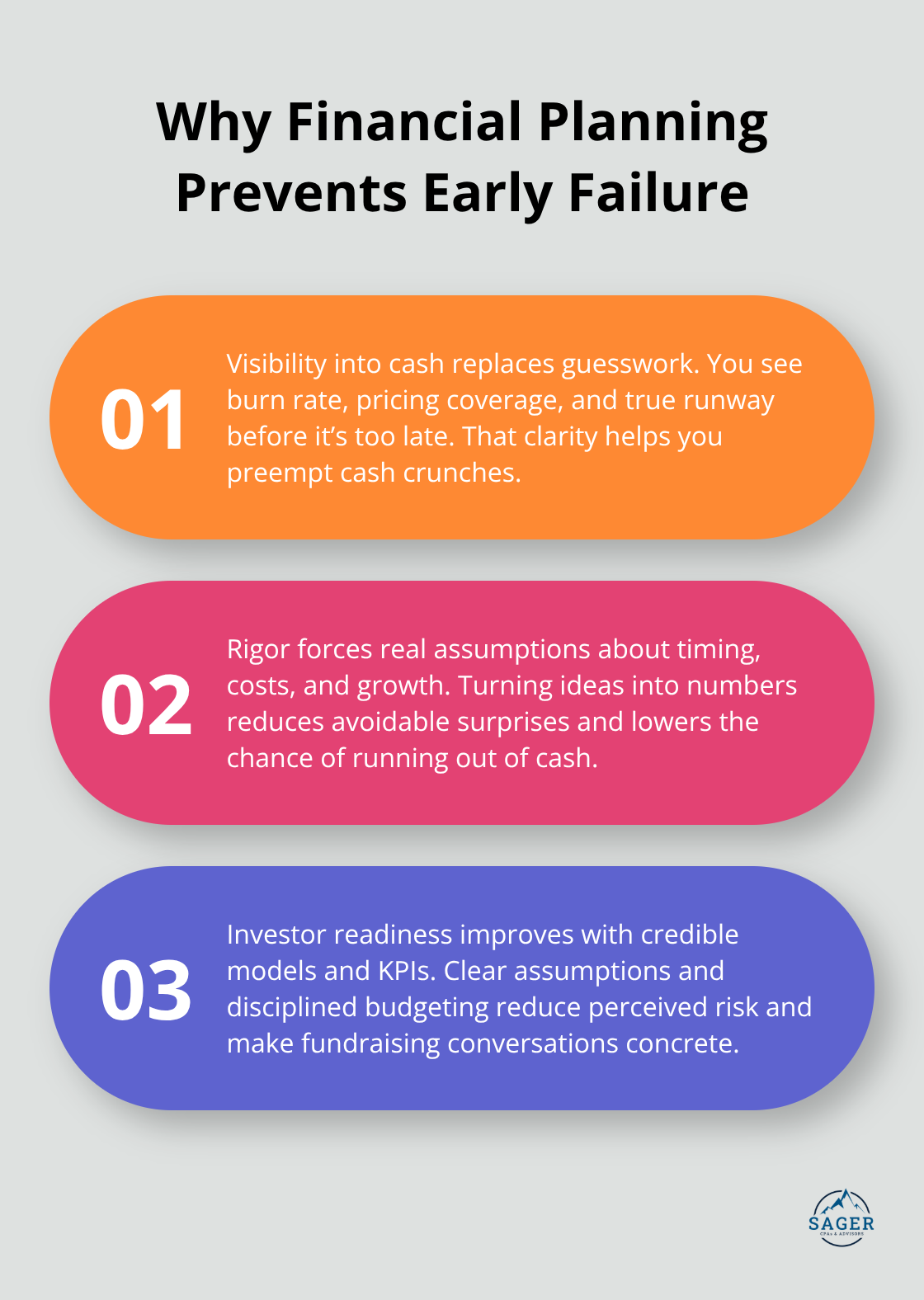
Founders with genuinely solid products have collapsed because they didn’t track their cash flow carefully enough. They thought they had six months of runway when they actually had three.
Financial planning forces you to answer hard questions early: How much will it actually cost to launch? When will customers start paying? What happens if growth takes longer than expected? These aren’t theoretical questions. They directly determine whether your startup survives the first 18 months.
Service-based startups typically require $5,000 to $25,000 to launch with margins around 15% to 20%. Product-based startups often need $50,000 to $150,000 upfront for inventory and manufacturing, though margins vary widely. Online-only ventures can stay lean at $3,000 to $10,000 in startup costs. The difference between these categories is enormous, and founders often underestimate expenses in their own category.
They skip over insurance costs, assume inventory will arrive on schedule, and forget about the months when they’re not yet generating revenue. Financial planning exposes these gaps before they become crises. Top-performing SaaS businesses often achieve gross margins of 80% or higher, demonstrating exceptional efficiency and profitability. This fundamentally changes your financial strategy. If you’re building a subscription service, your cash flow dynamics are completely different from a product business. You need to plan for customer acquisition costs upfront while revenue trickles in slowly over time. Without that planning, you’ll panic when month two looks worse than month one.
Investors don’t fund ideas. They fund founders who understand their own numbers. A clear financial plan with realistic projections, defined key performance indicators, and honest assumptions signals that you’ve thought through the business beyond the pitch. When you walk into a conversation with a detailed three-year model, separate expense budgets, and a working capital plan, you’re showing discipline.
Investors see founders without financial plans as risky bets. Investors see founders with solid plans as people who’ve done their homework. The data supports this: founders who rigorously test concepts and validate demand have roughly 2.6 times higher likelihood of success than those who rely on intuition alone. Financial planning forces that rigor. You can’t build a credible financial model without understanding your customer acquisition cost, your lifetime value, your churn rate, and your unit economics (metrics that matter whether you’re raising money or bootstrapping). These numbers tell you if your business model actually works.
Founders who avoid financial planning often discover problems too late. They launch without knowing their break-even point. They hire staff before validating that customers will pay. They spend on marketing without tracking return on investment. Each of these mistakes drains cash and delays profitability. The cost of fixing these problems after launch is exponentially higher than planning for them upfront.
Financial planning also protects you from making decisions based on emotion or optimism. Your projections force you to be honest about timelines, customer acquisition costs, and realistic growth rates. This honesty, while sometimes uncomfortable, prevents you from burning through capital on strategies that won’t work.
The next section covers the specific financial components you need to build into your startup plan-the tools and frameworks that transform planning from abstract thinking into actionable strategy.
Cash flow is the oxygen of your startup, and most founders treat it like an afterthought. You need to know exactly when money comes in, when it goes out, and what happens in the gaps between. Service businesses with 15% to 20% margins can sustain longer cash droughts than product businesses, but only if you map out the timing. If you run a consulting firm and clients pay 30 days after invoicing, you need enough cash to cover 30 days of expenses before the first invoice lands. Product-based startups face even harsher realities: you pay for inventory upfront, months before customers pay you. SaaS businesses invert this entirely-customers pay upfront, but your customer acquisition cost hits immediately while revenue spreads across 12 or 24 months. These aren’t subtle differences. They’re fundamental to whether you survive month six.
Build a 13-week cash flow forecast that accounts for payroll, supplier payments, tax deposits, and revenue timing. Most founders are wildly optimistic about when customers actually pay. They assume invoices get paid in 15 days when enterprise clients take 45. They underestimate how long it takes to close the first customer. Personal taxes, payroll taxes, and sales tax all hit at specific dates whether or not you’re profitable. A realistic 13-week view exposes these timing mismatches before they become crises.
Your budget should separate fixed costs from variable costs, and variable costs must connect directly to revenue assumptions. If you plan to acquire customers at $500 per customer and that represents 60% of your revenue per customer in year one, your math breaks. You lose money on every sale. Fixed costs-rent, salaries, software subscriptions-stay constant whether you have 10 customers or 100. Variable costs scale with revenue: product costs, payment processing fees, customer support hours. The moment you break these apart on a spreadsheet, you see where profitability actually lives. Most founders obsess over cutting fixed costs when the real problem is variable cost structure. You cannot scale a business where your cost per customer exceeds your revenue per customer, no matter how much rent you save.
Pricing strategy determines everything downstream. If you sell a product that costs $20 to make and you price it at $25, you’ve already lost. Subscription businesses need to think about annual contract value relative to customer acquisition cost-if your CAC is $2,000 and your ACV is $1,500, you’re underwater from day one. Freemium models look attractive until you realize that 95% of free users never convert. Test pricing with real customers before launch. Presales work exceptionally well here: offer early access at a discounted rate and measure willingness to pay. If you cannot get 10 customers to commit to your pricing within two weeks, your pricing is too high or your value proposition isn’t clear. Founders often price based on what feels reasonable rather than what the market will bear. Competition doesn’t set your price-customer value does. If your product solves a problem worth $10,000 per year to customers, pricing at $2,000 leaves money on the table. Pricing at $15,000 signals that you don’t understand your own value. The right price is where customers stop saying yes and start asking for discounts. Find that threshold before you scale, and you’ll have the financial clarity needed to move into the next phase of planning: building realistic budgets and expense projections that actually reflect how your business operates.
Most founders dramatically underestimate what it actually costs to start a business. You budget for product development and marketing, then reality hits and suddenly there’s legal paperwork, insurance premiums, accounting software, initial inventory that arrives late, and three months of runway before customers actually pay. Service-based startups need $5,000 to $25,000 to launch, but founders routinely forget that insurance, licensing, and the first few months of operating expenses consume half that budget before you sign a single client. Product-based businesses face even harsher math: you’re looking at $50,000 to $150,000 upfront, but that’s just inventory and manufacturing. Add in storage, shipping equipment, payment processing infrastructure, and the cash you need to survive while waiting for first sales, and many founders discover they’re short $30,000 to $50,000 before they’ve even started.
The problem isn’t that these numbers are hidden. It’s that founders don’t systematically map every expense category. They build a spreadsheet with the obvious costs and miss the dozens of smaller line items that add up to disaster. One-time legal fees for entity formation, contracts, and IP protection often run $2,000 to $5,000 for a properly structured startup. Professional liability insurance, general liability, and workers’ compensation can cost $1,500 to $3,000 annually depending on your industry. Domain registration, hosting, email, project management software, accounting tools, and CRM systems add another $200 to $500 per month. None of these feel expensive individually. Together, they consume 20 to 30 percent of your initial capital before you’ve acquired a single customer.
The second killer mistake is treating taxes and regulatory requirements as something to figure out later. They’re not. Tax obligations hit on specific dates regardless of your revenue. If you have employees, payroll taxes are due every quarter whether you’re profitable or not. Sales tax liability depends on your location and customer locations, not on whether you’ve thought about it. The IRS doesn’t care that you were too busy building your product to file quarterly estimated taxes. The penalty still arrives. Founders operating as sole proprietors often don’t realize they’re personally liable for business debts, which means creditors can come after personal assets if the startup fails. Setting up an LLC or S-Corp costs $500 to $1,500 and provides legal separation between personal and business finances, but only if you actually maintain that separation.
This is where the third mistake becomes catastrophic: mixing personal and business finances. You pay a business expense from your personal account, or you take a loan from the business and forget to document it, or you use business revenue to cover personal bills, and suddenly your financial statements are worthless. Your accountant can’t prepare accurate tax returns. Your business shows losses when it’s actually profitable. You can’t get a business loan because lenders see chaos. You can’t sell the business because due diligence reveals that personal and business finances are hopelessly tangled.
The solution is mechanical: open a separate business bank account immediately, pay yourself a salary or distributions through that account, and never mix the two. Every business expense goes through the business account. Every personal expense goes through your personal account. This takes fifteen minutes to set up and prevents months of accounting cleanup later. Establish this separation before your first dollar of revenue arrives, not after your accountant flags the problem during tax season. The discipline you build now (keeping meticulous records, maintaining clear boundaries between personal and business money) becomes the foundation for accurate financial reporting, tax compliance, and the ability to make decisions based on real numbers rather than confusion.
Financial planning for startups isn’t optional-it’s the difference between founders who build sustainable businesses and those who run out of cash before proving their concept works. The frameworks in this guide (mapping cash flow precisely, separating fixed from variable costs, testing pricing with real customers, and maintaining clean financial records) aren’t theoretical exercises. They form the operational backbone that keeps your startup alive through the critical early months. Those who treat financial planning for startups as a core business function from day one make better decisions faster and understand their break-even point before it becomes an emergency.
You don’t have to figure this out alone, and attempting to do so costs far more than getting it right upfront. Building accurate financial models, establishing proper tax structures, and creating realistic budgets requires expertise that most founders lack. Mixing personal and business finances, missing tax deadlines, or underestimating operating expenses creates problems that take months to untangle later. Working with financial professionals who understand startup dynamics accelerates your path to profitability and positions you for fundraising if that’s your goal.
Take the frameworks from this guide and apply them to your specific business model today. Build your 13-week cash flow forecast, map your fixed and variable costs, and test your pricing with actual customers. Then schedule a consultation with Sager CPA to validate your assumptions and create a personalized financial strategy tailored to your startup’s unique situation.




Phone: (208) 939-6029
Email: info@sager.cpa
Privacy Policy | Terms and Conditions | Powered by Cajabra
At Sager CPAs & Advisors, we understand that you want a partner and an advocate who will provide you with proactive solutions and ideas.
The problem is you may feel uncertain, overwhelmed, or disorganized about the future of your business or wealth accumulation.
We believe that even the most successful business owners can benefit from professional financial advice and guidance, and everyone deserves to understand their financial situation.
Understanding finances and running a successful business takes time, education, and sometimes the help of professionals. It’s okay not to know everything from the start.
This is why we are passionate about taking time with our clients year round to listen, work through solutions, and provide proactive guidance so that you feel heard, valued, and understood by a team of experts who are invested in your success.
Here’s how we do it:
Schedule a consultation today. And, in the meantime, download our free guide, “5 Conversations You Should Be Having With Your CPA” to understand how tax planning and business strategy both save and make you money.