
Startup Financial Risk Planning: Anticipate and Mitigate for Growth
Anticipate financial risks in your startup with practical strategies to protect cash flow, manage debt, and build sustainable growth.
Startups face financial pressures that can derail growth before they gain momentum. Cash flow gaps, unexpected costs, and revenue swings are real threats that demand attention.
At Sager CPA, we’ve seen how startup financial risk planning separates companies that survive from those that struggle. The good news is that anticipating and mitigating these risks is entirely within your control.
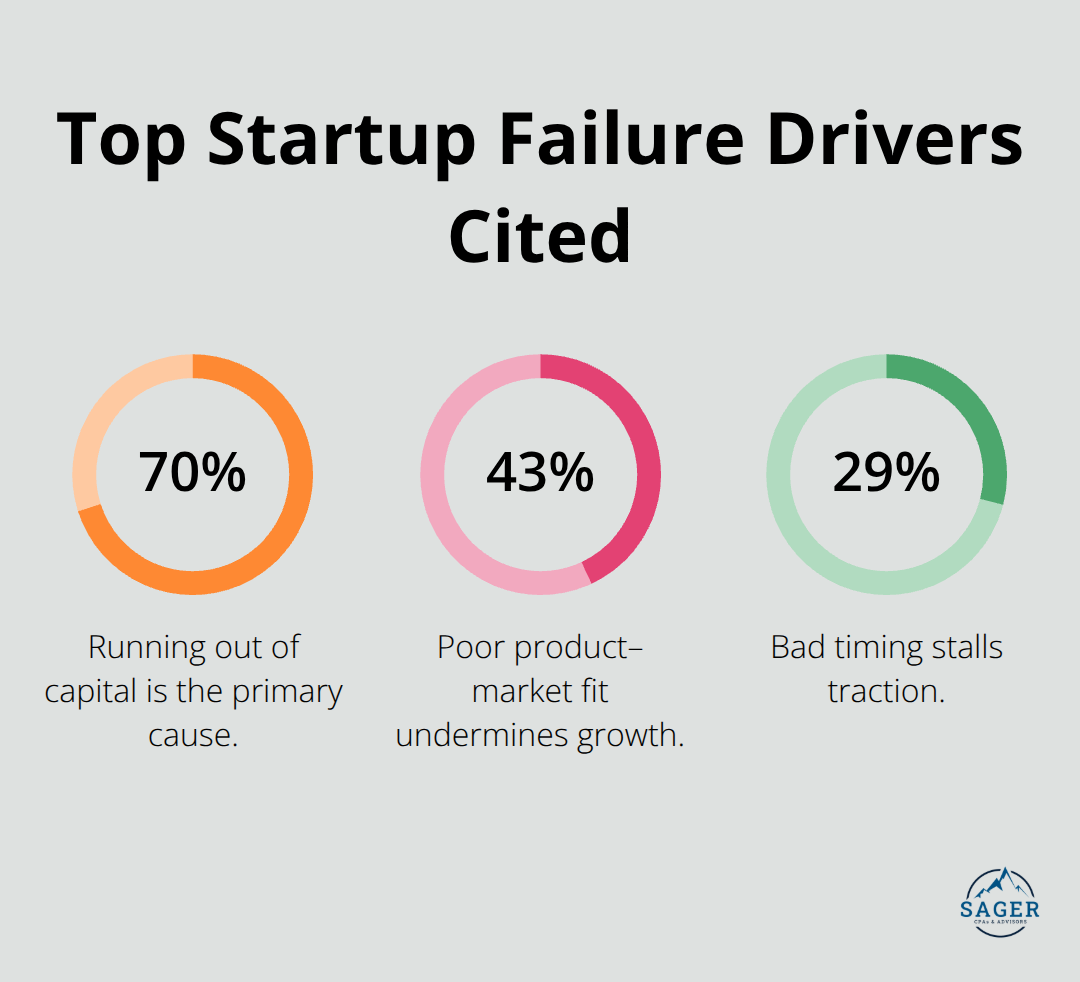
Startups fail from cash flow problems far more often than from bad ideas. The most common cause is running out of capital at 70%, though other critical factors include poor product-market fit (43%), bad timing (29%), and unsustainable unit economics (19%). Your runway is the number of months you can operate before running out of cash.
Many founders miscalculate this figure by ignoring seasonal revenue patterns or assuming growth will arrive on schedule. If you project closing deals in month six but they slip to month nine, your runway shrinks without warning. The math is brutal: if you burn $50,000 monthly and have $300,000 in the bank, you have exactly six months. Add one slow quarter and you’re in crisis mode.
Startups consistently underestimate costs by 20% to 40% according to research from the U.S. Small Bureau of Administration. You budgeted for salaries, software, and rent. Then your server crashes and the recovery costs $8,000. Your co-founder needs legal help with an employment contract and that’s another $5,000. You launch a product feature that requires a contractor for three weeks at $15,000. These aren’t theoretical scenarios-they happen in nearly every startup. The problem intensifies because founders often create budgets based on best-case assumptions rather than realistic contingencies. Equipment fails earlier than expected. Customer acquisition costs run 30% higher than your initial estimates. Compliance requirements emerge that demand professional support. Try a 15% buffer in every budget category-it’s not pessimism, it’s practical startup management.
Market volatility hits startups harder than established companies because you lack the customer base to absorb fluctuations. Lose one major customer and your revenue might drop 25% or 40%. Seasonal businesses face even sharper swings (a SaaS company serving retail might see 60% revenue increases in Q4 and 40% drops in January). Customer churn rates above 5% monthly are common in year-one startups, meaning you constantly replace revenue just to stay flat. Economic downturns hit differently too. The venture capital funding environment shifted dramatically in 2022 and 2023, with global funding dropping to approximately $357 billion in 2022 and further declining to around $214 billion in 2023. Your sales pipeline might look solid in month one but evaporate when prospects delay purchasing decisions. This unpredictability makes static annual budgets nearly useless. You need flexible financial planning that accounts for the reality that your revenue could swing 30% or 50% in either direction within a quarter.
These three threats don’t operate independently-they compound each other. A revenue drop forces you to cut costs, which creates friction with vendors and employees. Unexpected expenses accelerate your cash burn rate, which tightens your runway window. When all three pressures hit simultaneously (and they often do), reactive responses fail. Proactive financial planning separates startups that weather these storms from those that collapse under the pressure.
Financial projections separate startups that anticipate problems from those that react to crises. Most founders create a single projection based on best-case assumptions, then abandon it when reality diverges. This approach fails because it doesn’t account for the volatility that defines early-stage companies. Instead, construct three scenarios: a base case reflecting your realistic assumptions, a downside case, and an upside case where growth accelerates faster than planned. Run these scenarios monthly, not annually. The downside scenario matters most because it shows your actual survival runway under stress.
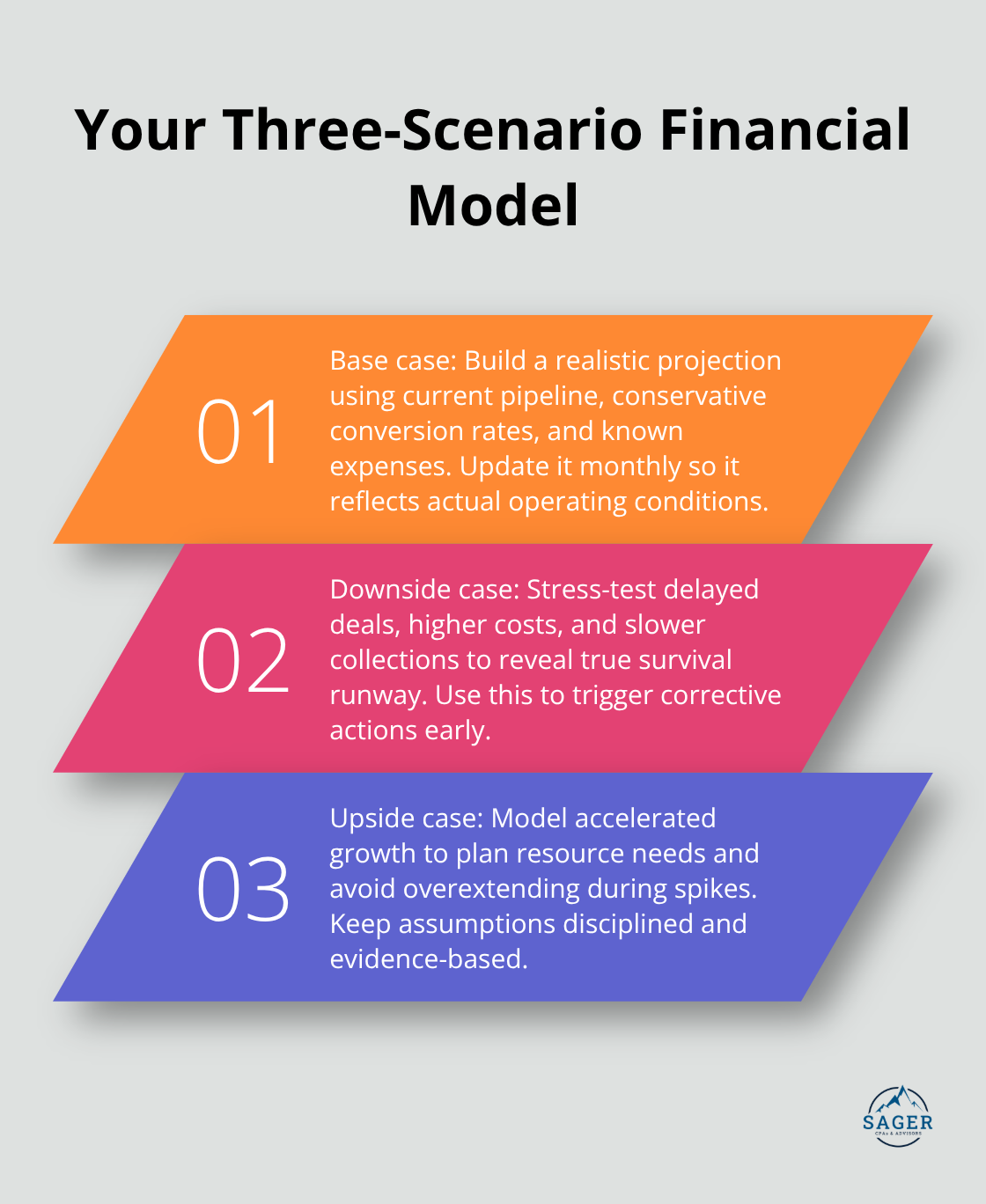
If your downside case shows you run out of cash in eight months, you have eight months to fix the problem through revenue growth, cost reduction, or fundraising. You’re not being pessimistic-you’re being realistic about startup conditions.
Pair scenario planning with weekly cash flow tracking. Most startups track cash monthly, which creates a dangerous blind spot. Weekly tracking reveals spending patterns and revenue timing issues that monthly reviews miss entirely. Tools like Stripe’s financial dashboard or Wave Accounting show cash position in real time, eliminating surprises. Track your actual burn rate against your projected burn rate every single week. When actual burn exceeds projections by 10% or more for two consecutive weeks, that’s your signal to investigate immediately.
Key performance indicators tell you whether your financial situation improves or deteriorates before your bank account shows it. The metrics that matter most depend on your business model, but cash conversion cycle, customer acquisition cost relative to lifetime value, and monthly cash burn rate apply across nearly all startups. A lengthening cash conversion cycle-the time between paying suppliers and receiving customer payments-signals trouble ahead. If your cycle extends from 45 days to 75 days, your cash needs increase even if revenue stays flat. Track this monthly and flag any movement above 5%. Your customer acquisition cost divided by customer lifetime value should exceed 3:1 for sustainable growth; if it’s below 2:1, your unit economics are broken regardless of revenue. Monthly burn rate against runway is non-negotiable. If you burn $40,000 monthly and have $200,000 in the bank, you have exactly five months. Losing one customer shouldn’t change that math, which means your customer concentration risk is too high. These metrics create an early warning system that tells you what’s happening before cash crises arrive.
Emergency reserves force discipline that most founders resist. Set aside one month of operating expenses immediately, then build toward three months. This sounds excessive until a server failure costs $12,000 or a key employee leaves and you need to hire a replacement. Three months of reserves means a revenue drop or unexpected cost doesn’t force emergency fundraising or immediate layoffs. Fund reserves from revenue or retained earnings, not from raised capital. Capital exists to fund growth and operations, not to sit in a savings account. Most startups that collapse under financial pressure had the cash to survive-they just didn’t allocate it defensively.
These early warning systems work only if you act on what they reveal. The next chapter covers the specific strategies that transform financial insights into concrete risk mitigation actions.
Startups obsess over acquiring customers, but the real problem emerges when they acquire them all from the same channel or segment. When 40% of your revenue comes from three customers, losing one client doesn’t reduce revenue by 10%-it crashes your entire financial model. The venture capital funding collapse from $357 billion in 2022 to $214 billion in 2023 proved this brutal truth. Startups with concentrated revenue sources faced immediate crises when one major customer paused spending or renegotiated terms.
Build revenue streams from different customer segments, geographies, or product lines simultaneously. A SaaS company relying entirely on annual contracts should add monthly subscription tiers and one-time implementation fees. An agency billing one industry should target two additional verticals with tailored service packages. This diversification creates stability that extends your runway and reduces panic when any single revenue source fluctuates.
Start with your top five customers and calculate what percentage of revenue each represents. If any single customer exceeds 15% of revenue, that’s your signal that concentration risk is too high. The math works against you: if you lose a 20% customer, you need to acquire four new customers at 5% each just to break even.
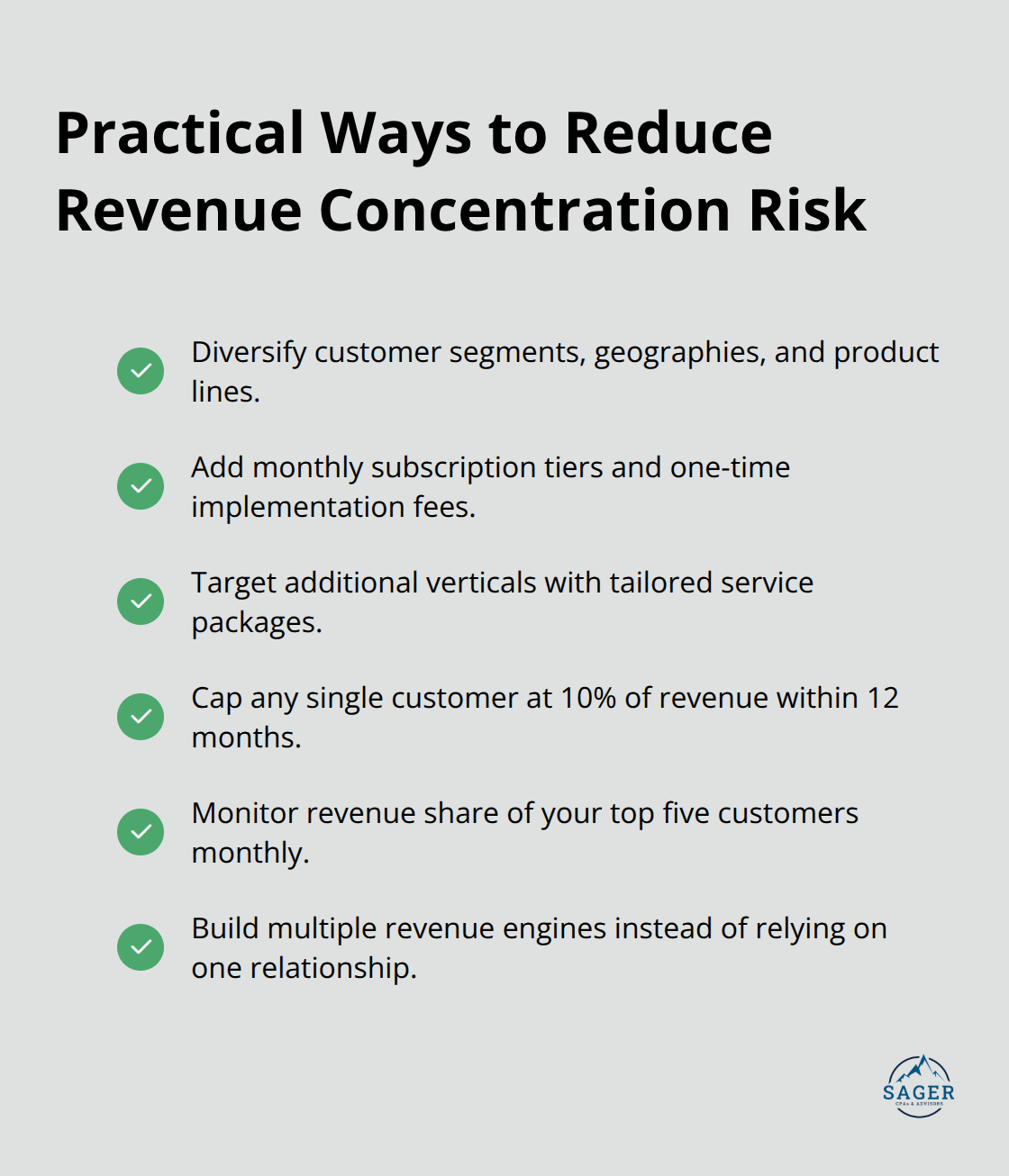
Most startups can’t execute that replacement speed, so they spiral into cash crises. Systematically reduce customer concentration to a maximum of 10% per customer within twelve months. This forces the discipline of building multiple revenue engines rather than betting everything on one relationship.
Vendor and lender relationships matter far more than founders realize because they directly impact your cash runway. When you negotiate 60-day payment terms instead of 30-day terms with your largest vendor, you extend your runway by an entire month without raising capital or cutting costs. Start these conversations before you need them-never negotiate terms from a position of desperation.
Document your payment history with each vendor for six months, then approach them with a simple proposal: extend terms by 15 days in exchange for consistent, on-time payments. Most vendors prefer predictable late payments to early defaults, so this conversation often succeeds. With lenders and lines of credit, the negotiation timing is critical. Establish a small business line of credit when you don’t need it, not when cash depletes. A $25,000 to $50,000 credit line costs almost nothing to establish and provides emergency runway when unexpected expenses hit.
Lenders evaluate applications based on financial history and cash position, so applying during strong cash months dramatically improves approval odds and interest rates. Track your cash conversion cycle religiously and use this metric in lender conversations-a 45-day cycle signals you manage working capital responsibly. Review all vendor contracts quarterly and identify renegotiation opportunities. Software subscriptions increase annually, but many vendors offer discounts for annual prepayment or multi-year commitments. Renegotiating three major vendor contracts annually can reduce expenses by 10% to 15%, directly extending your runway without revenue growth. A customized financial plan ensures your tax strategy and business goals stay aligned throughout this process.
Startup financial risk planning separates companies that weather downturns from those that collapse under pressure. Your three-scenario financial model reveals your actual runway under stress, weekly cash tracking catches spending problems before they become crises, and monitoring customer acquisition cost, cash conversion cycle, and burn rate provides early warning signals that matter. Building emergency reserves protects you from unexpected expenses, reducing customer concentration to a maximum of 10% per customer stabilizes revenue, and negotiating favorable payment terms with vendors and lenders extends your runway without raising capital.
These strategies work because they address the root causes of startup failure: cash flow blindness, revenue concentration, and reactive decision-making. Startups that implement these approaches don’t panic when revenue drops 30% or an unexpected $15,000 expense appears-they have visibility into their financial position and the flexibility to respond without desperation. The difference between survival and collapse often comes down to whether you act on financial insights before crises hit.
The next step is building a personalized financial strategy that fits your specific business model and growth stage. Schedule a consultation to create a financial strategy tailored to your startup’s unique challenges and opportunities.




Phone: (208) 939-6029
Email: info@sager.cpa
Privacy Policy | Terms and Conditions | Powered by Cajabra
At Sager CPAs & Advisors, we understand that you want a partner and an advocate who will provide you with proactive solutions and ideas.
The problem is you may feel uncertain, overwhelmed, or disorganized about the future of your business or wealth accumulation.
We believe that even the most successful business owners can benefit from professional financial advice and guidance, and everyone deserves to understand their financial situation.
Understanding finances and running a successful business takes time, education, and sometimes the help of professionals. It’s okay not to know everything from the start.
This is why we are passionate about taking time with our clients year round to listen, work through solutions, and provide proactive guidance so that you feel heard, valued, and understood by a team of experts who are invested in your success.
Here’s how we do it:
Schedule a consultation today. And, in the meantime, download our free guide, “5 Conversations You Should Be Having With Your CPA” to understand how tax planning and business strategy both save and make you money.