
Cash Flow Management for Startups: From Burn Rate to Break-Even
Master cash flow management for startups with proven strategies to reduce burn rate and reach profitability faster.
Most business owners spend decades building their companies but only weeks planning their exit. Owner retirement readiness requires more than hope-it demands a concrete strategy that addresses your finances, taxes, and business transition.
At Sager CPA, we’ve seen owners leave millions on the table because they waited too long to plan. This guide walks you through the essential steps to protect your wealth and build the retirement you’ve earned.
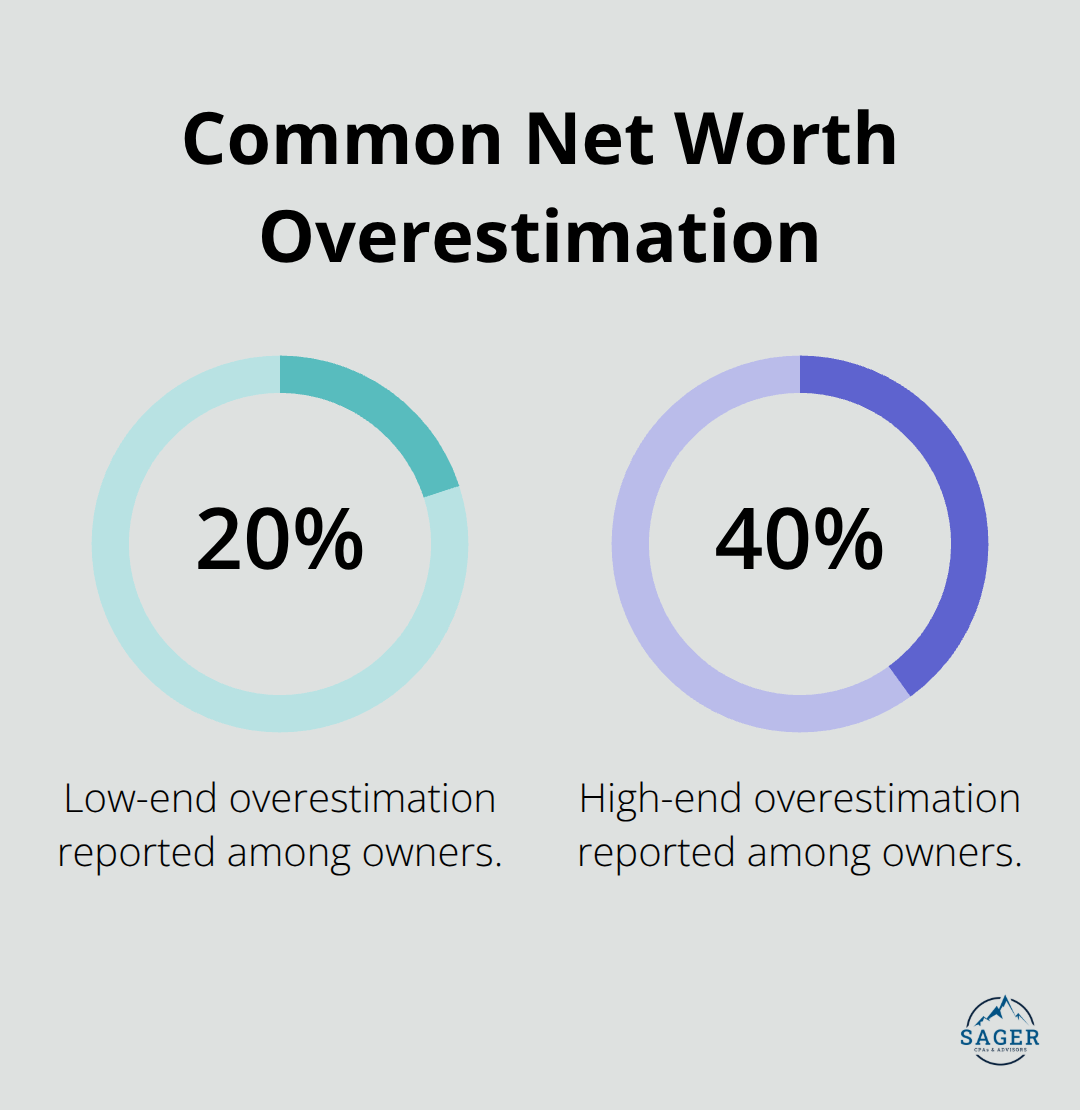
Start with an uncomfortable truth: most business owners guess at their net worth instead of calculating it. We’ve watched owners overestimate their financial position by 20 to 40 percent, then face shock when they attempt to sell or plan retirement. Your net worth is the difference between everything you own and everything you owe, and getting this number right shapes every decision that follows. Add up your business equity, real estate, investment accounts, retirement savings, and personal assets.
Then subtract your business debt, personal loans, mortgages, and any outstanding obligations. This single number becomes your baseline for retirement planning.
Most business owners hold 70 to 80 percent of their wealth in their company, according to data from the Federal Reserve’s Survey of Consumer Finances. This concentration creates risk. A business valuation is not guesswork-it requires a professional appraisal that examines revenue, profit margins, customer concentration, and market conditions. The valuation method matters significantly. Revenue multiples work well for service businesses, while asset-based approaches fit manufacturing. EBITDA multiples typically range from 3 to 6 times for small to mid-sized companies, depending on industry stability and growth trajectory.
If your business depends heavily on you personally, buyers will discount the value by 15 to 25 percent. If three customers represent half your revenue, that’s a red flag that reduces valuation. Get a formal business valuation done now, not when you’re ready to sell-this gives you years to address weaknesses and increase value before you exit.
Debt reduces the proceeds you take home from any exit. Many owners carry business debt they’ve stopped thinking about, along with personal liabilities that compound the problem. Calculate your total business liabilities including loans, lines of credit, equipment financing, and accounts payable. Then add personal liabilities: mortgages, credit cards, and any personal guarantees on business debt.
Buyers typically expect sellers to pay off business debt before closing, which comes directly from your sale proceeds. If you owe $500,000 on a business valued at $2 million, you’re working with $1.5 million before taxes. Some owners carry personal debt that never gets addressed in transition planning, then discover they’ve underestimated their true financial position.
Get a clear liability inventory in writing-list each debt, interest rate, remaining term, and whether you’ve personally guaranteed it. This reveals which liabilities you can eliminate before exit and which will survive your retirement. Once you understand your assets and liabilities, you can move forward with confidence into the next phase: building your exit strategy.
Your retirement timeline shapes every decision that follows, yet most owners pull a date from thin air without connecting it to their financial reality. If you plan to exit in three years, you operate under completely different constraints than someone with ten years ahead. Three years gives you limited time to address business weaknesses, build management depth, or optimize tax structure. Ten years allows you to systematically increase valuation, develop succession candidates, and spread tax implications across multiple years.
Start by writing down your target exit year, then work backward to identify what must happen before that date. This isn’t about wishful thinking-it’s about matching your timeline to the work required. Many owners discover their original timeline was unrealistic once they see the actual preparation needed, and that discovery is worth making years early, not months before you want to leave.
Your exit options fall into three distinct categories, and each demands a different preparation strategy. A sale to an external buyer typically generates the highest valuation but requires a professionally managed business that doesn’t depend on you personally, documented systems, and financial records that withstand buyer scrutiny.
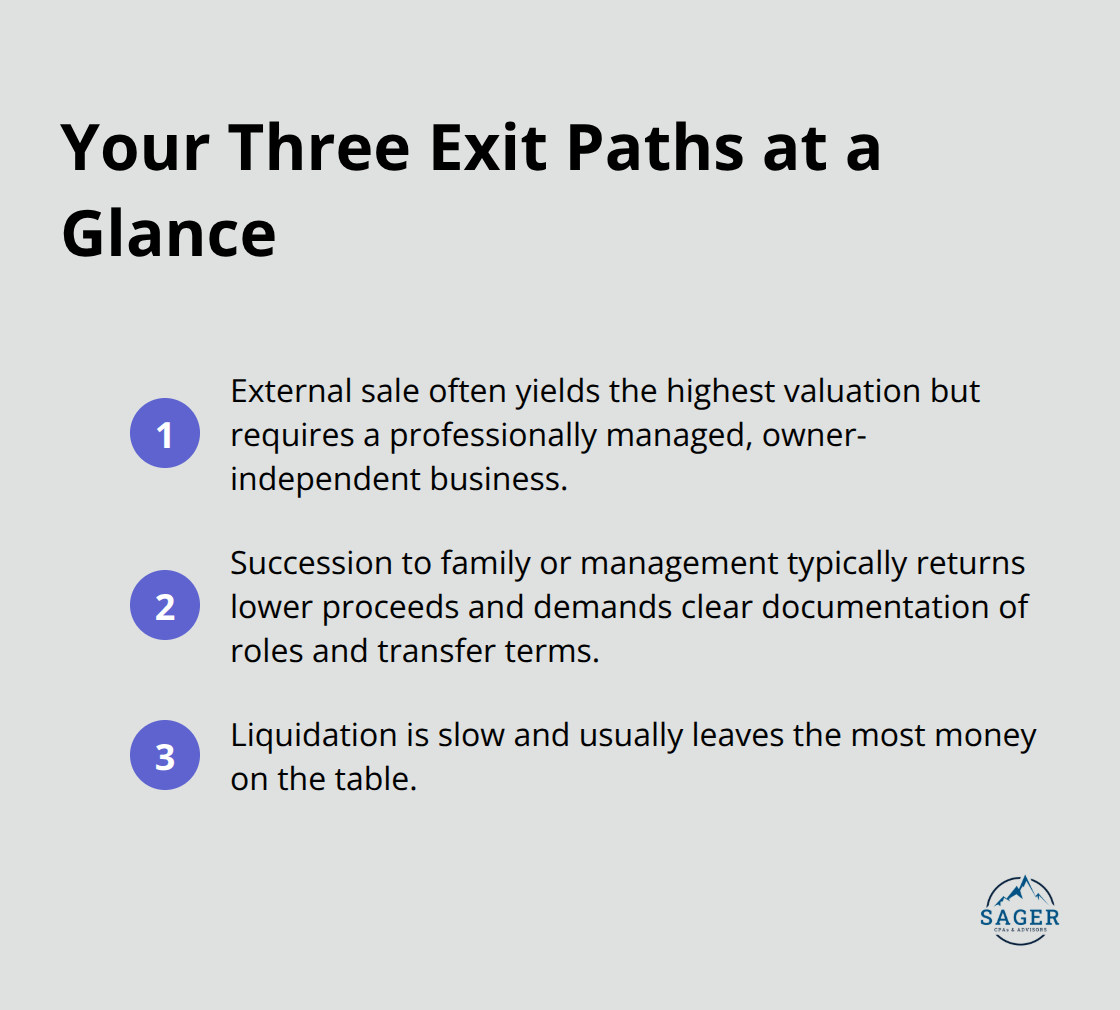
A succession plan through family or internal management works well when you’ve developed capable leaders, but it often returns lower proceeds than an external sale and requires clear documentation about ownership transfer and management roles.
Liquidation is the slowest path and typically leaves the most money on the table, yet some owners choose it when their business serves niche markets or carries customer concentration that makes sales difficult. Each path demands a distinct transition strategy that shapes how you prepare your business over the coming years.
In a sale, you prepare the business for an outsider to run profitably without you. In succession, you train your replacement while maintaining operations during overlap periods. In liquidation, you systematically convert assets to cash while managing customer relationships and employee transitions. The preparation work differs dramatically depending on which path you choose.
Don’t wait until you’re ready to exit to decide which path makes sense-start exploring your options now so you can build toward the right outcome. Your choice today determines the systems you build, the people you develop, and the financial structure you create. Once you understand your timeline and exit path, tax planning becomes your next critical lever for protecting what you’ve built.
Most business owners focus on the sale price and ignore the tax bill that follows, then watch 30 to 40 percent of proceeds disappear to federal and state taxes. This gap between gross sale price and net proceeds after taxes destroys retirement plans built on incomplete math. We’ve seen owners who thought they’d net $3 million discover they’ll take home $1.8 million after capital gains taxes, depreciation recapture, and state obligations. The difference between planning for taxes and ignoring them often determines whether your retirement looks comfortable or strained.
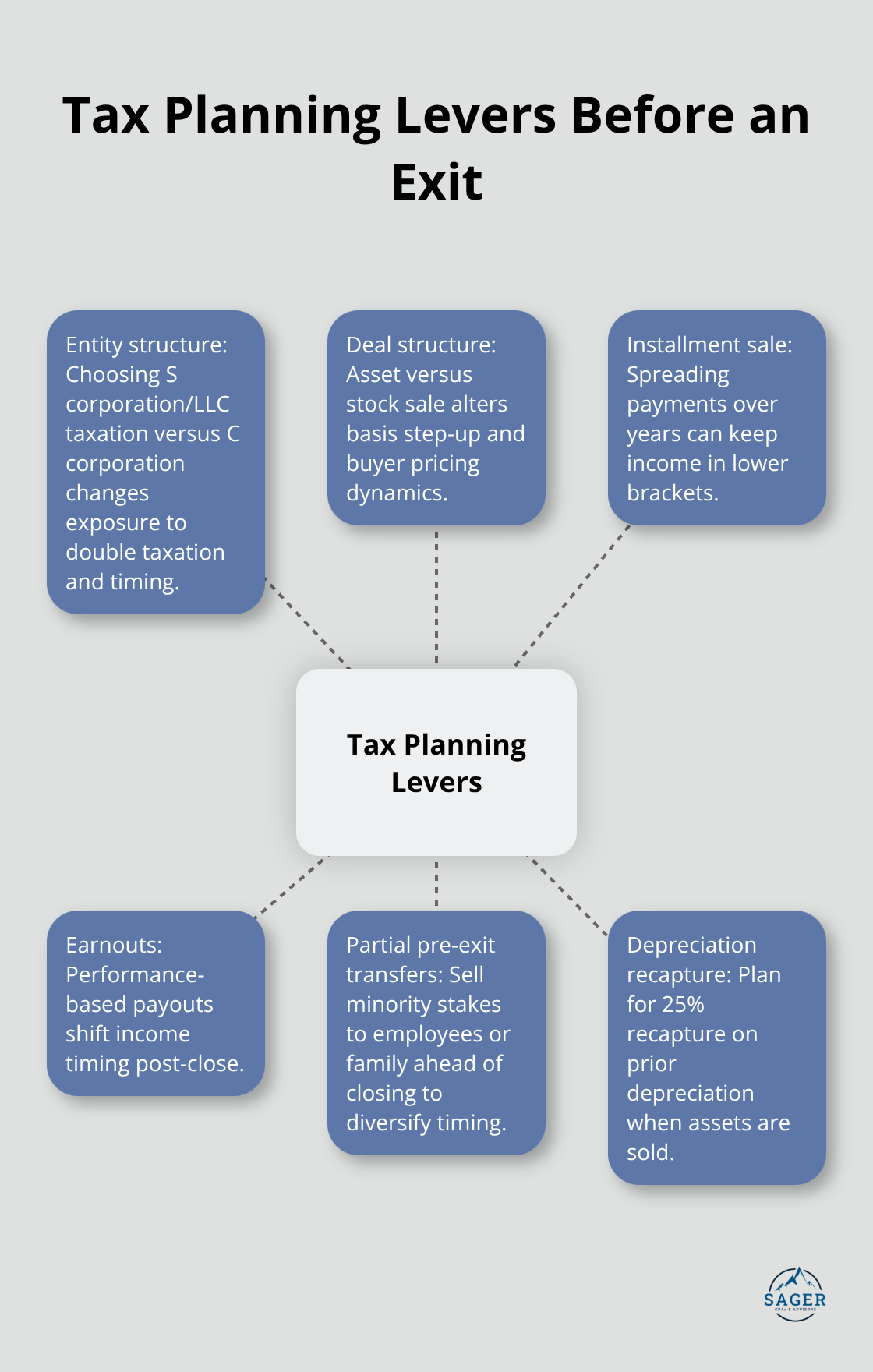
Capital gains taxes on business sales currently run up to 20 percent federal for long-term gains, plus your state tax rate which ranges from zero in states like Texas and Florida to over 13 percent in California. If you’ve depreciated equipment or real estate over decades, the IRS recaptures that depreciation recapture at 25 percent, adding another layer of tax on top of capital gains rates. A $2 million sale might generate $400,000 in federal capital gains tax, $200,000 in depreciation recapture, and $150,000 in state taxes, leaving you with $1.25 million instead of $2 million. These numbers aren’t theoretical-they’re what happens when you sign the closing documents without planning.
The strategic move is to start tax planning years before your exit, not months before. If you’re selling in three years, you still have time to shift income, restructure business debt, or time asset sales across multiple tax years to reduce your total burden. If you’re selling in six months, your options have narrowed dramatically.
A tax strategist who understands business sales can model different approaches and identify which strategies work for your specific situation.
The entity structure you choose for your sale changes your tax outcome significantly. C corporations face double taxation when they sell assets-the company pays tax on the sale, then you pay tax again on distributions. S corporations and LLCs taxed as S corporations avoid this double hit by passing gains directly to owners, saving roughly 15 to 20 percent in taxes on the same sale price. If you operate as a C corporation and haven’t converted to S status, you need to act now-the conversion requires planning because you’ll owe built-in gains tax if you sell within five years of converting.
For asset sales versus stock sales, buyers typically prefer asset purchases because they get a stepped-up cost basis on equipment and inventory. Your tax bill differs dramatically between these structures. Selling assets means you pay capital gains on the sale price less your basis, while selling stock means the buyer takes the business as-is with your original cost basis embedded in the purchase price. Buyers compensate for this by offering lower prices for stock sales, sometimes 10 to 15 percent less. The math often favors structuring your exit as an asset sale even though it generates higher taxes for you, because the buyer’s discount for a stock purchase wipes out your tax savings anyway.
Spreading your exit across multiple tax years reduces your tax bracket impact dramatically. If you sell your business for $2 million in a single year, you’re pushing income into the highest tax brackets where every additional dollar faces maximum tax rates. An installment sale where the buyer pays you over three to five years spreads that $2 million income across multiple years, potentially keeping you in lower brackets and reducing your total tax bill by 5 to 10 percent. Earnouts-where you receive additional payment if the business hits performance targets after sale-also spread income timing and can reduce your tax burden. Some owners structure partial sales to key employees or family members before the final exit, creating multiple taxable events spread across years. The IRS scrutinizes aggressive timing strategies, so this requires professional guidance, but legitimate spreading of income across years remains one of the most effective tax reduction tools available. Start this conversation with a tax strategist now, before you’re in final negotiations with a buyer when your options have vanished.
Owner retirement readiness demands action years before you leave, not months before. Owners who plan early typically net 20 to 30 percent more from their exit than those who wait, because they’ve had time to address business weaknesses, reduce tax liability through legitimate strategies, and structure their sale to maximize proceeds. Early planning also protects you from costly surprises that a buyer’s due diligence uncovers and uses to demand discounts.
Waiting eliminates your options and forces you to accept whatever outcome emerges from rushed preparation. If your business valuation falls short of expectations, you need years to increase it. If your personal dependency on the business creates a problem, you need time to build management depth. If your tax structure isn’t optimal, you can make changes before they’re locked in by a sale agreement.
Professional guidance matters because the stakes are too high for guesswork. A tax strategist who understands business sales identifies strategies specific to your situation that a general accountant would miss, and a business advisor helps you choose the right exit path and prepare accordingly. Schedule a consultation with us to start building your exit plan today.




Privacy Policy | Terms and Conditions | Powered by Cajabra
At Sager CPAs & Advisors, we understand that you want a partner and an advocate who will provide you with proactive solutions and ideas.
The problem is you may feel uncertain, overwhelmed, or disorganized about the future of your business or wealth accumulation.
We believe that even the most successful business owners can benefit from professional financial advice and guidance, and everyone deserves to understand their financial situation.
Understanding finances and running a successful business takes time, education, and sometimes the help of professionals. It’s okay not to know everything from the start.
This is why we are passionate about taking time with our clients year round to listen, work through solutions, and provide proactive guidance so that you feel heard, valued, and understood by a team of experts who are invested in your success.
Here’s how we do it:
Schedule a consultation today. And, in the meantime, download our free guide, “5 Conversations You Should Be Having With Your CPA” to understand how tax planning and business strategy both save and make you money.