
Startup Financial Risk Planning: Anticipate and Mitigate for Growth
Anticipate financial risks in your startup with practical strategies to protect cash flow, manage debt, and build sustainable growth.
Most startups fail because they run out of cash, not because their business model is broken. We at Sager CPA have seen countless founders focus on revenue while ignoring the timing of when money actually flows in and out.
Startup cash flow planning isn’t optional-it’s the difference between scaling fast and hitting a wall. This guide shows you exactly how to keep cash moving through your business.
Profitability and cash flow are not the same thing, and this confusion kills startups. A business can show a profit on paper while running out of cash in the bank account. Profit measures revenue minus expenses over a period, but cash flow measures actual money movement. If you invoice a customer for $50,000 in January but they don’t pay until June, your profit improves immediately, but your cash doesn’t. You still need to pay your team, rent, and software licenses in February through May. Founders make this mistake constantly, and it’s one of the fastest ways to derail growth.
Most startups ignore one critical reality: the gap between when you spend money and when you collect it. Your suppliers want payment in 30 days. Your employees need paychecks every two weeks. But your customers might take 60 or 90 days to pay. That timing mismatch creates a cash crunch that no amount of revenue can fix.
If you’re growing 20% month-over-month, you’re actually burning cash faster because you’re buying more inventory, hiring more staff, and covering more expenses before revenue comes in. Growth without cash management is a trap. The businesses that fail aren’t the ones with bad products-they’re the ones that couldn’t float their operations long enough to collect what customers owed them.
Poor cash flow management forces terrible decisions. You might skip paying yourself for months. You might delay hiring that critical person your team needs. You might turn down profitable projects because you can’t afford to fund them upfront. Worse, you might start taking expensive short-term loans at 40% interest rates or max out personal credit cards.
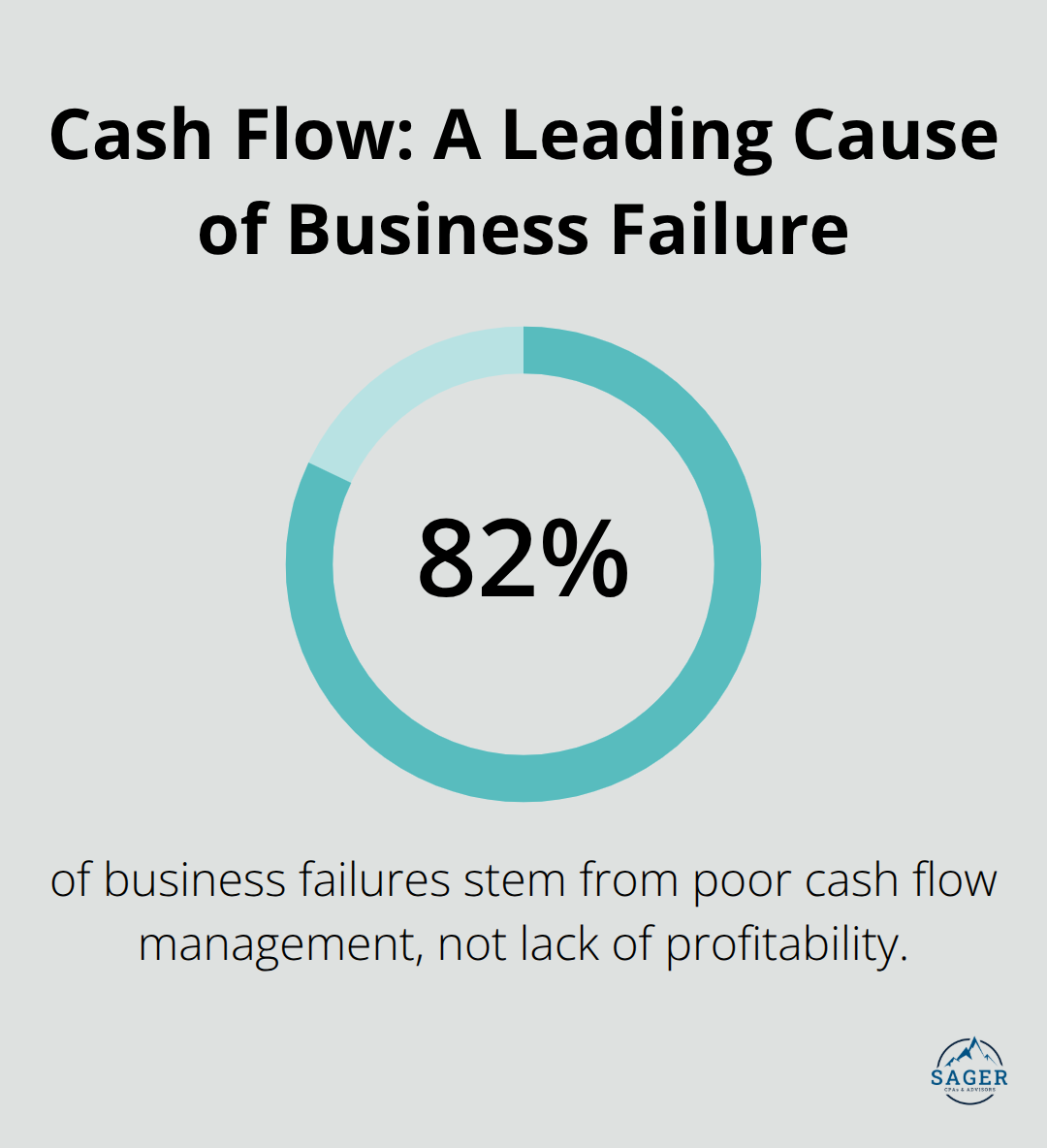
82% of business failures stem from poor cash flow management, not lack of profitability. The founders didn’t run out of customers-they ran out of money to keep operating. You need a cash flow forecast that shows you exactly where money comes in, where it goes, and when shortfalls hit.
Without that visibility, you’re flying blind while your business burns through cash.
The solution isn’t complicated, but it does require discipline. You need to know your cash position today and project it forward for the next 13 weeks (and ideally 12 months). This forecast reveals the timing gaps that destroy startups. When you see a shortfall coming in week 8, you can act early-chase overdue invoices, renegotiate supplier terms, or delay non-essential purchases. Waiting until cash runs out leaves you with no options.
The businesses that survive and scale are the ones that treat cash flow forecasting as a core operating discipline, not an afterthought. Your next step is to build the actual forecast that shows where your cash really stands.
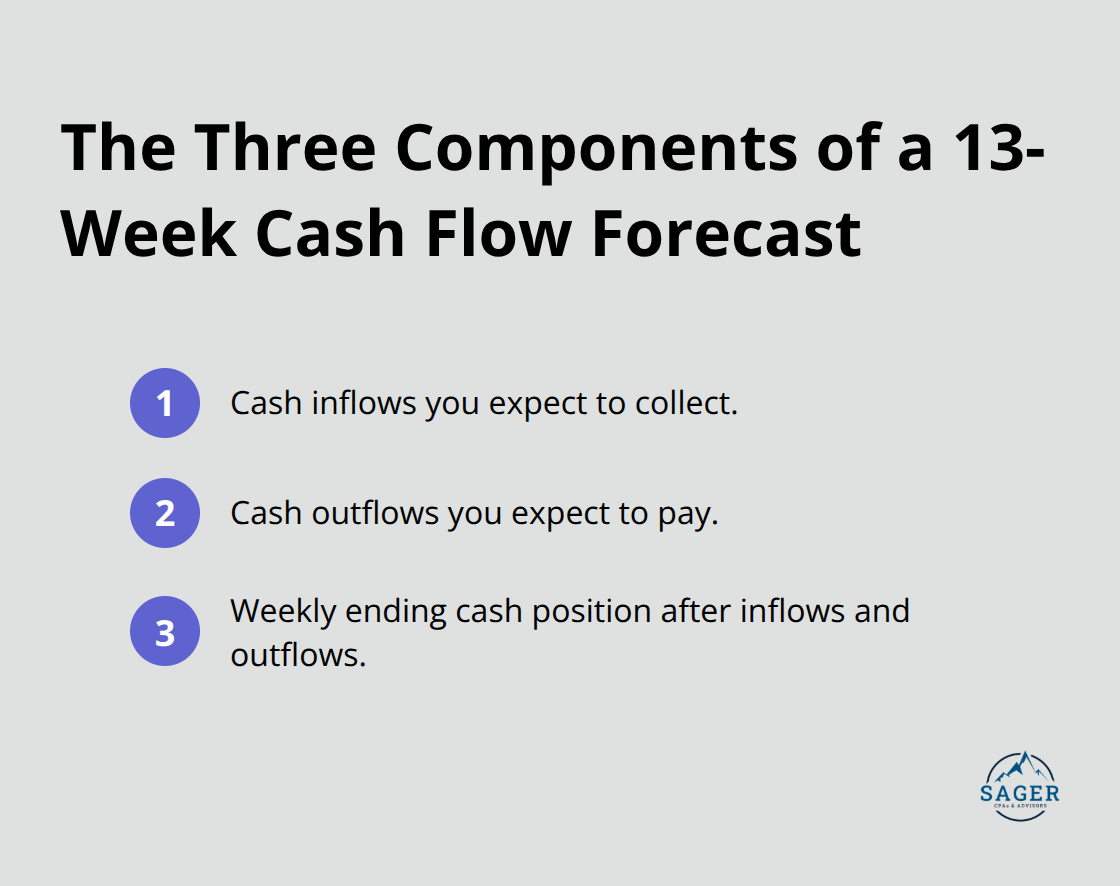
Start with your current bank balance and work forward week by week for the next 13 weeks. This is not optional if you want to survive rapid growth. Your forecast needs three components: cash inflows (customer payments, loans, investor funds), cash outflows (payroll, rent, software, supplier invoices, taxes), and the resulting cash position at the end of each week. Most founders skip this because they think their accounting software handles it automatically. It doesn’t. Your accounting software shows you what happened last month.
A real forecast shows you what happens next month when you can still change course.
Start by listing every dollar you expect to collect and every dollar you expect to spend. Include irregular expenses that most founders forget: annual insurance renewals, tax payments, equipment repairs, and software license renewals. A single forgotten $15,000 tax bill in quarter two destroys a forecast that looked healthy. Once you have the 13-week cash flow forecast locked in, extend it to 12 months so you see seasonal patterns. If you’re in retail or tourism, revenue in December might be three times November. If you’re in B2B services, summer slowdowns kill cash flow. Your 12-month forecast reveals these patterns so you can build cash reserves during peaks and cut costs during valleys. Update your forecast weekly. Don’t wait until month-end. Weekly updates catch problems early when you still have options.
Money your customers owe you isn’t cash yet, and every day an invoice sits unpaid is a day your business gets weaker. Set payment terms in writing before you start work: net-30 is standard, but net-15 is better if your customers can handle it. Then enforce those terms. Send invoices the same day work is delivered, not at week-end or month-end. Use accounting software like QuickBooks Online or Wave that sends automatic payment reminders at day 15 and day 25.
Offer a 2% discount if customers pay within 10 days instead of 30. On a $50,000 invoice, that’s $1,000 back in your account 20 days earlier, which compounds across multiple clients. If a customer hits day 45 without paying, call them. Email doesn’t work. A real conversation reveals whether they’re slow-paying by habit or whether there’s a problem you need to fix. Track which customers are serial late payers and either tighten their terms upfront or stop working with them. Your cash position is too important to subsidize someone else’s poor payment habits.
For B2B work, ask for 50% upfront and 50% on delivery. For SaaS or subscription businesses, charge annual plans instead of monthly and offer a 10% discount for the commitment. Annual payments hit your bank immediately instead of trickling in over 12 months.
Most advice says keep 3–6 months of operating expenses in reserve. That’s the minimum for survival, not growth. Try to keep enough cash to cover at least three months of payroll plus three months of fixed costs like rent and software. If your monthly payroll is $40,000 and fixed costs are $15,000, you need $165,000 sitting in a high-yield savings account earning interest. That feels impossible when you’re bootstrapped, so build it incrementally. Every month you have positive cash flow, move 20% of the surplus into your reserve account. Once you hit your target, you can breathe.
You’ll stop making desperate decisions like taking 40% interest loans or maxing personal credit cards. Your reserve also lets you say no to bad customers and bad deals. When cash is tight, you take whatever comes. When you have reserves, you can wait for customers that pay on time and projects with healthy margins. Store your reserve in a separate high-yield savings account at a different bank, not your operating account. This creates friction that prevents you from raiding it for non-emergencies. Only touch it when cash flow genuinely breaks down or when an unexpected expense hits.
Your suppliers want payment in 30 days. Your employees need paychecks every two weeks. But your customers might take 60 or 90 days to pay. That timing mismatch creates a cash crunch that no amount of revenue can fix. The solution is to negotiate longer payment terms with your suppliers without damaging the relationship.
Call your top three suppliers and ask for net-45 or net-60 terms instead of net-30. Many will agree if you’ve been a reliable customer. On a $10,000 monthly supplier bill, moving from net-30 to net-60 keeps an extra $10,000 in your account for 30 days. That’s real cash you can use to cover payroll or inventory. Pay on time every single time you negotiate better terms. Late payments destroy supplier relationships and eliminate your negotiating power. If a supplier refuses longer terms, ask for a small upfront discount (5–10%) in exchange for paying faster. Sometimes that trade works better than waiting longer to pay.
The next chapter covers the practical strategies that turn your forecast and reserves into real growth without cash crises.
You’ve built your forecast and identified where cash gaps appear. Now you need to act on that forecast before the crisis hits. The three moves that matter most are pulling money in faster from customers, pushing payments out longer with suppliers, and cutting expenses that don’t drive revenue. These aren’t theoretical tweaks-they’re operational changes that move cash immediately.
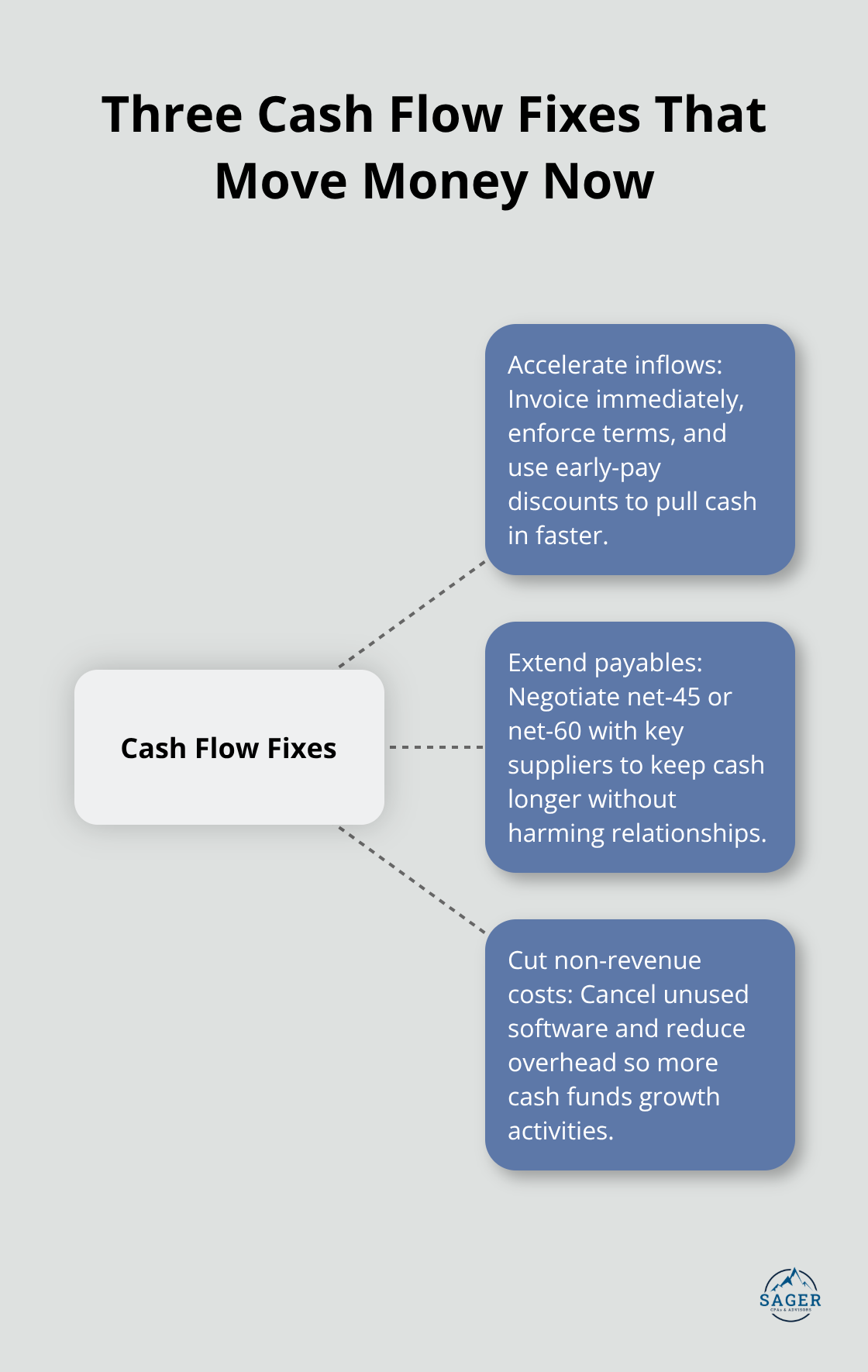
Your customers hold your cash hostage every day an invoice sits unpaid. If you have 20 customers paying net-60, moving half of them to net-30 puts thousands of dollars in your account weeks earlier. Call your top five customers this week and propose a 2% early-pay discount for net-15 instead of net-30. On a $100,000 annual contract, that’s $2,000 back in your pocket 45 days sooner. For one customer, that seems small. For ten customers, that’s $20,000 hitting your account before it otherwise would.
Send invoices the same day work completes, not at month-end. Most founders batch invoicing monthly, which delays cash collection by up to 30 days for no reason. Use QuickBooks Online or Wave to automate payment reminders at day 10 and day 20. When an invoice hits day 35, make a phone call. Emails disappear. A conversation reveals whether the customer is slow-paying by default or whether there’s a real problem. If they’re consistently late, tighten terms upfront on the next project or walk away. Your cash position matters more than being easy to work with.
For B2B contracts, negotiate 50% deposits before work starts. This shifts the cash timing problem onto your customer instead of your business. For SaaS and subscription businesses, push hard for annual commitments instead of monthly. Offer a 10–15% discount on annual plans. You lose some revenue flexibility but gain immediate cash that carries you through the year. That trade is worth it when cash is tight.
Your suppliers want payment in 30 days, but you can change that conversation. Call your three largest vendors and ask for net-45 or net-60 terms. Many will agree if you’ve paid reliably. On a $15,000 monthly supplier bill, moving from net-30 to net-60 keeps an extra $15,000 in your account for 30 days. That’s real working capital you didn’t have before.
Pay those invoices exactly on time every single time. Late payments destroy supplier relationships and eliminate your leverage for future negotiations. If a supplier refuses longer terms, ask whether they’ll accept a 5% discount for paying within 15 days instead of 30. Sometimes paying faster gets you better pricing, which improves margins without requiring sales growth.
Stop looking for small cuts and find the big ones. Most startups waste $500–$2,000 monthly on software subscriptions nobody uses. Audit every recurring charge on your credit card. If you’re paying for something you haven’t opened in 60 days, cancel it today.
Review your three largest fixed costs: rent, payroll, and software infrastructure. Can you renegotiate your lease? Can you hire contractors instead of full-time employees for non-core work? Can you move to cheaper cloud infrastructure? These moves hurt because they feel like scaling back. They’re not. They’re channeling cash toward revenue-generating activities instead of overhead. The companies that survive rapid growth are the ones that treat cash as a constraint that forces discipline, not a problem to solve later.
Cash flow is the operating system that keeps your startup running, and startups that survive treat startup cash flow planning as a core discipline, not something to figure out later. You now have the framework to build a 13-week forecast, identify where cash gaps appear, and act before they become crises. The forecast reveals timing mismatches between when you spend and when you collect, while accelerating customer payments, extending supplier terms, and cutting non-revenue expenses move cash immediately.
Start this week by pulling your bank balance and listing every dollar coming in and going out for the next 13 weeks. Call your top five customers and propose a 2% discount for faster payment, then call your largest supplier and ask for net-45 terms. Cancel one software subscription you’re not using, and these three actions alone will improve your cash position within 30 days.
The difference between startups that scale and startups that fail often comes down to whether someone was watching cash flow closely enough to catch problems early. If you want professional guidance building a cash flow strategy tailored to your business, we at Sager CPA offer expert financial management and tax planning services designed to give you the clarity and confidence you need. Schedule a consultation with Sager CPA to create a personalized financial strategy that keeps your startup moving forward without cash crises derailing your growth.




Phone: (208) 939-6029
Email: info@sager.cpa
Privacy Policy | Terms and Conditions | Powered by Cajabra
At Sager CPAs & Advisors, we understand that you want a partner and an advocate who will provide you with proactive solutions and ideas.
The problem is you may feel uncertain, overwhelmed, or disorganized about the future of your business or wealth accumulation.
We believe that even the most successful business owners can benefit from professional financial advice and guidance, and everyone deserves to understand their financial situation.
Understanding finances and running a successful business takes time, education, and sometimes the help of professionals. It’s okay not to know everything from the start.
This is why we are passionate about taking time with our clients year round to listen, work through solutions, and provide proactive guidance so that you feel heard, valued, and understood by a team of experts who are invested in your success.
Here’s how we do it:
Schedule a consultation today. And, in the meantime, download our free guide, “5 Conversations You Should Be Having With Your CPA” to understand how tax planning and business strategy both save and make you money.