
Startup Financial Risk Planning: Anticipate and Mitigate for Growth
Anticipate financial risks in your startup with practical strategies to protect cash flow, manage debt, and build sustainable growth.
Most people leave thousands of dollars on the table every year simply because they don’t know what deductions exist. Personal tax optimization isn’t about complex schemes-it’s about understanding the legitimate strategies that reduce what you owe.
We at Sager CPA have helped countless clients find money they didn’t know they were missing. This guide walks you through the deductions, timing strategies, and investment approaches that actually work.
Home office expenses represent one of the largest unclaimed deductions available to remote workers and self-employed individuals. The IRS allows you to deduct either $5 per square foot (simplified method) or actual expenses for the portion of your home used exclusively for work. If you work from home and claim a 200-square-foot office, the simplified method yields $1,000 annually with zero documentation required.
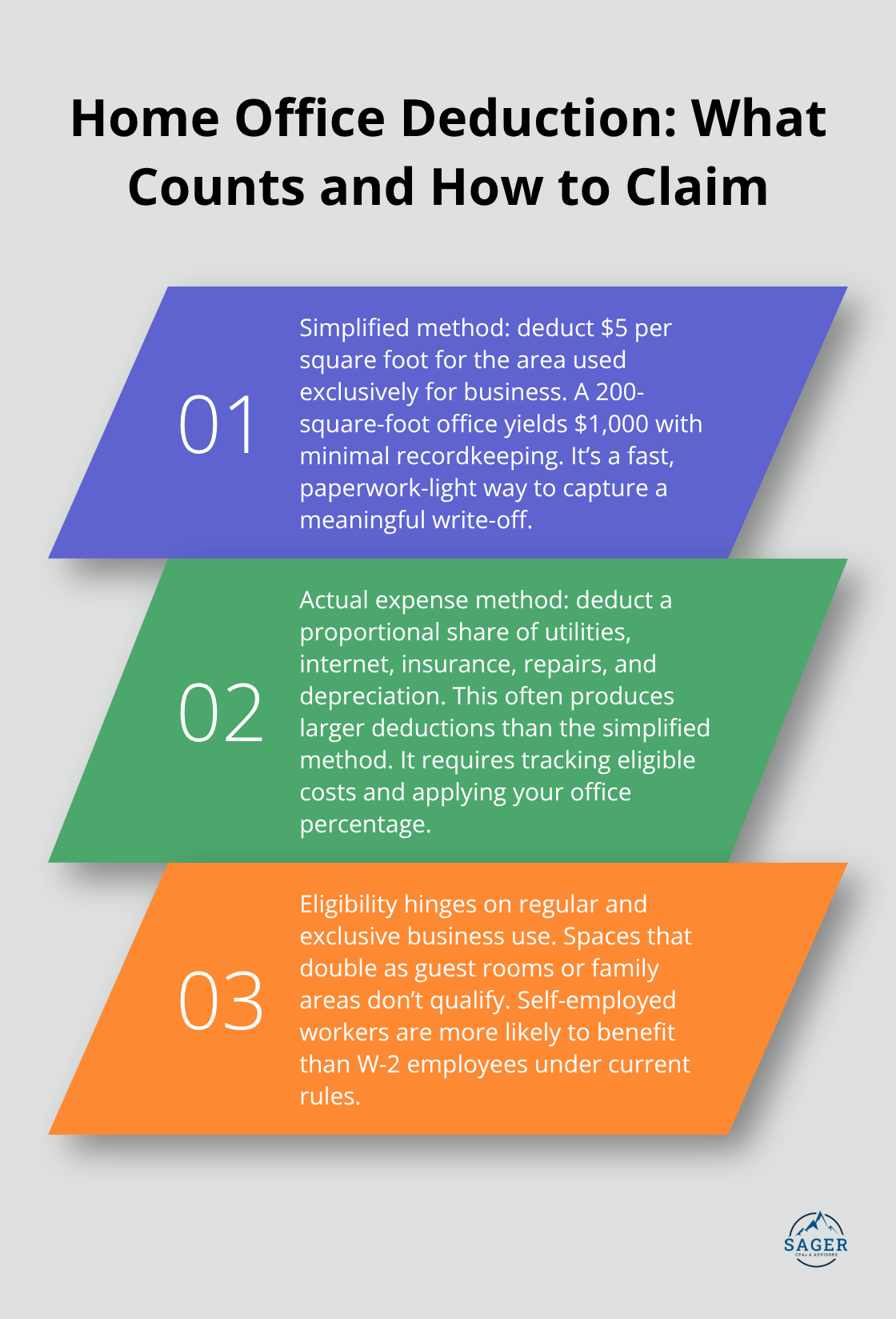
Actual expenses often produce higher deductions: you can write off utilities, internet, insurance, repairs, and depreciation proportional to your office space.
The critical requirement is that your workspace must be used regularly and exclusively for business. A spare bedroom that doubles as a guest room fails this test and disqualifies the deduction. Self-employed workers and remote employees working for themselves capture this deduction far more often than W-2 employees, who face stricter rules under current tax law.
Medical and healthcare costs that exceed 7.5% of your adjusted gross income become itemized deductions, yet most people fail to track these expenses year-round. Out-of-pocket costs for prescriptions, dental work, vision care, and therapy sessions all count toward this threshold. If you earn $100,000 in AGI, you need $7,500 in medical expenses before any deduction applies-but once you cross that threshold, every dollar above it reduces your taxable income.
High-earner households often miss this opportunity because they assume their insurance covers everything. Insurance premiums themselves count, and so do deductibles, copays, and procedures your plan doesn’t cover. Tracking these expenses throughout the year prevents you from leaving money on the table at tax time.
Education expenses present a different opportunity for career advancement. If you pursue courses, certifications, or degrees that maintain or improve job-related skills, you can deduct tuition and fees. A CPA pursuing additional certifications, a software developer taking cloud architecture courses, or a business owner attending leadership training all qualify for these deductions.
The lifetime learning credit provides up to $2,000 per year on your tax return, and unlike deductions, it directly reduces taxes owed rather than just reducing income. The IRS distinguishes between education that qualifies you for a new field (not deductible) and education that improves existing skills (deductible), so the intent and timing of your coursework matter significantly. Understanding this distinction helps you maximize the tax benefit from your professional investments.
These overlooked deductions form the foundation of smarter tax planning, but timing and strategic income management amplify their impact even further.
Timing your income and deductions across tax years ranks among the highest-impact strategies available, yet most people treat every year in isolation. The math is straightforward: if you earn $150,000 one year and $50,000 the next, you’ll pay substantially more in total taxes than if you smoothed that income to $100,000 annually, since higher income pushes you into steeper tax brackets. For 2026, the federal system uses seven brackets ranging from 10% to 37%, with single filers hitting the 24% bracket at $191,950 and the 32% bracket at $243,725 according to IRS inflation adjustments. Self-employed professionals, business owners, and those with variable income have real opportunities to manage this, while W-2 employees face tighter constraints.
The strategy works in both directions: income smoothing across tax years involves strategic timing of income and deductions, or defer income into low years and accelerate deductions into high years, depending on your projection. A business owner earning $300,000 in year one and $100,000 in year two should seriously consider realizing investment gains in year two when the 15% long-term capital gains rate applies to substantially lower income thresholds.
If you expect a significantly lower-income year-perhaps you’re taking a sabbatical, selling a business, or experiencing a temporary income dip-that’s the ideal time to convert traditional IRAs to Roth accounts, realize long-term capital gains, or bunch charitable donations that would normally span multiple years. Roth conversions in lower-income years involve paying taxes on the converted amount in the year of conversion, but once the funds are in the Roth IRA, they can grow tax-free. This locks in today’s tax rates before brackets potentially rise.
Conversely, if you anticipate higher income next year, defer professional development expenses, charitable contributions, and discretionary business equipment purchases into the current year to maximize their tax-reducing power.
Coordinating retirement contributions amplifies this timing advantage because contribution limits reset annually and you cannot recover unused contribution room. For 2025, the 401(k) limit stands at $23,500 for employees under 50, with an additional $7,500 catch-up at age 50 and an extra $11,250 supersize catch-up for ages 60 to 63 according to Schwab and IRS guidance. If you’re self-employed or have business income, a Solo 401(k) or SEP-IRA allows contributions up to roughly $70,000 annually depending on your structure, which dwarfs the standard IRA limit of $7,000.
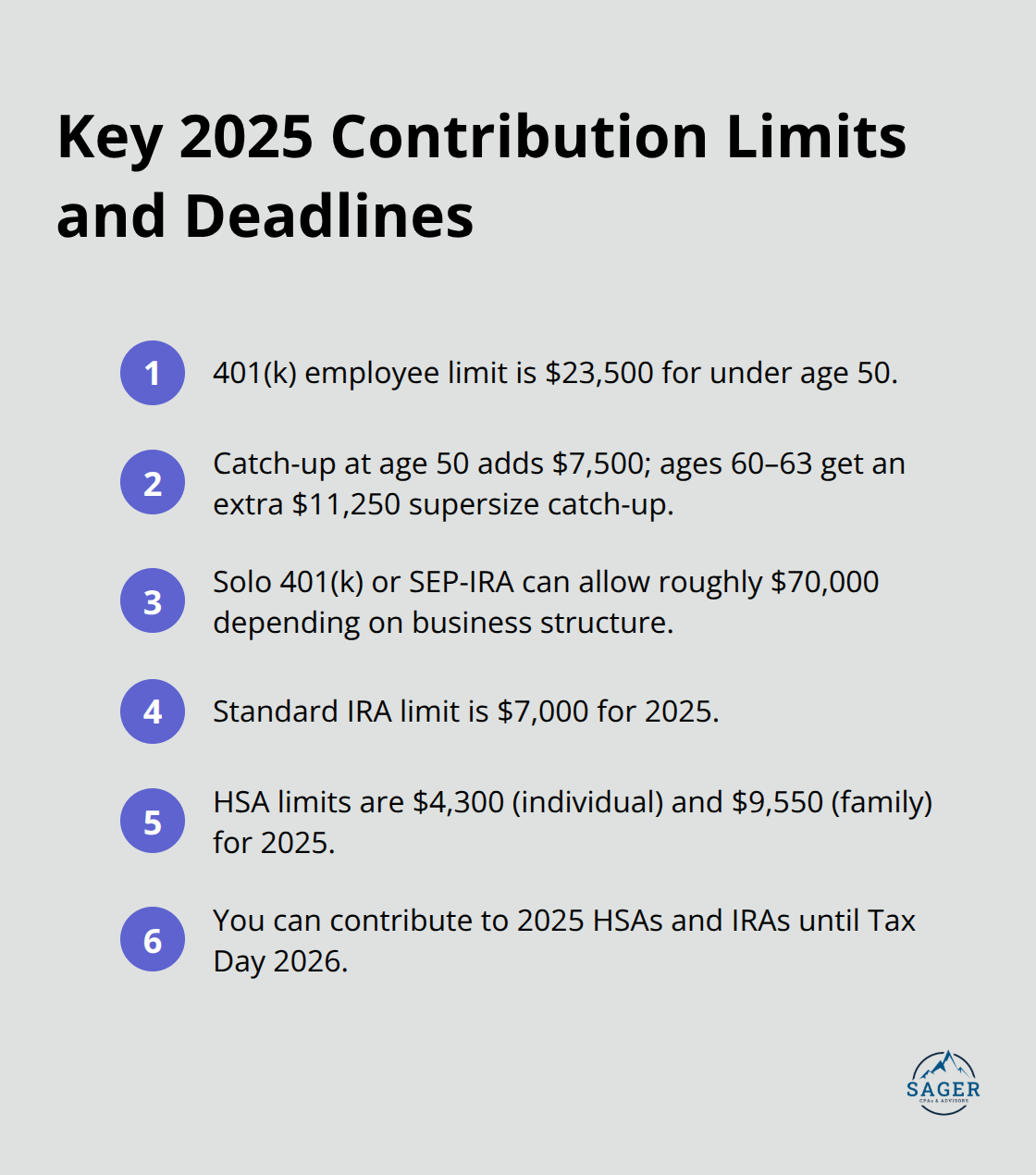
The critical insight: if you’re in a high-income year, max out these accounts to reduce taxable income immediately. Health Savings Accounts offer triple tax benefits-deductible contributions, tax-free growth, and tax-free withdrawals for qualified medical expenses-with 2025 limits of $4,300 for individuals and $9,550 for families. Many people miss this opportunity because they fail to connect it to their overall income timing. The IRS allows you to contribute up until Tax Day 2026 for the 2025 tax year, which means you have flexibility to assess your actual year-end income before deciding whether to max out your HSA or IRA.
Running a two-to-three-year tax projection every October allows you to make intentional decisions about income realization and deduction timing before year-end, rather than scrambling in December when options narrow significantly. This forward-looking approach reveals whether you should accelerate or defer specific transactions and helps you coordinate multiple strategies across accounts and income sources. With these timing strategies in place, the next step involves selecting investments that work harder for you after taxes.
The difference between pre-tax and after-tax returns compounds dramatically over decades, yet most investors focus entirely on what they earn before taxes. A Morgan Stanley study found that integrating tax-smart strategies could boost annual after-tax returns by roughly 1.6 percentage points, potentially delivering about 73% more wealth over 20 years. This gap widens when you move beyond passive holding and actively manage three specific levers: harvesting losses to offset gains, positioning tax-efficient investments strategically, and optimizing how you realize capital gains. The 2026 tax brackets and capital gains thresholds offer concrete opportunities to lock in favorable rates, but only if you act intentionally throughout the year rather than waiting until December.
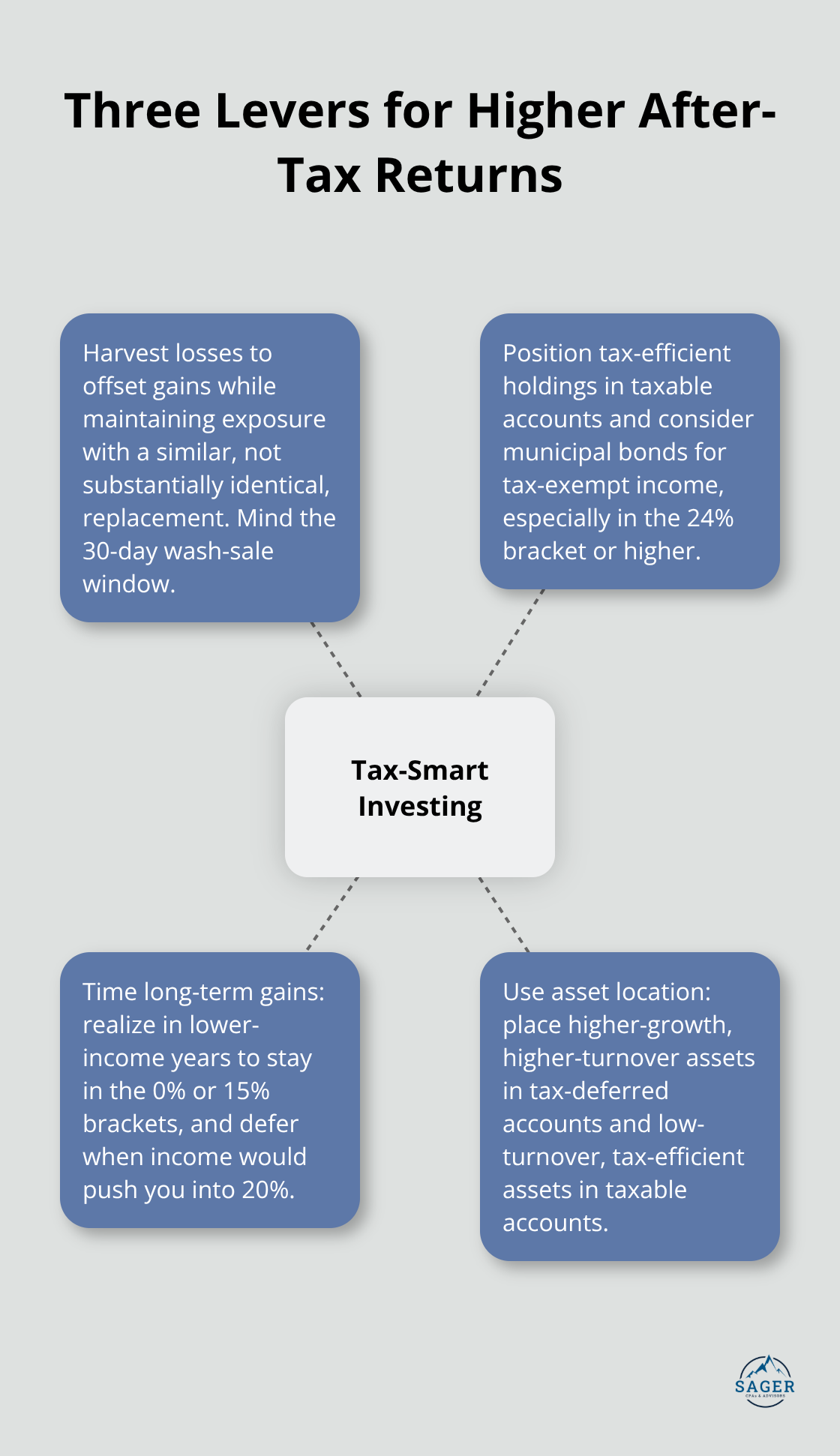
Tax-loss harvesting stands as the most underutilized tool available to taxable account holders. The mechanics are straightforward: when an investment declines in value, you sell it to capture the loss, then immediately purchase a similar but not substantially identical replacement to maintain your market exposure. That loss offsets capital gains realized elsewhere in your portfolio or up to $3,000 of ordinary income annually, with unused losses carrying forward indefinitely. The wash-sale rule creates one critical constraint: you cannot repurchase the same security within 30 days before or after the sale, or the IRS disallows the loss. Fidelity reports that taxable Personalized Portfolios averaged annual tax savings of $3,942 from tax-loss harvesting alone, based on account balances around $675,466. If you hold individual stocks rather than mutual funds, direct indexing amplifies this advantage by enabling stock-by-stock loss harvesting that fund structures cannot match. A December review of your portfolio positions can generate material tax savings with minimal effort, since losses harvested in December offset gains realized throughout the year.
Municipal bonds deserve serious consideration if you fall into the 24% federal bracket or higher. Interest from municipal bonds is exempt from federal income tax and often from state and local taxes if you reside in the issuing state, creating after-tax yields that dwarf taxable alternatives. A municipal bond yielding 4% provides the same after-tax income as a taxable bond yielding roughly 6.2% to a 35% combined federal and state tax-rate investor. The trade-off involves credit quality and liquidity, so municipal bond funds or ETFs offer easier access than individual bonds for most investors.
Long-term capital gains receive preferential tax treatment compared to ordinary income, but the income thresholds determining whether you pay 0%, 15%, or 20% in federal taxes shift annually. This creates actionable planning: if you’re in a lower-income year, realize long-term gains that fall within the 0% or 15% bracket before they’re pushed into the 20% bracket by other income. Conversely, if you anticipate higher income next year, defer gain realization to the current year when bracket thresholds sit lower. Qualified dividends receive the same preferential rates as long-term capital gains when held for the required period, so reviewing which holdings generate qualified versus non-qualified dividends helps you position high-dividend stocks in the right account type.
Tax-deferred accounts should hold your highest-growth, highest-turnover investments because the tax drag inside those accounts gets eliminated entirely. Low-growth, tax-efficient investments belong in taxable accounts where their minimal distributions create minimal tax friction. This asset-location strategy compounds the benefit of the other three approaches and requires nothing more than intentional account selection when you purchase new positions. The combination of these tactics-loss harvesting, municipal bonds, strategic gain realization, and proper asset location-transforms how your portfolio performs after taxes.
Personal tax optimization compounds over years and decades because small decisions made today multiply into substantial wealth differences tomorrow. The strategies in this guide address where most people lose money: unclaimed deductions, poor timing decisions, and tax-inefficient investments. A Morgan Stanley study found that integrating tax-smart strategies could boost annual after-tax returns by roughly 1.6 percentage points, potentially delivering about 73% more wealth over 20 years. Implementing even one approach typically saves thousands annually, but coordinating them across your entire financial picture produces exponentially better results.
Your specific situation determines which strategies matter most because income level, business structure, state of residence, retirement timeline, and investment holdings all influence your tax plan. A self-employed consultant in Connecticut faces different planning opportunities than a W-2 employee in Colorado, and someone converting a traditional IRA needs different guidance than someone harvesting losses in a concentrated stock position. Generic advice misses these nuances and often costs more than it saves. Professional guidance becomes invaluable when you need to identify high-impact moves specific to your circumstances and coordinate them with your retirement planning, investment strategy, and estate goals.
We at Sager CPA work with individuals and businesses to build customized action plans that reduce tax liabilities while keeping your overall financial strategy aligned. Schedule a consultation with Sager CPA to create a personalized tax strategy tailored to your numbers and goals. The cost of professional planning typically pays for itself many times over through taxes saved and better decisions made.




Phone: (208) 939-6029
Email: info@sager.cpa
Privacy Policy | Terms and Conditions | Powered by Cajabra
At Sager CPAs & Advisors, we understand that you want a partner and an advocate who will provide you with proactive solutions and ideas.
The problem is you may feel uncertain, overwhelmed, or disorganized about the future of your business or wealth accumulation.
We believe that even the most successful business owners can benefit from professional financial advice and guidance, and everyone deserves to understand their financial situation.
Understanding finances and running a successful business takes time, education, and sometimes the help of professionals. It’s okay not to know everything from the start.
This is why we are passionate about taking time with our clients year round to listen, work through solutions, and provide proactive guidance so that you feel heard, valued, and understood by a team of experts who are invested in your success.
Here’s how we do it:
Schedule a consultation today. And, in the meantime, download our free guide, “5 Conversations You Should Be Having With Your CPA” to understand how tax planning and business strategy both save and make you money.