
Startup Financial Risk Planning: Anticipate and Mitigate for Growth
Anticipate financial risks in your startup with practical strategies to protect cash flow, manage debt, and build sustainable growth.
Small business owners often leave thousands of dollars on the table each year by missing deductions and overlooking tax planning opportunities. At Sager CPA, we’ve seen firsthand how strategic tax planning throughout the year makes a real difference in what you actually owe.
This guide walks you through the deductions you’re likely missing, planning strategies that work, and the tools that make tax management simpler.
The home office deduction remains one of the most underutilized tax breaks available to small business owners. The IRS allows two methods: the simplified approach at $5 per square foot up to 300 square feet, or the standard method using actual expenses tracked through Form 8829. Many owners dismiss the home office deduction thinking it triggers an audit, but that’s outdated thinking. The simplified method in particular offers straightforward documentation with minimal audit risk. If you use 200 square feet exclusively for business, that’s $1,000 annually in deductions with almost no paperwork.
The standard method captures actual rent or mortgage interest, utilities, insurance, repairs, and depreciation-often totaling $3,000 to $5,000 per year for a dedicated office space. The catch is simple: your office must be your principal place of business and used regularly and exclusively for work. A desk in your bedroom doesn’t qualify; a separate room or converted garage does.
Vehicle and travel expenses represent another massive blind spot. The IRS standard mileage rate for 2025 sits at $0.70 per mile for business use, meaning a daily commute of 20 miles to a client site generates $7 in deductions per day. Over a year with 250 working days, that’s $3,500 in deductions from one route alone. However, you must track actual mileage with dates, destinations, and business purposes-a miles log kept in your car or phone app is non-negotiable.
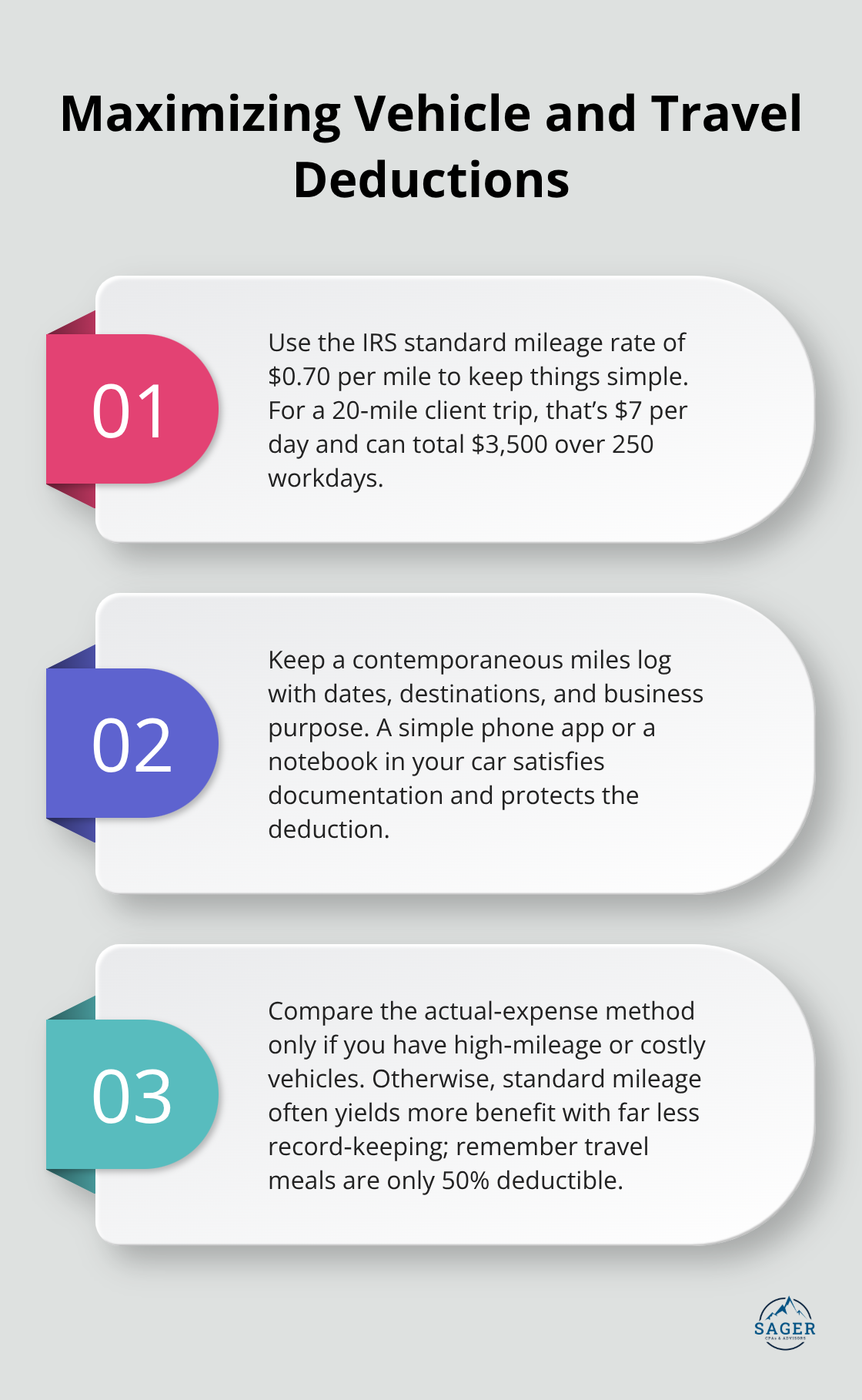
The alternative is deducting actual operating expenses like gas, maintenance, insurance, and depreciation, but this requires meticulous record-keeping and typically yields less than the standard rate unless you drive high-mileage vehicles. Business travel expenses for trips away from your tax home are fully deductible: airfare, hotels, meals at 50 percent, rental cars, parking, and even dry cleaning for extended trips.
Professional services and contractor fees often get overlooked because owners underestimate what qualifies. If you pay a contractor $600 or more annually, you’re required to issue a Form 1099-NEC by January 31-but more importantly, those payments are fully deductible business expenses. Legal fees for business contracts, accounting services, website design, marketing consultants, and bookkeeping all reduce your taxable income dollar-for-dollar.
Many owners also forget that business insurance premiums for property, liability, workers’ compensation, and group health coverage for employees are entirely deductible. Education costs that maintain or improve your business skills qualify as well. These overlooked deductions add up fast, and identifying them now positions you to implement smarter tax strategies throughout the year.
Quarterly estimated tax payments are non-negotiable if you expect to owe $1,000 or more when filing, according to IRS guidance. Most small business owners wait until April to calculate what they owe, then scramble to pay. Instead, calculate your expected liability every quarter and pay what you actually owe rather than waiting until tax season.
The number 100% seems to be not appropriate for this chart. Please use a different chart type. The IRS safe harbor requires you to pay at least 90% of the tax shown on the return for the taxable year or 100% of the tax shown on the return for the prior year, whichever is less. If your income fluctuates seasonally, the annualization method lets you adjust payments based on actual earnings each quarter rather than spreading equal payments across all four periods. Underpayment penalties compound quickly, so electronic payment through EFTPS or Direct Pay takes minutes and creates a permanent record of your payment.
Income timing decisions made in November and December often determine whether you owe an extra $5,000 or save $5,000. If profits are strong heading into year-end, defer invoicing until January, delay placing equipment orders until next year, or prepay expenses like insurance and subscriptions to shift income to the following tax year. Conversely, if your business had a slow year and profits look weak, accelerate client collections and defer discretionary spending. These moves require planning, but they directly impact your final tax liability.
Your entity structure directly impacts how much tax you actually owe. A sole proprietor pays self-employment tax on all net income, but an S-corporation allows you to split income into reasonable W-2 wages and distributions. However, S-corps require payroll processing and quarterly filings, so the savings only justify the complexity if your net business income exceeds $60,000 annually. The Qualified Business Income deduction under Section 199A provides a 20 percent deduction for pass-through entities, but certain service businesses face restrictions, making your choice of entity structure even more critical.
These decisions require coordination with a tax advisor who understands your specific situation. The right structure combined with proper income timing and consistent quarterly payments creates a foundation for tax efficiency. Next, we’ll explore the tools and resources that make managing these strategies throughout the year straightforward and sustainable.
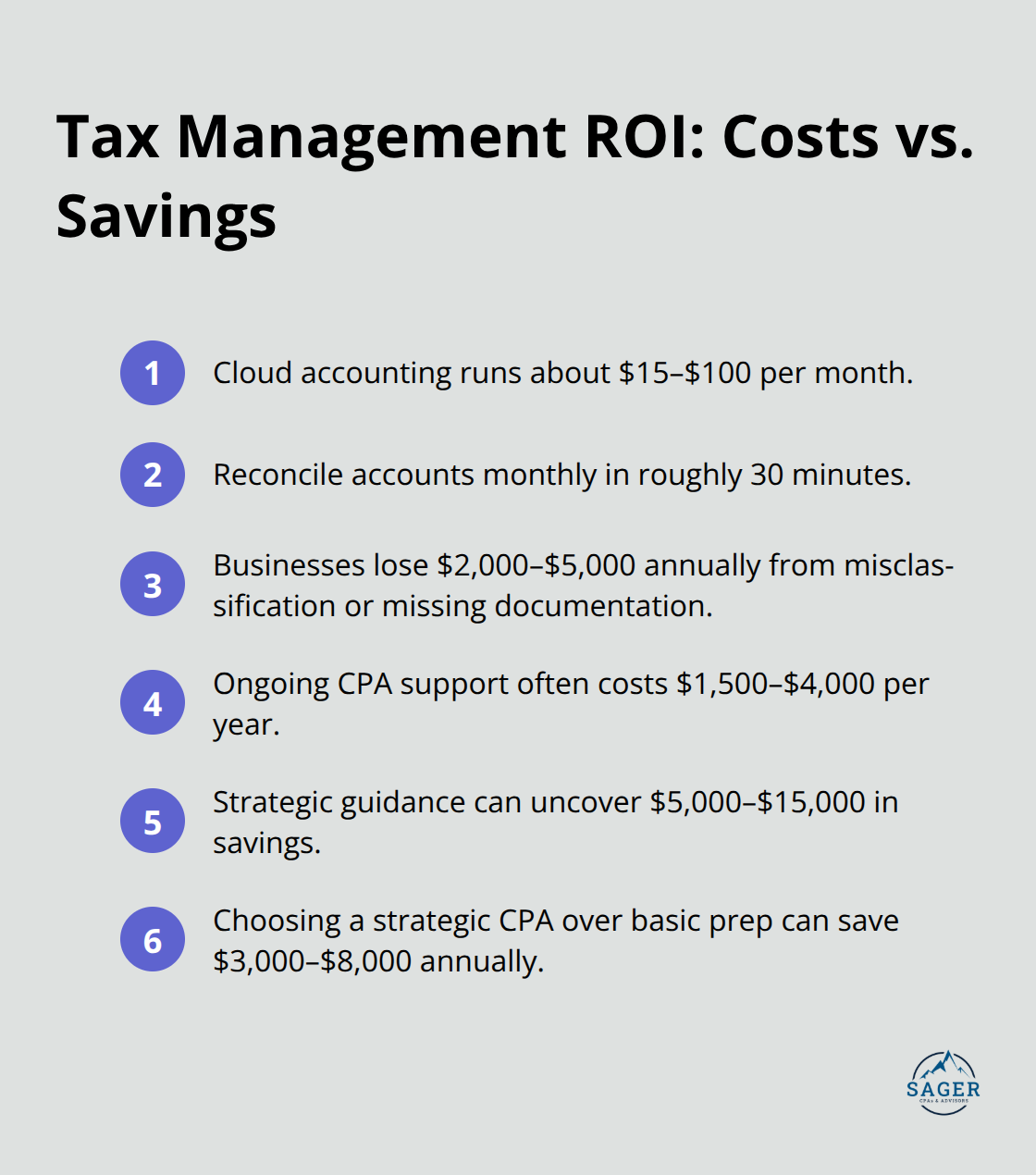
Accounting software and bookkeeping systems matter far less than most small business owners think, but using the right one consistently makes a measurable difference in what you owe. IRS Publication 535 outlines deductible business expenses in detail, and tracking them from day one prevents the scramble at tax time when you’ve forgotten half your deductions. Basic cloud accounting platforms like QuickBooks Online or Xero cost between $15 and $100 monthly and automatically categorize transactions when you connect your business bank account, capturing deductions you’d otherwise miss. The real power comes from discipline: reconcile your account monthly and assign expenses to the correct category in about 30 minutes, which ensures that when tax season arrives, your numbers are accurate and audit-ready. Many owners use spreadsheets instead, which works fine until a transaction gets misclassified or a receipt disappears.
Businesses lose $2,000 to $5,000 annually simply because expense categories were wrong or documentation was incomplete. The software itself is secondary; the habit of recording transactions promptly and keeping receipts is what actually reduces your tax liability.
Working with a tax professional or CPA transforms tax planning from a reactive scramble into a strategic advantage, especially once your business income exceeds $75,000 annually. IRS Tax Tips guidance emphasizes that professional support helps maximize legitimate deductions and reduces liability risk, and that statement understates the value significantly. A competent CPA coordinates your quarterly estimated payments, advises on entity structure changes when your income shifts, and identifies timing opportunities that generic tax software misses entirely.
For instance, if your profit trajectory suggests a 25 percent increase this year, a CPA calculates whether deferring equipment purchases or accelerating client collections actually saves more than it costs, accounting for your specific tax bracket and state obligations. The cost typically ranges from $1,500 to $4,000 annually for ongoing support, but those conversations often identify $5,000 to $15,000 in additional deductions or planning adjustments that pay for themselves multiple times over. IRS Publication 505 covers withholding and estimated tax requirements in detail, but interpreting those rules correctly for your specific situation requires expertise. The difference between choosing a CPA who understands small business tax strategy versus using a basic tax preparation service is often $3,000 to $8,000 in annual tax savings, making professional guidance an investment rather than an expense.
The gap between what small business owners actually owe and what they pay comes down to planning and action. Missing deductions, skipping quarterly payments, and ignoring entity structure decisions cost thousands annually, but these mistakes are entirely preventable. Taxes for small business owners improve dramatically when you capture every deductible expense throughout the year, make income timing decisions before December closes, and align your entity structure with your actual income level.
Proactive tax planning transforms how you manage your business finances instead of scrambling each April. Quarterly estimated payments prevent penalties and cash flow surprises, while regular coordination with a tax professional identifies opportunities that accounting software alone misses. These habits compound over time, turning tax planning from a burden into a genuine competitive advantage that strengthens your bottom line.
Schedule a consultation with Sager CPA to review your current situation and build a personalized tax strategy that works for your business. We identify missed deductions, optimize entity structure, and implement timing strategies that reduce what you owe. The cost of professional guidance pays for itself through deductions and planning adjustments you’d otherwise overlook.




Phone: (208) 939-6029
Email: info@sager.cpa
Privacy Policy | Terms and Conditions | Powered by Cajabra
At Sager CPAs & Advisors, we understand that you want a partner and an advocate who will provide you with proactive solutions and ideas.
The problem is you may feel uncertain, overwhelmed, or disorganized about the future of your business or wealth accumulation.
We believe that even the most successful business owners can benefit from professional financial advice and guidance, and everyone deserves to understand their financial situation.
Understanding finances and running a successful business takes time, education, and sometimes the help of professionals. It’s okay not to know everything from the start.
This is why we are passionate about taking time with our clients year round to listen, work through solutions, and provide proactive guidance so that you feel heard, valued, and understood by a team of experts who are invested in your success.
Here’s how we do it:
Schedule a consultation today. And, in the meantime, download our free guide, “5 Conversations You Should Be Having With Your CPA” to understand how tax planning and business strategy both save and make you money.