
Retirement Planning For Owners: A Practical Roadmap To Financial Security
Build a retirement plan that works for business owners with our practical roadmap to financial security and long-term wealth
Business owners face retirement planning challenges that employees never encounter. You’re juggling business valuation, succession planning, and tax strategy all at once.
At Sager CPA, we’ve helped countless owners navigate these complexities. This roadmap walks you through the practical steps to build real financial security for your future.
The retirement account options available to you as a business owner dramatically exceed what employees can access. While employees max out at $23,000 in 401(k) contributions for 2024 according to the IRS, you can contribute significantly more when you structure the right plan for your business. A Solo 401(k) allows you to contribute up to $23,500 as the employee plus an additional employer contribution of up to 25% of your net self-employment income, reaching a total of $69,000 in 2024. If you’re over 50, you can add another $7,500 catch-up contribution. A SEP IRA offers up to 25% of net earnings from self-employment with a $69,000 cap, making it simpler to administer than a Solo 401(k) since it requires less paperwork.
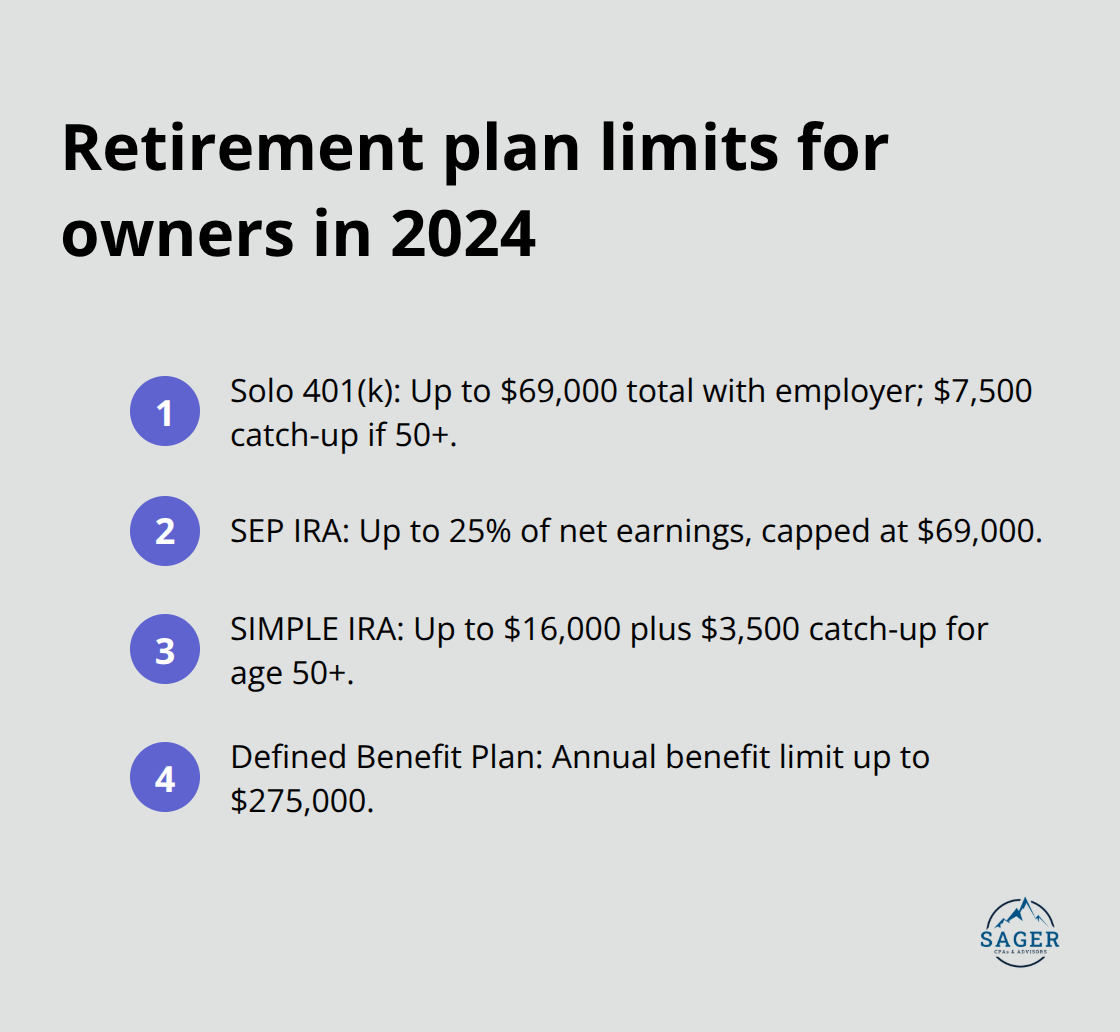
Your business structure and cash flow determine which plan makes sense. A Solo 401(k) works well if you have variable income because contributions are discretionary. A SEP works best if you want simplicity and have consistent earnings. A SIMPLE IRA works best if you have a small team, allowing contributions up to $16,000 in 2024 plus a $3,500 catch-up for those 50 and older, though it requires you to make either a 2% fixed contribution or a 3% matching contribution for employees. The IRS notes that defined benefit plans provide annual benefits up to $275,000, which appeals to owners in their peak earning years who want to shelter substantial income. Owners in their 50s or 60s find defined benefit plans particularly valuable for catching up aggressively on retirement savings.
Your exit strategy directly impacts retirement planning in ways employees never face. When you sell your business, the proceeds become a massive retirement asset that needs tax planning and investment strategy. Many owners sell their business without considering the tax impact or how to invest the proceeds for long-term growth. The timing of when you sell, the structure of the deal, and whether you take a lump sum or an earn-out all affect your tax liability and retirement security. You should separate your business assets from your personal retirement accounts now, not after a sale. This clarity prevents mixing operating capital with retirement funds and makes your business more attractive to buyers.
A financial advisor who understands business owner taxation helps you coordinate your retirement plan contributions with business profitability and succession timing. This coordination ensures your exit strategy and retirement security work together rather than compete for resources. The next section covers how to build a diversified portfolio that protects both your business assets and your personal retirement savings.
The moment you separate your business operating account from your retirement savings is the moment your financial picture becomes manageable. Most business owners keep these accounts tangled together, which creates three immediate problems: you cannot accurately track retirement progress, you risk commingling taxable business income with tax-advantaged retirement funds, and you make your business less attractive to potential buyers. Open a dedicated retirement account separate from your business checking and operating accounts. If you have a Solo 401(k), establish it at a financial institution like Fidelity or Vanguard, not at your business bank. If you use a SEP IRA, open it through a different institution than your business accounts. This physical separation forces discipline.
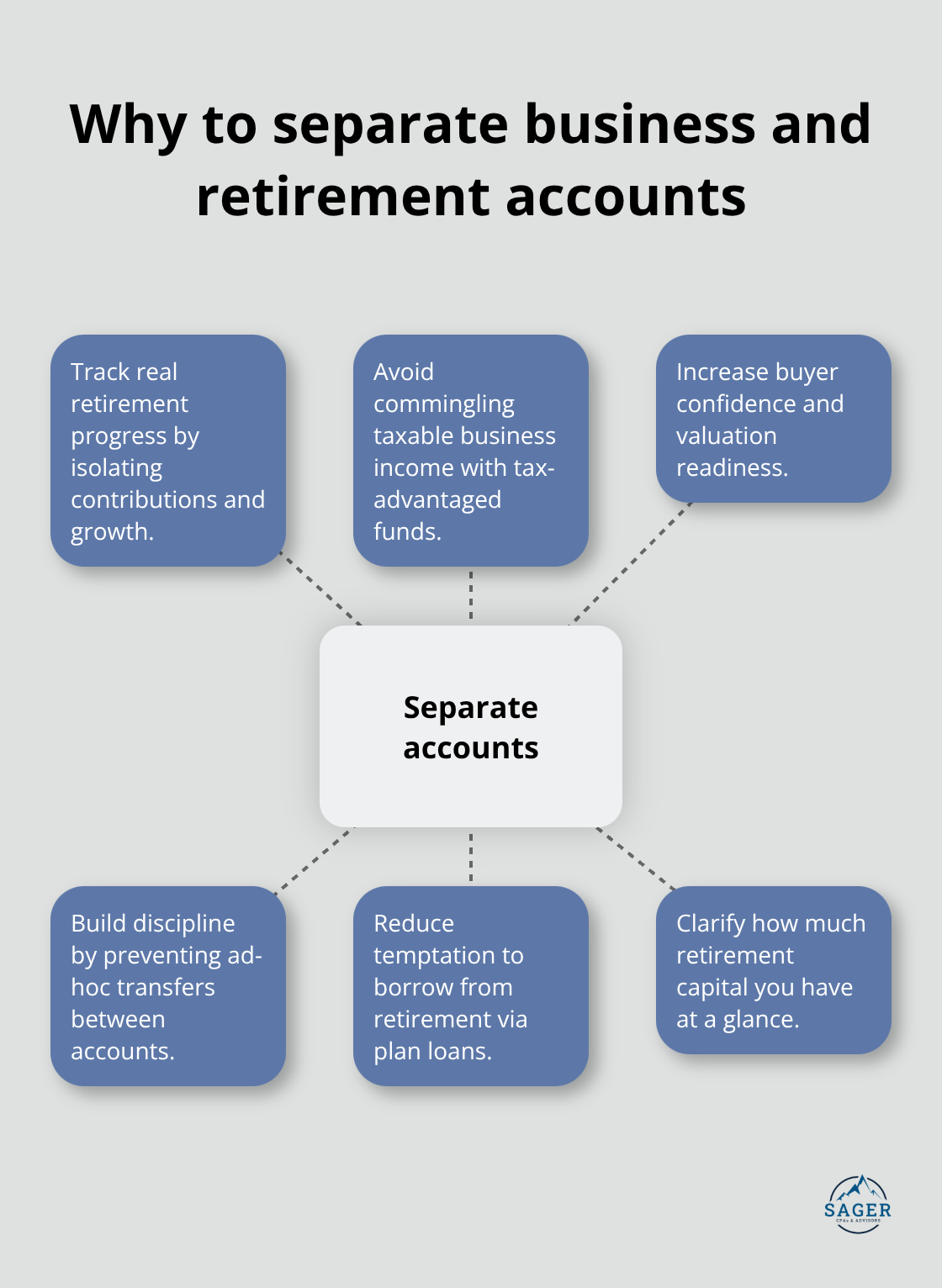
You see exactly how much retirement capital you have accumulated, and you prevent the temptation to borrow from retirement funds to cover business cash flow problems. The IRS allows loans from Solo 401(k) plans up to 50% of the balance or $50,000, whichever is less, but taking these loans derails long-term growth. When you keep accounts separate, you avoid the trap entirely.
Your asset allocation depends on your timeline and risk tolerance, not on what financial articles recommend for generic investors. If you plan to exit your business in three years, your personal retirement portfolio should hold more bonds and cash because you cannot recover from a market downturn before you need the money. If you sell in three years, a 20% market correction means real losses you cannot recoup. Conversely, if you are 15 years from exit, stocks should dominate because you have time to weather downturns and capture growth. Modern retirement planning should focus on converting savings into reliable lifetime income, not just chasing returns. This means your allocation should shift gradually over time, becoming more conservative as you approach your exit date.
Rebalance your portfolio annually, not monthly. Monthly rebalancing creates unnecessary tax events and trading costs. Once yearly, check whether your stock-to-bond ratio has drifted from your target. If stocks have grown to 75% of your portfolio when you intended 60%, sell some stocks and buy bonds. This forces you to sell high and buy low, the opposite of what most investors do naturally. The discipline of annual rebalancing protects you from emotional decisions during market swings. When markets surge, you trim winners and reinvest in lagging positions. When markets crash, you buy depressed assets instead of panic selling. This mechanical approach works because it removes emotion from investment decisions. Your rebalancing schedule should align with your business calendar-perhaps during tax season or after your annual business review-so the habit sticks. As you approach your business exit, your portfolio decisions become even more important because your portfolio must support both your transition and your long-term retirement income needs.
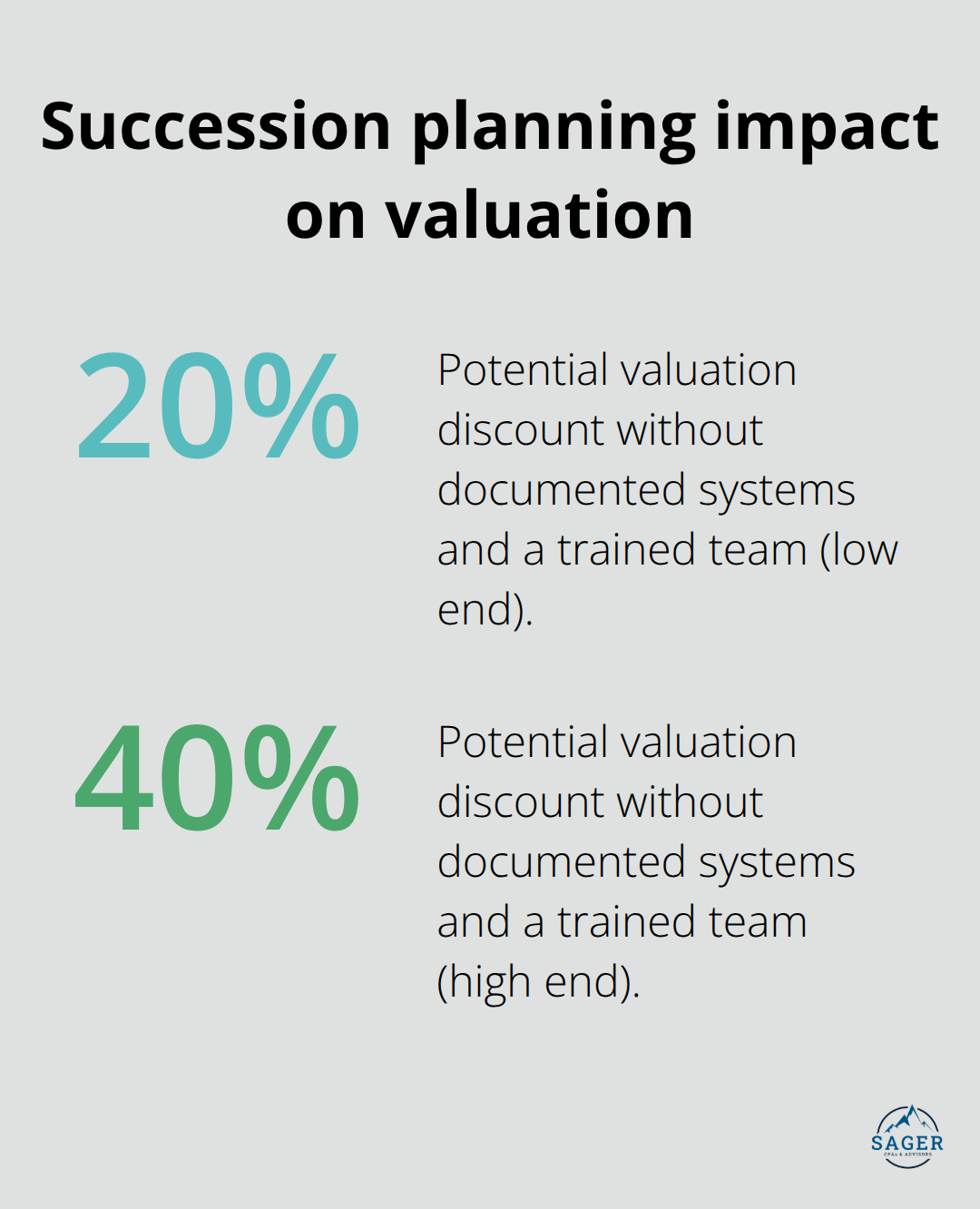
Most business owners treat succession planning as something to handle later, not now. You cannot separate your retirement security from your business exit strategy. If you plan to sell in ten years but have not documented your business processes, trained a successor, or established your business’s standalone value, you will face a fire sale at a discount. A business without documented systems and a trained team sells for 20 to 40 percent less than one with these foundations in place. When you finally exit, you lose retirement capital you cannot recover.
Start documenting your business operations, systems, and key client relationships immediately. Assign leadership responsibilities to team members who could eventually run the company or make it attractive to buyers. The clearer your succession path, the higher your business valuation, and the stronger your retirement position becomes.
Most business owners underestimate healthcare and long-term care costs in retirement. According to the U.S. Department of Labor, the average American spends roughly 20 years in retirement. Medicare covers hospital care, doctor visits, and prescription drugs starting at age 65, but it leaves significant gaps. Part B premiums run around $175 per month in 2024, and supplemental Medigap coverage averages $125 per month at age 65 in many cases.
Long-term care costs are the real budget killer. A semi-private nursing home costs a median of $315 per day, or $114,975 annually, while assisted living runs about $54,000 per year. Most owners fail to account for these expenses in their retirement projections. Open a Health Savings Account now if your business health plan qualifies; HSA contributions are tax-deductible, grow tax-free, and can be used for qualified medical expenses in retirement.
Your will, power of attorney, and healthcare directives become critical when you transition from active business owner to retiree. Without updated documents, your family faces legal complications, delays, and unnecessary taxes during your transition years. Update your estate plan every three to five years or whenever major life changes occur, such as selling your business or reaching a new net worth threshold.
Your retirement security as a business owner depends on decisions you make today. The three areas covered in this roadmap-maximizing contributions, building a diversified portfolio, and avoiding common mistakes-form the foundation of retirement planning for owners. Without action, you risk leaving money on the table through missed contribution opportunities, commingling business and personal assets, or discovering succession gaps when it’s too late to fix them.
Start with the retirement account structure that fits your business. A Solo 401(k) gives you the highest contribution ceiling at $69,000 in 2024 if you have variable income and want flexibility, while a SEP IRA requires minimal paperwork if you value simplicity. If you have employees, a SIMPLE IRA or defined benefit plan may serve your team better, and the choice you make compounds your tax advantages over decades.
Open separate accounts for your retirement savings and keep them physically distinct from your business operating accounts (this single step prevents commingling funds, clarifies your retirement progress, and makes your business more attractive to future buyers). Then establish an annual rebalancing schedule tied to your business calendar so the habit sticks without requiring willpower. Schedule time to document your succession plan and update your estate planning documents, since these tasks directly impact your business valuation and your family’s financial security.
We at Sager CPA help business owners coordinate retirement planning with tax strategy and business succession. Our advisors work with you to align your exit timeline with your retirement account contributions and investment allocation, ensuring your business sale and personal retirement security work together. Schedule a consultation to create a personalized financial strategy that reflects your specific business structure and retirement timeline.




Phone: (208) 939-6029
Email: info@sager.cpa
Privacy Policy | Terms and Conditions | Powered by Cajabra
At Sager CPAs & Advisors, we understand that you want a partner and an advocate who will provide you with proactive solutions and ideas.
The problem is you may feel uncertain, overwhelmed, or disorganized about the future of your business or wealth accumulation.
We believe that even the most successful business owners can benefit from professional financial advice and guidance, and everyone deserves to understand their financial situation.
Understanding finances and running a successful business takes time, education, and sometimes the help of professionals. It’s okay not to know everything from the start.
This is why we are passionate about taking time with our clients year round to listen, work through solutions, and provide proactive guidance so that you feel heard, valued, and understood by a team of experts who are invested in your success.
Here’s how we do it:
Schedule a consultation today. And, in the meantime, download our free guide, “5 Conversations You Should Be Having With Your CPA” to understand how tax planning and business strategy both save and make you money.