
Small Business Cash Flow: Practical Forecasting for Steady Growth
Forecast small business cash flow with practical strategies to stabilize operations and fuel steady growth without guesswork.
Most business leaders make decisions based on incomplete information or gut feeling. That’s a recipe for costly mistakes.
Business advisory consulting changes this by bringing expert analysis, market data, and objective thinking to your decision-making process. At Sager CPA, we’ve seen firsthand how the right advisory partner transforms how companies operate and grow.
When Harvard Business Review analyzed strategic decisions across 500 companies, organizations using external advisors made decisions 40% faster while reducing implementation failure rates by half. The speed stems from advisors bringing pre-built frameworks, market benchmarks, and pattern recognition from dozens of similar situations. Your team no longer rebuilds analysis from scratch; advisors compress months of research into weeks. They have already mapped competitive positioning in your industry, identified which operational levers move profitability, and stress-tested strategies against market volatility. This applied experience directly shortens your decision cycle rather than offering theoretical knowledge.
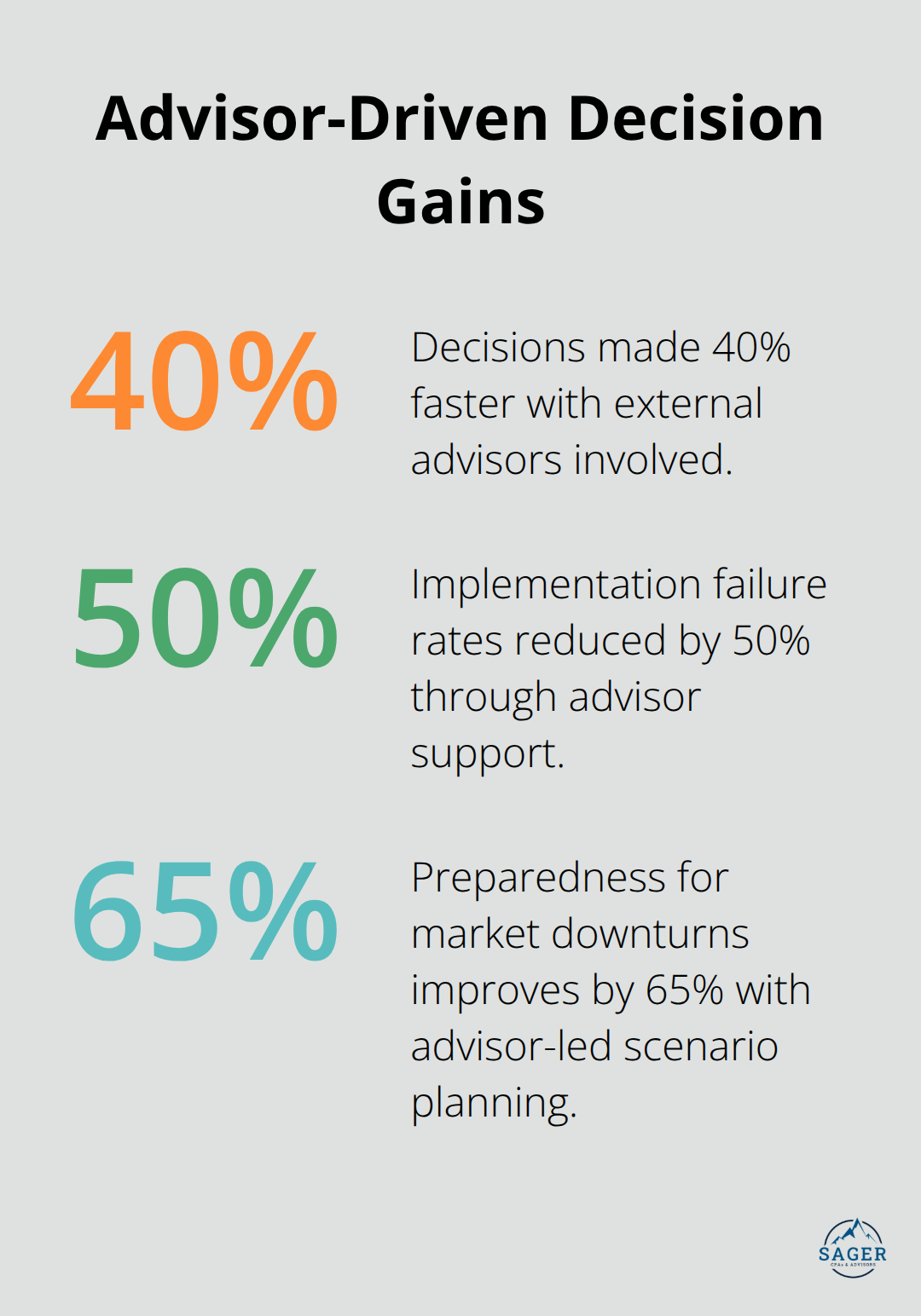
McKinsey research on scenario planning shows that companies conducting resilience testing with external advisors improved their preparedness for market downturns by 65%. Advisors push leadership to examine assumptions that internal teams often accept without question. Your finance team knows your numbers. An advisor knows what those numbers mean in the context of your market, your competitors’ moves, and where customer demand is shifting. That context gap is where costly mistakes happen.
Advisors eliminate the cognitive biases that plague internal decision-making. Harvard Business Review documented that independent perspectives reduce confirmation bias and groupthink by introducing structured challenge and alternative viewpoints that internal hierarchies discourage. When your CFO proposes a strategic direction, your team often aligns around it quickly. An external advisor questions whether the market data supports that direction, whether you overweight recent wins, and whether execution timelines are realistic. This friction isn’t comfortable, but it prevents decisions that look brilliant in the boardroom and fail in the market.
Advisors translate raw data into specific trade-offs and options. Instead of presenting a dashboard, they frame decisions as: if you pursue growth in this segment, you reduce margin by this percentage, requiring cost reductions here. This forces leadership to see actual consequences, not abstract metrics.
Implementation-focused advisors show that turning strategy into executable roadmaps with defined milestones improves adoption rates because teams understand exactly what changes and why. Without this translation layer, strategic recommendations sit in reports while operations continue unchanged. The gap between strategy and execution is where most advisory engagements fail-and where the best ones create measurable value.
This foundation of faster decisions, reduced bias, and executable strategy sets the stage for understanding the real-world impact that advisory consulting delivers across profitability, risk management, and organizational change.
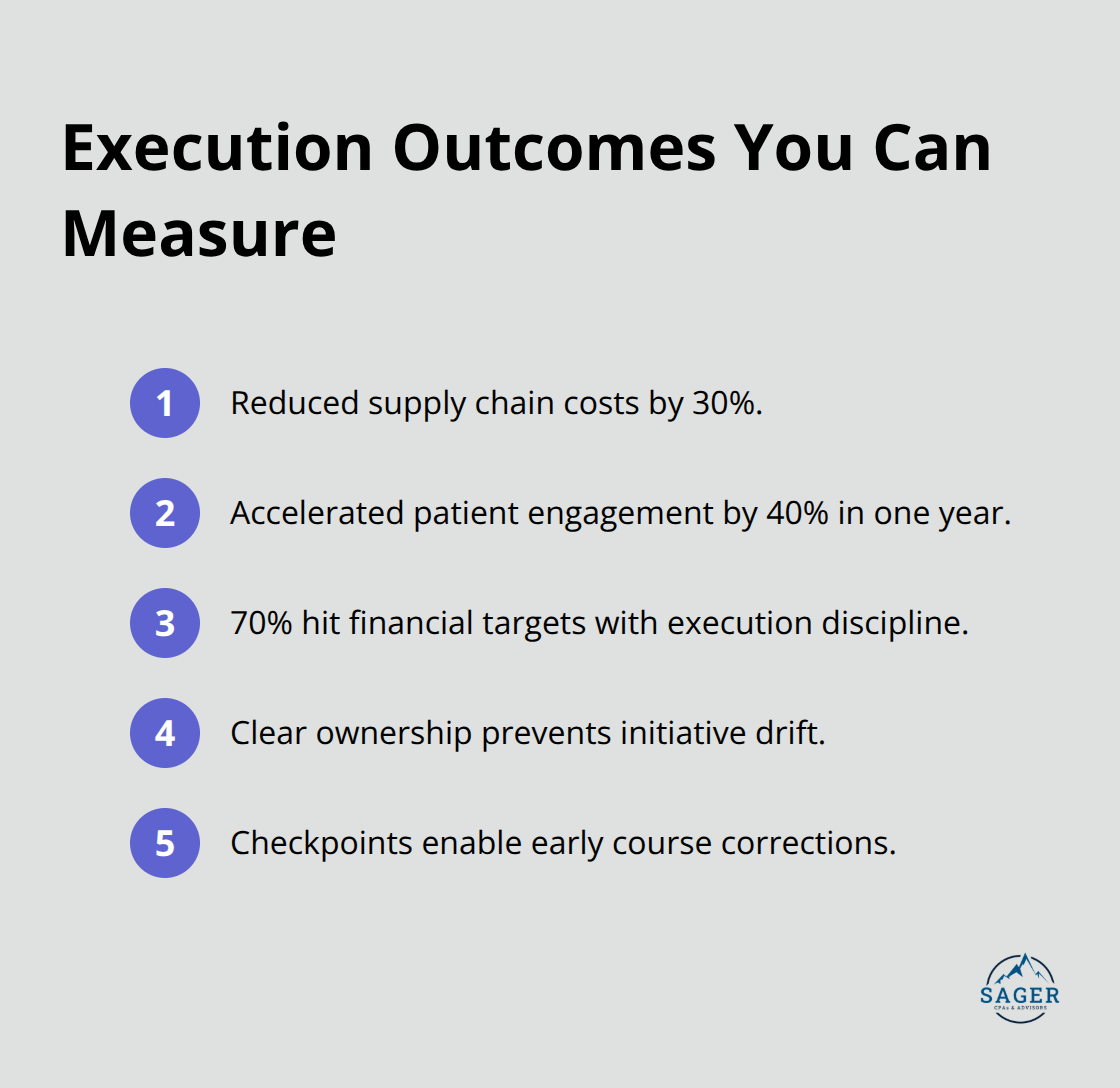
The financial impact of advisory consulting isn’t theoretical. A retail company working with operational consultants reduced supply chain costs by 30% through comprehensive workflow analysis and technology integration, directly lifting margins without price increases. A healthcare organization accelerated patient engagement by 40% in one year through digital transformation advisory, which also improved operational efficiency and reduced administrative waste. These outcomes happen because advisors identify where money leaks in your operations and where revenue opportunities sit ignored. They don’t present findings in a report and leave; they help you execute changes that translate analysis into cash.
Deloitte research on implementation-focused advisory shows that organizations with structured execution plans and defined ownership achieve their financial targets 70% of the time, compared to 30% for those without clear accountability frameworks. The difference isn’t better strategy; it’s better execution discipline. An advisor helps you design metrics that matter, assigns ownership for each initiative, and creates checkpoints where you course-correct before small misalignments become major shortfalls.
Risk management becomes concrete when you work with advisors. McKinsey found that companies using scenario planning with advisors improved their preparedness for market downturns by 65%, which translates directly to avoiding reactive cost-cutting that damages long-term competitiveness. Instead of slashing budgets when revenue dips, you’ve already identified which investments to protect and which to pause. You move faster because you’ve rehearsed the decision tree.
This advance planning separates companies that weather downturns from those that emerge weakened. Your team doesn’t scramble to make cuts under pressure; they execute a plan that preserves the capabilities you’ll need when markets recover.
Implementation speed matters more than most leaders acknowledge. Gartner research on change management shows that organizations with clear communication of why changes happen and how they align to strategy achieve 60% higher adoption rates than those without this narrative. Your team executes faster when they understand the reasoning behind decisions, not just the directives. Advisors create this clarity through structured communication plans and milestone celebrations that reinforce momentum. The result is strategic changes that stick, not initiatives that fade when focus shifts.
When your organization moves from understanding the financial opportunity to actually capturing it, the next challenge emerges: choosing an advisory partner who can deliver these results consistently.
Businesses without advisory support operate on information that’s either incomplete, outdated, or filtered through internal politics. Your finance team reports on last quarter’s results. Your sales leader interprets market feedback through the lens of their pipeline. Your operations manager sees efficiency opportunities within their current processes. Each perspective contains truth, but none captures the full picture.
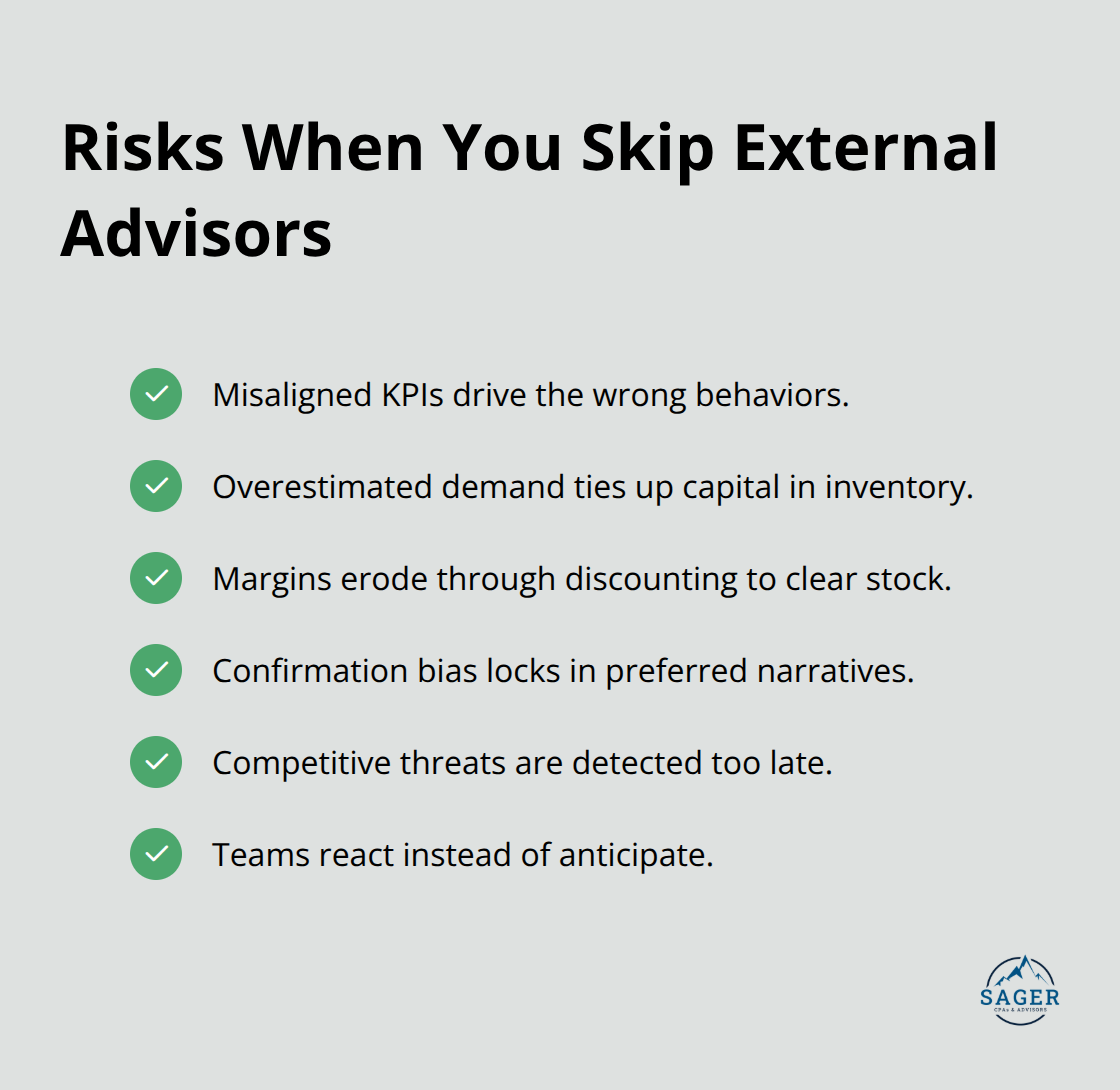
Gartner research on data governance shows that organizations without external validation of their analytics have higher rates of misaligned KPIs, meaning teams optimize for metrics that don’t actually move business value. A company that overestimates market demand doesn’t just miss revenue targets; they over-invest in capacity, tie up capital in inventory, and reduce margins on discounted goods to clear stock. That error wasn’t stupidity-it was the natural result of relying on internal forecasts without stress-testing assumptions against broader market signals that an external advisor would immediately flag.
Emotion and internal consensus masquerade as strategy in advisory-free organizations. Confirmation bias in leadership teams without external challenge often contributes to flawed decision-making, where executives unconsciously favor data supporting their preferred direction while dismissing contradictory signals. Your CEO believes the market is shifting toward premium positioning. Your team aligns around this view. Quarterly results seem to validate it. Then market share erodes because a competitor moved faster into the mid-market segment your company abandoned.
An advisor would have questioned whether premium positioning was actually supported by customer research or whether the team was simply more comfortable with that narrative. Advisors introduce friction through structured questioning: What if your customer base is price-sensitive? What if the market segment you’re targeting is shrinking? What if your competitor’s move into mid-market is capturing customers you’ll need in three years? These questions feel uncomfortable because they challenge consensus, but they prevent strategies that collapse when reality diverges from internal assumptions.
Without external pressure, competitive threats remain invisible until they become existential. Companies without scenario planning and external competitive intelligence miss emerging threats more often than those with structured advisory engagement, meaning they react instead of anticipate. That reaction is always more expensive and more disruptive than preparation.
Business advisory consulting delivers measurable returns because it addresses the root cause of poor decisions: incomplete information, internal bias, and reactive thinking. Companies that outperform their competitors aren’t smarter; they’re better informed and more disciplined about testing assumptions before committing resources. Advisory partners compress decision cycles, eliminate blind spots, and translate strategy into execution that actually moves profitability.
Choosing the right advisory partner matters more than the decision to hire one. Look for advisors with deep experience in your specific industry, not generalists offering one-size-fits-all frameworks. Verify their track record through concrete examples of how they’ve improved financial performance or accelerated strategic change for similar organizations, and confirm they combine data expertise with implementation discipline so they help you execute solutions and measure results.
Define what better decision-making looks like for your organization-whether you’re accelerating growth, reducing risk during market volatility, or improving operational efficiency. Schedule a consultation with Sager CPA to explore how tailored financial and advisory strategies can strengthen your decision-making process and drive sustainable growth.




Phone: (208) 939-6029
Email: info@sager.cpa
Privacy Policy | Terms and Conditions | Powered by Cajabra
At Sager CPAs & Advisors, we understand that you want a partner and an advocate who will provide you with proactive solutions and ideas.
The problem is you may feel uncertain, overwhelmed, or disorganized about the future of your business or wealth accumulation.
We believe that even the most successful business owners can benefit from professional financial advice and guidance, and everyone deserves to understand their financial situation.
Understanding finances and running a successful business takes time, education, and sometimes the help of professionals. It’s okay not to know everything from the start.
This is why we are passionate about taking time with our clients year round to listen, work through solutions, and provide proactive guidance so that you feel heard, valued, and understood by a team of experts who are invested in your success.
Here’s how we do it:
Schedule a consultation today. And, in the meantime, download our free guide, “5 Conversations You Should Be Having With Your CPA” to understand how tax planning and business strategy both save and make you money.