
Startup Financial Risk Planning: Anticipate and Mitigate for Growth
Anticipate financial risks in your startup with practical strategies to protect cash flow, manage debt, and build sustainable growth.
Professionals leave thousands of dollars on the table every year by missing deductions and overlooking strategic planning opportunities. At Sager CPA, we’ve seen how small oversights compound into significant tax bills that could have been avoided.
This guide shows you the deductions you’re likely missing, the planning moves that pay off over time, and the mistakes that cost professionals the most. You’ll find actionable steps to reduce your tax burden both immediately and throughout the year.
Home office deductions remain one of the most underutilized write-offs for self-employed professionals. The IRS allows you to deduct either $5 per square foot (up to 300 square feet) or calculate actual expenses like mortgage interest, property taxes, utilities, and insurance based on the percentage of your home used for business. If you use 200 square feet exclusively for work, that’s $1,200 annually under the simplified method. Many professionals skip this entirely because they assume their setup doesn’t qualify or the amount seems trivial. The reality is different: over a decade, that’s $12,000 in deductions.
Equipment purchases tied to your home office compound the benefit. A professional monitor, ergonomic chair, or software subscription directly supports your work and qualifies as a deductible expense in the year purchased or depreciated over time depending on the item. You should track the purchase date, amount, and business purpose for each item.
Professional development costs are equally overlooked. Continuing education, certifications, course fees, and industry conferences directly reduce your taxable income. If you’re an accountant pursuing additional certifications or a consultant attending specialized training, these expenses are fully deductible. Conference travel, meals during the event, and registration fees all qualify. Many professionals treat these as personal development rather than business expenses, but the IRS views them as necessary to maintain your professional standing.
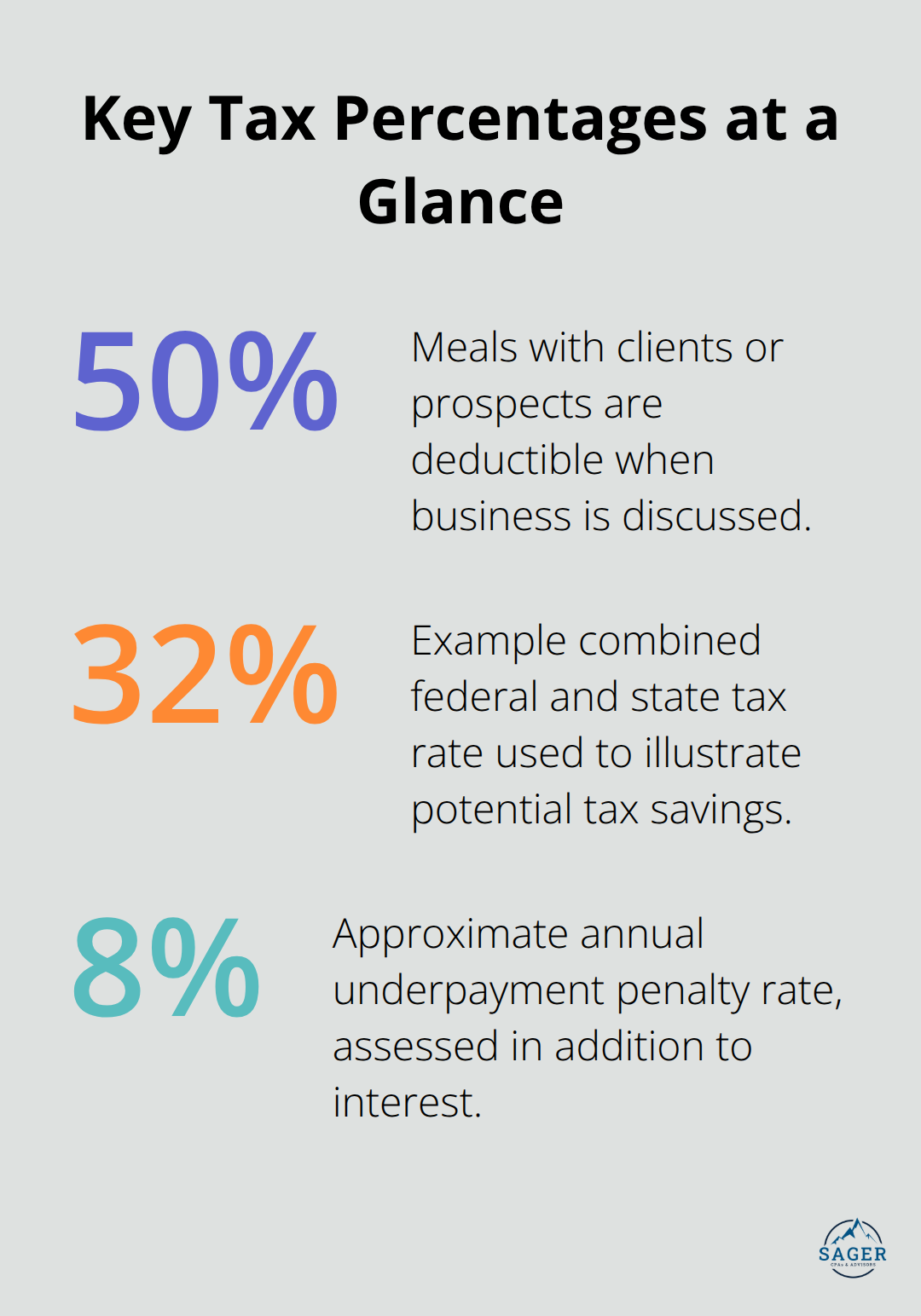
Business travel and client entertainment create substantial deductions when you document them properly. Professional services including accounting and legal fees are fully deductible when directly related to operating your business. Meals with clients or prospects are 50 percent deductible when you discuss business. If you take a client to lunch and spend $75, you claim $37.50. You should keep the receipt, note the attendees, and write the business purpose on the receipt itself.
Travel to client sites, conferences, or other business locations is fully deductible including airfare, hotels, rental cars, and ground transportation. Documentation is your primary concern. Entertainment expenses like golf outings or sporting events with clients are 50 percent deductible if business is discussed.
Vehicle expenses for client visits or business purposes can be deducted at 70 cents per mile in 2025 if you track mileage meticulously. Most professionals underestimate their mileage because they don’t log trips consistently. You should use your phone’s notes app or a dedicated mileage tracker to record the date, destination, miles, and business purpose immediately after each trip. Over a year, professionals easily accumulate 5,000 to 10,000 business miles, translating to $3,500 to $7,000 in deductions. The difference between professionals who claim these deductions and those who don’t often amounts to $2,000 to $5,000 annually in tax savings.
These deductions form the foundation of immediate tax relief, but they work best when paired with strategic planning that extends throughout your fiscal year.
Immediate tax deductions shrink your current bill, but retirement contributions and entity structure decisions shape your tax burden for years ahead. Professionals who max out deductions yet miss the compounding benefit of strategic retirement savings and the wrong business structure leave substantial tax relief on the table. These long-term moves often save more than quick wins because they reduce taxable income annually while building wealth simultaneously.
The 2026 contribution limits reset higher across all retirement accounts. A 401(k) or 403(b) allows up to $24,500 in contributions for 2026, and if you’re 50 or older, catch-up contributions add $8,000 more, bringing your total to $32,500. Traditional IRA contributions cap at $7,500 in 2026 with a $1,000 catch-up for those 50 and above.
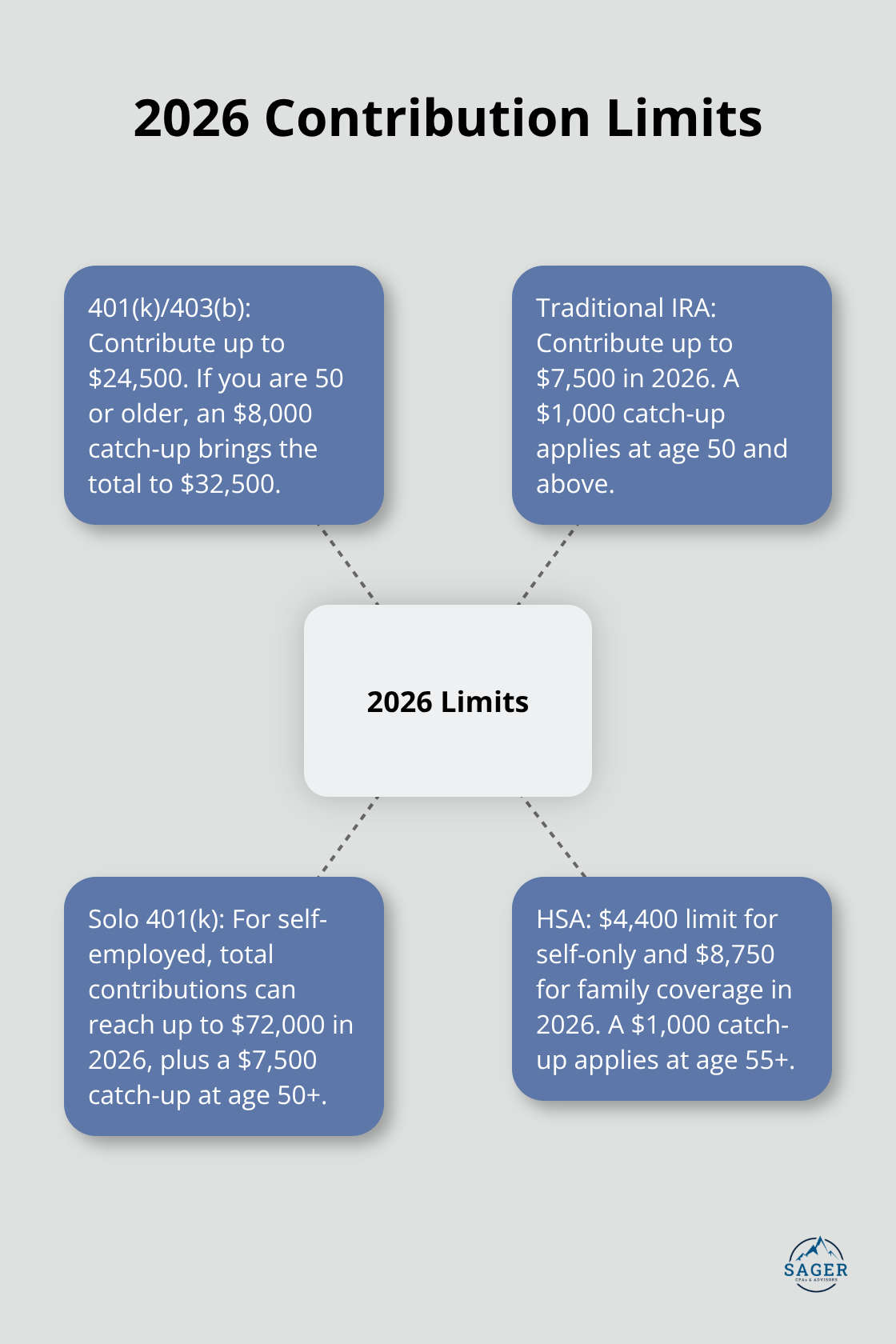
For self-employed professionals, a Solo 401(k) contribution limits and catch-up allowances combines employee and employer contributions, reaching up to $72,000 total in 2026 plus a $7,500 catch-up for ages 50 and above.
Contributing $24,500 to a 401(k) reduces your taxable income dollar-for-dollar. At a 32 percent combined federal and state tax rate, that’s $7,840 in immediate tax savings while your money grows tax-deferred. Most professionals contribute sporadically rather than strategically, missing thousands in tax relief. The deadline for 401(k) contributions is December 31, but traditional IRA contributions can be made until the following April 15 tax filing deadline, giving you flexibility if cash flow tightens before year-end.
Health Savings Accounts paired with high-deductible health plans offer triple tax advantage: contributions are tax-deductible, growth is tax-free, and withdrawals for qualified medical expenses are tax-free. The 2026 limit for self-only coverage is $4,400 and $8,750 for family coverage, with $1,000 catch-up contributions available at age 55.
Your business structure determines how much you pay in self-employment taxes, how deductions flow through your return, and what liability protection you receive. A sole proprietorship offers simplicity but exposes you to self-employment tax on 92.35 percent of net profit. An S-Corporation or C-Corporation can reduce self-employment taxes by allowing you to take a reasonable salary and distribute remaining profits as dividends, which avoid the 15.3 percent self-employment tax.
The tradeoff is compliance complexity and accounting costs, which typically run $1,500 to $3,000 annually. For a professional earning $150,000 in net income, switching to an S-Corp could save $4,500 to $6,000 yearly in self-employment taxes, easily justifying the added accounting expense. A Limited Liability Company taxed as an S-Corp provides liability protection and the same tax benefits without corporate formalities. The decision hinges on your income level, state taxes, and risk exposure. Professionals earning under $60,000 rarely benefit from entity conversion, but those exceeding $100,000 should model the numbers with a tax advisor.
Professionals who ignore estimated quarterly tax payments face penalties that compound throughout the year. The IRS requires estimated payments if you expect to owe $1,000 or more in taxes. Quarterly payments are due April 15, June 15, September 15, and January 15 of the following year. Underpayment penalties run around 8 percent annually plus interest, and they apply even if you ultimately owe nothing at tax time.
Many professionals wait until year-end to calculate their tax liability, then scramble to pay everything at once, triggering penalties unnecessarily. Setting up quarterly payments based on last year’s tax bill or current year projections keeps you compliant and prevents surprise penalties. If your income fluctuates, adjust payments mid-year based on actual earnings rather than paying equally each quarter. A professional earning $120,000 annually should make quarterly estimated payments of approximately $9,000 to $12,000 each, depending on deductions claimed and filing status.
These strategic moves-maximizing retirement accounts, selecting the right entity structure, and maintaining quarterly payment discipline-form the backbone of long-term tax efficiency. The next section addresses the mistakes that undermine these strategies and how to avoid them.
The gap between what you owe and what you should owe often comes down to three preventable mistakes that compound throughout the year. The first mistake is treating business and personal finances as interchangeable. A professional who pays a $200 software subscription from a personal credit card, reimburses themselves from the business account, and never documents the connection has created a documentation nightmare. The IRS scrutinizes mixed accounts aggressively, and without a clear paper trail showing business purpose and timing, auditors disallow the deduction entirely. This happens thousands of times annually with professionals who think the expense will obviously qualify. It won’t, not without documentation.
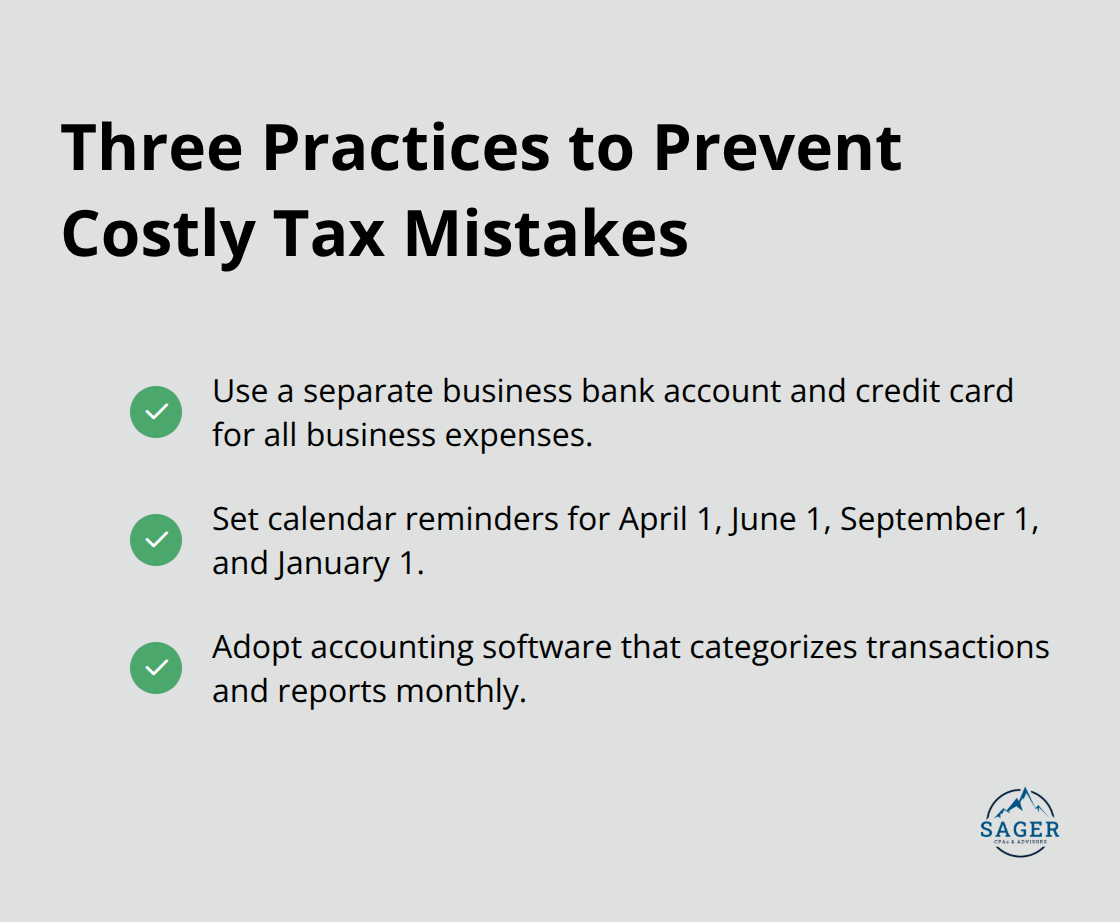
The solution is straightforward: use a separate business bank account and credit card for all business expenses. Every transaction flows cleanly, and you eliminate the burden of proving business purpose retroactively. A $50 monthly business credit card fee saves you far more in audit risk and disallowed deductions. When your accounts remain separate, the IRS finds no reason to question your expense categorization or timing. Mixed finances invite scrutiny that clean accounts avoid entirely.
The second mistake is missing deadlines that trigger penalties nobody anticipated. Estimated quarterly tax payments are due on specific dates: April 15, June 15, September 15, and January 15. Missing even one payment costs around 8 percent in underpayment penalties plus interest, compounding throughout the year. A professional who owes $10,000 in estimated taxes but makes three payments instead of four faces roughly $200 in unnecessary penalties.
Extensions for filing taxes are filed on Form 4868 by April 15 and give you until October 15 to file, but they do not extend your payment deadline. The IRS still expects payment by April 15 even if you file an extension. Professionals who confuse these deadlines pay penalties on top of their tax bill. Set calendar reminders for April 1, June 1, September 1, and January 1-this five-minute task prevents thousands in penalties over a career.
The third mistake is inadequate record-keeping that makes tax planning impossible mid-year. Professionals who lack organized records cannot adjust quarterly estimated payments when income fluctuates, cannot identify which deductions they’ve claimed, and cannot model entity structure changes effectively. You need a system that captures date, amount, business purpose, and category for every transaction.
Spreadsheets work if discipline is consistent, but accounting software like QuickBooks Online or Wave automates categorization and generates reports showing your tax position monthly. Professionals using proper accounting software adjust quarterly payments based on actual earnings and catch tax problems before they become expensive. Those using spreadsheets or worse, no system at all, discover problems in January when their accountant tells them they underpaid by $15,000. The cost of preventing this mistake is negligible compared to the consequences.
Establish these three practices immediately: separate accounts, calendar reminders for deadlines, and accounting software that tracks every transaction with business purpose documented. These three changes eliminate the mistakes that destroy thousands in potential tax relief each year.
Tax relief for professionals starts with claiming deductions you’ve already earned, then builds through strategic planning that compounds year after year. Home office write-offs, professional development costs, and mileage tracking represent immediate wins that reduce your current tax bill, while retirement contributions and entity structure decisions shape your tax position for years ahead. The professionals who save the most money aren’t those who find one clever deduction-they’re the ones who separate business and personal finances, meet every deadline without exception, and maintain organized records throughout the year.
Proactive tax planning means you review your position quarterly rather than waiting until January. If your income surges mid-year, you adjust estimated payments to avoid underpayment penalties. If your business structure no longer fits your earnings, you model the numbers for a potential change. Professionals who plan throughout the year make informed decisions based on actual numbers, while those who wait until tax season react to problems they could have prevented.
The difference between professionals who reduce their tax burden significantly and those who don’t often comes down to one decision: working with a tax advisor who understands your specific situation. Schedule a consultation with Sager CPA to review your current tax position, identify missed deductions, and build a strategy that delivers both immediate relief and long-term savings. The cost of professional guidance pays for itself many times over through deductions claimed, penalties avoided, and taxes reduced.




Phone: (208) 939-6029
Email: info@sager.cpa
Privacy Policy | Terms and Conditions | Powered by Cajabra
At Sager CPAs & Advisors, we understand that you want a partner and an advocate who will provide you with proactive solutions and ideas.
The problem is you may feel uncertain, overwhelmed, or disorganized about the future of your business or wealth accumulation.
We believe that even the most successful business owners can benefit from professional financial advice and guidance, and everyone deserves to understand their financial situation.
Understanding finances and running a successful business takes time, education, and sometimes the help of professionals. It’s okay not to know everything from the start.
This is why we are passionate about taking time with our clients year round to listen, work through solutions, and provide proactive guidance so that you feel heard, valued, and understood by a team of experts who are invested in your success.
Here’s how we do it:
Schedule a consultation today. And, in the meantime, download our free guide, “5 Conversations You Should Be Having With Your CPA” to understand how tax planning and business strategy both save and make you money.