
Startup Financial Risk Planning: Anticipate and Mitigate for Growth
Anticipate financial risks in your startup with practical strategies to protect cash flow, manage debt, and build sustainable growth.
Consultants often leave thousands of dollars on the table each year simply because they don’t have a structured approach to tax planning. The self-employed tax code is complex, and without the right strategy, you’ll pay more than necessary.
At Sager CPA, we’ve seen firsthand how tax planning for consultants transforms both their tax bills and their ability to reinvest in growth. This guide walks you through the deductions, business structures, and retirement strategies that actually move the needle.
Consultants operate under a fundamentally different tax structure than W-2 employees, and most don’t realize how much this costs them annually. As a consultant, you’re responsible for self-employment taxes that total 15.3 percent on top of income taxes, which means a consultant earning $100,000 pays roughly $15,300 in self-employment tax alone. Employees split this burden with employers, but you cover the full amount.
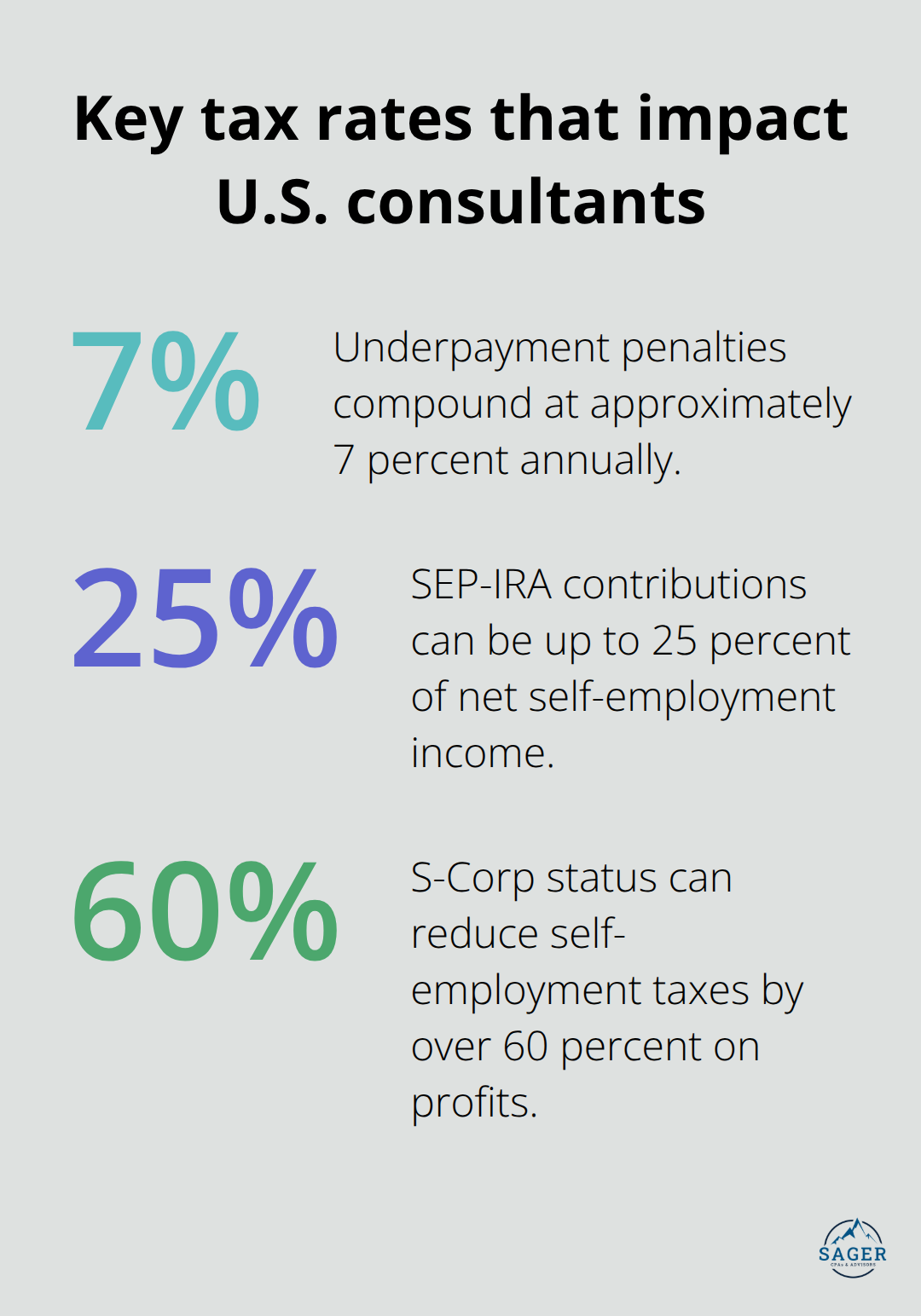
Beyond self-employment tax, consultants also face the burden of quarterly estimated tax payments. Missing or underpaying these by even a few hundred dollars triggers IRS penalties that compound at roughly 7 percent annually, according to current IRS underpayment rates.
The complexity multiplies because consultants must track income across multiple clients, manage deductible expenses that vary wildly month to month, and decide whether to operate as a sole proprietor, LLC, or S-Corp without clear guidance on which structure actually saves money for their specific situation. Most consultants we work with admit they’ve never calculated the tax impact of their business structure choice, which means they’re potentially overpaying by thousands annually.
Consultants commonly fail to separate business and personal expenses, which costs them deductions worth 10 to 15 percent of their tax liability. Home office deductions go unclaimed even though consultants working from home can deduct a portion of rent, utilities, and internet. Travel expenses for client work get ignored because consultants assume they need extensive documentation, when in reality a simple log of dates, destinations, and business purposes satisfies the IRS.
Software subscriptions, professional memberships, and educational courses all qualify as deductions but get paid from personal accounts without tracking. One consultant realized they’d missed $8,400 in deductible education and software expenses over two years simply because they didn’t categorize spending systematically.
The structural mistakes run deeper: consultants who should have elected S-Corp status continue filing as sole proprietors, missing opportunities to reduce self-employment taxes by over 60 percent on profits. Proactive financial planning flips this entirely by identifying deductions before year-end, structuring the business correctly from the start, and timing income strategically to avoid bracket creep when you have multiple revenue streams.
A consultant who implements these strategies typically reduces their effective tax rate by 3 to 5 percentage points, translating to $3,000 to $8,000 in annual savings that compounds as your consulting business grows. Understanding which deductions apply to your specific situation and which business structure fits your income level sets the foundation for everything that follows.
The home office deduction remains one of the most underutilized tax breaks for consultants, yet the math is straightforward. If you use 300 square feet of your home exclusively for client work, and your home’s total square footage is 2,000 square feet, you can deduct 15 percent of your rent, utilities, internet, property taxes, home insurance, and depreciation. For a consultant paying $2,000 monthly in rent, that amounts to $3,600 annually in deductible housing costs before utilities and internet. The IRS allows two methods: the simplified method at $5 per square foot (maximum $300 monthly) or the actual expense method, which captures the full benefit if your home office is substantial. Most consultants should use the actual expense method because the numbers favor it once you calculate utilities and internet. Equipment purchases like computers, monitors, desks, and office furniture qualify for immediate deduction under Section 179 expensing up to $2.56 million in 2026, or you can depreciate them over five to seven years. A $2,000 standing desk, ergonomic chair, and second monitor purchased in January can reduce your 2026 tax bill by $500 to $700 depending on your tax bracket, yet most consultants simply expense these from personal accounts without capturing the deduction.
Business travel for client work produces substantial deductions that consultants regularly leave unclaimed. If you travel to meet a client in another city, every dollar of airfare, hotel, rental car, meals, and ground transportation becomes deductible. A three-day client engagement involving a $400 flight, $300 hotel per night, and $150 in meals totals $1,250 in deductions. Over a year, consultants with five to ten client trips accumulate $6,000 to $12,000 in travel deductions that disappear because they don’t track them systematically. The IRS requires only that you document the date, destination, business purpose, and amount spent; a simple spreadsheet or email confirmation satisfies the requirement.
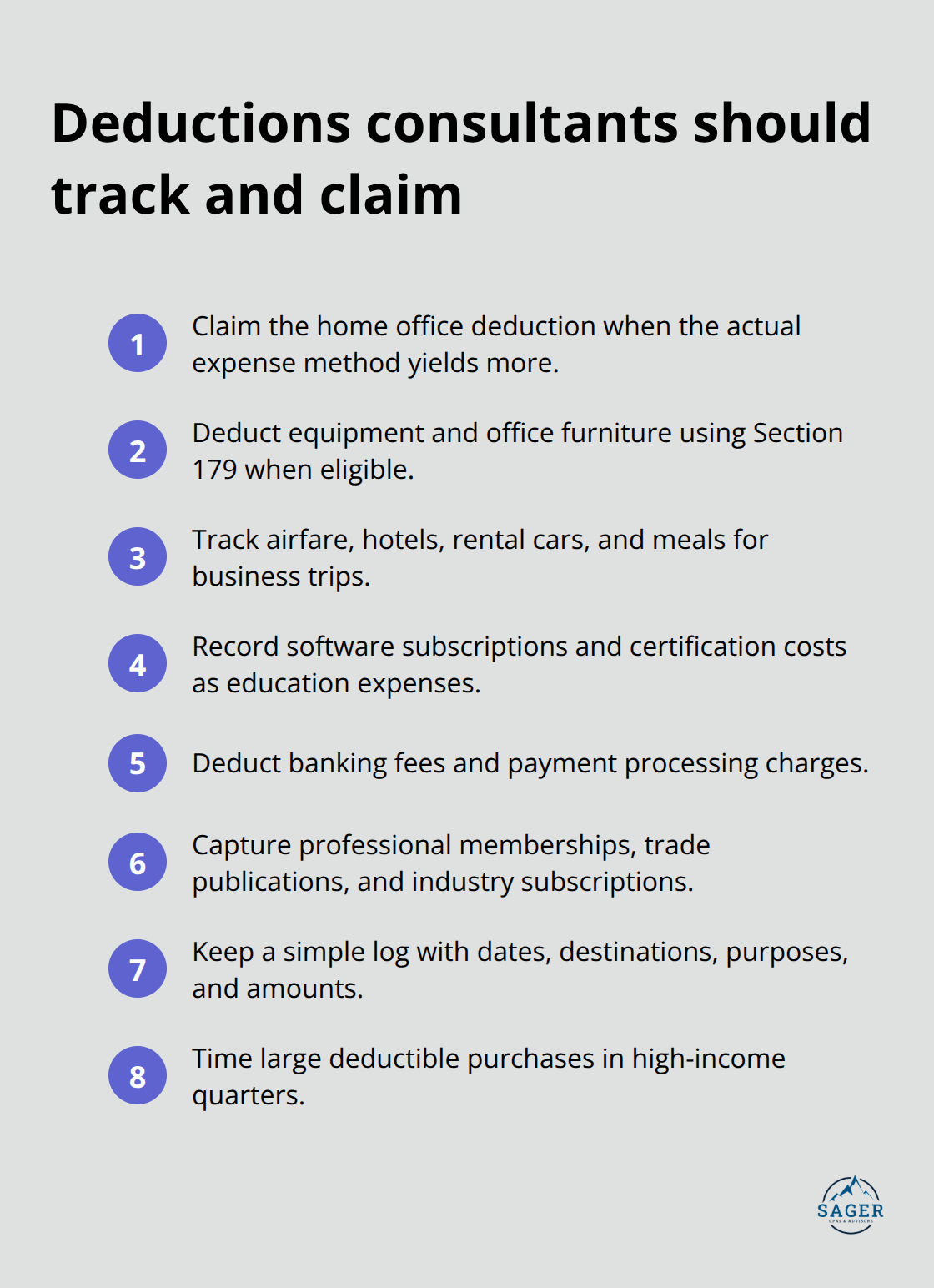
Software subscriptions, professional certifications, and industry conference attendance all qualify as education and research materials. A consultant spending $1,500 annually on specialized software, $800 on a professional certification course, and $2,000 on conference registration and travel can deduct the full $4,300. Banking fees, credit card processing fees, and financial service charges are fully deductible but often buried in monthly statements. A consultant processing $100,000 in client payments annually might pay $2,500 to $3,000 in processing fees that reduce taxable income dollar-for-dollar. Professional memberships, trade publications, and industry subscriptions typically range from $500 to $2,000 annually and are entirely deductible.
Quarterly estimated tax payments prevent IRS penalties but most consultants make them incorrectly by paying equal amounts each quarter when their income fluctuates wildly. If you earn $40,000 in Q1, $15,000 in Q2, $10,000 in Q3, and $35,000 in Q4, paying $25,000 each quarter means overpaying in low-income quarters and underpaying in high-income quarters. The IRS calculates underpayment penalties at approximately 7 percent, so underpaying Q4 by $10,000 costs roughly $700 in penalties. Instead, calculate your estimated tax based on actual income each quarter and adjust your payment accordingly. If your income drops in Q2, reduce that quarter’s payment and preserve cash for operations.
Deferring large deductible expenses to high-income quarters magnifies this benefit: if Q4 looks strong, accelerate professional development spending, software purchases, or equipment acquisitions into that quarter to reduce the estimated tax payment due January 15th. A consultant who spends $8,000 on a certification course in Q4 reduces their final quarter’s estimated tax payment by $2,400 to $2,800 depending on their tax bracket, improving cash flow when you need it most. A tax professional can identify which deductions you’ve missed and which expenses you should accelerate or defer to optimize your effective tax rate and quarterly payment schedule. This strategic approach to timing transforms your tax liability from a fixed burden into a flexible tool that aligns with your actual cash flow and business cycles.
The structure you operate under-sole proprietor, LLC, or S-Corp-determines how much of these deductions actually stick and how efficiently they reduce your overall tax exposure. Choosing the right structure requires understanding not just the deductions available, but how each entity type treats them differently.
The choice between sole proprietor, LLC, and S-Corp determines whether you pay thousands in unnecessary self-employment taxes or keep that money in your business. Most consultants default to sole proprietor status because it requires no paperwork, but this decision costs money the moment your profits exceed $50,000 annually. Self-employment tax hits 15.3 percent on net income, meaning a consultant earning $100,000 pays $15,300 in self-employment tax alone.
An S-Corp election changes this calculation dramatically. You pay yourself a reasonable salary (subject to payroll taxes) and take distributions on remaining profits that avoid self-employment tax entirely. If you earn $100,000 and pay yourself a $60,000 salary with $40,000 in distributions, you owe self-employment tax only on the $60,000 salary portion, saving roughly $6,180 annually in self-employment taxes. The payroll processing cost runs $1,500 to $2,500 yearly, meaning the net savings reaches $3,600 to $4,700 per year.
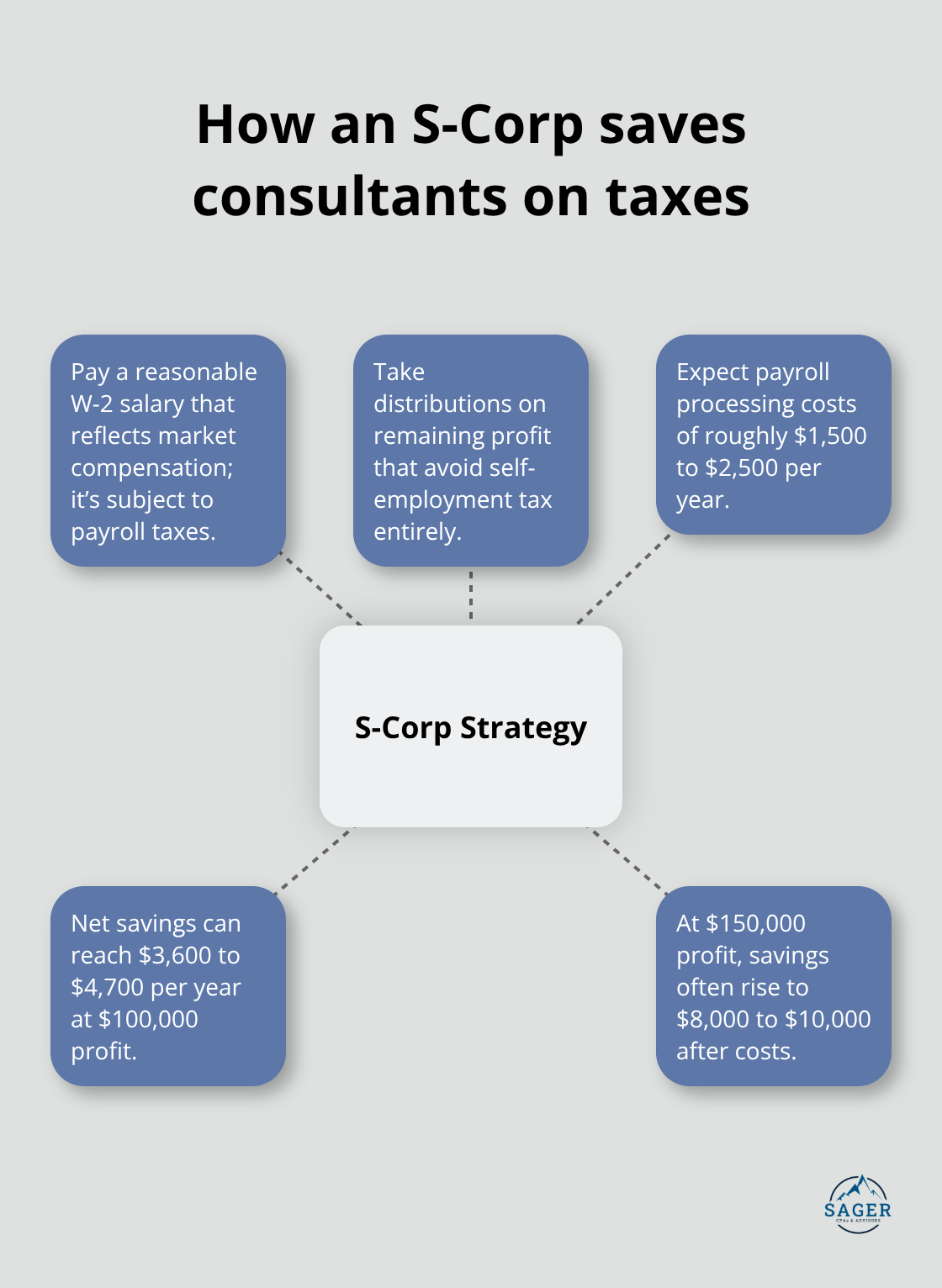
This advantage compounds: at $150,000 in annual profit, S-Corp status saves $8,000 to $10,000 after accounting for payroll costs.
The IRS scrutinizes S-Corp salary levels, requiring that your W-2 salary reflect reasonable compensation for the work performed. A consultant claiming a $20,000 salary on $100,000 profit faces audit risk, while a $50,000 salary on the same profit passes scrutiny because it aligns with market rates for consulting services. A tax professional can calculate your break-even point, which typically occurs around $50,000 in annual profit depending on your specific situation and state taxes.
An LLC provides liability protection but offers no inherent tax advantage unless you elect S-Corp taxation. This election gives you the liability shield and the self-employment tax savings combined. The LLC election to be taxed as an S-Corp costs roughly $500 to $1,200 in professional fees to set up correctly, then $1,500 to $2,500 annually in payroll processing, making this structure viable only if your profits justify the complexity. For consultants earning under $50,000 annually, remaining a sole proprietor keeps things simple and avoids unnecessary overhead.
Retirement planning amplifies your tax savings because contributions to SEP-IRAs and solo 401k plans reduce your taxable income directly. A SEP-IRA allows contributions up to 25 percent of net self-employment income, capped at $72,000 for 2026, meaning a consultant earning $150,000 can contribute $37,500 to a SEP-IRA and reduce taxable income by that full amount. This $37,500 contribution saves roughly $9,375 in federal income tax at the 25 percent bracket, plus additional savings on self-employment tax.
A solo 401k offers similar high contribution limits at $72,000 total for 2026 but provides more flexibility because you can borrow against the account balance if you face cash flow challenges. Both accounts grow tax-deferred, meaning investment gains accumulate without annual tax drag. A consultant maxing a SEP-IRA from age 35 to 65 accumulates approximately $2.1 million assuming 7 percent annual returns, compared to $890,000 in a taxable account with equivalent contributions.
Health Savings Accounts present another overlooked tool. If you carry a high-deductible health plan, HSA contributions deliver triple tax benefits through deductible contributions, tax-free medical withdrawals, and tax-free growth. Contributing $4,150 annually to an HSA in 2026 reduces taxable income by that amount while allowing the balance to grow invested for future retirement healthcare costs. The combination of maximizing retirement contributions, electing S-Corp status when profits justify it, and strategically timing business expenses creates a comprehensive tax reduction strategy that compounds year over year. A tax professional helps identify which combination of structures and retirement accounts fits your specific income level, growth trajectory, and personal circumstances.
Tax planning for consultants transforms from an annual obligation into a strategic advantage when you implement these approaches throughout the year. Timing equipment purchases, accelerating professional development expenses in high-income quarters, and adjusting quarterly estimated payments based on actual cash flow converts your tax liability into a flexible tool that supports your business goals. Over five years, these decisions compound into tens of thousands of dollars in cumulative savings that fund expansion, hiring, and investment in client delivery.
The complexity of self-employment taxation means professional guidance pays for itself immediately through identified deductions and optimized business structures. We at Sager CPA work with consultants to calculate the exact break-even point for S-Corp elections, uncover missed deductions, and create customized action plans aligned with your income and growth trajectory. Scheduling a consultation gives you clarity on your current tax position and a concrete roadmap for reducing your liability while building long-term wealth.
Your tax strategy should support your business goals, not hinder them, and tax planning for consultants works best when you address it proactively rather than scrambling in December or facing penalties for underpayment. The right structure, retirement contributions, and deduction timing build stronger financial foundations that accelerate your consulting business forward.




Phone: (208) 939-6029
Email: info@sager.cpa
Privacy Policy | Terms and Conditions | Powered by Cajabra
At Sager CPAs & Advisors, we understand that you want a partner and an advocate who will provide you with proactive solutions and ideas.
The problem is you may feel uncertain, overwhelmed, or disorganized about the future of your business or wealth accumulation.
We believe that even the most successful business owners can benefit from professional financial advice and guidance, and everyone deserves to understand their financial situation.
Understanding finances and running a successful business takes time, education, and sometimes the help of professionals. It’s okay not to know everything from the start.
This is why we are passionate about taking time with our clients year round to listen, work through solutions, and provide proactive guidance so that you feel heard, valued, and understood by a team of experts who are invested in your success.
Here’s how we do it:
Schedule a consultation today. And, in the meantime, download our free guide, “5 Conversations You Should Be Having With Your CPA” to understand how tax planning and business strategy both save and make you money.