
Real Estate Tax Planning: Personalize Strategies for Property Success
Maximize your property profits with personalized real estate tax planning strategies that lower taxes and boost returns.
Real estate tax planning isn’t one-size-fits-all. Your rental income, property sales, and deductions depend on your specific situation-and so should your tax strategy.
At Sager CPA, we’ve seen property owners leave thousands on the table by using generic approaches. This guide walks you through the tax strategies that actually work for real estate investors.
Owning rental property fundamentally shifts how the IRS treats your income and expenses. Unlike a W-2 job where taxes are straightforward, real estate creates multiple tax layers that most owners misunderstand. Rental income gets reported on Schedule E, and here’s what matters: the IRS taxes your net rental income after deductions, not your gross rents. This means a property generating $24,000 in annual rent doesn’t automatically mean $24,000 in taxable income.
According to IRS Publication 527, you can deduct ordinary and necessary expenses including property management fees, repairs, insurance, property taxes, mortgage interest, and depreciation deductions. Depreciation alone often creates substantial tax shields for owners. Residential properties depreciate over 27.5 years and commercial properties over 39 years, so a $300,000 building basis yields roughly $10,900 in annual residential depreciation deductions.
The critical step most owners skip is allocating your purchase price between the building and land, since land doesn’t depreciate. Many investors leave five figures on the table by failing to separate these components properly at purchase. The timing of when you place a property in service also matters. If you close on rental property in December but don’t rent it until February, your depreciation deductions don’t start until February. This timing error costs real money in deferred tax benefits.
Capital gains taxes hit you when you sell, and the rate depends entirely on how long you owned the property. Sell within one year and short-term capital gains rates apply, taxed as ordinary income up to 37 percent according to IRS guidance. Hold longer than one year and you qualify for long-term capital gains tax rates of zero, 15, or 20 percent depending on your income bracket.
For 2026, single filers pay zero percent on long-term gains up to roughly $49,450 in taxable income, then 15 percent up to about $533,400, then 20 percent above that. This structure creates a powerful incentive to hold properties beyond one year. Additionally, the 3.8 percent Net Investment Income Tax applies if your modified adjusted gross income exceeds $200,000 for single filers or $250,000 for married couples filing jointly, per IRS Form 8960 calculations.
State taxes compound the federal burden significantly. Washington imposes seven percent on long-term gains up to $1 million and 9.9 percent above, while nine states including Texas, Florida, and Nevada impose zero capital gains tax. If you own properties across multiple states, your state tax exposure varies dramatically. The 2026 estate tax exemption jumps to $15 million per individual, creating a temporary window for strategic wealth transfers before potential changes.
These three tax layers-rental income, deductions, and capital gains-determine your actual tax liability. Understanding how each one works transforms how you evaluate property investments and hold periods.
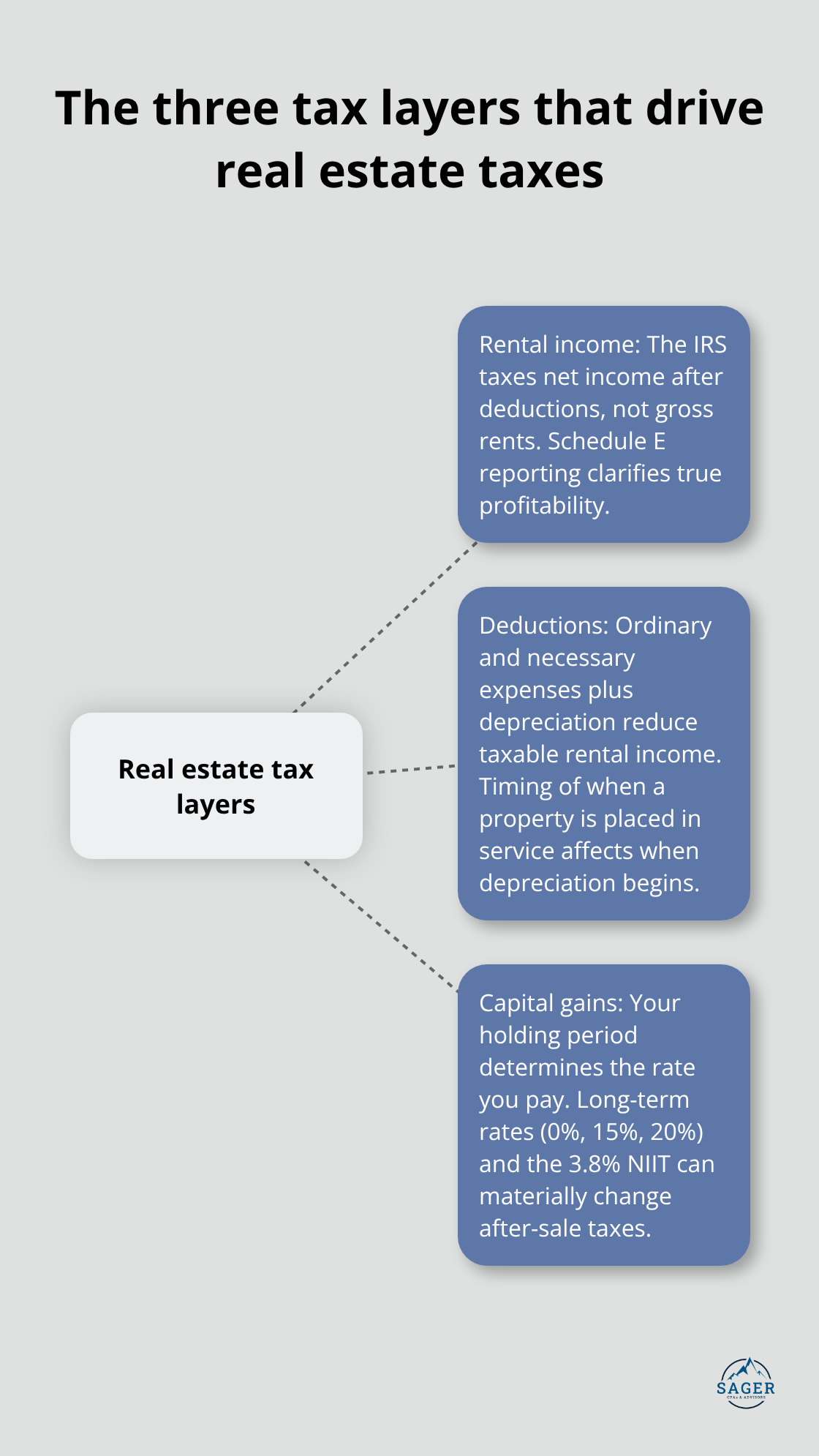
Tailored tax strategy plans coordinate depreciation, exchanges, and entity structures into a cohesive approach that reduces your burden across all three areas.
Depreciation stands as your most powerful tax weapon in real estate, yet most owners tap only a fraction of its potential. When you own a rental property, the IRS permits you to deduct a portion of the building’s value annually, even though no cash leaves your account. A residential property with a $300,000 building basis generates roughly $10,900 in annual depreciation deductions spread across 27.5 years. Standard depreciation follows a rigid timeline, but cost segregation transforms that equation. A cost segregation study reallocates 20 to 30 percent of your building’s cost into shorter 5, 7, and 15-year recovery periods, compressing decades of deductions into the first few years. For a $1 million property, this acceleration can mean $50,000 to $100,000 in additional deductions in year one alone.
The upfront study costs between $3,000 and $8,000, making the math work when property basis exceeds $500,000 or you plan to hold for ten-plus years. Cost segregation studies require professional analysis, so factor in professional fees when evaluating whether the strategy fits your situation.
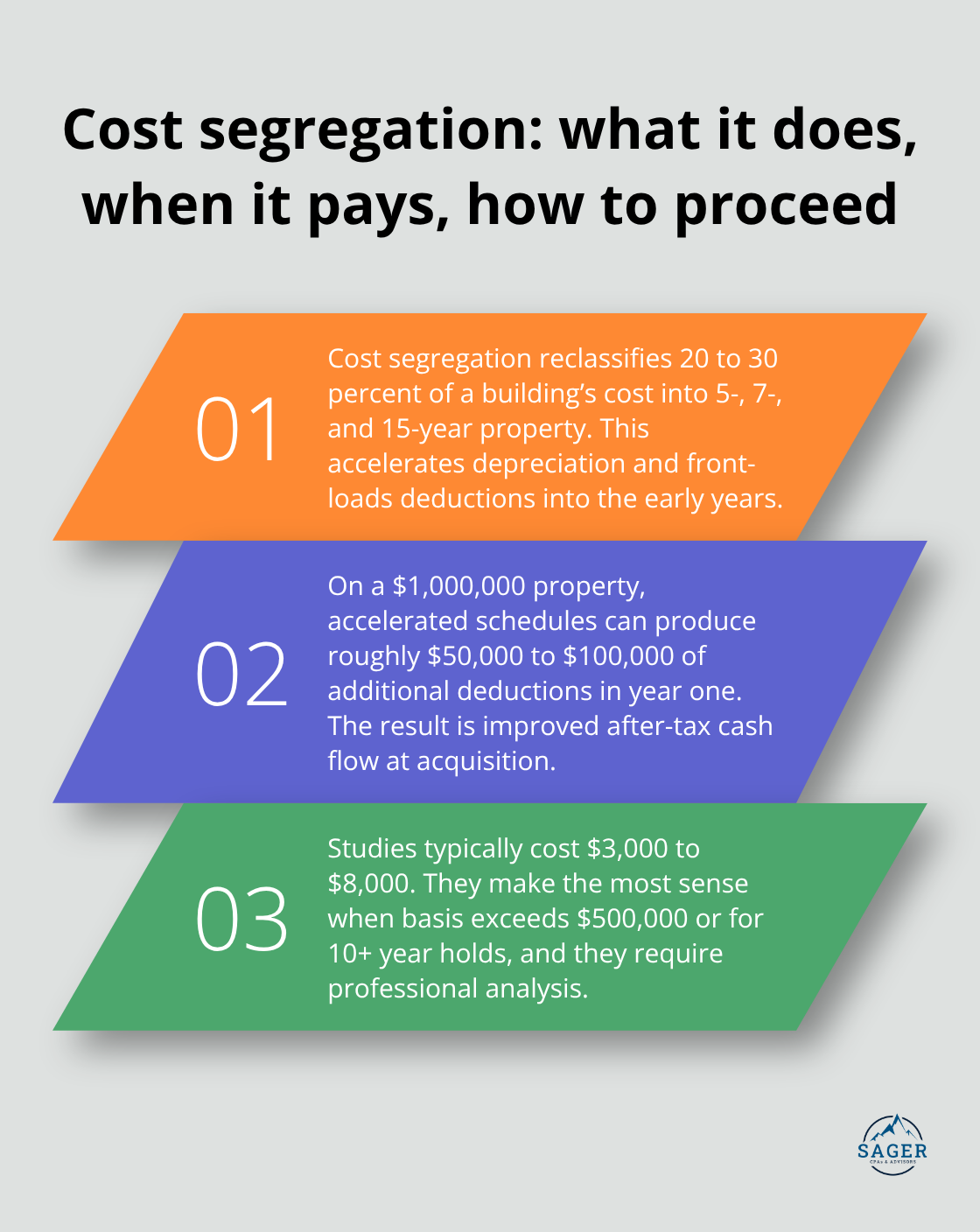
Bonus depreciation 100 percent through 2026 permits you to expense qualifying property immediately rather than spreading deductions across years. This provision eliminates the pressure to rush purchases before year-end, creating flexibility in your acquisition timing. Pair bonus depreciation with cost segregation and you front-load massive tax shields in the acquisition year, transforming a property’s cash flow profile from day one. The combination of these two strategies creates substantial first-year write-offs that reduce your taxable income when you need it most.
Beyond acceleration, 1031 exchanges permit you to defer capital gains indefinitely by reinvesting sale proceeds into like-kind property. Sell a property with $500,000 in gains and reinvest those proceeds within 45 days of identification and 180 days of closing, and you owe zero capital gains tax that year. The IRS allows this deferral to repeat across multiple exchanges, so you can continuously defer gains by rolling into new properties. Delaware Statutory Trusts offer a passive structure for 1031 exchanges if you want hands-off ownership, though they come with sponsor risk and limited control over decisions. Qualified Opportunity Funds present another path, allowing gains deferral through 2026 with potential exclusion of post-investment appreciation after a 10-year hold in designated zones.
Entity structure matters far more than most owners realize. Avoid defaulting to S corporations for rental holdings because they create self-employment tax complications and don’t reduce your income tax burden. LLCs and partnerships offer liability protection without the tax headaches of S corps, and they preserve your ability to use depreciation, 1031 exchanges, and cost segregation without friction. The choice of entity affects not only current-year taxes but also your flexibility for future strategies.
The 2026 estate tax exemption of $15 million per individual creates a temporary window for strategic wealth transfers of appreciated properties before potential changes. Coordinate your entity choice, depreciation strategy, and exit plan together rather than making these decisions separately. This integrated approach positions you to maximize tax efficiency across multiple years and multiple properties. Your ownership structure and depreciation decisions today directly influence the tax impact of your eventual sale or transfer, making advance planning essential for long-term wealth preservation.
Most property owners make the same three mistakes repeatedly, and these errors compound across multiple properties and years. Property owners discover thousands in missed deductions during tax preparation, when the opportunity to capture those deductions has already passed. The first mistake treats expense documentation as an afterthought rather than an ongoing system. You cannot deduct what you cannot prove. The IRS demands receipts, invoices, and documentation for every deductible expense-from property management fees to repairs to travel for property management. According to IRS Publication 946, the moment you place a property in service, you should establish a documentation system for all expenses. A spreadsheet works, accounting software works better, but nothing works if you wait until March to gather scattered receipts from a year of ownership.
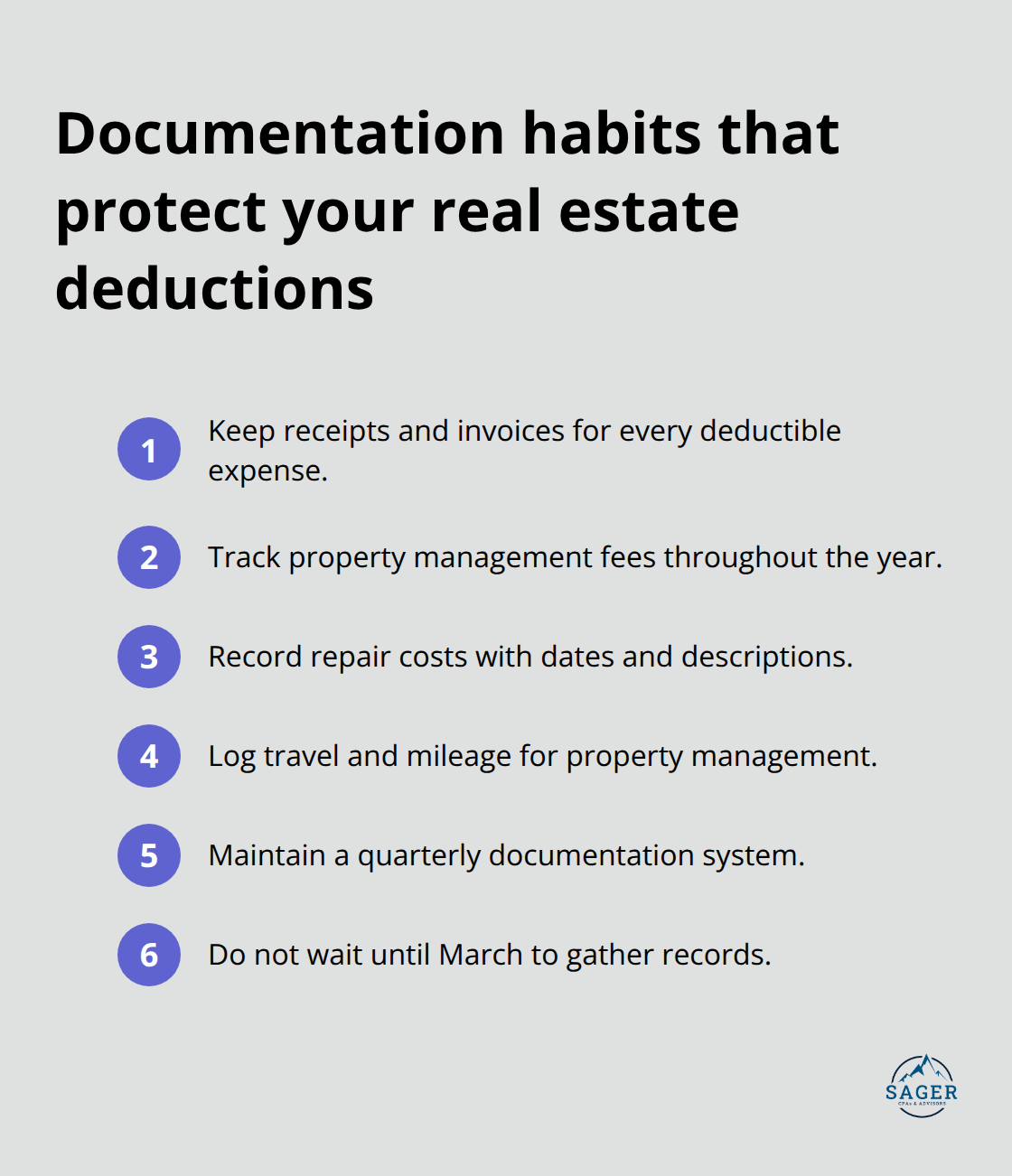
Property owners who document expenses quarterly catch misclassifications early and identify overlooked deductions. The difference between replacing a roof component versus replacing an entire roof determines whether you deduct immediately or capitalize and depreciate over years. The BAR test-betterments, adaptations, and restorations-separates repairs you deduct now from improvements you capitalize, and this distinction directly impacts your current-year tax liability. Document mileage to the property, meals during property visits, professional fees for tax planning, and insurance premiums as you incur them, not months later when details fade. This systematic approach prevents the costly error of losing deductions simply because documentation disappeared.
The second critical mistake misclassifies property use, which shifts your entire tax treatment and loss deduction eligibility. A vacation home you rent out part of the year receives different treatment than a pure investment property, and the IRS scrutinizes this classification heavily. If you use the property personally for more than 14 days per year or rent it out for fewer than 30 days annually at fair market value, the IRS may reclassify it as personal-use property, eliminating your ability to deduct operating losses. Short-term rentals with average stays under seven days receive different passive activity treatment under Treasury Regulation 1.469-1T, and this affects whether rental losses offset your ordinary income or suspend indefinitely. Document your rental activity, occupancy rates, and intended use at purchase to defend your classification if audited. This documentation protects your deduction strategy from IRS challenges.
The third mistake compounds the first two: ignoring Qualified Opportunity Zones. These designated geographic areas offer substantial tax benefits for real estate investors, including deferral of capital gains through 2026 and potential exclusion of post-investment appreciation after a 10-year hold. Many investors never investigate whether their target properties fall within these zones because they lack systematic knowledge of where zones exist. The U.S. Treasury maintains a searchable database of all designated Opportunity Zones, and checking this database takes fifteen minutes and can reveal a tax strategy worth six figures on a large property purchase. If your property qualifies and you’re considering a 1031 exchange anyway, a Qualified Opportunity Fund becomes a genuine alternative worth evaluating against traditional exchanges. This simple research step transforms how you structure your exit strategy and capital gains management.
Real estate tax planning works only when it matches your specific situation, and the strategies that save one investor thousands might miss opportunities for another. Depreciation accelerates your deductions, 1031 exchanges defer your capital gains, and entity structure shapes your tax burden across years. The gap between generic tax preparation and strategic planning is substantial-generic approaches treat your real estate taxes as a filing requirement, while strategic planning coordinates your depreciation decisions, entity structure, and exit strategy into one cohesive system.
Your property portfolio deserves more than a spreadsheet and a tax return filed in April. We at Sager CPA build customized action plans that align your real estate holdings with your financial goals and tax situation. We handle the documentation systems, the entity structure decisions, and the timing of deductions so you capture every legitimate tax benefit available to you.
Schedule a consultation with Sager CPA to create a personalized real estate tax planning strategy tailored to your portfolio and goals. The difference between a generic approach and a strategic one often exceeds the cost of professional guidance by thousands of dollars annually.




Privacy Policy | Terms and Conditions | Powered by Cajabra
At Sager CPAs & Advisors, we understand that you want a partner and an advocate who will provide you with proactive solutions and ideas.
The problem is you may feel uncertain, overwhelmed, or disorganized about the future of your business or wealth accumulation.
We believe that even the most successful business owners can benefit from professional financial advice and guidance, and everyone deserves to understand their financial situation.
Understanding finances and running a successful business takes time, education, and sometimes the help of professionals. It’s okay not to know everything from the start.
This is why we are passionate about taking time with our clients year round to listen, work through solutions, and provide proactive guidance so that you feel heard, valued, and understood by a team of experts who are invested in your success.
Here’s how we do it:
Schedule a consultation today. And, in the meantime, download our free guide, “5 Conversations You Should Be Having With Your CPA” to understand how tax planning and business strategy both save and make you money.