
Startup Financial Strategy: Aligning Vision With Cash Realities
Build a startup financial strategy that transforms your vision into sustainable cash flow and profitability.
Most startups fail not because their business idea is bad, but because they run out of cash. We at Sager CPA see this pattern repeatedly: companies that look profitable on paper collapse because they didn’t understand the difference between making money and having money.
Your startup financial strategy determines whether you survive the early years or become another cautionary tale. This guide walks you through the real numbers that matter.
The gap between profit and cash is where most startups die. A company can show positive revenue on its income statement while watching its bank account drain to zero. This happens because profit is an accounting concept tied to when you earn revenue, while cash is the actual money sitting in your bank account that you can spend today. Founders are often shocked to discover their profitable quarter still left them short on payroll. The disconnect stems from timing. You might invoice a customer in January and recognize that revenue immediately under accrual accounting, but the customer doesn’t pay until March. Meanwhile, your payroll, rent, and vendor bills are due every month without exception. Revenue recognized on paper doesn’t pay salaries. Cash in the bank does.
Accounts receivable looks great on a balance sheet but won’t cover operating expenses. Liquid cash-the actual money you can spend right now, excluding restricted funds or intercompany loans-is your true lifeline. Many founders underestimate how long customers take to pay. A SaaS company with net-30 terms might see customers paying net-45 or net-60 in reality. A product-based business shipping inventory faces weeks between when inventory costs cash to produce and when customers actually pay. These timing gaps compound across dozens of transactions every month. If you have strong revenue growth but customers consistently pay late, your cash runway shrinks faster than your profit margins suggest it should.
You must separate what accrual accounting shows from what actually moves money. Your income statement might project 40% gross margins, but that assumes customers pay on time and inventory turns as planned. Your cash flow forecast must account for the reality: customers pay late, refunds happen, and inventory sits longer than expected. Separate operating cash from strategic cash. Operating cash covers your immediate 12-month needs including salaries, software subscriptions, vendor payments, and tax obligations. Strategic cash is your buffer for longer-term liabilities like equipment purchases, loan repayments, or seasonal swings. Most startups treat all cash the same, then panic when they need $50,000 for tax payments they didn’t anticipate.
Calculate your actual monthly burn rate by looking at cash that left your bank account, not accrual expenses. This number drives your runway calculation. If you have $200,000 in cash and burn $25,000 monthly, your runway is eight months, not longer. That eight-month window is when you must reach profitability, raise capital, or make significant changes. Update this forecast monthly as conditions change.
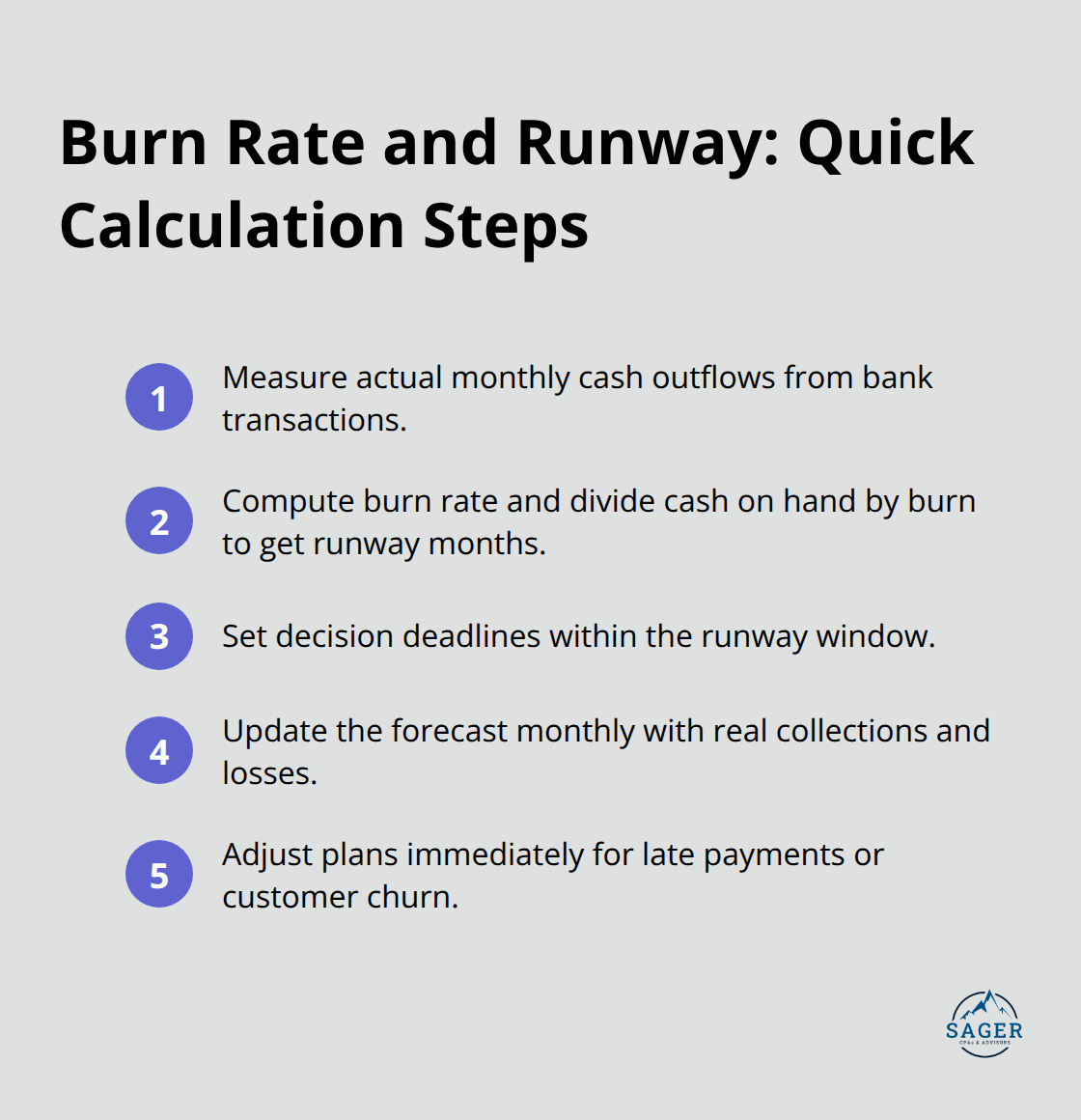
New customer wins that extend payment terms shrink your cash runway even if they look great in revenue projections. Losing a major customer accelerates cash depletion faster than the revenue line suggests because you still have fixed costs to cover. These monthly updates transform your forecast from a static document into a living tool that reflects your actual financial position.
Most founders build financial plans backward from their vision. They decide how much they want to grow, then estimate the costs needed to achieve that growth. This approach fails because it treats expenses as variables that bend to ambition rather than constraints that demand respect. Start instead with your actual fixed costs, then determine what growth rate you can sustain without running out of cash. Your payroll, rent, software subscriptions, and insurance don’t negotiate. These numbers are fixed. Everything else is flexible.
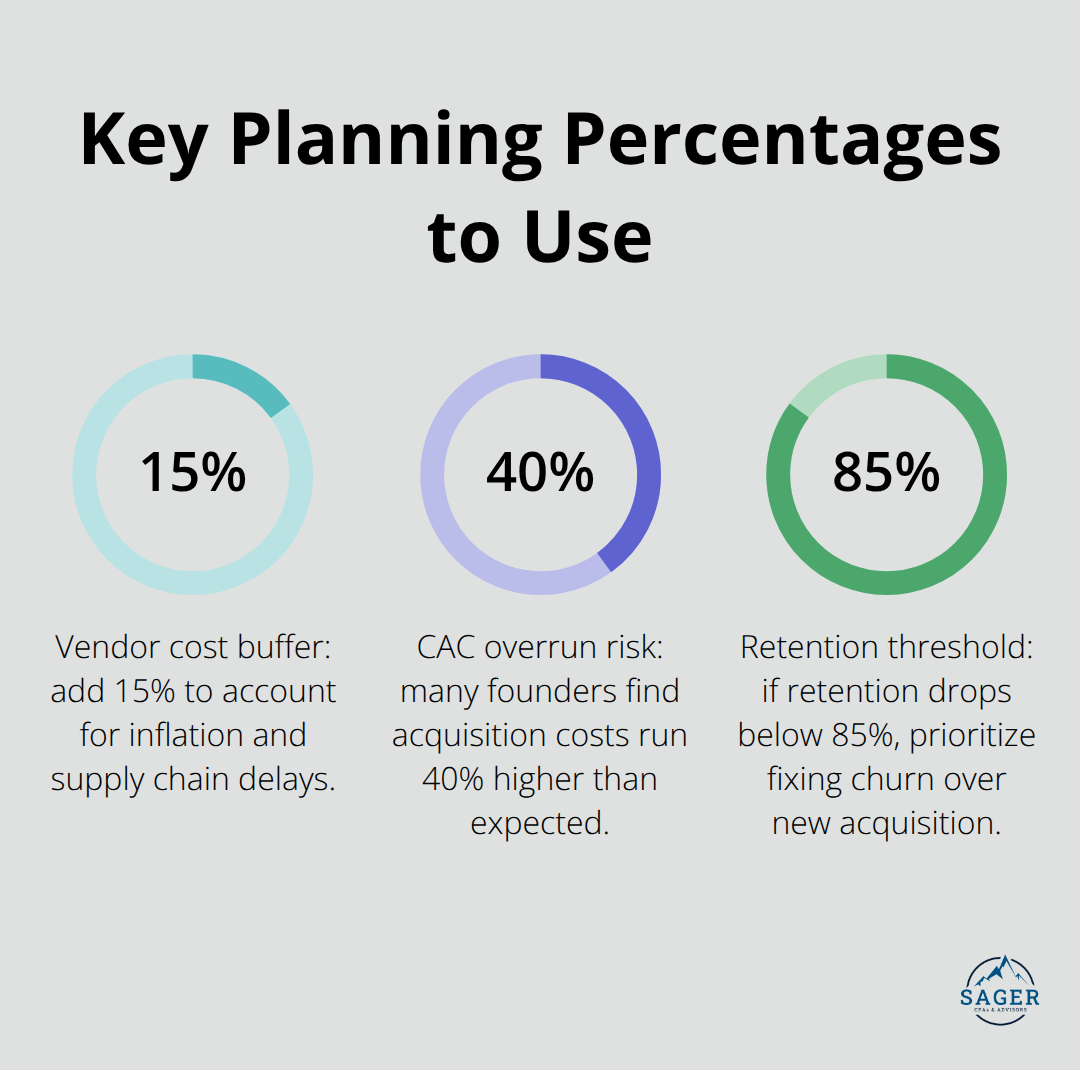
List every recurring monthly expense and commit to that number for the next 12 months. Include salaries at market rates for your location, not the discounted rates you hope to pay. Add 15% to vendor costs because inflation and supply chain delays happen. Account for taxes quarterly, not as an afterthought.
Most startups underestimate compensation by 20-30% because they forget about payroll taxes, benefits, and the salary increases needed to retain talent as you scale. Once you know your true monthly burn, you can calculate how many months of runway you actually have and work backward to set realistic revenue targets.
Monthly cash flow projections must reflect when money actually moves, not when invoices are sent. Create a simple spreadsheet with three columns: cash in, cash out, and net cash position. For cash in, list every revenue stream but reduce it by your actual collection rate. If you invoice customers on net-30 terms but historically collect on net-45, use 45 days in your projection. If you sell physical products, account for the cash you spend on inventory months before customers pay.
For cash out, include every payment that leaves your account including payroll, rent, vendor bills, loan repayments, and tax withholdings. Run this projection 12 months forward and update it monthly as actual results come in. The gap between projected and actual cash flow reveals where your assumptions break down. Most founders discover their customer acquisition costs run 40% higher than expected or that customer churn accelerates faster than their model predicted. These monthly reality checks let you adjust spending before you hit a cash crisis.
Set a minimum cash reserve equal to two months of operating expenses and treat it as untouchable. When unexpected challenges hit-and they will-that buffer keeps you operational while you respond. Unexpected challenges are not hypothetical. Equipment fails, key employees leave and need replacement costs, customers delay payments by 60 days instead of 30, or you discover a compliance issue that requires immediate spending. Founders who build reserves survive these moments. Founders who spend every dollar fail them.
Your reserve strategy determines whether you weather disruptions or collapse under them. A two-month buffer sounds conservative until you face a customer who represents 30% of revenue and suddenly extends payment terms by 45 days. That reserve transforms a potential crisis into a manageable problem. Without it, you scramble for emergency financing or cut payroll mid-month. The cost of that scramble-both in time and in the terms you accept-far exceeds the opportunity cost of holding cash in reserve.
Your financial plan must connect spending decisions to actual revenue performance, not projected revenue. Many startups hire aggressively based on revenue forecasts that never materialize. They commit to office space, software licenses, and contractor relationships assuming growth that doesn’t arrive on schedule. When revenue falls short, they face fixed commitments they can’t easily reduce. This misalignment between spending and actual results drains cash faster than any single mistake.
Test your assumptions monthly and adjust your spending plan accordingly. If customer acquisition costs exceed your model by 25%, reduce your hiring timeline or shift budget toward retention. If a major customer delays their purchase decision, cut discretionary spending immediately rather than waiting for the next quarterly review. This responsiveness keeps your cash runway aligned with your actual business performance. The companies that survive the early years treat their financial plan as a living document that changes with market conditions, not a static forecast locked in place at the start of the year.
With your fixed costs mapped and your cash flow projections grounded in reality, you’re ready to make the hard trade-off decisions that separate sustainable growth from reckless expansion.
Most startups allocate spending based on what feels important rather than what moves the revenue needle. You need a different approach: rank every expense by its impact on cash generation, then cut everything else. This means evaluating whether hiring that marketing manager accelerates customer acquisition faster than doubling your sales team’s commission, or whether upgrading your office space improves retention enough to justify the rent increase. Customer acquisition costs have risen significantly since 2017, making it essential to maximize returns on every dollar spent acquiring and retaining customers. The companies that survive this exercise quarterly and make cuts without hesitation when spending fails to correlate with revenue growth.
Start with your customer acquisition cost for each channel you use. If paid ads cost you $150 per customer but referrals cost you $20, your spending allocation must reflect that reality. Move budget aggressively toward the $20 channel and away from the $150 channel, even if the $150 channel feels more professional or prestigious. Your runway is too short for vanity spending. This channel-by-channel analysis reveals where your money actually works and where it disappears into inefficiency.
Scaling without overextending means matching your headcount growth to your actual revenue trajectory, not your projected one. Most founders make this mistake: they hire based on the revenue they expect to generate, then panic when that revenue arrives three months late. Your payroll represents your largest fixed cost and the hardest to reduce quickly. If you hire 10 salespeople expecting $2 million in annual revenue and that revenue arrives 90 days late, you burn $150,000 in salary for headcount that hasn’t yet generated return. Instead, hire in stages tied to actual revenue milestones, not projected ones. When you hit $100,000 in monthly recurring revenue, hire your first operations person. When you hit $250,000, hire your second. This approach keeps your burn rate aligned with your actual business performance.
Prioritizing existing customers generates more cost-effective results than chasing new ones, with retention and upsell driving substantially better returns. Improving your customer retention rate by 10% often generates more cash impact than acquiring 20% more customers. Track this number monthly and weight it equally with new customer acquisition in your spending decisions. If your retention rate drops below 85%, pause new customer acquisition spending and redirect that budget toward understanding why customers leave and fixing the underlying problems. This reallocation protects your cash runway far more effectively than aggressive new customer spending.
Every spending decision competes for your limited runway. When you approve a $50,000 annual software license, you state that tool generates more value than hiring a contractor for six months or investing in customer success. Make these trade-offs visible by calculating the runway impact of each decision.
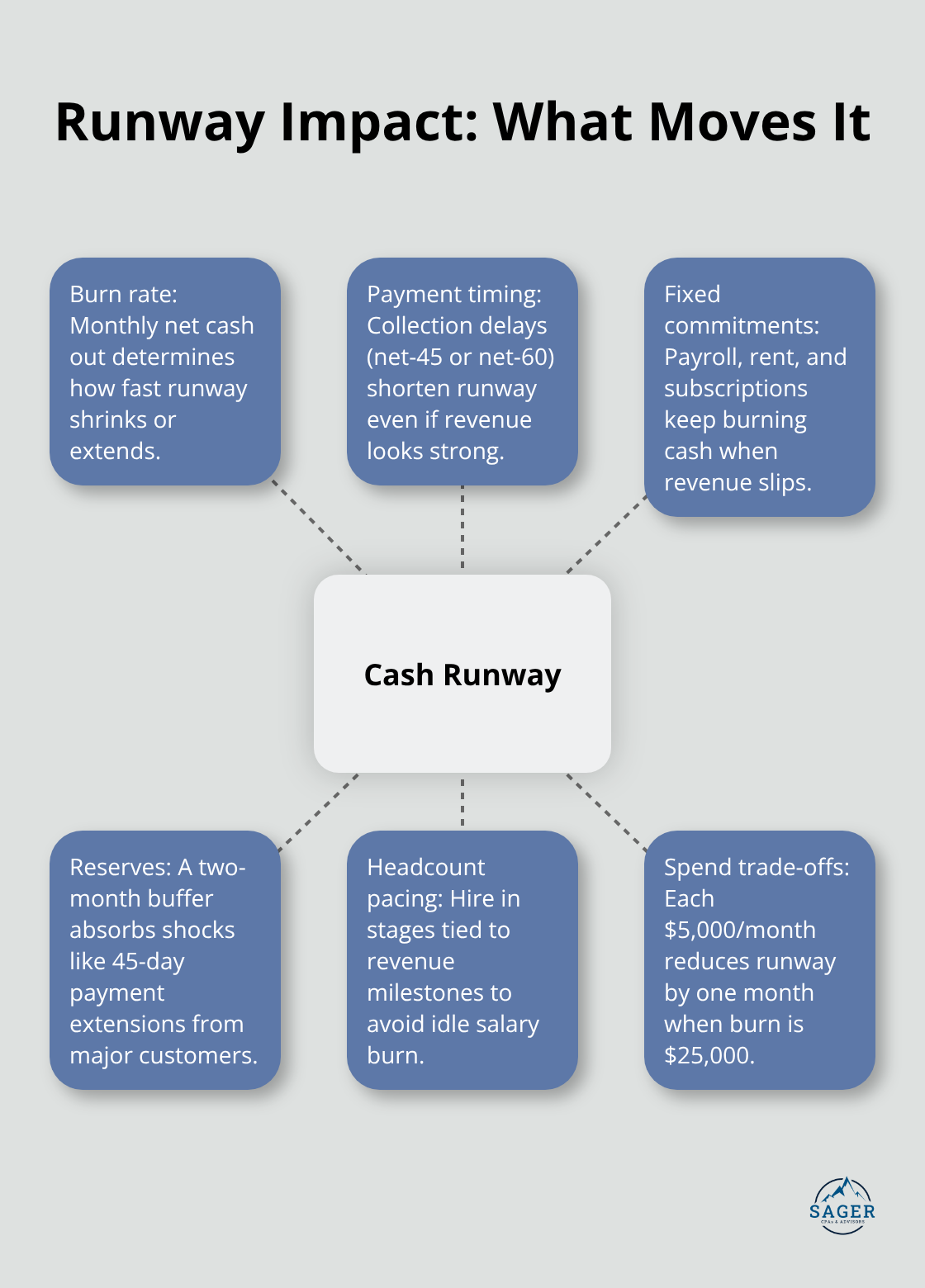
A $5,000 monthly expense reduces your runway by one month if your burn rate is $25,000 and revenue stays flat. That clarity changes how you evaluate spending. Most founders discover they can cut 20-30% of expenses without hurting core operations once they see the runway impact explicitly.
Cut first in areas that don’t directly touch revenue: reduce travel, pause office expansion, negotiate longer payment terms with vendors, and eliminate redundant software subscriptions. Then make harder cuts in areas that do touch revenue, but only after testing whether the spending actually correlates with results. Reduce your marketing budget for channels that show high customer acquisition costs before cutting sales headcount. The order matters because revenue-generating cuts are painful and should come last, after you wring efficiency from everything else.
Financial discipline separates startups that survive from those that collapse under cash pressure. The difference isn’t intelligence or market opportunity-it’s the willingness to align spending decisions with cash reality rather than ambition. Every founder we work with at Sager CPA faces the same challenge: they’ve built a business around a vision, but that vision doesn’t automatically generate cash on a predictable schedule. The startups that make it past year three accept this gap and build systems to manage it.
Your startup financial strategy must answer three hard questions honestly. First, how much cash do you actually burn each month, and how many months of runway does that give you? Second, which spending decisions directly generate revenue, and which are nice-to-haves that drain your runway? Third, when revenue falls short of projections-and it will-what gets cut first? The founders who answer these questions monthly, not annually, maintain control of their cash position. Start your financial strategy today by calculating your true monthly burn rate and your actual runway, then build a 12-month cash flow projection that reflects when money actually moves, not when invoices are sent.
Market conditions shift, customers delay payments, and growth arrives slower than expected-that’s not failure, that’s reality. The companies that thrive respond to reality with speed and precision rather than hoping projections come true. If you’re ready to build a startup financial strategy grounded in real numbers and actual cash flow, Sager CPA can help you create a personalized financial plan tailored to your stage and industry.




Privacy Policy | Terms and Conditions | Powered by Cajabra
At Sager CPAs & Advisors, we understand that you want a partner and an advocate who will provide you with proactive solutions and ideas.
The problem is you may feel uncertain, overwhelmed, or disorganized about the future of your business or wealth accumulation.
We believe that even the most successful business owners can benefit from professional financial advice and guidance, and everyone deserves to understand their financial situation.
Understanding finances and running a successful business takes time, education, and sometimes the help of professionals. It’s okay not to know everything from the start.
This is why we are passionate about taking time with our clients year round to listen, work through solutions, and provide proactive guidance so that you feel heard, valued, and understood by a team of experts who are invested in your success.
Here’s how we do it:
Schedule a consultation today. And, in the meantime, download our free guide, “5 Conversations You Should Be Having With Your CPA” to understand how tax planning and business strategy both save and make you money.