
Startup Financial Strategy: Aligning Vision With Cash Realities
Build a startup financial strategy that transforms your vision into sustainable cash flow and profitability.
Most startups fail because they run out of cash, not because their business idea is flawed. Understanding cash flow management for startups is the difference between scaling successfully and shutting down.
At Sager CPA, we’ve worked with hundreds of founders who didn’t realize their burn rate until it was too late. This guide walks you through the numbers that matter, the cuts that work, and the path to profitability.
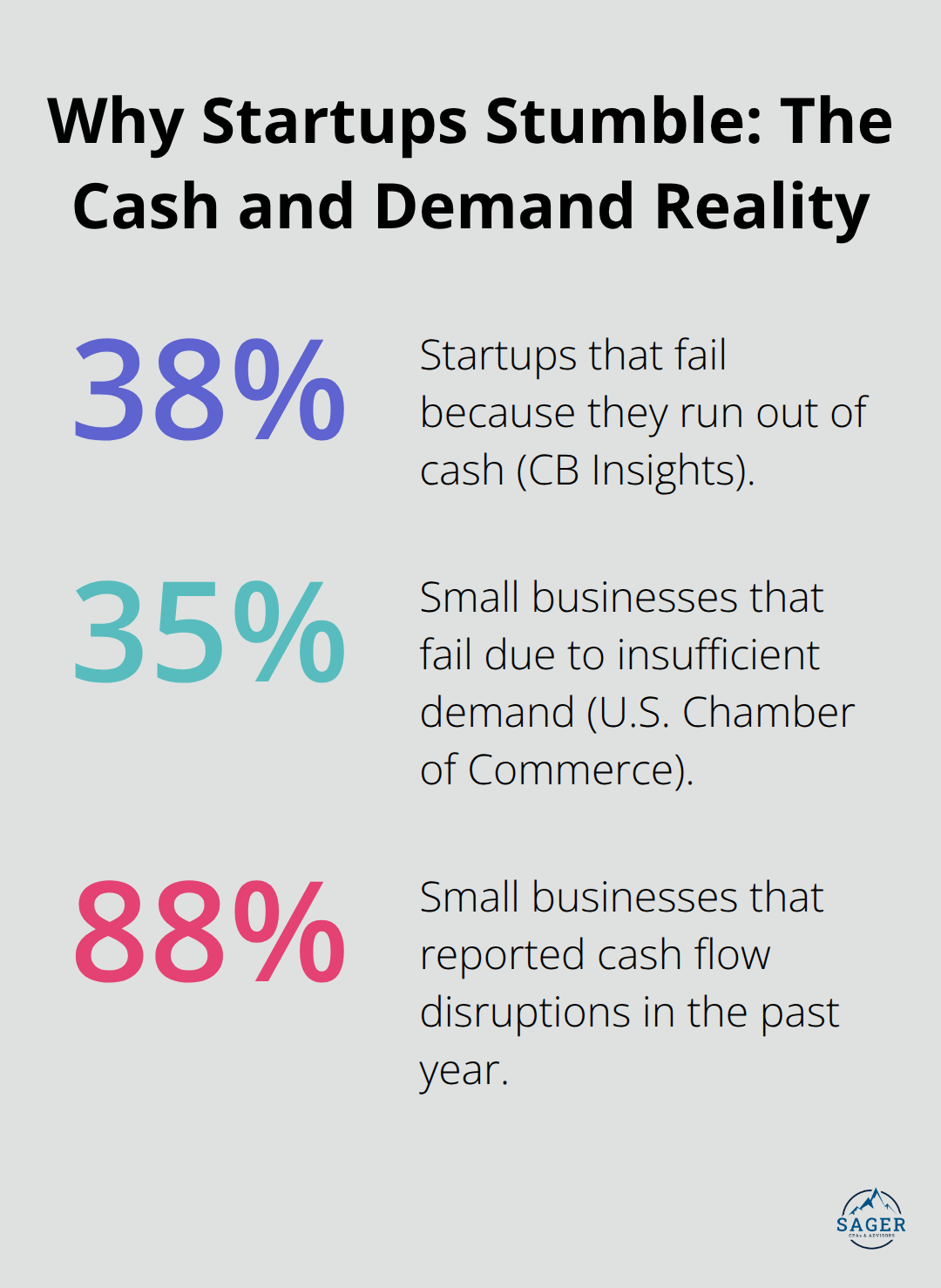
Burn rate is the speed at which your startup spends cash each month. Gross burn rate counts all your monthly expenses-salaries, rent, software, marketing, everything. Net burn rate subtracts any revenue you collect, showing what you actually lose. The difference matters because a startup spending $50,000 monthly with $15,000 in revenue has a net burn of $35,000, not $50,000. That distinction changes how many months you survive. According to CB Insights, 38% of startups fail because they run out of cash, and most founders ignore burn rate until the problem becomes critical.
We’ve seen this pattern repeatedly-founders chase growth metrics and overlook the cash drain until their runway shrinks to three months or less.
Start by listing every dollar that leaves your account each month: payroll, benefits, office space, software subscriptions, payment processing fees, marketing spend, professional services, and everything else. Don’t estimate-pull actual bank and credit card statements for the last three months and average them. Then subtract actual revenue you collected (not invoiced). If you have $100,000 in cash and a net burn of $8,000 monthly, your runway is roughly 12 months before you hit zero. Investors typically expect you to raise new funding when your runway drops to five to eight months, so if you’re at 12 months, you need a plan now. The math is straightforward: cash balance divided by monthly net burn equals months remaining. Update this calculation monthly because burn rate changes as you hire, cut costs, or land customers. Many startups use a simple spreadsheet or a burn rate calculator to model scenarios-what happens if you hire two people, or if revenue grows 20% next quarter.
Your burn rate isn’t just a metric-it’s a constraint on every choice you make. High overhead costs drain cash quickly, which is why you should start lean with remote work, coworking spaces, and cloud-based tools instead of leasing offices or buying servers. Audit your subscriptions ruthlessly and cancel anything you don’t use actively. Outsource non-core functions like bookkeeping or initial customer support rather than hiring full-time staff early. When burn rate is high and runway is short, you can’t afford distractions. You must focus on revenue-generating activities and cut anything that doesn’t directly support customer acquisition or retention. The U.S. Chamber of Commerce reports that nearly 35% of small businesses fail because there’s insufficient demand for their product or service. Track burn rate monthly, share it with your co-founders and board, and let it guide your hiring, spending, and fundraising timeline.
Founders who monitor burn rate monthly make faster decisions about cost cuts and revenue priorities. You spot trends three months ahead instead of reacting when cash runs low. This forward visibility lets you negotiate vendor terms from a position of strength, plan hiring around actual runway, and approach investors with realistic timelines rather than panic. The startups that survive aren’t always the ones with the best ideas-they’re the ones that watch their cash like it’s their last dollar, because at some point, it is.
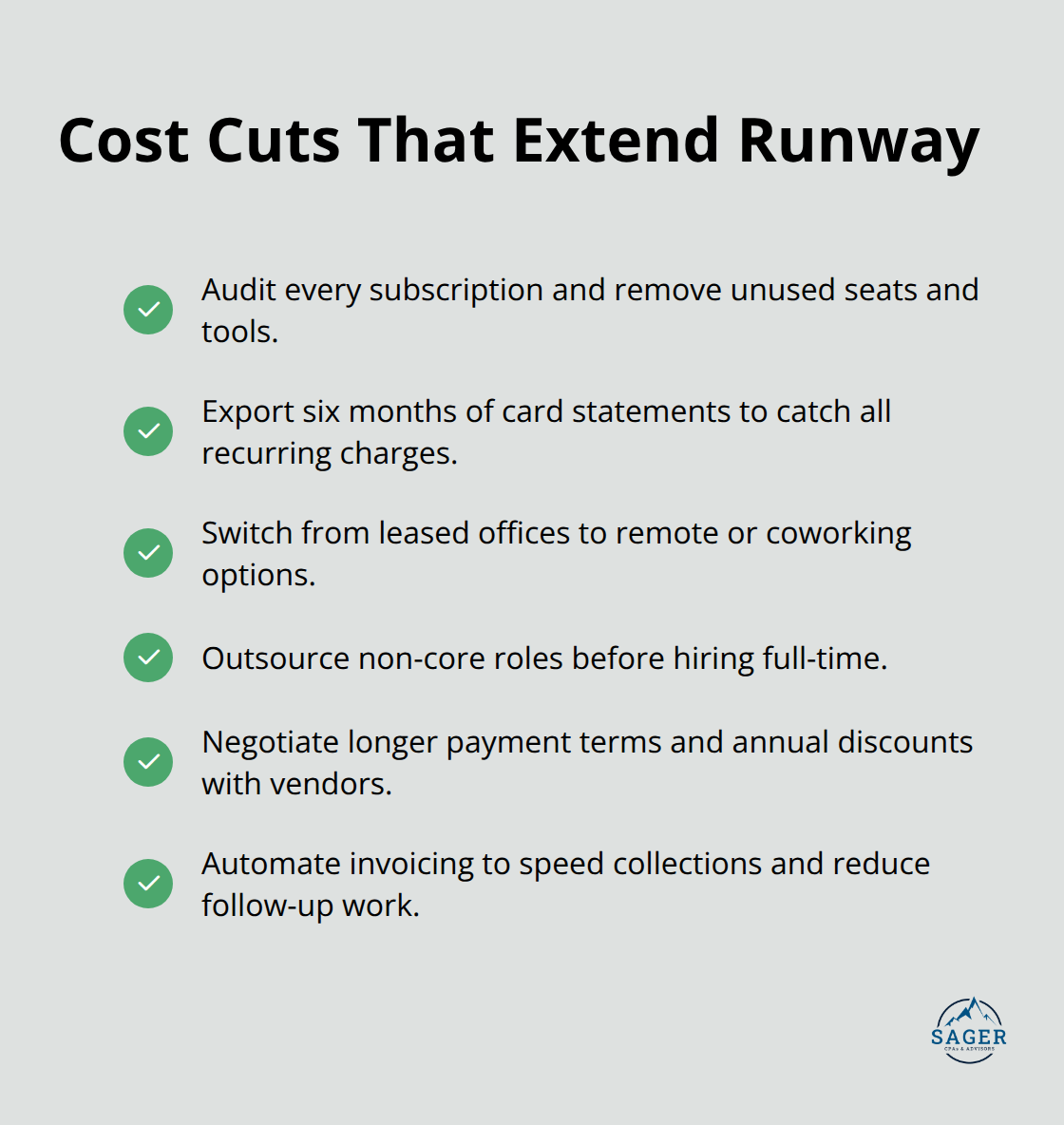
The startups that extend runway longest cut with precision, not indiscriminately. Most founders waste money on three categories: infrastructure they’ve outgrown, services they don’t actively use, and roles that shouldn’t exist yet. Start by auditing every subscription and software tool your team uses. 88% of small businesses report experiencing cash flow disruptions in the past year, and a significant portion of that struggle comes from abandoned subscriptions. Pull your credit card statements for the last six months and list every recurring charge. You’ll likely find tools nobody touches, seats nobody occupies, and services purchased during optimistic planning that no longer fit your needs.
Cancel ruthlessly.
Next, examine your physical footprint. If you pay for office space, stop. Remote-first operations cut overhead dramatically and let you hire talent anywhere. If remote doesn’t work for your team, move to coworking instead of a multi-year lease. The difference between a $5,000 monthly office and a $500 coworking membership is $54,000 yearly-that’s money you can spend on customer acquisition instead.
For roles, resist the urge to hire full-time employees for functions you can outsource cheaply. Fractional bookkeeping, part-time customer support contractors, and freelance marketers cost a fraction of full-time salaries and benefits. You keep the flexibility to scale down if revenue doesn’t materialize. Payroll is your largest expense, so every hire should directly accelerate revenue or reduce costs elsewhere. Don’t hire for hypothetical future needs.
Revenue growth matters more than expense cuts alone, but most founders approach it backwards. They focus on acquiring new customers when they should focus on collecting from existing ones. Late payments from customers are a silent cash drain-when large contracts have 60 to 120 day payment cycles, your cash flow breaks before you see the money. Set clear upfront payment terms and require deposits on projects over a certain size. Invoice automation platforms speed collections and reduce the manual work of chasing payments. Diversify your customer base so no single account represents more than 30% of revenue; one delayed payment from a major client can trigger a cash crisis.
On the revenue generation side, concentrate on high-margin work or products first. A $10,000 project with 80% margins generates $8,000 in cash contribution toward covering fixed costs. A $50,000 project with 15% margins contributes only $7,500 and ties up more time and resources. Calculate your contribution margin per customer and per project type, then bias your sales efforts toward the work that funds your runway.
Vendor negotiations often get overlooked because founders assume terms are fixed. They’re not. If you pay net 30 to suppliers, ask for net 45 or net 60. If you’re on a monthly subscription, ask about annual discounts. Suppliers would rather keep your business at slightly better terms than lose it entirely. The gap between what you pay and what you could pay is often 10 to 20%, and that compounds monthly. Negotiate when you still have runway, from a position where you’re a valued customer they want to keep-not when desperation forces your hand.
Once you’ve tightened costs and stabilized revenue collection, the next challenge emerges: reaching the point where your business generates more cash than it burns. This transition requires a realistic path forward, one grounded in actual numbers rather than optimistic projections.
Break-even is the revenue level where your monthly income matches your monthly expenses. At that point, you stop losing money. Most founders treat break-even as a distant finish line, but it’s actually a practical milestone you should reach within 12 to 24 months if your business model is sound.
The calculation itself is straightforward. Start by separating fixed costs (salaries, rent, insurance) from variable costs (payment processing, shipping, materials). Fixed costs don’t change when revenue changes, so they anchor your break-even target.
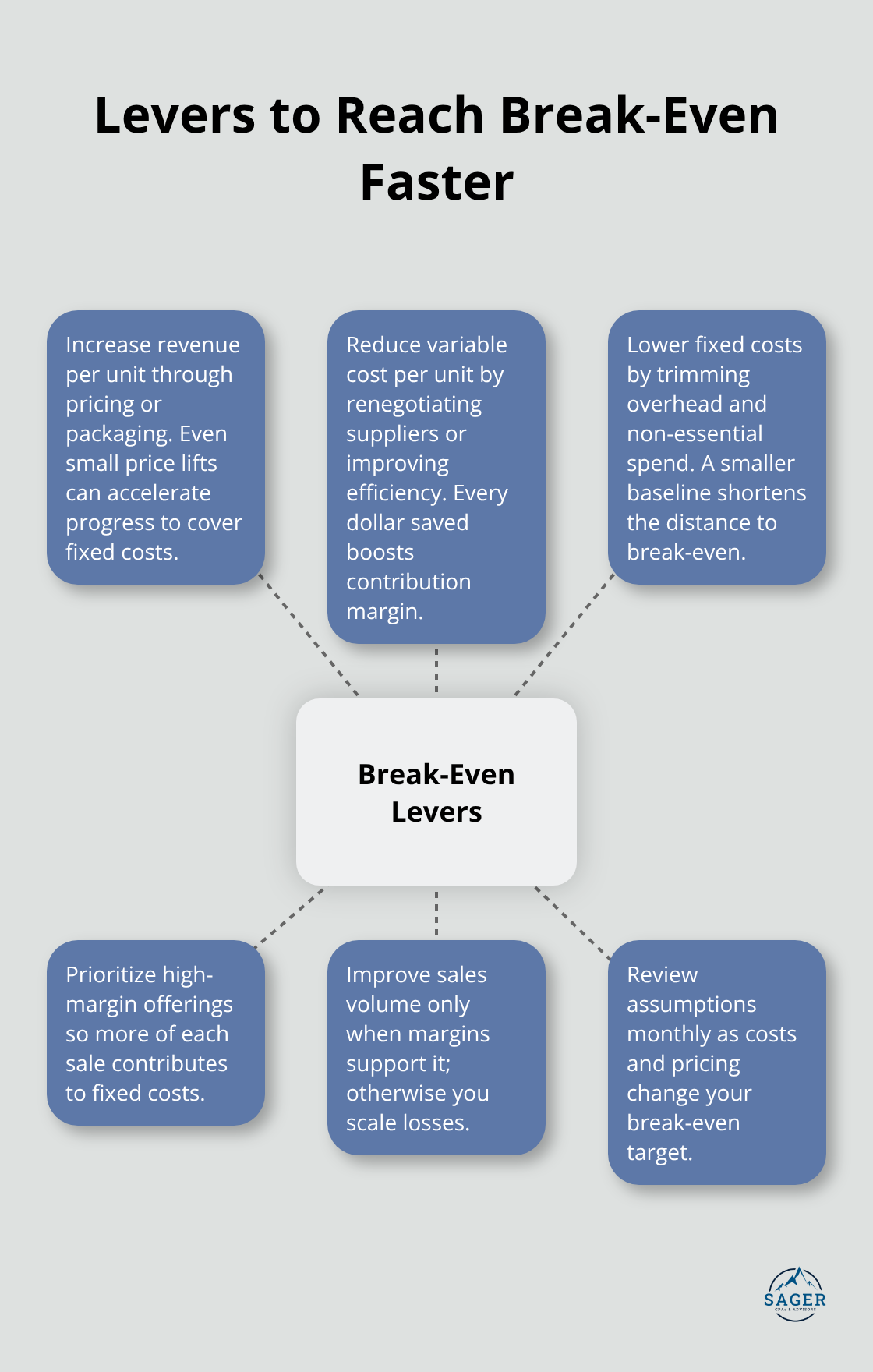
Variable costs scale with revenue, which means high-margin revenue has a bigger impact on reaching break-even than low-margin revenue. To calculate your break-even point calculation, use the formula: Break-Even Point (Units) = Fixed Costs ÷ (Revenue per Unit – Variable Cost per Unit).
A SaaS founder with $80,000 fixed costs and 75% gross margins needs $107,000 in monthly recurring revenue to break even. An e-commerce founder with the same fixed costs but 25% gross margins needs $320,000 in monthly revenue. The margin difference makes break-even either achievable or impossible, which is why margin optimization matters more than revenue growth alone. Your business model determines whether break-even is 6 months away or 3 years away, so examine your margins before you commit to aggressive growth targets.
Most startups fail not at break-even but before it, which is why building a financial buffer changes everything. Maintain a financial buffer of 3 to 6 months of operating expenses in cash reserves before you’re even close to break-even. This sounds expensive when you’re burning cash, but it’s the difference between surviving a slow quarter and collapsing when a customer delays payment or a vendor negotiation stalls. With three months of runway beyond your current burn rate, you gain negotiating power with investors, customers, and vendors because you’re not desperate. You can wait for the right customer deal instead of taking low-margin work just to extend runway by weeks. You can push back on a vendor’s payment terms without caving immediately.
Start building reserves now by setting aside a percentage of every revenue dollar that arrives. If you collect $30,000 in revenue and your burn is $20,000, put $2,000 to $3,000 into a separate savings account each month. This doesn’t slow your path to break-even-it accelerates it by giving you the stability to make smarter decisions. When you have a buffer, you make decisions based on strategy, not survival. Your cash reserves act as a shock absorber that lets you negotiate from strength rather than desperation.
Cash flow management for startups isn’t optional-it’s the foundation of survival. The three core principles work together: monitor your burn rate monthly to understand how long you can operate, cut costs with precision by eliminating waste without gutting growth, and build a realistic path to break-even that your business model can actually support. Founders who treat these as interconnected decisions rather than separate problems move faster and make smarter choices.
Pull your last three months of bank statements and calculate your actual net burn rate this week. List every subscription and recurring expense, then cancel what you don’t actively use. Set a target break-even date based on your fixed costs and gross margins, then work backward to identify the revenue level and cost reductions needed to reach it. Share these numbers with your co-founders and board monthly so everyone operates from the same reality.
The startups that reach profitability aren’t the ones with perfect business models-they’re the ones that obsess over cash. They know their runway to the month, they negotiate from strength, and they make hiring and spending decisions based on actual numbers rather than optimism. We at Sager CPA work with founders who want to move beyond survival mode into sustainable growth, and our financial planning services help you build the systems and strategies that turn cash flow management for startups from a monthly panic into a predictable process.




Privacy Policy | Terms and Conditions | Powered by Cajabra
At Sager CPAs & Advisors, we understand that you want a partner and an advocate who will provide you with proactive solutions and ideas.
The problem is you may feel uncertain, overwhelmed, or disorganized about the future of your business or wealth accumulation.
We believe that even the most successful business owners can benefit from professional financial advice and guidance, and everyone deserves to understand their financial situation.
Understanding finances and running a successful business takes time, education, and sometimes the help of professionals. It’s okay not to know everything from the start.
This is why we are passionate about taking time with our clients year round to listen, work through solutions, and provide proactive guidance so that you feel heard, valued, and understood by a team of experts who are invested in your success.
Here’s how we do it:
Schedule a consultation today. And, in the meantime, download our free guide, “5 Conversations You Should Be Having With Your CPA” to understand how tax planning and business strategy both save and make you money.