
Startup Funding Planning: Secure Capital and Scale
Plan your startup funding strategy with proven tactics to secure capital, avoid common pitfalls, and scale faster than competitors.
Most business owners wait until December to think about taxes. By then, it’s too late to make the moves that actually save money.
Proactive tax planning is different. It means making strategic decisions throughout the year so you pay less when April rolls around. We at Sager CPA have seen firsthand how businesses that plan ahead cut their tax bills significantly while those that wait scramble to find deductions that no longer apply.
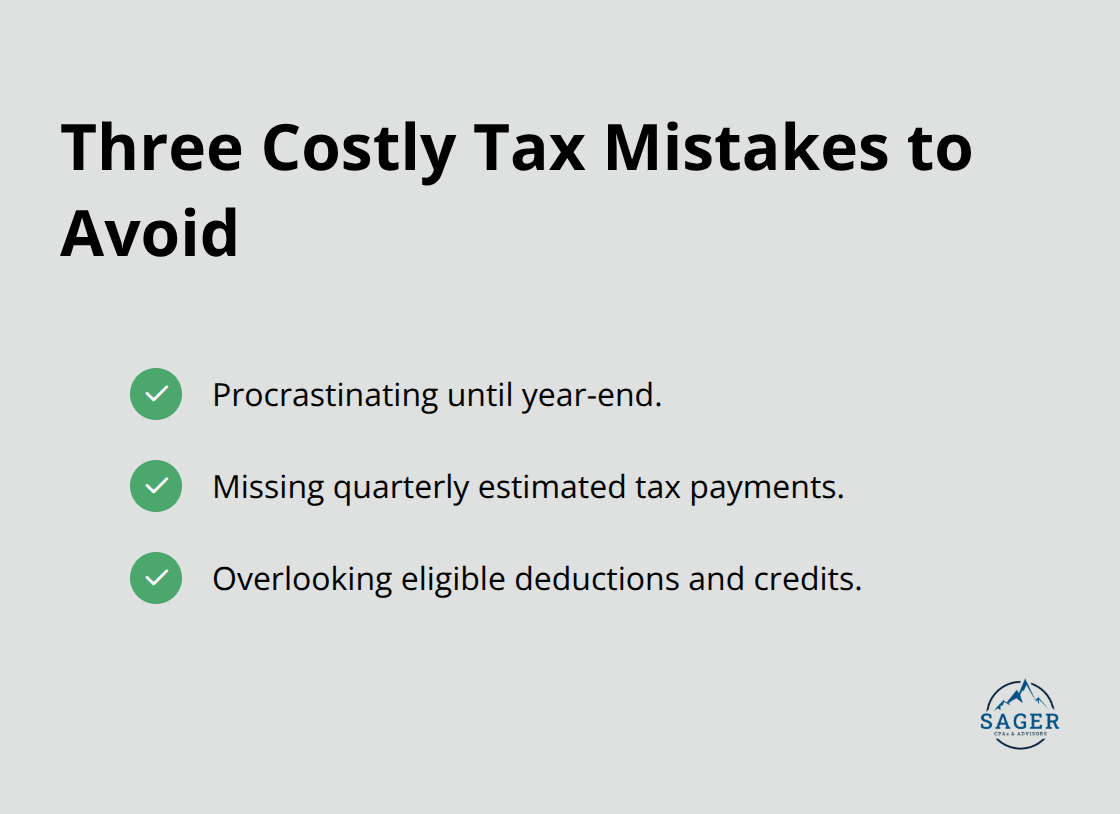
Most business owners wait until December to think about taxes. Once that deadline arrives, it’s too late to make the moves that actually save money. The IRS doesn’t care about your timeline. If you miss a quarterly estimated tax payment deadline, you owe penalties and interest immediately, regardless of whether you had time to plan.
A business owner who discovers in January that they owe $50,000 in taxes has almost no options left. They cannot restructure their business, time major expenses strategically, or maximize retirement contributions for that year. The damage is already done. This pattern repeats constantly, and it’s entirely preventable.
Self-employed people and business owners with significant income that isn’t subject to withholding must make quarterly payments to the IRS. For 2026, these payments are due by January 15, 2027. Miss even one deadline and the IRS assesses an underpayment penalty. The current federal interest rate on underpayment sits at 7 percent, compounding quarterly.
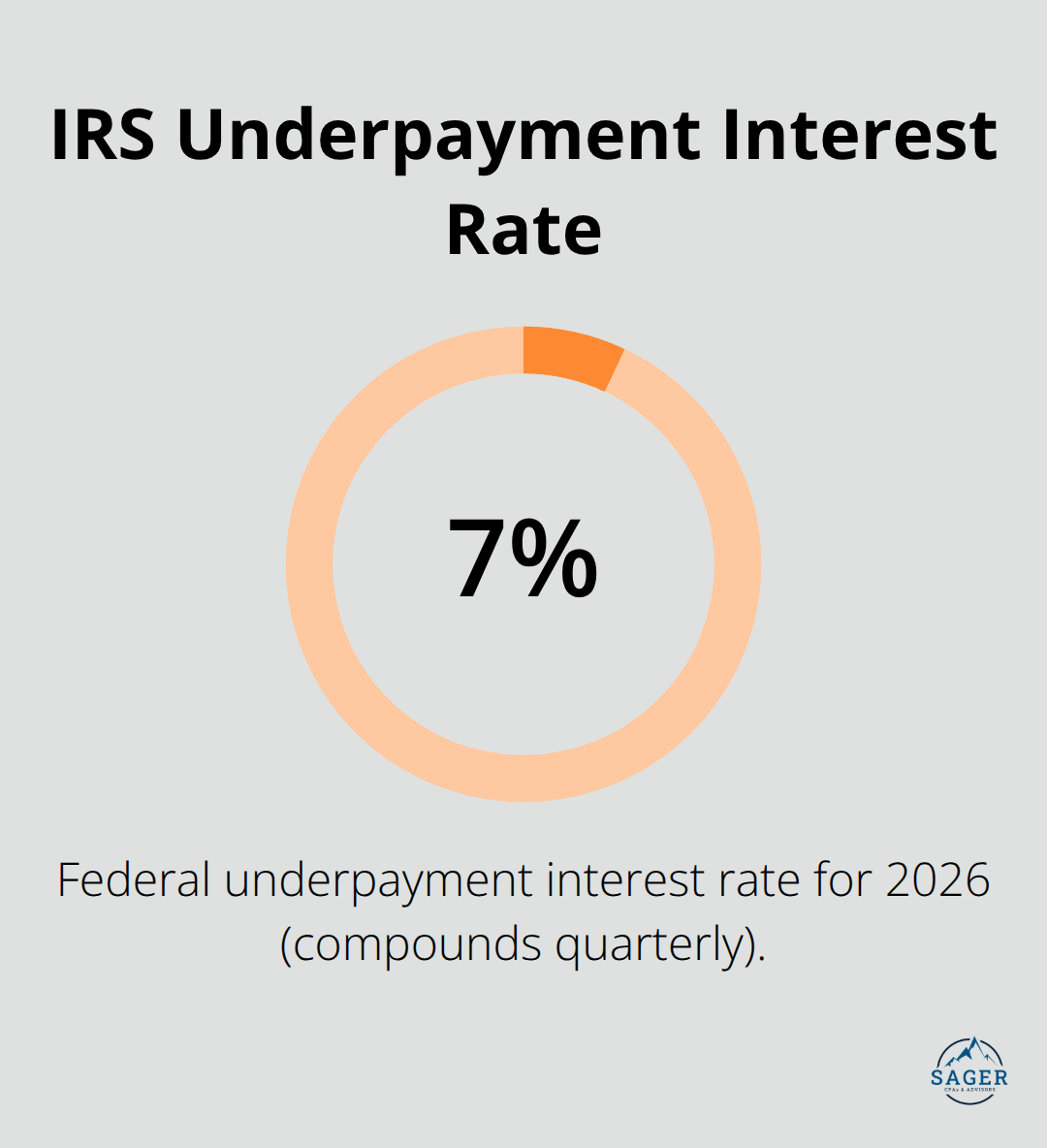
A business that owes $30,000 in taxes but pays nothing quarterly and settles everything in April loses roughly $2,100 to penalties and interest alone. That’s money that could have gone toward growth, equipment, or employee salaries. Many business owners wait to calculate what they owe, which means they scramble in mid-April when the deadline has already passed.
The solution is straightforward: calculate your estimated tax liability every three months, not once a year. If your income fluctuates, adjust your payments accordingly. This takes a few hours per quarter and saves thousands annually.
The most expensive mistake is overlooking deductions and credits available to your business. The average business owner captures maybe 60 to 70 percent of eligible deductions. Home office expenses, vehicle mileage, professional development, software subscriptions, health insurance premiums, and equipment depreciation all qualify but require documentation and planning.
Some deductions have income limits or phase-out thresholds that change year to year. The R&D tax credit can return substantial savings for qualifying businesses but only if you identify eligible activities and document them properly throughout the year. Waiting until tax time means you’ve lost receipts, forgotten about expenses, or missed deadlines for claiming certain credits.
A business that spends $8,000 on professional development but never deducts it essentially throws away roughly $1,920 to $2,400 in tax savings (depending on their bracket). The fix is tracking expenses as they happen, categorizing them correctly, and reviewing your tax strategy quarterly with your tax advisor. These three mistakes-procrastination, missed payments, and overlooked deductions-create the foundation for unnecessary tax liability. Understanding how to reverse each one positions you to move forward with strategies that actually reduce what you owe.
Timing determines everything in tax planning, and most business owners misjudge it completely. You cannot wait until you have income to decide whether to defer it or accelerate expenses. The decisions that matter happen months before year-end. If your business tracks toward $120,000 in profit but you can push $30,000 of that into next year through strategic timing of invoices and expense recognition, that shift alone drops you into a lower tax bracket this year. For 2026, a single filer moves from the 24 percent bracket into the 22 percent bracket at $95,375 of taxable income according to IRS data. That difference is real money.
Self-employed professionals and business owners with variable income should calculate their projected tax liability by September, not December. If you head toward a higher bracket, accelerate deductible business expenses like equipment purchases, professional services, or software licenses into the current year. If next year looks lighter, defer income-generating activities or delay client invoicing. This requires discipline and planning, but the tax savings compound year after year. A business that reduces taxable income by $20,000 annually through strategic timing saves between $4,400 and $6,000 depending on its tax bracket-money that can fund growth or strengthen cash reserves.
Your business structure determines how much tax you actually owe, yet most owners never revisit this decision after formation. A sole proprietor pays self-employment tax on all net income at a combined rate of 15.3 percent for Social Security and Medicare. An S-Corporation or LLC taxed as an S-Corp allows you to split income into a reasonable W-2 salary and distributions, with distributions avoiding the self-employment tax.
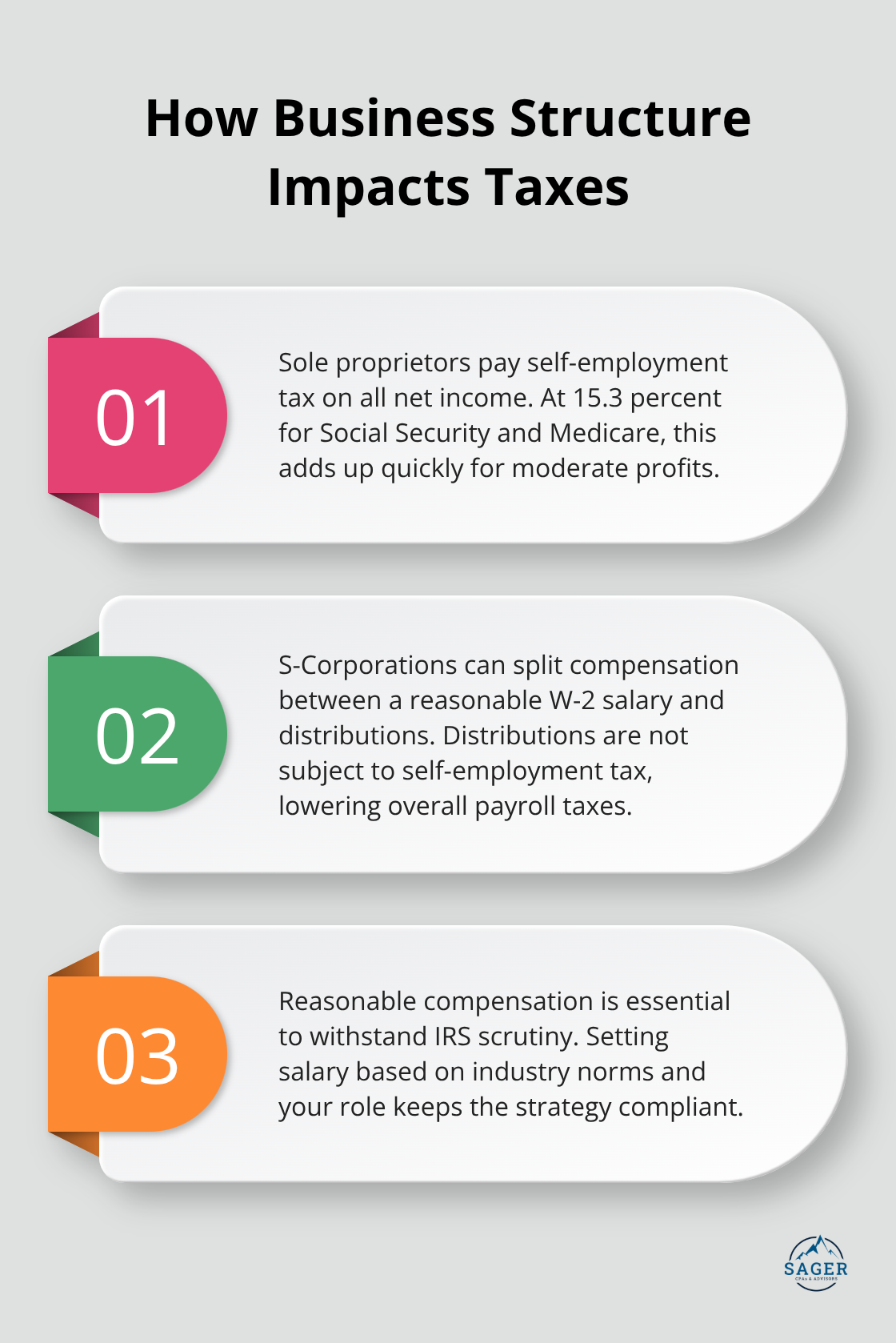
A business earning $80,000 in profit as a sole proprietorship pays roughly $11,304 in self-employment tax alone. Restructured as an S-Corp, that same owner might take a $50,000 salary and $30,000 in distributions, reducing self-employment tax to approximately $7,065 and saving $4,239 annually. The IRS scrutinizes unreasonably low W-2 salaries, so the strategy only works if your salary is defensible based on industry standards and your actual work.
Tax credits represent another layer of savings that vanishes if you do not plan ahead. The R&D tax credit rewards businesses that develop new products, processes, or software through qualifying research expenses. Documenting eligible activities throughout the year is non-negotiable. A technology company that spends $50,000 on development but never documents which hours and expenses qualify for the credit leaves $7,500 to $10,000 on the table.
Energy-efficient equipment upgrades, hiring credits for certain employee categories, and small business equipment deductions all carry strict documentation requirements and phase-out thresholds. These credits expire or shrink without advance planning and proper record-keeping. The difference between capturing these opportunities and missing them often determines whether your business thrives or merely survives financially. Working with a tax professional who understands your industry helps identify credits you would otherwise overlook and ensures you document everything correctly as the year unfolds.
Self-employed professionals face a fundamentally different tax situation than small business owners, and partnerships operate under entirely separate rules. A freelance consultant earning $75,000 annually cannot use the same strategies as a business with employees and inventory. The 2026 tax code offers specific advantages for each structure, but you must identify which ones apply to your situation and act before year-end.
Self-employed professionals should prioritize retirement contributions because they reduce both income tax and self-employment tax simultaneously. For 2026, you can contribute up to $24,500 to a Solo 401(k) plus an additional $8,000 catch-up if you’re 50 or older, according to IRS data. A freelancer earning $90,000 who contributes $24,500 to a Solo 401(k) reduces their taxable income to $65,500 and avoids self-employment tax on that $24,500 contribution, saving approximately $3,600 in self-employment tax alone.
Health savings accounts offer another layer of savings for self-employed people with high-deductible health plans. For 2026, you can contribute $4,400 for individual coverage or $8,750 for family coverage, plus $1,000 catch-up contributions if you’re 55 or older. These contributions are tax-deductible, grow tax-free, and withdrawals for qualified medical expenses avoid taxation entirely.
Small business owners with employees must focus on business structure optimization because the tax difference between operating as a sole proprietor versus an S-Corporation can exceed $5,000 annually on moderate income levels. An S-Corporation requires filing Form 2553 with the IRS and maintaining payroll, but it eliminates self-employment tax on distributions above your reasonable W-2 salary.
If your business generates $100,000 in profit and you take a $60,000 salary with $40,000 in distributions, you avoid self-employment tax on that $40,000, saving roughly $5,640. The IRS requires your W-2 salary to reflect what you would reasonably pay someone else for your role, so underreporting wages invites audits and penalties.
Partnerships and LLCs taxed as partnerships face unique challenges because income passes through to partners regardless of whether distributions occur, forcing partners to pay taxes on profits they never received. A partnership earning $150,000 with two equal partners means each partner owes taxes on $75,000 even if the partnership distributes nothing.
Planning for this reality requires either ensuring adequate distributions match tax liability or managing quarterly estimated tax payments carefully to avoid penalties. Partnerships should also review their operating agreement annually to confirm profit-sharing allocations match their tax intentions. This attention to detail separates businesses that control their tax burden from those that scramble to cover unexpected liabilities.
Proactive tax planning separates business owners who control their tax burden from those who react to it. The strategies outlined in this post work only if you implement them throughout the year, not when April approaches. Waiting costs thousands in penalties, missed deductions, and unnecessary tax liability.
Working with a tax professional matters because tax law changes constantly and your situation is unique. A CPA who understands your industry identifies credits and deductions you would otherwise miss, and IRS data shows roughly 60 percent of simple returns contain errors that a professional advisor prevents entirely. More importantly, a tax professional helps you make decisions months before year-end when those decisions actually move the needle on your tax bill.
We at Sager CPA build customized tax plans that align with your business goals and reduce what you owe. Rather than treating taxes as an annual event, we work with you quarterly to monitor income, adjust strategies, and capture opportunities as they emerge. Schedule a consultation to discuss your specific situation and create a personalized tax strategy that transforms proactive tax planning into a competitive advantage for your business.



Phone: (208) 939-6029
Email: info@sager.cpa
Privacy Policy | Terms and Conditions | Powered by Cajabra
At Sager CPAs & Advisors, we understand that you want a partner and an advocate who will provide you with proactive solutions and ideas.
The problem is you may feel uncertain, overwhelmed, or disorganized about the future of your business or wealth accumulation.
We believe that even the most successful business owners can benefit from professional financial advice and guidance, and everyone deserves to understand their financial situation.
Understanding finances and running a successful business takes time, education, and sometimes the help of professionals. It’s okay not to know everything from the start.
This is why we are passionate about taking time with our clients year round to listen, work through solutions, and provide proactive guidance so that you feel heard, valued, and understood by a team of experts who are invested in your success.
Here’s how we do it:
Schedule a consultation today. And, in the meantime, download our free guide, “5 Conversations You Should Be Having With Your CPA” to understand how tax planning and business strategy both save and make you money.