
Tax Optimization for Businesses: Proactive Planning for Profits
Reduce your tax burden with strategic planning. Learn tax optimization strategies for businesses to keep more profits and grow faster.
Most businesses leave thousands of dollars on the table each year simply because they don’t plan ahead. Tax optimization for businesses isn’t something that happens in April-it happens throughout the year.
At Sager CPA, we’ve seen firsthand how proactive planning transforms tax liability into real savings. This guide shows you exactly where businesses go wrong and how to fix it.
Most business owners treat tax planning like a spring cleaning project-something that happens once a year in the weeks before filing. This reactive approach guarantees missed opportunities. Taxpayers fail to pay hundreds of billions of dollars in taxes every year, yet these opportunities require planning well before year-end. When you wait until April, your major financial decisions for the year are already locked in. You’ve made hiring decisions, purchased equipment, taken distributions, and recognized income-all without considering the tax impact.
A business that spent $150,000 on equipment in December without evaluating bonus depreciation versus spreading deductions over time paid $16,000 more in federal taxes than necessary. Quarterly planning sessions prevent this entirely. In January, you review projections and identify which deductions to accelerate or which income to defer. In April, you adjust withholding based on actual performance. In October, you model major spending decisions before they happen.
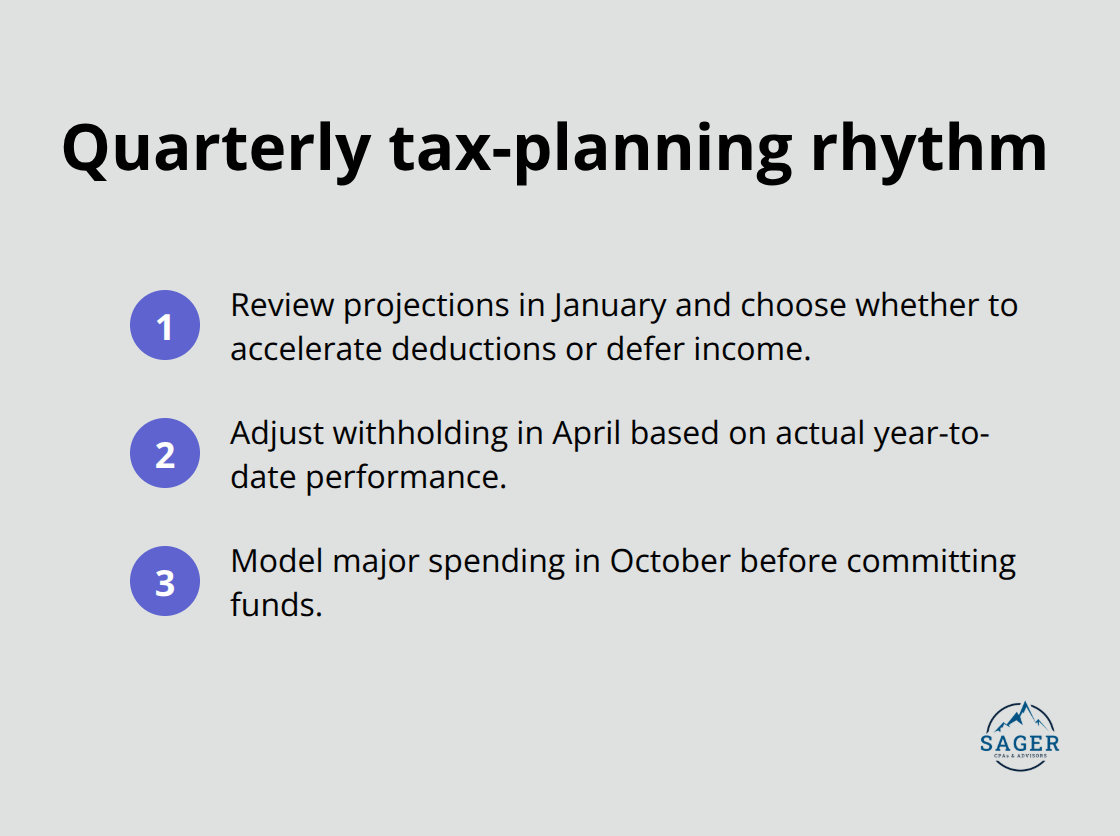
This rhythm keeps you working with current numbers and real flexibility, not historical decisions.
Businesses routinely miss deductions because they lack systematic tracking or don’t know what qualifies. R&D expenses, home office allocations, vehicle costs, and professional development often go unclaimed. Without a structured approach to expense capture, thousands of dollars slip away each year. The solution requires you to establish clear categories for business expenses and review them monthly, not annually. This practice alone surfaces deductions that reactive tax preparation misses entirely.
Many owners never question their entity structure-they stay as sole proprietors or LLCs without exploring whether an S-Corp election would reduce self-employment taxes. A layered structure combining an S-Corp inside an LLC holding assets can dramatically shift your tax burden beyond traditional setups. The 20% Qualified Business Income deduction available to pass-through entities can save thousands, yet requires proper entity positioning and documentation.
A service business generating $500,000 in taxable income can reduce effective tax rates through strategic timing maneuvers in the first year through proactive planning that combines strategic timing, proper entity structure, and disciplined deduction capture. The path forward involves analyzing your last two years of returns and bookkeeping to identify quick wins, then mapping a quarterly planning rhythm tailored to your business cycle and projected income. These foundational steps reveal where your specific situation stands and what strategies apply to your circumstances.
Timing decisions determine whether you pay taxes on income you haven’t yet received or miss deductions before year-end. Most businesses make these decisions reactively, based on cash flow needs rather than tax impact. Strategic timing flips this approach: you model the tax consequence of each major decision before you commit to it. A service business projecting $600,000 in revenue for the year can defer income to lower your tax bill if cash flow permits, dropping into a lower tax bracket and saving thousands in federal and self-employment taxes. Conversely, accelerating $30,000 in equipment purchases into December instead of January creates immediate depreciation deductions that offset current-year income.
The IRS allows Section 179 expensing up to $2,500,000 in 2025, meaning you can write off qualified business property in the year you purchase it rather than spreading the deduction across years. A $100,000 equipment purchase using Section 179 generates $24,000 in federal tax savings alone for a business in the 24% bracket, plus additional state and self-employment tax benefits. Bonus depreciation, which allows 100% immediate deduction of qualified property placed in service in 2025, amplifies this benefit further.
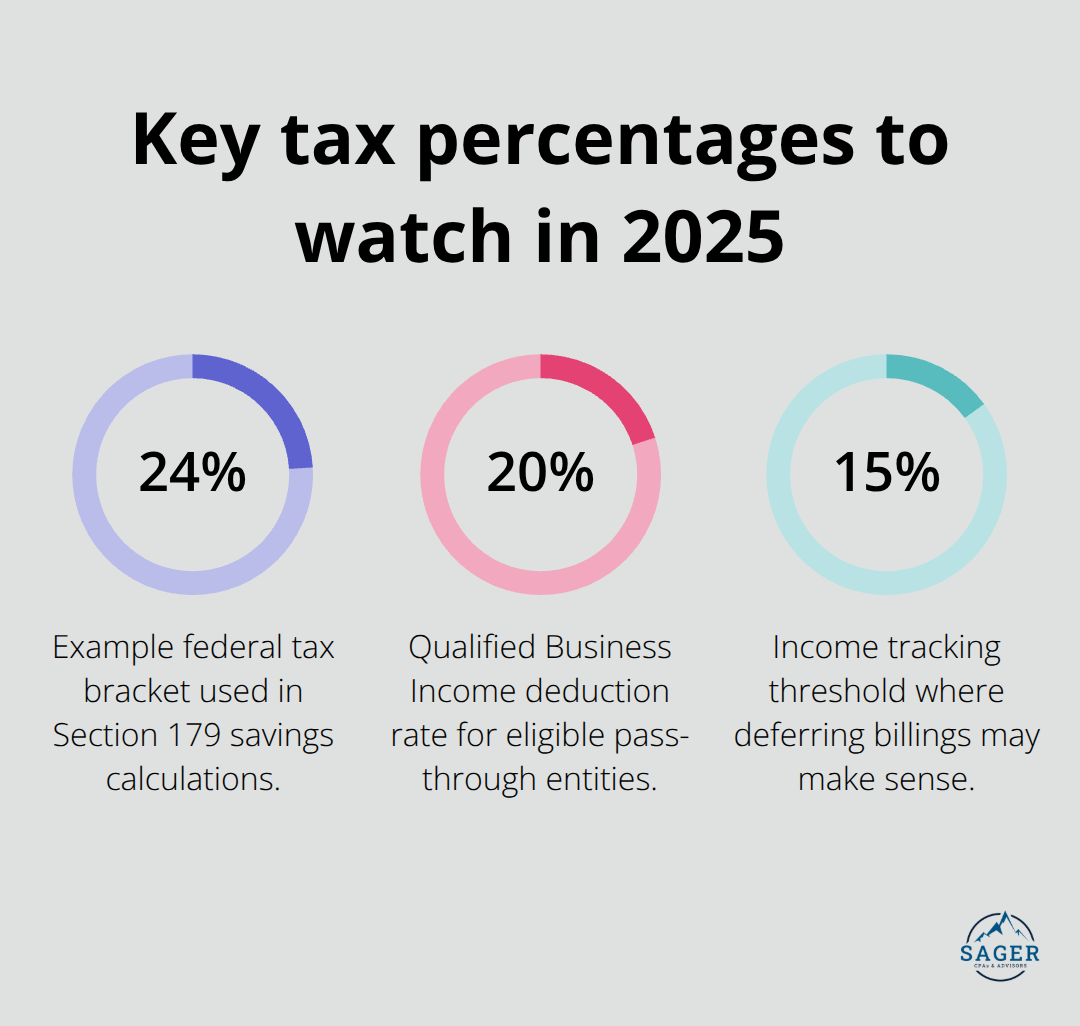
The mechanics require discipline: in September, you project your year-end income based on actual results through August, then identify whether deferring income or accelerating deductions makes sense. If income tracks 15% above projections, defer client billings or service delivery to January. If you fall below projections, pull forward planned equipment purchases. Quarterly estimated tax payments adjust based on this modeling, preventing underpayment penalties while optimizing your cash position. Most business owners skip this entirely and pay estimated taxes based on last year’s numbers, which guarantees either overpayment or underpayment depending on whether this year is stronger or weaker.
Deductions and credits operate differently but deliver equally powerful results when captured systematically. The R&D tax credit rewards companies that invest in product development or technological innovation, directly reducing tax liability as a percentage of qualified research expenses. Manufacturing firms often overlook this entirely despite spending 10-15% of revenue on qualifying activities. Work Opportunity Tax Credit reduces payroll taxes for hiring employees from targeted groups, yet requires proper documentation at hire time-if you miss the filing window, the credit disappears.
Retirement plan contributions offer immediate tax deductions while building personal wealth: a Solo 401(k) allows contributions up to $70,000 in 2025 plus catch-up amounts for those 50 and older, creating substantial tax relief for profitable service businesses. A 50-year-old business owner earning $300,000 can contribute $77,500 to a Solo 401(k), directly reducing taxable income and deferring taxes on that amount. Defined benefit plans offer even higher contribution limits for owners in their 50s with stable income, sometimes exceeding $80,000 annually. Health Savings Accounts connected to high-deductible health plans allow $4,300 in individual contributions for 2025, reducing current taxable income while preserving funds for future medical expenses. The trap most businesses fall into involves making these contributions after year-end when options are limited. January planning reveals exactly how much contribution room exists based on actual income, allowing you to structure the optimal retirement vehicle before the year closes. These decisions set the stage for more advanced strategies that push tax optimization even further.
When quarterly planning and strategic timing have squeezed savings from standard deductions and credits, three advanced strategies separate businesses that pay their fair share from those that genuinely optimize their tax position.
Cost segregation studies break down buildings into components with shorter useful lives, accelerating depreciation on real property and creating immediate deductions that offset operating income. A business that purchased an office building for $2 million can typically identify $400,000 to $600,000 in personal property and land improvements eligible for accelerated depreciation, generating $100,000 to $150,000 in tax savings in year one alone.
This strategy works best when implemented within three years of property acquisition, though amended returns allow retroactive application. The investment in a professional study typically costs $8,000 to $15,000-an expense that pays for itself through tax savings in the first year.
Pass-through entity taxation structures your business to avoid double taxation while maximizing the 20% Qualified Business Income deduction available under current tax law. An S-Corp election transforms how you pay yourself: instead of taking all profits as self-employment income subject to 15.3% self-employment tax, you pay yourself a reasonable W-2 salary and take remaining profits as distributions taxed only at income tax rates.
A service business generating $400,000 in net profit might pay a $200,000 reasonable salary and take $200,000 in distributions, saving roughly $15,300 in self-employment taxes annually compared to a sole proprietorship. The IRS scrutinizes what constitutes reasonable salary, but guidance from the National Association of the Self-Employed and case law support salary levels that reflect actual work performed.
Entity structure optimization extends further through layered approaches: an S-Corp holding an operating business inside an LLC that owns real estate creates tax efficiency across multiple income streams. The 20% QBI deduction phases out for single filers above $197,300 and married filing jointly above $394,600 in 2025 (according to IRS thresholds), but proper entity structuring preserves access to this deduction even as income grows.
These structures require meticulous payroll documentation and quarterly estimated tax adjustments, but the tax savings justify the administrative complexity.
Cost segregation studies must start before year-end to deliver deductions in the current tax year, yet the actual study takes 4 to 8 weeks. S-Corp elections require filing by March 15 of the year following the election to be effective for that tax year, meaning a business deciding in October needs to plan for the following year or miss the window entirely.
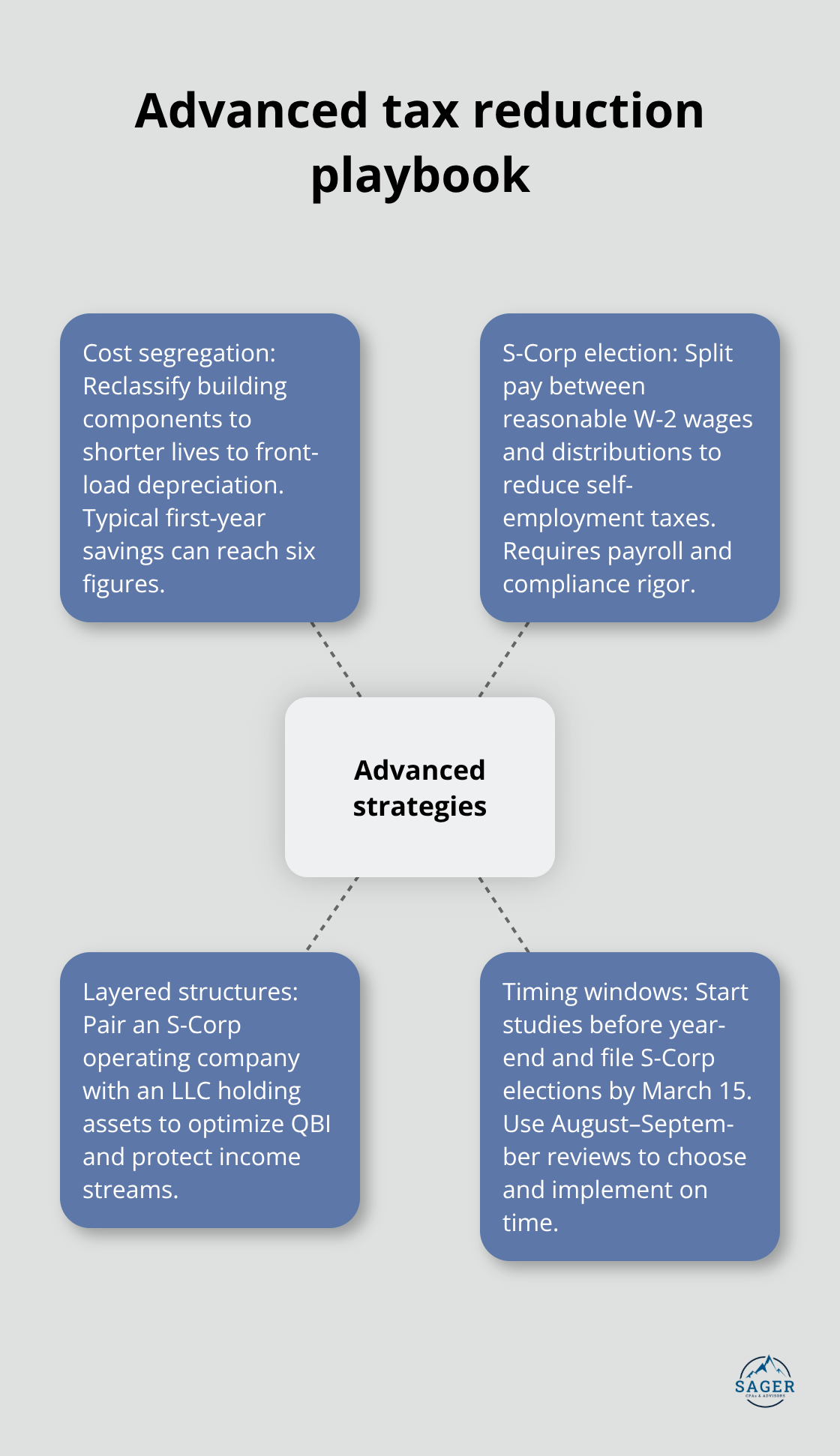
QBI deduction optimization depends on business structure, income level, and W-2 wages paid, making mid-year strategy reviews essential rather than year-end scrambles. Analyzing your situation in August or September determines which advanced strategies apply, leaving adequate time to implement without rushing into decisions that create compliance headaches.
Proactive tax optimization for businesses transforms how you manage profits and cash flow. The difference between reactive tax filing and strategic planning isn’t academic-it’s thousands of dollars annually. Businesses that plan quarterly, model decisions before committing, and implement advanced strategies consistently reduce effective tax rates by 30–50% in the first year compared to those waiting until April.
Tax planning happens throughout the year, not during tax season. Quarterly reviews catch opportunities while you still control the outcome, strategic timing of income and expenses shifts your tax bracket, and systematic deduction capture surfaces money you already earned but hadn’t claimed. Entity structure optimization eliminates unnecessary self-employment taxes, cost segregation accelerates real property deductions, and these concrete strategies work across industries and business sizes.
We at Sager CPA help businesses reduce tax liability through expert financial management and strategic tax planning tailored to your specific situation. Schedule a consultation with us to create a personalized financial strategy that reduces your tax burden and strengthens your bottom line.




Phone: (208) 939-6029
Email: info@sager.cpa
Privacy Policy | Terms and Conditions | Powered by Cajabra
At Sager CPAs & Advisors, we understand that you want a partner and an advocate who will provide you with proactive solutions and ideas.
The problem is you may feel uncertain, overwhelmed, or disorganized about the future of your business or wealth accumulation.
We believe that even the most successful business owners can benefit from professional financial advice and guidance, and everyone deserves to understand their financial situation.
Understanding finances and running a successful business takes time, education, and sometimes the help of professionals. It’s okay not to know everything from the start.
This is why we are passionate about taking time with our clients year round to listen, work through solutions, and provide proactive guidance so that you feel heard, valued, and understood by a team of experts who are invested in your success.
Here’s how we do it:
Schedule a consultation today. And, in the meantime, download our free guide, “5 Conversations You Should Be Having With Your CPA” to understand how tax planning and business strategy both save and make you money.