
Tax Planning Efficiency: Streamline Your Tax Strategy for Better Outcomes
Streamline your tax strategy with proven planning efficiency methods. Reduce tax liability and optimize deductions for better financial outcomes.
Most business owners spend years building their companies but never spend a day planning their exit. We at Sager CPA see this pattern constantly, and it’s a costly mistake.
Owner retirement readiness requires more than hope-it demands a concrete strategy. The difference between a confident retirement and financial stress often comes down to planning you do today.
One in five small business owners has zero retirement savings. Among those who do save, the majority have accumulated less than $50,000-a figure that sits far below the roughly $1.2 million target commonly cited for someone earning about $120,000 annually. This gap between where owners are and where they need to be reveals a systemic problem: most business owners operate without any formal retirement strategy.
The numbers extend beyond individual finances. Only about 34% of small businesses offer a retirement plan to their employees, with cost and complexity cited as the primary barriers. Roughly 55 million Americans work for small businesses and have no access to employer-sponsored retirement plans. When owners skip retirement planning for themselves, they often neglect their teams as well.
This isn’t laziness or oversight. When you run a company, your attention goes to revenue, employees, and daily operations. Retirement planning feels abstract until it suddenly becomes urgent. The pattern repeats across countless business owners: focus shifts to what demands immediate attention, and long-term financial security takes a back seat.
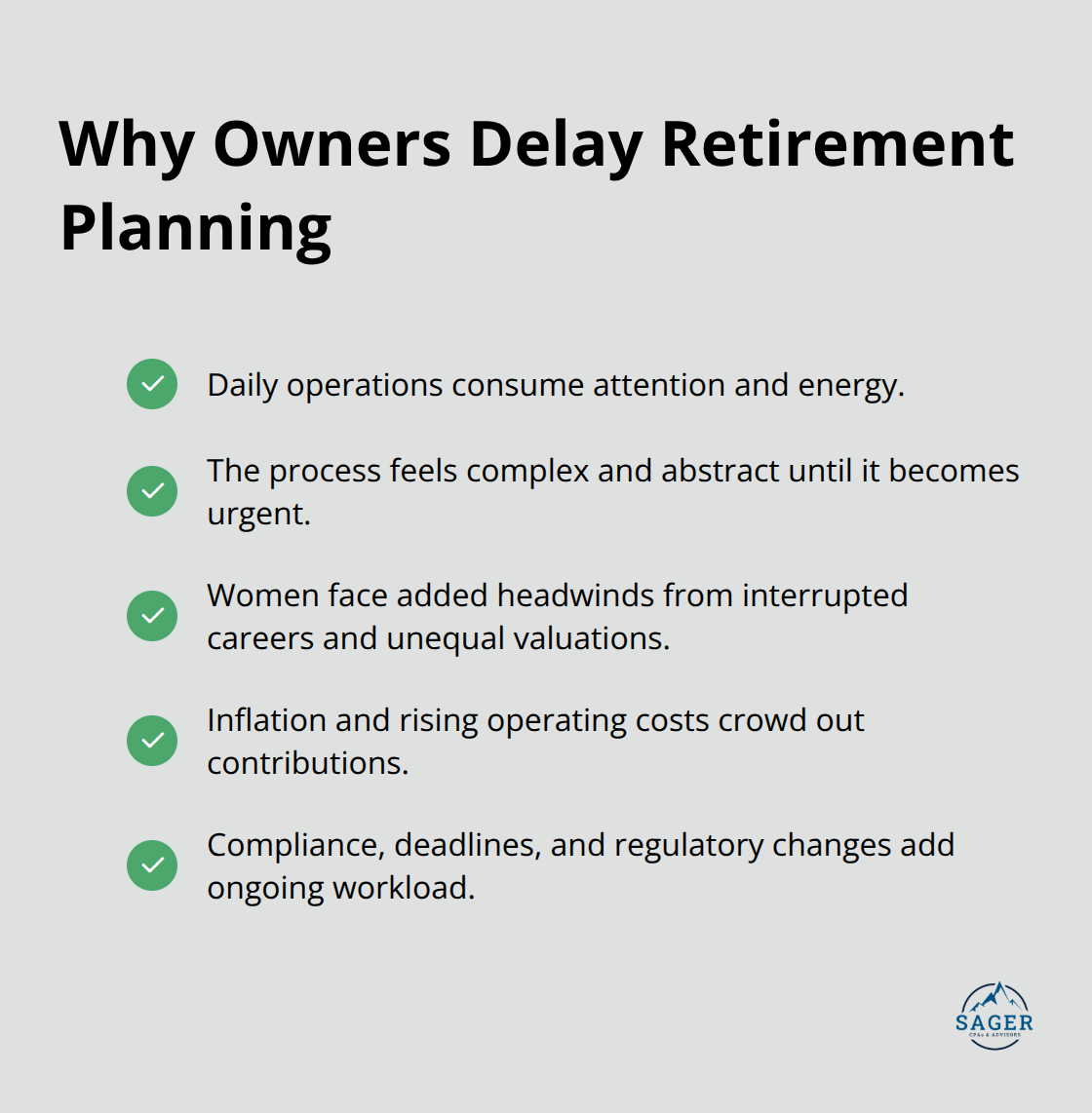
Women in small business face an additional barrier-they’re twice as likely as men to have no retirement savings, often due to interrupted career paths and unequal business valuations. Inflation and rising operating costs amplify owner concerns, making the thought of adding retirement contributions feel impossible. Time compounds the problem. Implementing and maintaining a retirement plan requires ongoing attention to compliance, contribution deadlines, and regulatory changes. For a solo founder juggling everything, this feels like one more burden.
Many owners make a critical mistake: they conflate business growth does not guarantee personal wealth accumulation. A thriving company doesn’t automatically translate into retirement security. Most owners keep their net worth locked inside the business, leaving them vulnerable if the company faces economic downturns or if a sale falls through.
Businesses without succession or exit strategies face operational chaos during transitions, which typically reduces the sale value by 20% to 40% depending on the industry. This vulnerability compounds when owners delay planning because they feel overwhelmed by options. Working with advisors who understand tax exposure and exit strategy can transform how you approach this transition.
The solution isn’t to add more to your plate. It’s to establish a clear plan now and identify which retirement strategy fits your business size and employee needs. Working with advisors who can handle the administration and compliance allows you to focus on operations while your retirement readiness strengthens in the background.
The next step requires understanding what a solid retirement plan actually contains-and how to build one that works for your specific situation.
Your retirement plan means nothing without three foundational pillars working together. Most business owners focus on one and ignore the others, which explains why even owners with substantial businesses end up financially unprepared for retirement. Owners who built million-dollar companies often structure their personal finances in ways that create massive tax liability and liquidity problems at exit.
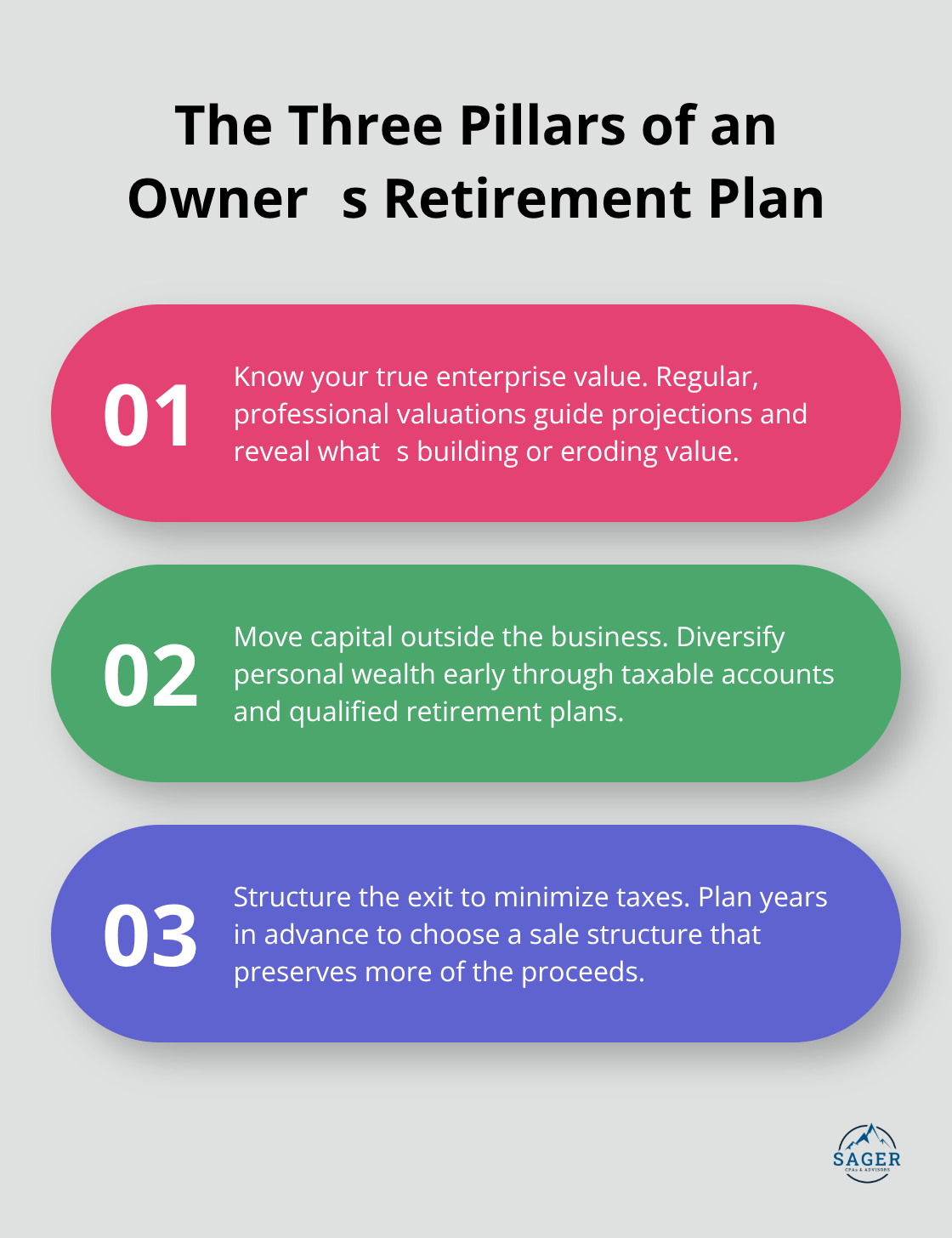
Business valuation isn’t a one-time event you conduct when you decide to sell. It shapes every retirement decision you make. Many owners guess their business value based on revenue multiples they heard at industry conferences, but that approach ignores the specific factors that determine what a buyer will actually pay.
Revenue multiples for small businesses typically range from 0.5x to 3x annual revenue depending on industry, profitability, and customer concentration. A service business with clients concentrated among three major accounts carries far less value than one with diversified revenue streams, even if both generate identical revenue. A business dependent on the owner’s personal relationships has significantly lower enterprise value than one with established systems and management depth.
Get a professional valuation every two to three years, not just when you plan to exit. This gives you real numbers to work with for retirement projections instead of speculation. More importantly, it reveals what factors are eroding or building value so you can address them now. A buyer will eventually conduct their own valuation, and if your internal assessment is wildly off, you’ll face a rude shock during negotiations.
Locking your entire net worth inside the business creates a single point of failure. If the sale falls through, the company faces economic challenges, or unexpected events disrupt operations, your retirement disappears with it. Start moving capital out of the business while you’re still operating profitably.
This serves two purposes: it diversifies your personal wealth and it demonstrates to potential buyers that the business can generate profits independent of owner extraction. Open a taxable investment account and move capital there regularly, or maximize retirement contributions through a Solo 401(k) if you’re self-employed, a SEP IRA with up to 25% of net self-employment income, or a SIMPLE IRA if you have employees.
For self-employed individuals in 2025, a Solo 401(k) allows employee contributions up to $23,500 plus a $7,500 catch-up contribution, with employer contributions reaching up to 25% of net self-employment income and a combined maximum of $70,000 or $77,500 with catch-up. Health Savings Accounts offer triple tax advantages with 2025 limits at $4,300 for self-only coverage and $8,550 for family coverage, plus a $1,000 catch-up for those 55 and older, making them powerful retirement-health savings tools beyond medical expenses alone.
The largest financial event of your life shouldn’t become a tax disaster. How you structure the sale determines whether you keep 60% of proceeds or 80%. An asset sale versus a stock sale carries completely different tax consequences.
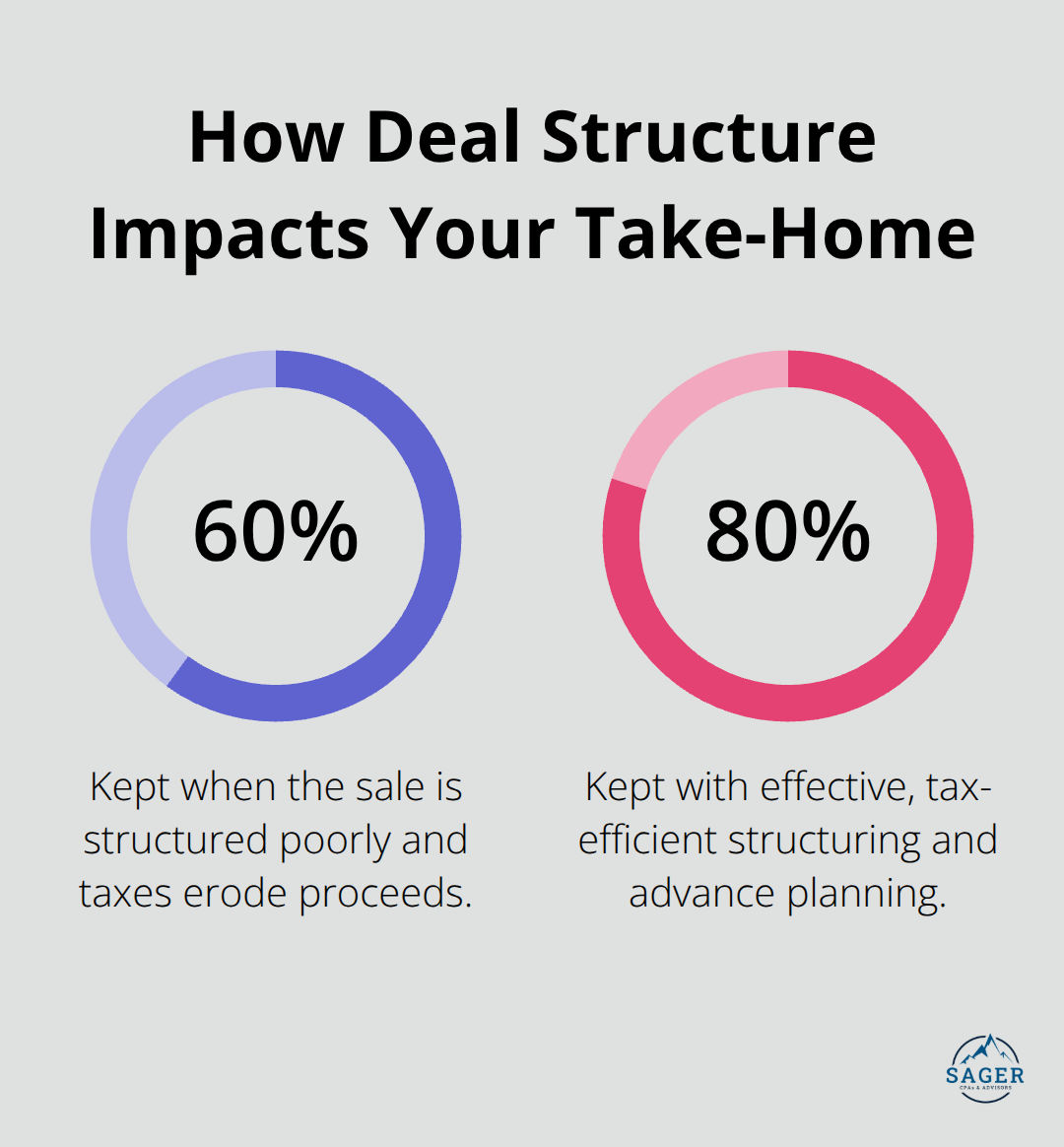
A buyer paying $2 million for your business might result in you netting $1.2 million after federal taxes, state taxes, and self-employment taxes if the structure is wrong, versus potentially $1.6 million with proper planning. Installment sales, earnouts, and employment agreements all affect your tax position. If you’re selling to a family member, the structure matters even more because it determines whether you’re gifting value or receiving fair market value.
Work with advisors who understand both the business side and the tax side of exits before you start negotiations. The time to plan this is years in advance, not weeks before closing. This preparation directly influences the next critical decision: determining when you actually want to step away and what that timeline requires from your business operations.
The moment you decide to retire shapes everything that follows, yet most owners never formally make that decision. They drift toward retirement when health fails, energy depletes, or a buyer appears unexpectedly. We at Sager CPA have watched owners who could have sold at peak valuation wait three years too long and watch their business value decline by 30 percent due to market shifts or management gaps.
Your ideal retirement age isn’t arbitrary-it’s a financial target that determines how aggressively you need to build value, how much capital to extract annually, and when succession planning becomes urgent. If you want to retire at 60, you have a completely different exit timeline than someone targeting 70. Starting at 55 with a ten-year horizon gives you time to systematically increase profitability, document operational systems, and attract serious buyers. Starting at 60 with five years left requires aggressive action immediately.
A 2022 MassMutual study indicates that only 8 percent of business owners have a completed written succession plan. This delay costs money. A business with clear management depth and documented systems commands a premium valuation-typically 20 to 40 percent higher than one dependent on the owner. If you’re five years from your target retirement date and haven’t identified a successor or buyer, you’re already behind.
Succession within your family or to a key employee requires years of preparation, not months. You need to identify who has the capability and willingness to lead, then create a structured development plan that includes mentoring, gradual responsibility increases, and transparent conversations about compensation and ownership transfer. An installment sale to a family member might involve transferring 20 percent ownership annually over five years, with formal documentation of valuation and terms.
A sale to a third party demands different preparation: you need clean financial records, documented client relationships, established management systems, and ideally three to five years of consistent or growing profitability. A buyer evaluating your business will scrutinize whether revenue depends on your personal relationships or whether the business generates profits independent of your involvement. If clients leave when you leave, the valuation drops dramatically. A sale to a third party typically requires two years of preparation: the first year focuses on increasing profitability and cleaning up operational loose ends, the second year involves engaging a business broker, preparing financial documentation, and vetting potential buyers.
The tax structure of your exit-whether structured as an asset sale, stock sale, or something hybrid-determines whether you keep 60 cents of every dollar or 80 cents. This decision can’t wait until closing day. Work with advisors who understand both business valuation and tax law years in advance, not weeks before you expect offers.
Owner retirement readiness demands three concrete actions you must take today. First, obtain a professional business valuation to replace guesswork with real numbers. Second, start moving capital outside your business through retirement contributions or taxable investments so your net worth doesn’t depend entirely on a future sale. Third, decide your target retirement age and work backward to determine what needs to happen operationally and financially to make that timeline realistic.
Most business owners delay these steps because complexity overwhelms them. Solo 401(k)s, SEP IRAs, SIMPLE IRAs, business valuations, succession planning, and tax structuring all demand attention, yet attempting this alone wastes time and creates costly mistakes. A business owner earning $120,000 annually who structures their exit poorly might lose $400,000 in unnecessary taxes compared to one who planned strategically (the difference between keeping 60 cents or 80 cents of every dollar).
Working with advisors who understand both business operations and tax law transforms your readiness. They identify opportunities you’d miss alone, coordinate your retirement contributions to maximize deductions, structure your exit to minimize tax liability, and handle compliance so you stay focused on operations. Schedule a consultation with Sager CPA to assess your current position, identify gaps in your retirement plan, and build a timeline that works for your specific situation.




Phone: (208) 939-6029
Email: info@sager.cpa
Privacy Policy | Terms and Conditions | Powered by Cajabra
At Sager CPAs & Advisors, we understand that you want a partner and an advocate who will provide you with proactive solutions and ideas.
The problem is you may feel uncertain, overwhelmed, or disorganized about the future of your business or wealth accumulation.
We believe that even the most successful business owners can benefit from professional financial advice and guidance, and everyone deserves to understand their financial situation.
Understanding finances and running a successful business takes time, education, and sometimes the help of professionals. It’s okay not to know everything from the start.
This is why we are passionate about taking time with our clients year round to listen, work through solutions, and provide proactive guidance so that you feel heard, valued, and understood by a team of experts who are invested in your success.
Here’s how we do it:
Schedule a consultation today. And, in the meantime, download our free guide, “5 Conversations You Should Be Having With Your CPA” to understand how tax planning and business strategy both save and make you money.