
Startup Financial Risk Planning: Anticipate and Mitigate for Growth
Anticipate financial risks in your startup with practical strategies to protect cash flow, manage debt, and build sustainable growth.
Most startups fail because they don’t plan for financial risks. Cash flow problems, funding gaps, and market shifts can derail even promising businesses before they gain traction.
At Sager CPA, we’ve seen firsthand how startups financial risk planning separates companies that survive from those that don’t. The good news is that building a solid financial risk plan is entirely within your control.
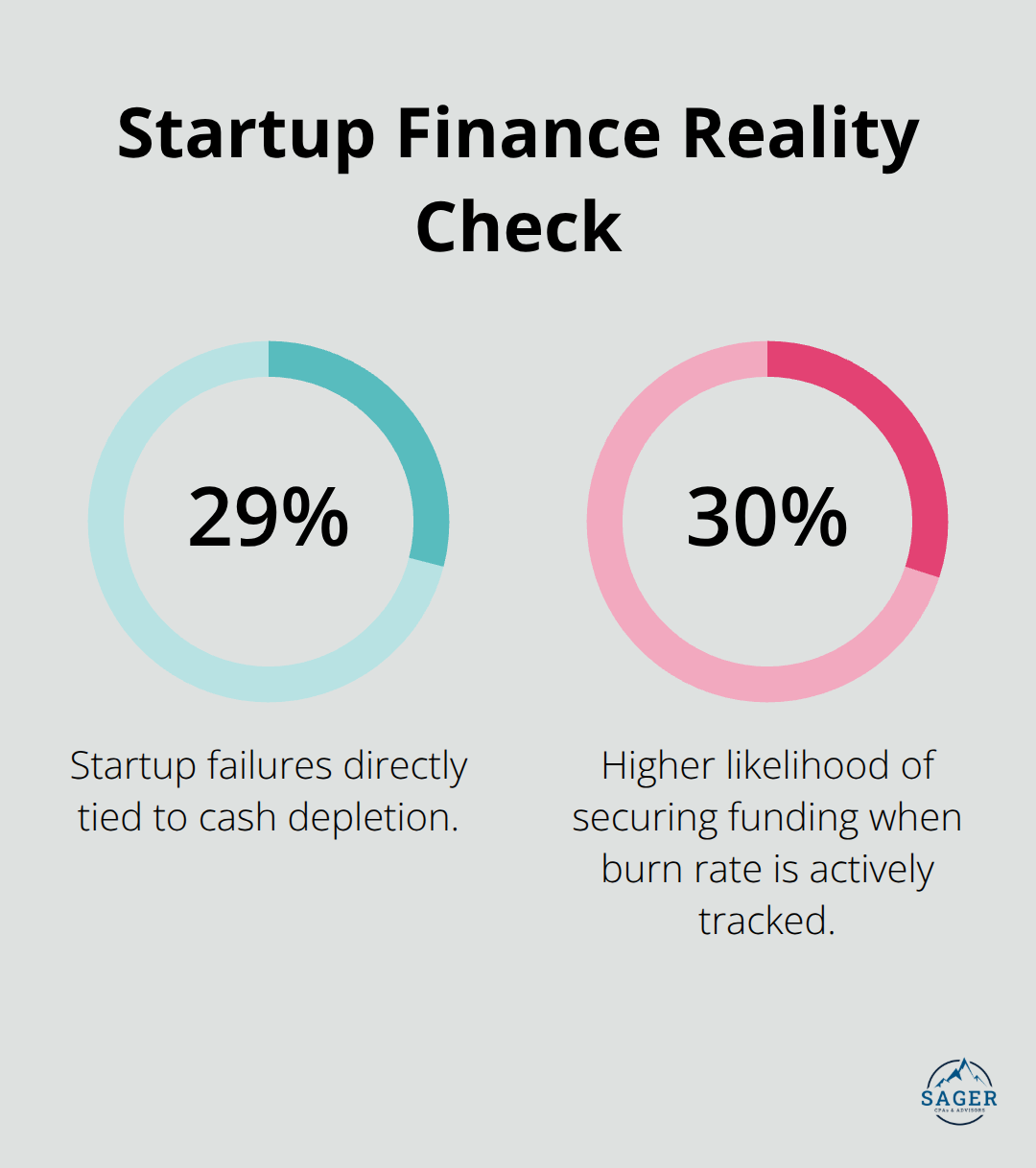
Cash flow problems rank as the primary killer of early-stage companies, with about 29% of startup failures directly tied to cash depletion. This isn’t a theoretical concern-it’s the difference between meeting payroll next month and scrambling for emergency funding. The challenge intensifies because startups typically operate with razor-thin margins, meaning a single delayed customer payment or unexpected expense can spiral into a liquidity crisis. Many founders underestimate how quickly cash burns through operational costs, especially when revenue takes longer to materialize than projected.
You need to track not just whether your business is profitable on paper, but whether you actually have cash in the bank to survive the next 90 days.
Your burn rate-how much cash you spend monthly-directly determines your runway, which is calculated by dividing available cash by average monthly burn. If you’re burning $50,000 monthly with $300,000 in the bank, you have roughly six months before funds run dry. This timeline becomes your fundraising deadline, not a suggestion. Most founders discover this reality too late, after they’ve already committed to hiring, office leases, or marketing campaigns. According to data from 2024, seed-to-Series A conversion rates fell below 20%, meaning most startups won’t secure their next funding round when expected. Add a 20-30% buffer to your runway calculations for slower-than-expected fundraising or revenue. This contingency planning prevents forced decisions made under extreme pressure.
Inadequate funding isn’t just about having too little capital; it’s about having capital arrive at the wrong time. A Series A that closes three months late forces you to cut staff, pause marketing, or abandon growth initiatives that were essential to your strategy. Yet many startups rely on a single funding source, leaving them vulnerable if that investor pulls back or faces their own capital constraints. The startup ecosystem remains active, but economic shifts can dry up funding overnight. You need a diversified funding approach that includes personal investment, angel networks, and strategic partnerships, not just venture capital. This diversity buys you time and optionality when primary funding sources become unavailable.
Market conditions shift faster than most startups adjust their financial plans. A new competitor entering your space, regulatory changes affecting your industry, or broader economic downturns can evaporate demand for your product overnight. Your financial risk plan must account for scenarios where customer acquisition slows, churn increases, or pricing power disappears. Startups that actively track burn rate are 30% more likely to secure funding, not because investors like watching you spend money, but because disciplined tracking signals operational control. This means building financial models with multiple scenarios-best case, worst case, and most likely case-so you’re not blindsided when reality diverges from your original plan.
The risks outlined above share one common thread: they all accelerate when you lack visibility into your financial position. Founders who operate without clear cash flow forecasts, expense tracking, or scenario planning stumble into crises rather than navigate around them. The data supports this reality. Startups that actively monitor their financial metrics catch problems early, when options still exist. Those that wait until the bank account runs low face impossible choices. Understanding these threats isn’t about pessimism-it’s about building the operational discipline that separates survivors from casualties. The next section shows you exactly how to construct a financial risk plan that transforms these threats into manageable challenges.
Financial risk planning does more than help you avoid disasters-it fundamentally changes how you operate and how investors perceive your startup. The moment you build scenario plans and establish monitoring systems, you shift from reactive firefighting to proactive management. This distinction matters enormously because startups with formal financial risk frameworks make faster, better decisions when pressure increases. A founder operating without contingency plans faces a cash shortage and panics, potentially cutting salaries or abandoning customer acquisition simultaneously. A founder with scenario modeling already knows which expense categories to trim first, which revenue initiatives to preserve, and what the financial impact looks like under different severity levels.
This preparation compresses decision-making from days to hours, which directly translates to better outcomes. When your team knows in advance that if churn exceeds 8% monthly you’ll reduce marketing spend by 30% while protecting engineering headcount, you execute that plan cleanly rather than debate it during a crisis. The operational continuity you gain isn’t theoretical-it’s the difference between surviving a three-month revenue dip and collapsing under it.
Investors notice this discipline immediately. Founders who present financial models with clearly documented assumptions, multiple scenarios, and transparent burn-rate tracking project competence and control. Startups that actively track burn rate are more likely to secure funding because this practice signals operational maturity to investors evaluating risk. Seed-stage investors especially scrutinize cash runway calculations and contingency planning because they know that capital efficiency determines whether their investment survives long enough to reach product-market fit.
When you walk into a fundraising meeting with detailed cash flow forecasts, worst-case scenario planning, and a clear explanation of your contingency triggers, you eliminate a major source of investor skepticism. Conversely, founders who offer vague runway estimates or haven’t modeled what happens if customer acquisition slows by 40% appear unprepared. This credibility gap costs real capital-investors either demand larger equity stakes to compensate for perceived risk or pass entirely. A robust financial risk management plan addresses this directly by demonstrating that you’ve thought through the threats and have predetermined responses.
This isn’t about impressing investors with spreadsheet sophistication; it’s about proving that you understand your business deeply enough to manage uncertainty without external rescue. Founders who transition from intuitive financial management to disciplined risk planning with documented assumptions and scenario analysis transform their investor conversations entirely. The shift signals that you’ve moved beyond hope-based planning to evidence-based strategy. Your next step involves translating this understanding into concrete action-which means conducting a comprehensive assessment of your specific financial vulnerabilities and building the contingency plans that will protect your startup when conditions deteriorate.
Start by mapping every financial risk specific to your business, not generic startup risks. This assessment requires you to examine three categories: operational risks tied to your cost structure, revenue risks connected to customer concentration and market demand, and external risks from economic conditions or regulatory changes.
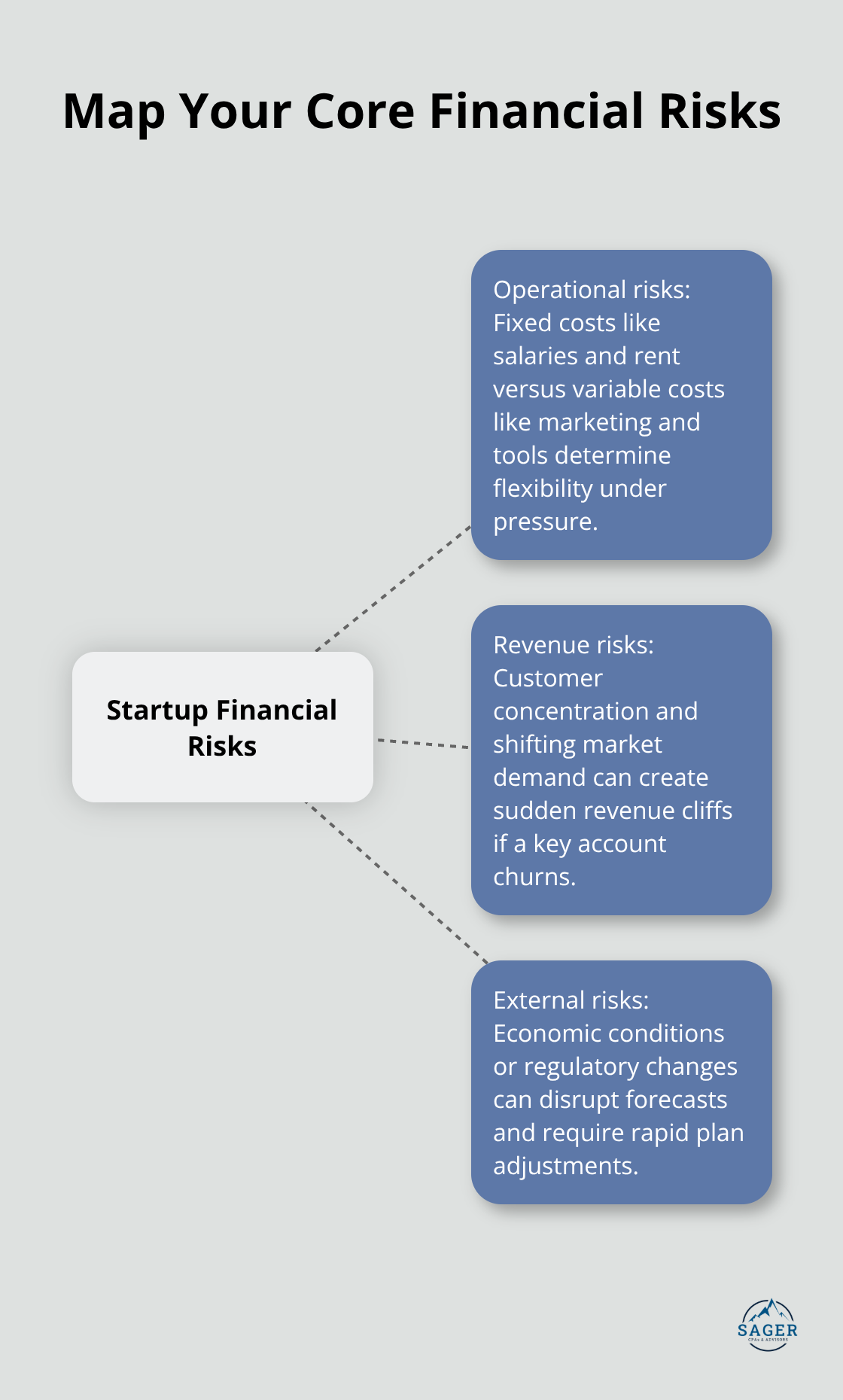
For operational risks, calculate what percentage of your monthly cost structure and flexibility comes from fixed costs like salaries and rent versus variable costs like marketing and tools. If your burn is heavily weighted toward fixed costs, you have limited flexibility when revenue drops-you’ll struggle to cut expenses fast enough. If a significant portion is variable, you can adjust spending more nimbly. This distinction determines how quickly you can respond to financial pressure without destroying your business. Next, identify your customer concentration: if one customer represents more than 20% of revenue, that relationship is a financial risk because losing it creates an immediate revenue cliff. Map your funding sources too. Relying entirely on personal savings or a single investor creates dependency risk that leaves you vulnerable to circumstances beyond your control.
Document the assumptions underlying your financial model-your average customer acquisition cost, expected churn rate, sales cycle length-because these financial assumptions in startup projections drive your projections and need stress-testing. Most founders build financial models on optimistic assumptions without questioning whether those numbers reflect reality. Your acquisition cost might be $500 per customer, but what if it actually runs $750 once you account for failed campaigns and sales overhead? Your churn rate might be 3% monthly, but what if market conditions push it to 6%? At this stage, you’re not creating polished reports; you’re identifying where your startup is genuinely vulnerable so you can build protections around those specific weaknesses.
Once you’ve identified your risks, construct three distinct financial scenarios: a most-likely case based on your current trajectory, a best-case scenario where customer acquisition accelerates and churn drops, and a worst-case scenario where revenue declines 30-40% and major expenses hit simultaneously. For the worst-case scenario, model what happens to your runway if you lose your largest customer, if fundraising delays by three months, or if a key vendor increases prices 25%. This exercise forces you to confront uncomfortable possibilities before they occur.
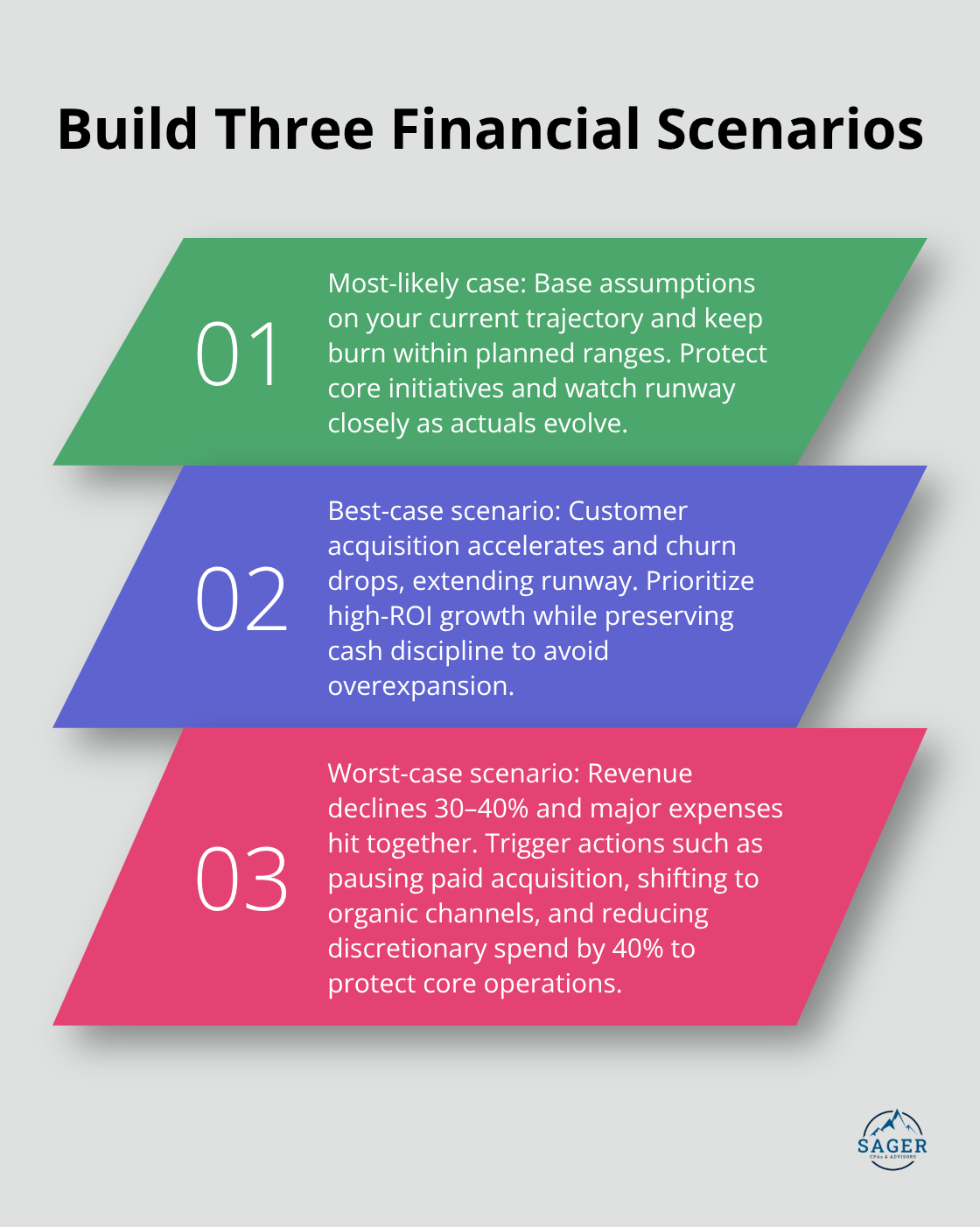
Then establish specific trigger points: if your monthly churn exceeds 8%, you’ll pause paid acquisition and shift to organic channels. If cash drops below three months of runway, you’ll reduce discretionary spending by 40%. If Series A fundraising extends beyond six months, you’ll cut non-essential hires. These triggers transform scenarios from hypothetical exercises into action plans your team can execute without debate during high-stress periods.
Monitor your core metrics weekly: cash balance, burn rate, monthly recurring revenue, customer acquisition cost, and churn rate. Weekly monitoring catches problems within days rather than weeks, giving you time to adjust before your situation becomes critical. Most startups monitor financials monthly, which means a revenue drop that occurs in week two stays hidden until month-end review, eating up 75% of your response window. Set target ranges for each metric-your burn rate should stay within 10% of forecast, your churn below 5% monthly-and establish clear escalation procedures when actuals diverge from targets. This cadence combined with predetermined contingency plans transforms financial risk management from an abstract exercise into operational discipline that protects your startup when uncertainty strikes.
Financial risk planning isn’t optional for startups that want to survive beyond year two. The frameworks and monitoring systems outlined in this guide transform abstract threats into manageable challenges with predetermined responses. Startups that build scenario plans, track metrics weekly, and establish trigger points for contingency actions operate with operational control that investors recognize and reward.
About 29% of startups fail due to cash depletion, and many of those failures were preventable through disciplined financial planning. A founder who discovers a cash shortage with two months of runway remaining faces impossible choices: cut staff aggressively, abandon growth initiatives, or accept unfavorable funding terms. A founder who identified that same risk six months earlier through scenario modeling has time to adjust spending, accelerate revenue initiatives, or secure bridge funding on reasonable terms.
Starting your financial risk plan today prevents the costly scrambling that derails most startups. You don’t need perfect forecasts or sophisticated financial models to begin-document your assumptions, map your vulnerabilities, build three scenarios, and commit to weekly metric reviews. Contact Sager CPA to strengthen your financial foundation and build the risk planning framework that protects your startup’s future.




Phone: (208) 939-6029
Email: info@sager.cpa
Privacy Policy | Terms and Conditions | Powered by Cajabra
At Sager CPAs & Advisors, we understand that you want a partner and an advocate who will provide you with proactive solutions and ideas.
The problem is you may feel uncertain, overwhelmed, or disorganized about the future of your business or wealth accumulation.
We believe that even the most successful business owners can benefit from professional financial advice and guidance, and everyone deserves to understand their financial situation.
Understanding finances and running a successful business takes time, education, and sometimes the help of professionals. It’s okay not to know everything from the start.
This is why we are passionate about taking time with our clients year round to listen, work through solutions, and provide proactive guidance so that you feel heard, valued, and understood by a team of experts who are invested in your success.
Here’s how we do it:
Schedule a consultation today. And, in the meantime, download our free guide, “5 Conversations You Should Be Having With Your CPA” to understand how tax planning and business strategy both save and make you money.