
Tax Planning Efficiency: Streamline Your Tax Strategy for Better Outcomes
Streamline your tax strategy with proven planning efficiency methods. Reduce tax liability and optimize deductions for better financial outcomes.
Most small business owners know they need a marketing strategy, but they’re not sure where to start. The gap between having a vague idea and executing a good marketing strategy for small business is where most companies get stuck.
At Sager CPA, we’ve worked with hundreds of small business owners who transformed their marketing results by following a structured approach. This guide walks you through the exact framework that works.
Your marketing strategy fails the moment you try to appeal to everyone. We’ve seen countless small business owners waste thousands on ads that reach the wrong people because they never took time to define their actual customer. Consumer segmentation systems enable more precise identification and targeting of potential customers. If you sell accounting services to freelancers in your city, your target isn’t just anyone who needs an accountant. It’s someone aged 28 to 45, earning between $50,000 and $150,000, working independently, and struggling with tax complexity. That specificity changes everything about where you advertise, what you say, and how much you spend.
Vague goals kill marketing budgets. Instead of wanting to increase sales, set a concrete target: grow revenue from your top service line by 15% in the next 12 months. Or acquire 20 new clients in Q2. Make it measurable so you know whether your strategy worked. The Bureau of Labor Statistics tracks employment and income data that helps you understand whether your market is growing or shrinking, which directly impacts how aggressive your goals should be. If your industry is declining, a 5% growth goal might be aggressive. If it’s expanding, 20% might be realistic. Many small business owners fail here by setting goals that sound good but have no connection to their actual market conditions or current revenue. Write your goals down, assign them to specific quarters, and assign numbers to each one.
Competitive analysis doesn’t mean obsessing over your direct competitors. It means understanding the entire landscape of alternatives your customer considers. If you’re a tax preparation service, your competition includes DIY software like TurboTax, online services, and other local accountants. Look at what they charge, what they emphasize in their marketing, and where they advertise. Check their Google reviews to see what customers praise and complain about-this reveals what matters most to your market.
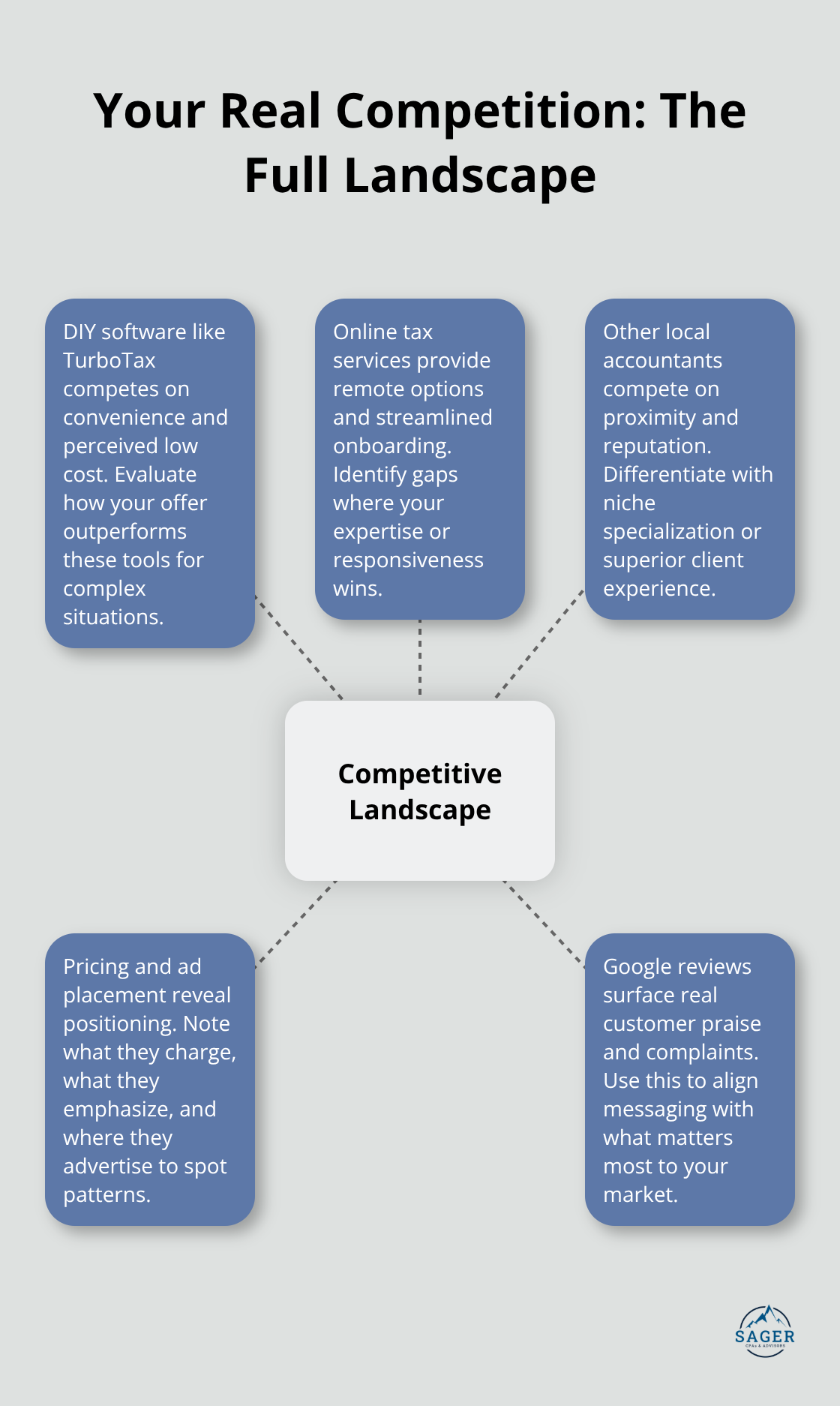
Work with a business mentor who can help you map your competitive position. Your sustainable advantage comes from finding something your competitors ignore or do poorly. Maybe they have terrible customer service, outdated technology, or they don’t serve a specific niche. That gap is where you win, and that’s what your entire marketing strategy should emphasize. Don’t try to beat them at everything. Beat them at one thing your customers actually care about.
Once you know who your customers are, what you want to achieve, and where you stand against the competition, you’re ready to build the actual foundation of your marketing strategy.
Your target audience and goals are defined. Now comes the part where most small business owners stumble: choosing the right channels and messages to reach those people. The landscape has fragmented so completely that spreading yourself thin across every platform is the fastest way to waste money and time. You need to pick where your customers actually spend their attention, then dominate those spaces instead of dabbling everywhere. Salesforce research shows that 67% of SMB leaders say community support matters to survival, which means local engagement should anchor your channel strategy.

If you’re a service business targeting local customers, Google My Business and local SEO should be non-negotiable. If you sell to professionals, LinkedIn makes sense. If you’re visual-first, Instagram or Pinterest works better than Twitter. The mistake we see constantly is small business owners choosing channels based on personal preference rather than customer behavior. You don’t advertise on TikTok because you like it. You advertise there if your target market spends significant time scrolling it. Start by identifying the two platforms where your actual customers are active, then commit real effort to those channels instead of posting sporadically across six platforms.
Your brand message is what separates you from the noise. This isn’t a tagline or logo-it’s the specific reason someone chooses you over alternatives. If you’re a tax preparation service competing against DIY software and national chains, saying you offer quality service means nothing. Saying you specialize in tax strategy for self-employed consultants earning $75,000 to $300,000 annually and you typically save clients $3,000 to $8,000 in taxes means everything. That specificity attracts the right customers and repels the wrong ones, which saves you money on ads that reach people who’ll never hire you.
Content planning follows naturally once your message is clear. You’re not creating generic blog posts about accounting tips. You’re creating content that solves specific problems for your specific audience. If your customers struggle with quarterly tax payments, write about optimizing quarterly estimated tax strategies. If they’re confused by business structure choices, explain S-corp versus LLC taxation with actual numbers. Make your content so specifically useful to your target audience that sharing it becomes natural. Track which topics drive traffic and conversions, then create more content in those areas. This isn’t theoretical-it’s the difference between content that sits ignored and content that generates actual leads and sales.
With your channels selected, your message refined, and your content strategy mapped out, you’re ready to measure what actually works and adjust accordingly.
Most small business owners measure the wrong things. They obsess over vanity metrics like social media followers or website visits while ignoring the numbers that actually predict revenue. We’ve seen business owners spend thousands on marketing channels that generate traffic but zero conversions. The problem isn’t the channel-it’s that they never defined what success looks like in measurable terms before launching.
Start with three to five core KPIs that directly reflect your strategic objectives. If you run Google Ads for your service business, track cost per lead, conversion rate from lead to client, and average client value. If you use email marketing, measure open rates, click-through rates, and revenue generated per email campaign. According to Google Analytics data, businesses that track conversion rates achieve 50% higher ROI than those tracking only traffic metrics.
Set a baseline for each metric before you spend a dollar on marketing, then review performance weekly. Most small business owners check results once a month or quarterly, which means they waste money for weeks before noticing a problem. Weekly reviews catch underperforming channels fast. Use Google Analytics with UTM codes to attribute each sale back to its source channel. This tells you exactly which marketing dollar produced which revenue, not guesses about what might be working.
Testing different approaches matters far more than perfecting one approach before launch. Run small experiments with controlled budgets instead of betting everything on one strategy. If you test email marketing, run an A/B test on subject lines across 500 subscribers before scaling to your entire list. Change one variable at a time so you know what actually caused the result.
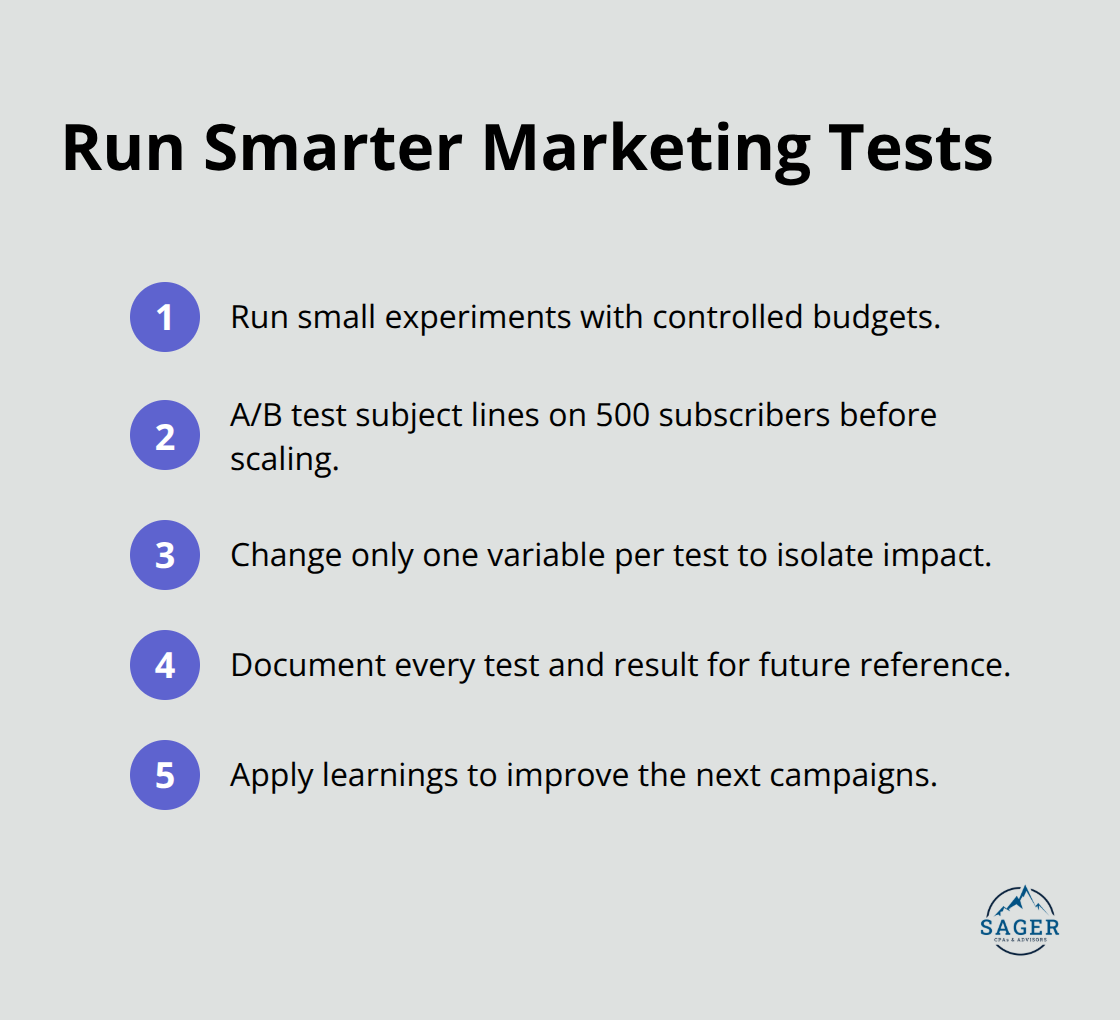
Test send times, subject line length, call-to-action placement, and email frequency. Document every test and its result. After running ten tests, you’ll have clear data about what your audience responds to. Many small business owners run one email campaign, see mediocre results, and abandon email entirely. The reality is that your first email campaign will underperform because you haven’t learned your audience yet. The second and third campaigns perform better as you apply what you learned.
Scale what works and cut what doesn’t. If a particular content topic drives more traffic and conversions than others, create more content in that category. If a specific ad audience converts better than others, increase spending toward that segment and reduce spending elsewhere.
Track your cost per acquisition by channel monthly. When one channel drops below your target cost, increase investment there. When another rises above your target, reduce or pause it. This disciplined approach prevents money from flowing to underperforming channels out of habit or preference. The channels that deliver the lowest cost per acquisition deserve your attention and budget growth.
A good marketing strategy for small business doesn’t require perfection-it requires clarity, discipline, and willingness to adjust based on what actually works. The businesses we’ve seen succeed at this don’t have bigger budgets than their competitors; they have better focus. They pick one or two channels instead of six, measure three to five metrics that matter instead of vanity numbers, and test small before scaling big.
Your next step is simple: pick one element from this framework and implement it this week. If you haven’t defined your target audience with specificity, write down exactly who your ideal customer is, what problem you solve for them, and why they’d choose you over alternatives. If you already have that clarity, audit which channels your customers actually use and commit real effort to two of them instead of dabbling across many.
The businesses that thrive understand that marketing strategy isn’t a one-time project-it’s an ongoing process of testing, learning, and refining. Review your strategy quarterly, check whether your goals still match your market conditions, test new channels when old ones plateau, and cut spending from what stops working. Schedule a consultation with Sager CPA to align your marketing investments with your overall financial strategy and ensure your growth is sustainable and profitable.



Phone: (208) 939-6029
Email: info@sager.cpa
Privacy Policy | Terms and Conditions | Powered by Cajabra
At Sager CPAs & Advisors, we understand that you want a partner and an advocate who will provide you with proactive solutions and ideas.
The problem is you may feel uncertain, overwhelmed, or disorganized about the future of your business or wealth accumulation.
We believe that even the most successful business owners can benefit from professional financial advice and guidance, and everyone deserves to understand their financial situation.
Understanding finances and running a successful business takes time, education, and sometimes the help of professionals. It’s okay not to know everything from the start.
This is why we are passionate about taking time with our clients year round to listen, work through solutions, and provide proactive guidance so that you feel heard, valued, and understood by a team of experts who are invested in your success.
Here’s how we do it:
Schedule a consultation today. And, in the meantime, download our free guide, “5 Conversations You Should Be Having With Your CPA” to understand how tax planning and business strategy both save and make you money.