
Startup Financial Risk Planning: Anticipate and Mitigate for Growth
Anticipate financial risks in your startup with practical strategies to protect cash flow, manage debt, and build sustainable growth.
Most finance business owners operate without a clear strategy, reacting to problems instead of preventing them.
At Sager CPA, we’ve seen firsthand how the right approach transforms struggling businesses into profitable ones. This guide walks you through the three essential steps: assessing where you stand, planning your growth, and executing with precision.
You cannot build a winning strategy on assumptions. Start by pulling together your actual financial statements from the last three years-income statements, balance sheets, and cash flow statements. Most business owners we work with find gaps between what they think is happening and what the numbers actually show. Your revenue might look strong on paper, but if cash isn’t flowing consistently, you have a problem that growth won’t fix.
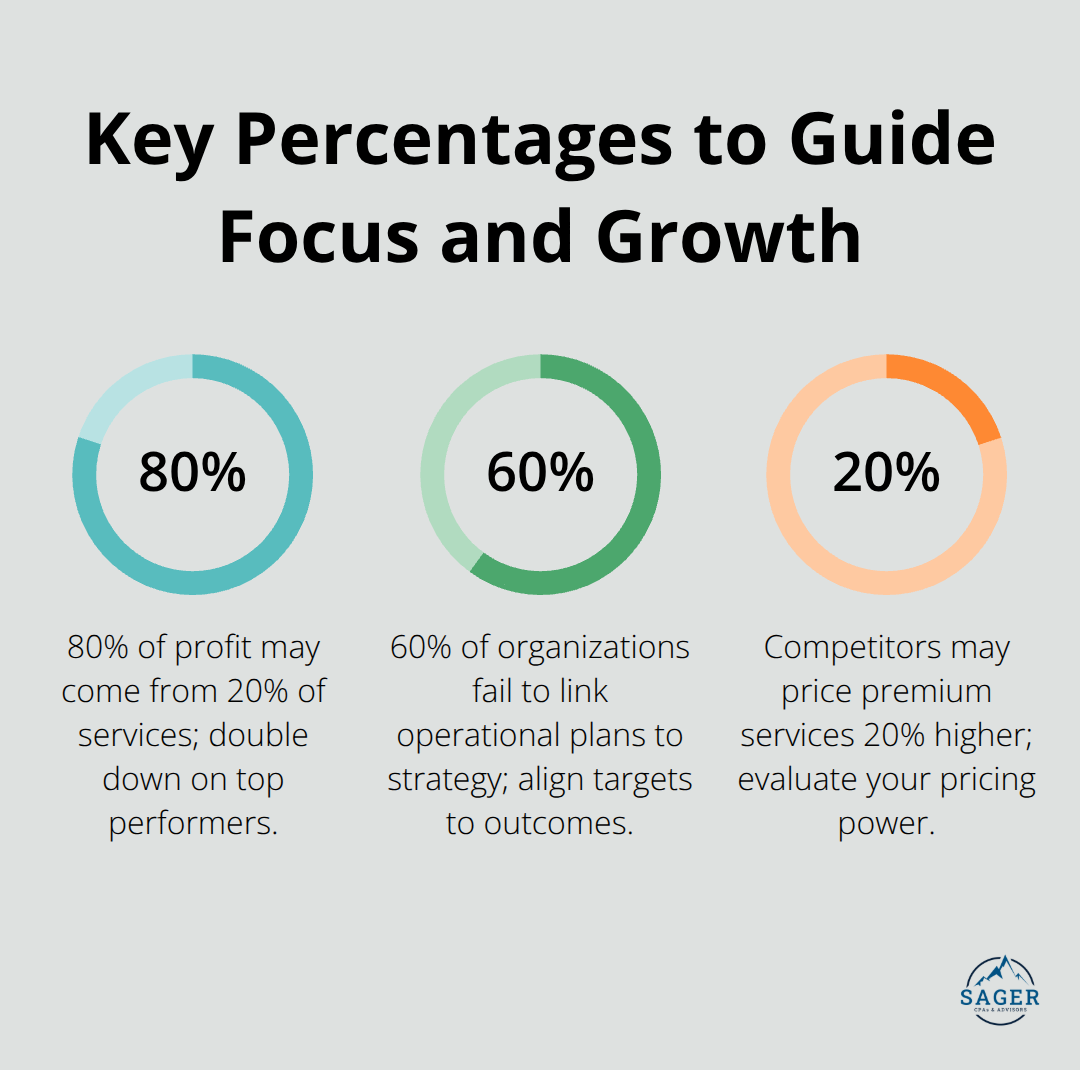
Map out your profitability by service line or product category, not just overall. You might find that 80% of your profit comes from 20% of your services, while other offerings drain resources. This clarity matters because it tells you where to focus and what to cut.
Analyze where your money comes from. Are you dependent on a handful of clients or contracts? Businesses with revenue concentrated in fewer than three major clients face significantly higher failure rates during economic downturns. Look at your gross margins, operating margins, and net profit margins over time. If margins are shrinking year over year, the cause is usually one of three things: pricing that hasn’t kept pace with costs, operational inefficiency, or service mix drift. Fix the root cause, not just the symptom.
Cash flow is where most strategies fail. Profitable businesses go bankrupt when cash dries up, and this happens more often than you’d think. Calculate your cash conversion cycle-the number of days between when you pay suppliers and when customers pay you. If you extend 45-day payment terms to clients while paying vendors in 15 days, you finance their operations.
Track your accounts receivable aging religiously. Invoices older than 60 days represent money you’ve already spent but haven’t collected. Set up a system to flag these immediately and follow up. Your working capital position also determines how much growth you can actually handle. Growing revenue 30% without managing working capital carefully will exhaust your cash reserves faster than you expect.
Understand your competitive position honestly. What are competitors charging? What services do they offer that you don’t? Are you winning on price, quality, speed, or relationships? If you can’t articulate a clear competitive advantage, you’re competing on price alone, which erodes margins.
Research your market’s growth rate. Different service sectors grow at vastly different rates. Positioning yourself in a declining market requires a different strategy than operating in one with strong growth. Collect this information now, while you have time to think clearly about it. Once you understand where you stand financially and competitively, you’re ready to move forward with a strategic plan that actually reflects your business reality.
Strategy without measurable targets is just wishful thinking. Translate your financial reality from the previous section into specific, quantified goals. If your cash conversion cycle is 60 days and drains working capital, your first goal becomes reducing it to 45 days within 12 months. If one service line carries 40% of your profit on only 15% of revenue, set a goal to grow that line by 25% annually while reducing dependency on lower-margin work. These targets need dollar amounts and deadlines, not vague aspirations.
Gartner research shows that 60% of organizations fail to link operational plans to strategy, which explains why many businesses drift without direction. Your financial targets should connect directly to the business outcomes that matter: revenue growth, margin improvement, cash flow stability, or market share gains.
Assign ownership to specific people, not committees. One person owns the cash flow improvement goal, another owns revenue growth, and a third monitors cost control. Without clear ownership, targets become suggestions rather than commitments. Review progress monthly progress reviews, not quarterly, for immediate cash flow control and expense tracking.
Accountability requires consequences. If someone misses a milestone, you need a process to understand why and adjust either the plan or the resources supporting it. Weak accountability is why many strategies fail despite good intentions.
Look beyond financial targets to identify the specific growth opportunities that emerged from your competitive analysis. If competitors charge 20% more for premium services you already deliver, that represents a pricing opportunity worth pursuing immediately. If your market grows at 8% annually but you only grow at 3%, you lose share and need to understand why. Perhaps your sales process moves too slowly, your marketing doesn’t reach the right prospects, or your service delivery doesn’t match what customers actually want.
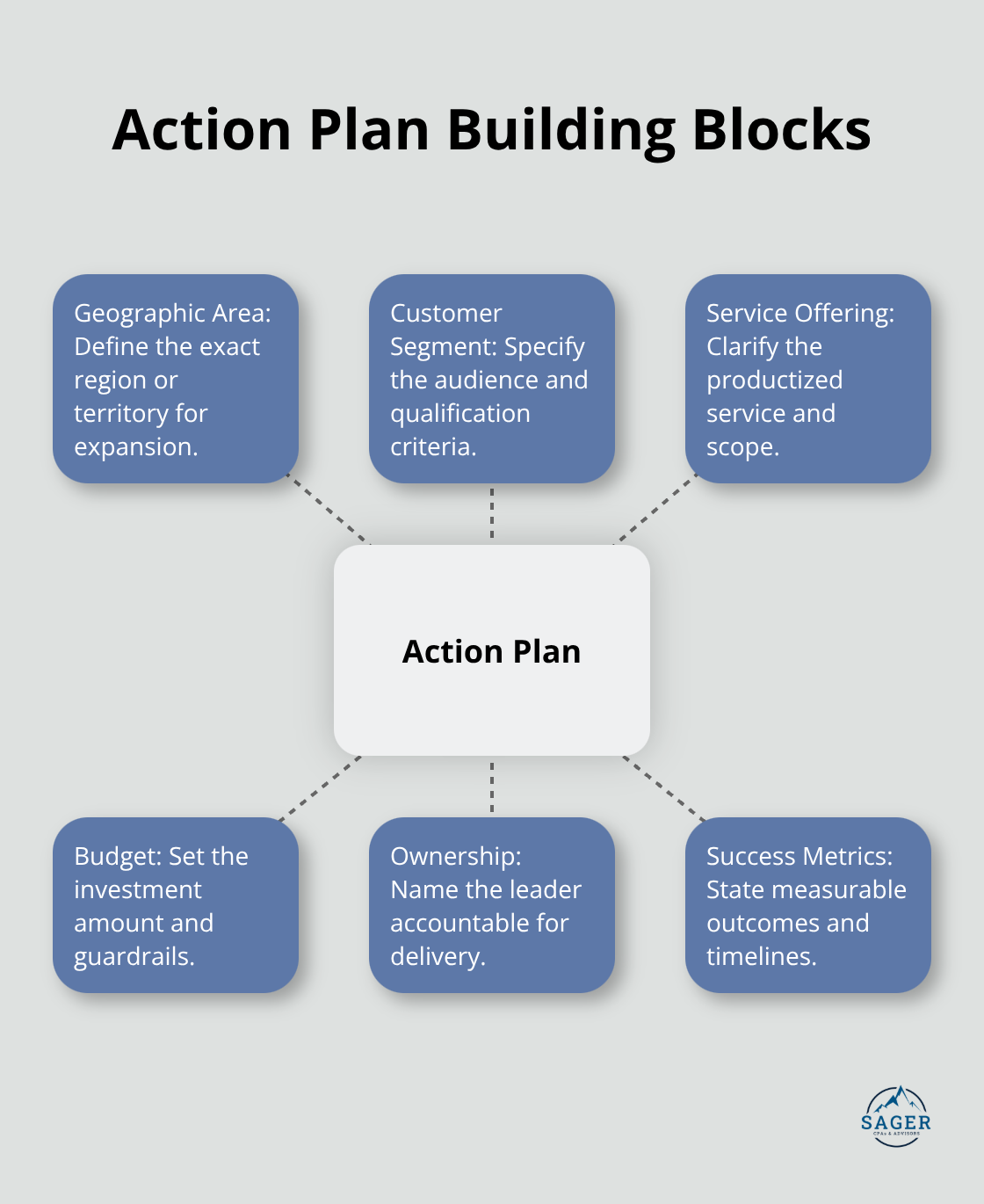
Develop action plans with real timelines and resource commitments. Instead of saying you’ll expand into a new market, specify exactly what that means: which geographic area, which customer segment, what service offering, how much budget, who leads the effort, and what success looks like in measurable terms. Set quarterly milestones so progress becomes visible.
If you launch a new service, your first quarter might involve completing market research and developing the offering. Second quarter focuses on selling to five pilot customers. Third quarter refines the offering based on feedback. Fourth quarter executes full launch. This approach breaks overwhelming goals into manageable pieces and keeps momentum steady.
With your goals and action plans in place, you now face the real test: execution. The strategies that separate thriving businesses from struggling ones aren’t more sophisticated-they’re simply executed with discipline and flexibility. The next section walks you through the systems and practices that turn plans into results.
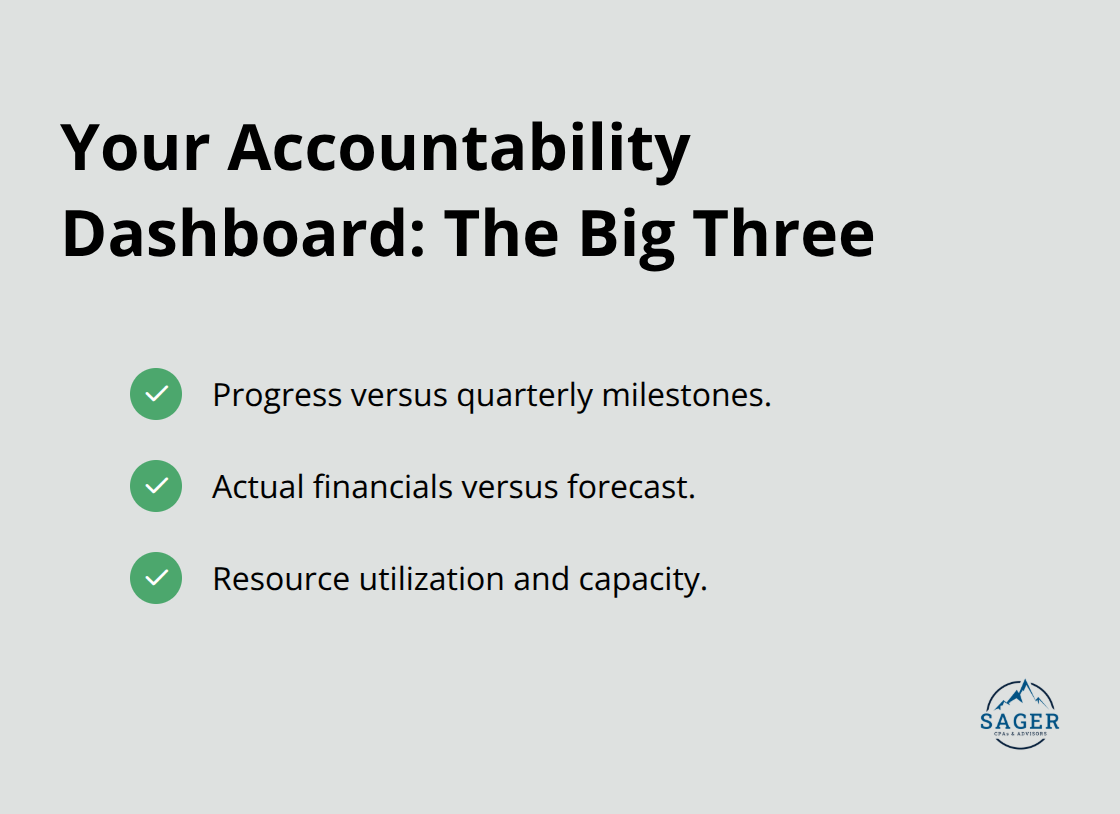
Execution separates businesses that grow from those that stall. Your plan means nothing without systems that force accountability and visibility. Start with a single tracking dashboard that shows three things: progress against your quarterly milestones, actual financial performance versus forecast, and resource utilization. This dashboard should update monthly, not quarterly. Monthly cadence matters because it catches problems early when you still have time to correct course.
If you wait until quarter-end to discover you’re off track on cash flow, you’ve already lost weeks of corrective action. Assign one person to own this dashboard and present findings to leadership each month. That person becomes your early warning system.
Track actual results against the targets you set, but focus on leading indicators, not just lagging ones. If your goal is growing high-margin services by 25%, your leading indicator is pipeline value and proposal conversion rate. If you miss these indicators in month one, you know by month two that you need to adjust either your sales effort or your timeline.
Most businesses track only financial results after the fact, which is too late. Your team needs to see real-time data on what drives those results. Use simple tools for this-spreadsheets work fine if they’re disciplined and updated consistently. Don’t buy expensive software that nobody uses.
Market conditions shift faster than they did five years ago, so your plan needs built-in flexibility. Quarterly reviews are the moment to examine whether your assumptions still hold. Did a competitor enter your market with aggressive pricing? Did your largest client signal they might reduce spending? Did hiring costs rise 15% in your region?
These shifts require honest conversations about what changes and what stays. Adjust your targets or timelines, but document why. This isn’t failure-it’s intelligence. Your team executes better when they understand the reasoning behind course corrections.
The team executing your strategy needs specific skills that many organizations lack. You need at least one person who understands your financial statements deeply and can translate them into operational language your team actually cares about. You need someone focused purely on sales pipeline and conversion metrics. You need operational discipline from whoever manages delivery.
Most small businesses try to do all of this with existing staff who already have full jobs, which guarantees something gets neglected. Either hire the missing skills or acknowledge that certain goals will move to next year. Weak execution beats ambitious planning every time, so build your team around what you actually need to win.
Building a winning finance business strategy requires three things: honest assessment of where you stand, clear goals tied to specific numbers, and disciplined execution with monthly accountability. Most businesses fail not because they lack ambition but because they skip the first step or abandon the plan when reality shifts. Start this week by pulling your last three years of financial statements, identifying your three biggest profit drivers, and setting one concrete goal for the next 90 days with assigned ownership.
The businesses we work with at Sager CPA that succeed treat their strategy as a working tool, not a sacred document. They review quarterly, adjust without hesitation, and accept that good execution beats perfect planning. Someone owns the dashboard, someone reviews the numbers monthly, and leadership has honest conversations about what’s working and what isn’t (this discipline separates thriving businesses from those that stall).
If you need help building or refining your finance business strategy, schedule a consultation with Sager CPA to create a personalized approach that actually works for your business.




Phone: (208) 939-6029
Email: info@sager.cpa
Privacy Policy | Terms and Conditions | Powered by Cajabra
At Sager CPAs & Advisors, we understand that you want a partner and an advocate who will provide you with proactive solutions and ideas.
The problem is you may feel uncertain, overwhelmed, or disorganized about the future of your business or wealth accumulation.
We believe that even the most successful business owners can benefit from professional financial advice and guidance, and everyone deserves to understand their financial situation.
Understanding finances and running a successful business takes time, education, and sometimes the help of professionals. It’s okay not to know everything from the start.
This is why we are passionate about taking time with our clients year round to listen, work through solutions, and provide proactive guidance so that you feel heard, valued, and understood by a team of experts who are invested in your success.
Here’s how we do it:
Schedule a consultation today. And, in the meantime, download our free guide, “5 Conversations You Should Be Having With Your CPA” to understand how tax planning and business strategy both save and make you money.