
Startup Financial Risk Planning: Anticipate and Mitigate for Growth
Anticipate financial risks in your startup with practical strategies to protect cash flow, manage debt, and build sustainable growth.
Most business owners focus on daily operations and miss the bigger picture. That’s where comprehensive business advisory makes the difference-guiding you through strategic decisions, financial optimization, and risk management.
We at Sager CPA help companies at every growth stage find clarity and direction. This guide shows you what advisory services deliver and how to find the right partner for your business.
Business advisory isn’t about theoretical frameworks or generic advice. It’s about moving your numbers and your position. The best advisors examine revenue streams, cost structure, and debt load to build a real profitability roadmap.
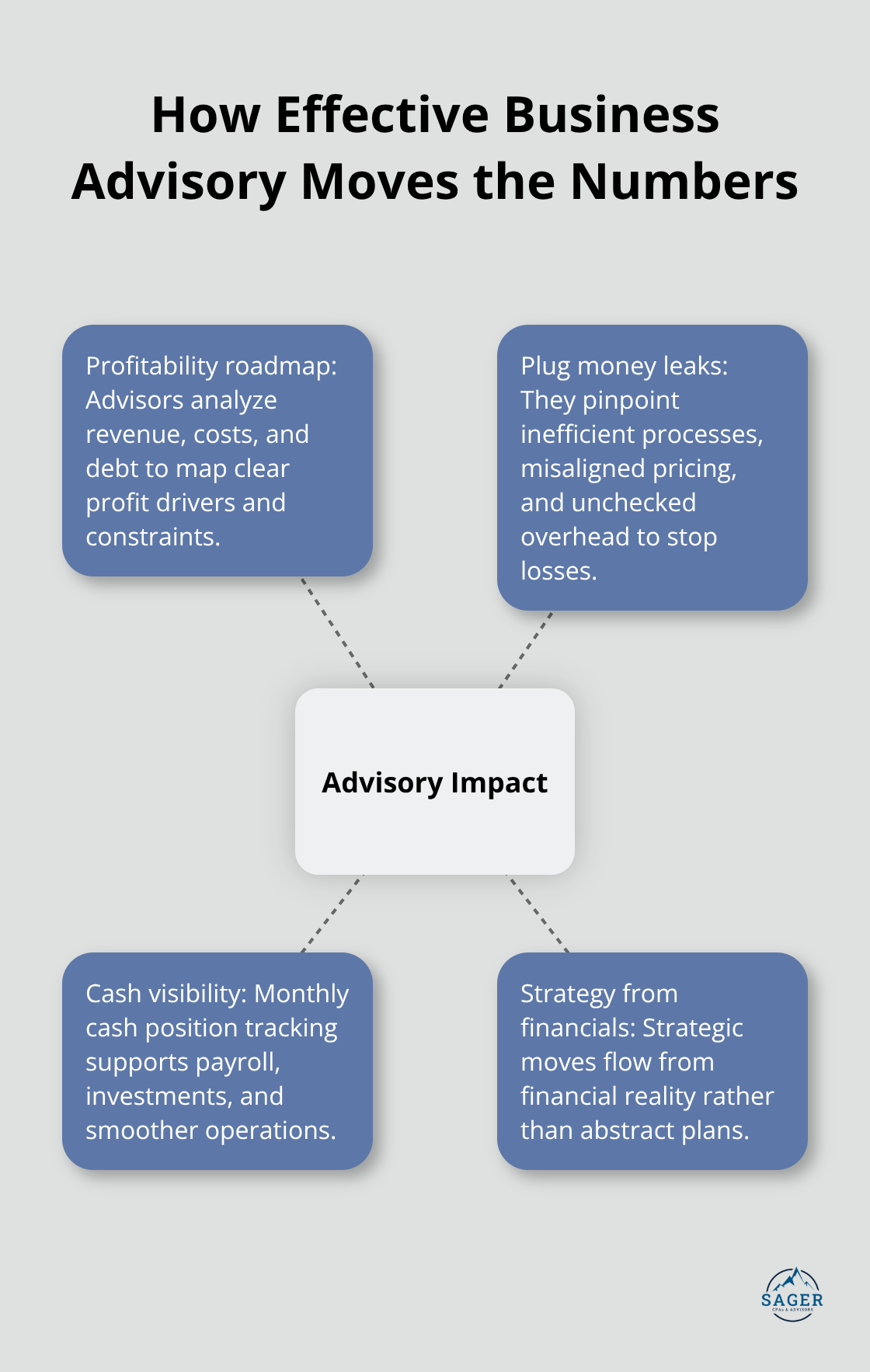
They identify where money leaks exist-inefficient processes, pricing that doesn’t match market value, or overhead that’s grown unchecked. This operational analysis directly impacts your bottom line. An advisor might discover you’re leaving 15-20% on the table through poor expense management or suboptimal pricing strategy. They also help you understand your cash position month to month, which matters far more than annual profit when you manage payroll and growth simultaneously. Strategic direction flows from this financial reality, not the other way around.
Every business faces moments where conditions shift unexpectedly. Market downturns, supply chain disruptions, or customer concentration risk threaten stability. A competent advisor builds contingency plans before crisis hits, examining what happens to your business if your largest client leaves, if interest rates spike, or if a key person becomes unavailable. They help you design a business retirement plan that reduces risk while providing tax advantages and supporting employee retention-something many owners overlook until it’s too late. They also assess your current debt structure and create strategies to optimize it rather than just manage it. This proactive work transforms your business from reactive to resilient.
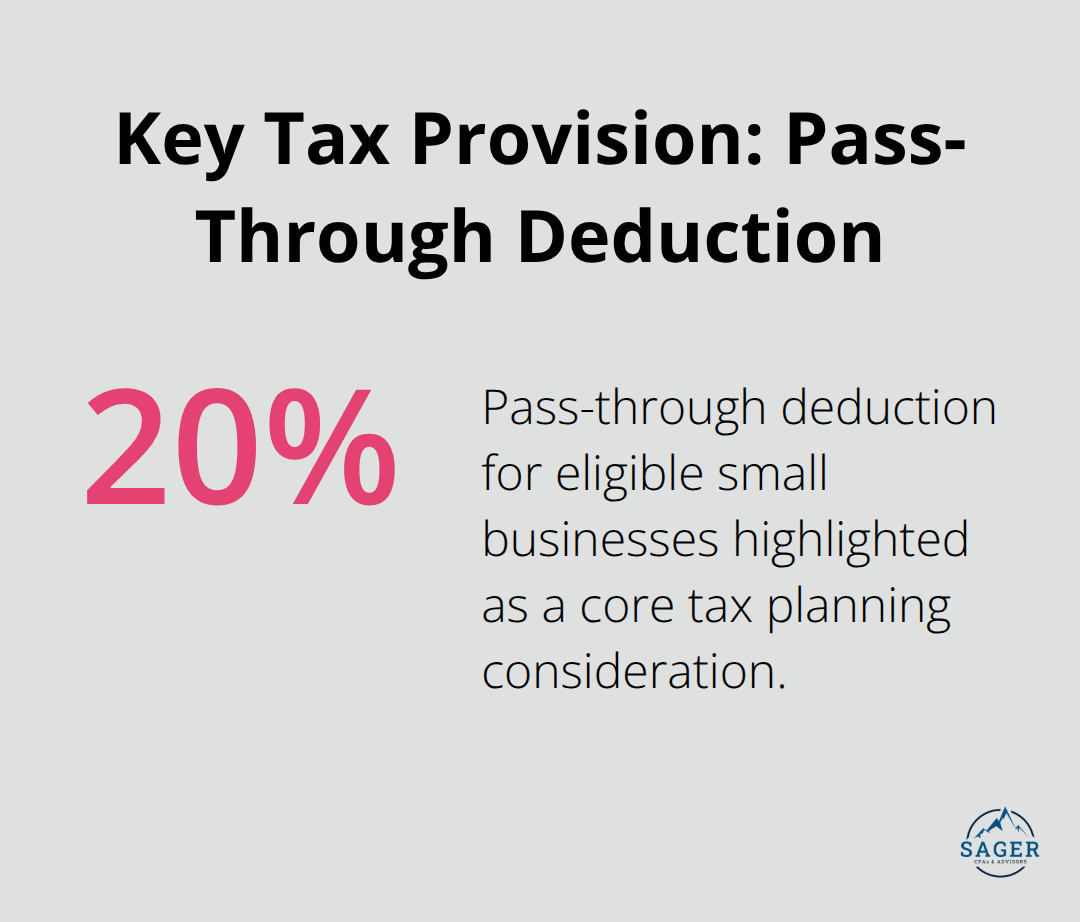
Succession and estate planning often gets pushed to the back burner, but it directly affects what your business is actually worth. An advisor guides gifting strategies and succession structures that maximize value for you and future leaders while minimizing tax impact. They coordinate with external specialists-CPAs, estate attorneys-to ensure your plans align across all areas. This integrated approach prevents costly mistakes where one decision undermines another. Year-round tax optimization integrated with your broader business strategy captures opportunities you’d otherwise miss, especially as tax law changes continuously. The U.S. Chamber of Commerce has highlighted tax parity considerations for small businesses, including the 20% pass-through deduction, as essential planning components. A knowledgeable advisor ensures you’re not leaving money on the table simply because tax law shifted.
The right advisor combines financial expertise with industry knowledge and a commitment to your specific goals. They ask hard questions about your competitive position, your margins, and your capacity to scale. They don’t offer one-size-fits-all solutions; they tailor recommendations to your business model and risk tolerance. They also maintain a network of specialists (tax professionals, legal counsel, insurance experts) to handle complex issues that fall outside their core competency. This collaborative approach means you get coordinated guidance rather than conflicting advice from siloed professionals.
Finding the right partner requires more than credentials. You need someone who understands your industry, has helped similar businesses navigate growth, and aligns with how you want to operate.
Small and mid-size businesses that scale operations face a critical problem: growth exposes every weakness in your financial infrastructure. As you add revenue, you also add complexity-multiple revenue streams, expanded teams, higher debt loads, and operational bottlenecks that didn’t matter when you were smaller. Many owners in this position realize too late that their accounting systems, pricing strategy, and cost structure weren’t built for scale.
An advisor identifies these gaps before they become crises. They examine your current financial position and profitability roadmap to show exactly where inefficiencies live and what operational changes drive real growth. The difference between a business that scales cleanly and one that stumbles during growth often comes down to having someone who understands both the numbers and the operational reality of your industry.
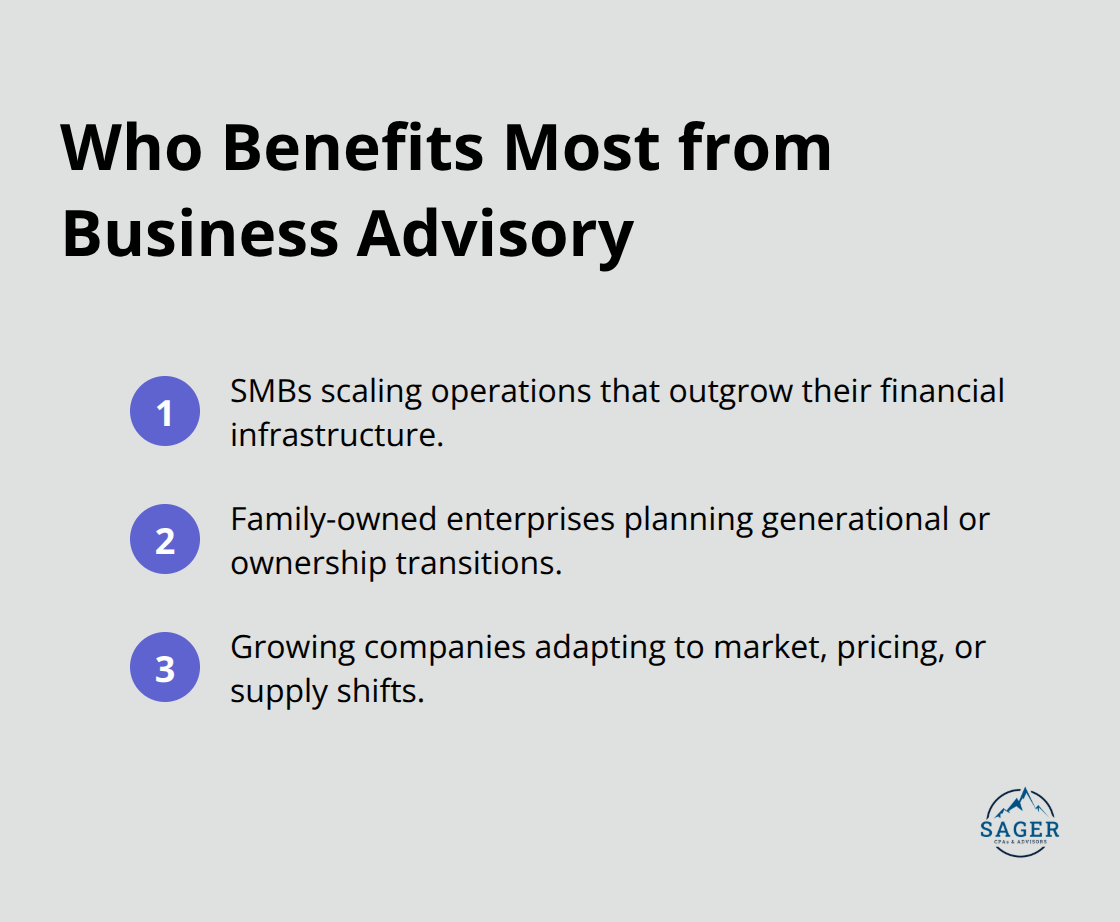
Family-owned enterprises face a different but equally pressing challenge: how to preserve business value while managing transitions between generations or ownership structures. The emotional weight of succession planning often paralyzes owners, so they avoid it until death or illness forces a crisis decision. This avoidance is expensive.
Without structured planning, family businesses lose 70-90% of their value in the transition to the next generation. A competent advisor works backward from your goal-what do you want the business worth, who should lead it, and what tax and legal structures support that outcome-then builds a concrete plan. They coordinate with estate attorneys and tax specialists to ensure your succession strategy, tax plan, and business structure align rather than conflict.
Growing companies that navigate market changes need advisors who help them understand which shifts are temporary and which require fundamental business model changes. An advisor builds contingency scenarios showing what happens to your profitability if customer demand shifts, pricing power weakens, or supply costs spike. This forward-looking analysis lets you respond strategically instead of reactively, adjusting operations or investment before conditions force your hand.
The right advisor recognizes that each business type demands different expertise and timing. What works for a scaling operation differs from what a family business needs during succession, which differs again from what a growth-stage company requires when markets shift. Understanding which category fits your situation determines whether advisory services actually move your business forward-or simply add another voice to the noise.
The credentials on a wall mean nothing if the advisor doesn’t understand how your business actually operates. Too many business owners hire based on reputation or referrals without asking the right questions first. You need someone who has worked with companies at your stage, in your industry, and facing similar challenges. Start by asking for specific clients they’ve advised through growth phases, succession planning, or operational restructuring. Push for details: what was the client’s revenue range, what problem did they solve, and what measurable outcome resulted?
Vague answers like “we helped improve profitability” tell you nothing. Specific answers like “we identified $200K in annual cost savings through supply chain optimization” or “we restructured their equity plan to reduce founder tax liability by $35K annually” show they’ve done real work. An advisor who speaks in specifics has real experience to back it up.
Industry expertise matters enormously because the financial dynamics of a manufacturing business differ completely from a service firm or a retail operation. An advisor who specializes in your industry understands your typical margins, cash flow patterns, seasonal fluctuations, and competitive pressures without needing to learn your business from scratch. This matters because you’re paying for their time, and an advisor learning your industry on your dime costs you money and delays results.
Ask directly whether the advisor has managed businesses through the specific transition you’re facing. If you’re scaling from $2 million to $10 million in revenue, you need someone who has guided that journey before, not someone learning it with you. If you’re planning succession within your family, ask how many family business transitions they’ve coordinated and whether they work regularly with estate attorneys and tax specialists.
The best advisors maintain a network of external specialists and coordinate across disciplines because business problems rarely stay in one lane. Someone who claims to handle everything alone without external partners is limiting your options and your results. This collaborative approach means you receive coordinated guidance rather than conflicting advice from siloed professionals.
During your initial conversation, notice whether they ask about your goals and constraints or immediately pitch solutions. Notice whether they explain their thinking in plain language or hide behind jargon. Notice whether they respect your time and come prepared with specific questions about your business. These interactions reveal how they’ll actually work with you over months and years.
Alignment on values and approach matters as much as expertise. Some advisors operate transactionally, delivering a tax return or a plan and moving on. Others embed themselves in your business, understanding your priorities and checking in regularly to adjust strategies as conditions change. The difference between these approaches determines whether you get a vendor or a true partner.
We at Sager CPA believe in embedding ourselves in your business, working as an extension of your leadership team rather than an outside vendor. This means regular communication, proactive strategies, and customized action plans tailored to your specific situation. When you evaluate potential advisors, try to identify which approach aligns with how you want to operate and grow your business.
Comprehensive business advisory delivers real results because it addresses your full financial picture, not isolated pieces. Advisors who move your numbers understand your financial position, identify operational inefficiencies, and build strategies that align with your long-term goals. They coordinate across tax planning, succession strategy, and risk management so decisions reinforce each other rather than conflict.
The value compounds over time as your business operates with clear financial visibility, optimized cost structure, and proactive planning. You gain the ability to scale without chaos, navigate market shifts without panic, and plan succession without crisis. A business that acts strategically outperforms one that reacts to problems as they emerge.
We at Sager CPA work as an extension of your leadership team, combining expert financial management, strategic advisory services, and customized financial strategy tailored to your specific situation. Contact us to start moving your business forward with clarity and confidence.




Phone: (208) 939-6029
Email: info@sager.cpa
Privacy Policy | Terms and Conditions | Powered by Cajabra
At Sager CPAs & Advisors, we understand that you want a partner and an advocate who will provide you with proactive solutions and ideas.
The problem is you may feel uncertain, overwhelmed, or disorganized about the future of your business or wealth accumulation.
We believe that even the most successful business owners can benefit from professional financial advice and guidance, and everyone deserves to understand their financial situation.
Understanding finances and running a successful business takes time, education, and sometimes the help of professionals. It’s okay not to know everything from the start.
This is why we are passionate about taking time with our clients year round to listen, work through solutions, and provide proactive guidance so that you feel heard, valued, and understood by a team of experts who are invested in your success.
Here’s how we do it:
Schedule a consultation today. And, in the meantime, download our free guide, “5 Conversations You Should Be Having With Your CPA” to understand how tax planning and business strategy both save and make you money.