
Startup Financial Risk Planning: Anticipate and Mitigate for Growth
Anticipate financial risks in your startup with practical strategies to protect cash flow, manage debt, and build sustainable growth.
Most businesses hit a wall when they try to grow without outside perspective. That’s where corporate advisory services make the difference-bringing in experts who see what you can’t from the inside.
At Sager CPA, we’ve watched companies transform their strategy, cut unnecessary costs, and enter new markets successfully with the right guidance. This post walks you through what corporate advisory actually does and how to find the right partner for your business.
Most business owners rely on internal teams to make critical decisions, but internal perspectives have blind spots. You see your market the way you’ve always seen it. You know your operations because you built them that way. An external advisor sees inefficiencies, missed opportunities, and market shifts you’ve normalized. This isn’t weakness-it’s how successful companies operate. Companies that bring in corporate advisory services report measurable improvements in decision quality and execution speed. The difference comes down to three core areas where outside expertise changes outcomes.
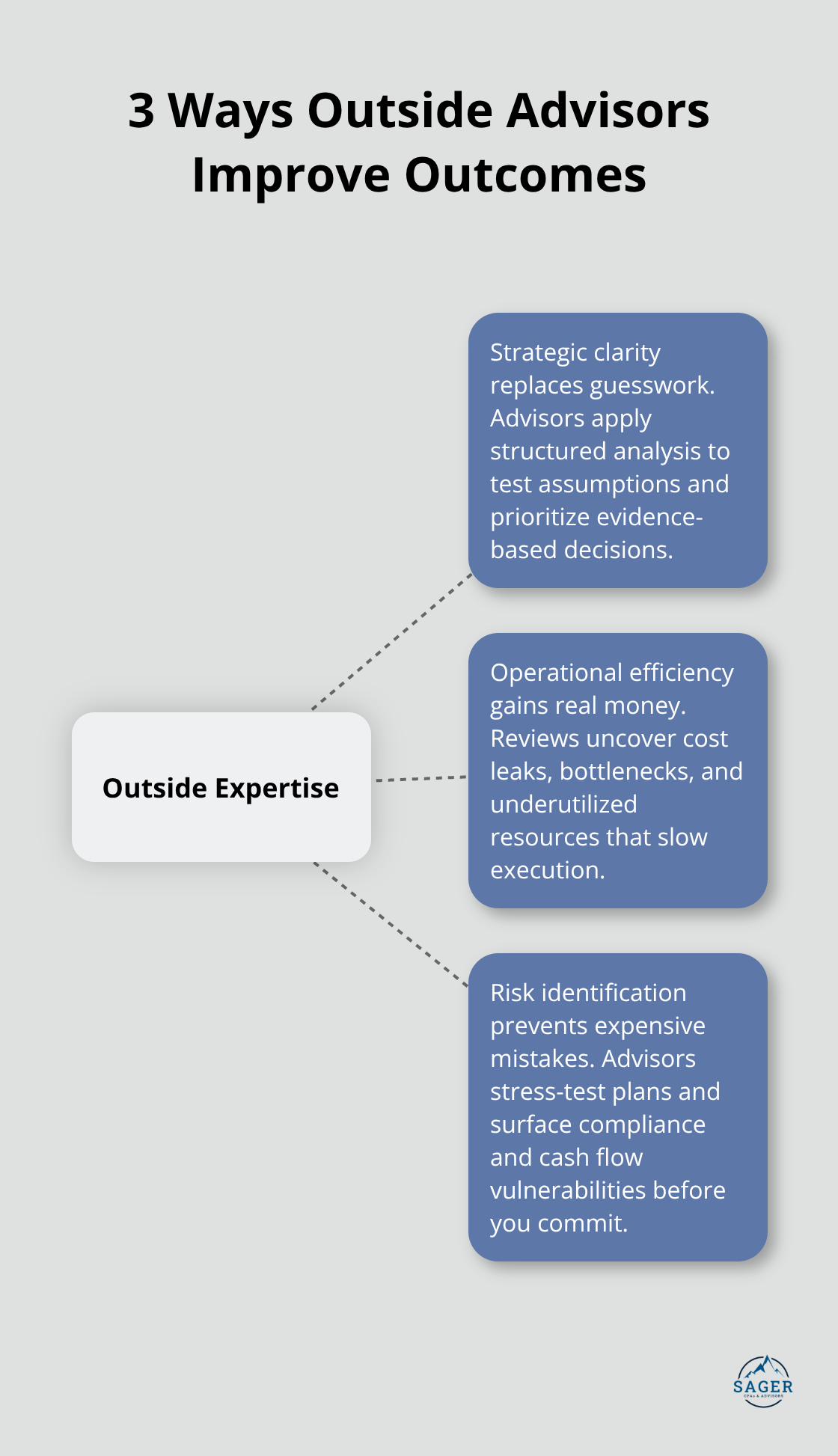
Your strategy should be built on data, not intuition. Most businesses make major decisions without formal frameworks. You might expand into a new market because it feels right, or restructure because a competitor did. External advisors apply structured approaches like SWOT analysis and scenario planning to test assumptions before you commit resources. They model different outcomes, identify which decisions carry real risk, and help you prioritize based on evidence rather than instinct. This matters because wrong strategic bets drain cash and waste years. When you work with advisors who’ve seen dozens of similar situations across industries, they spot patterns you can’t see alone. They also challenge internal groupthink-the shared assumptions that feel true but limit growth.
Many businesses operate with cost structures that made sense five years ago but now drain profitability. Advisors review your operating model, identify resource inefficiencies, and spot pricing gaps. They benchmark your costs against industry standards and show where you’re overspending. They also reveal underutilized resources and process bottlenecks that slow execution.
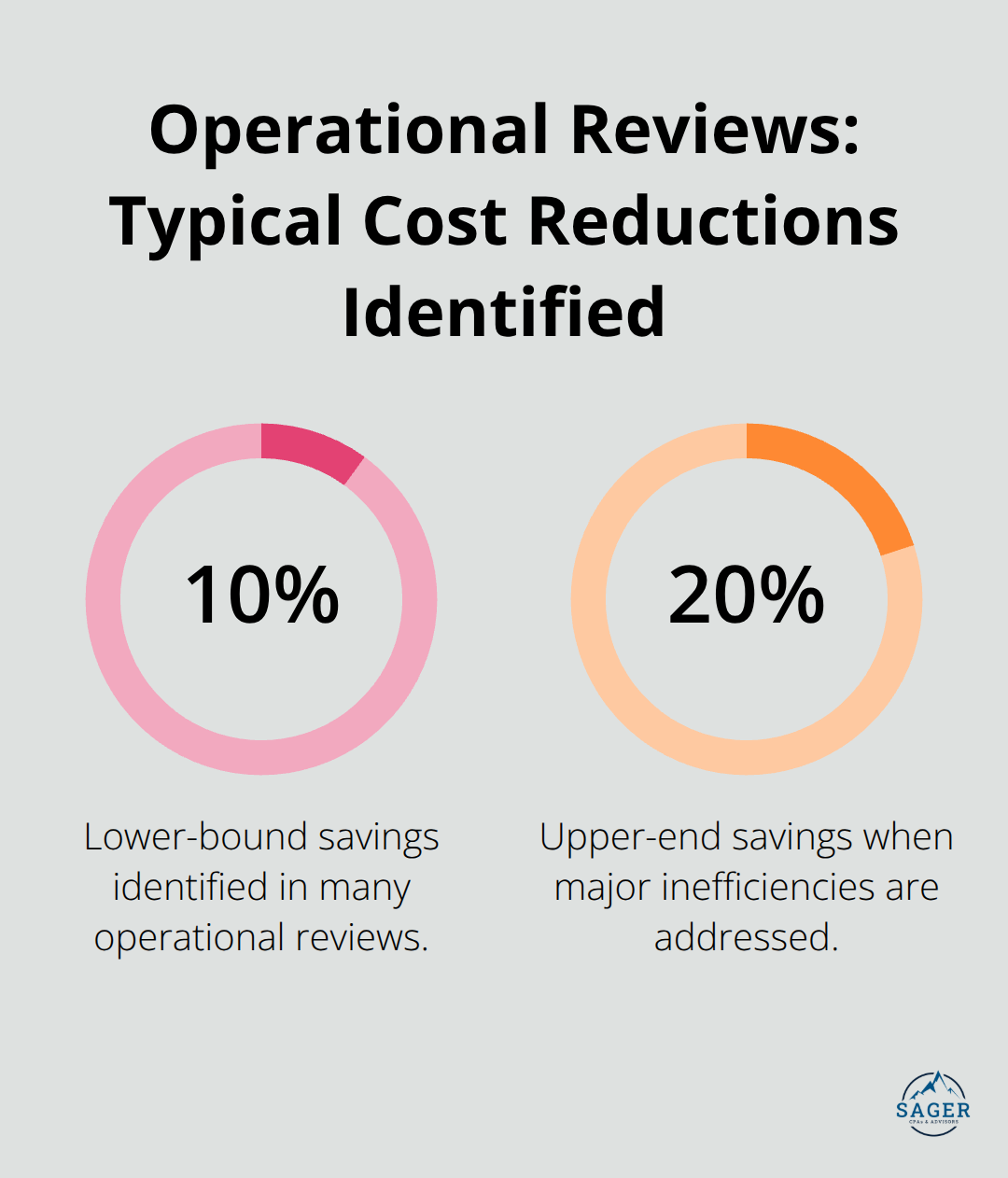
These aren’t theoretical improvements-companies typically find 10-20% in cost reductions through operational reviews. Advisors provide the analysis and implementation support to actually build scalable systems instead of patching problems. This becomes critical during growth phases when old processes break down under volume.
Before major moves-market entry, acquisitions, fundraising, or restructuring-advisors conduct proactive risk assessment. They stress-test your financial forecasts, identify cash flow vulnerabilities, and flag compliance gaps. They help you understand what could go wrong before you’re already committed. This prevents the revenue loss and competitive disadvantage that comes from poorly planned expansions or acquisitions that fail post-close. Advisors also help you prepare for investor meetings with polished financials and investor-ready documentation, strengthening your position whether you’re seeking loans or equity funding.
These three areas form the foundation of what comprehensive business advisory delivers. The next section walks through the specific service areas where advisors create the most impact for growing businesses.
Financial performance sits at the core of every advisory engagement because numbers reveal what’s actually working. Advisors reconstruct your cost structure, identify where margin leaks occur, and model what happens if you change pricing, reduce overhead, or shift your product mix. Many businesses discover they’re underpricing simply because they’ve never benchmarked against competitors or calculated true cost-per-service.
Advisors build financial forecasts that replace outdated spreadsheets, giving you actual visibility into cash flow patterns six to twelve months ahead. This matters during growth phases when you need to know whether expansion will strain working capital or create new cash problems. They help you understand which customer segments are profitable and which drain resources, allowing you to make deliberate choices about where to invest.
Organizational restructuring represents another critical area where advisors add immediate value. When companies grow from ten to fifty employees, the management structure that worked at twenty breaks down completely. Advisors assess your current operating model, identify reporting gaps, and recommend changes that align decision-making with growth.
They also guide you through change management-the hardest part of restructuring-because most internal teams resist shifts that threaten their influence or require new skill development. Advisors bring objectivity to these conversations and help leadership communicate why changes matter to the business and employees.
Market expansion and growth planning separate successful expansion attempts from costly failures. Before entering a new market or launching a new service line, advisors conduct feasibility analysis that goes beyond optimistic projections. They research customer demand, assess competitive positioning, identify regulatory requirements, and model realistic revenue scenarios based on market size and your realistic penetration rate.
This prevents the common mistake of assuming your success in one market automatically transfers elsewhere. They also help you decide whether to build new capabilities internally, acquire them, or partner with other companies. For companies considering acquisitions or investment, advisors conduct due diligence on targets, validate financial statements, and identify integration risks before you commit capital. They model post-acquisition synergies and help you understand what integration actually costs in time and resources, not just the purchase price. This structured approach to growth decisions means you’re competing on evidence rather than hope-which is why growth-focused companies consistently outperform competitors that move faster but with less clarity.
The next section addresses how to identify an advisory partner whose expertise and approach align with your specific business challenges and growth trajectory.
The difference between a mediocre advisory engagement and a transformational one comes down to fit. You need an advisor who understands your specific industry challenges, communicates in ways that work for your leadership team, and offers services structured around how you actually operate.
Start by examining what the advisor has accomplished with companies similar to yours. Look for evidence of real outcomes, not just client lists. If they claim to have helped manufacturing companies improve margins, ask for specifics about which companies, what the baseline was, and what they actually achieved. Advisors who hedge on results or speak only in percentages without naming clients are avoiding accountability. The best advisors can point to concrete transformations because they’ve documented them.
Check whether they’ve worked in your specific industry. An advisor experienced in healthcare brings fundamentally different knowledge than one who primarily serves retail. They understand your regulatory environment, your typical cost structure, your customer acquisition patterns, and the growth constraints unique to your space. Industry-specific experience compresses the learning curve and means they’re not starting from scratch understanding your business model.
Beyond experience, evaluate how they think about problems. Do they push back on your assumptions or simply validate what you want to hear? During initial conversations, a strong advisor asks tough questions about why you make specific decisions and challenges you to defend them with data. If an advisor agrees with everything you say, they’re not adding perspective-they’re confirming bias.
Also assess whether they have capacity to actually execute. Some advisory firms are sales operations that hand off engagements to junior consultants who lack the authority to make recommendations stick. You want senior-level expertise directly engaged in your work, not delegated to people still learning their craft. Ask who will actually do the work and request to meet them before committing.
Communication style matters more than most businesses realize because strategy means nothing if your team doesn’t understand it or trust the person delivering it. Some advisors communicate in dense financial models and frameworks that confuse operational leaders. Others translate complex analysis into clear language that resonates with your entire leadership team. During initial conversations, notice how they explain concepts. Do they use jargon or plain language? Do they listen more than they talk? Strong advisors ask questions to understand your perspective before launching into recommendations.
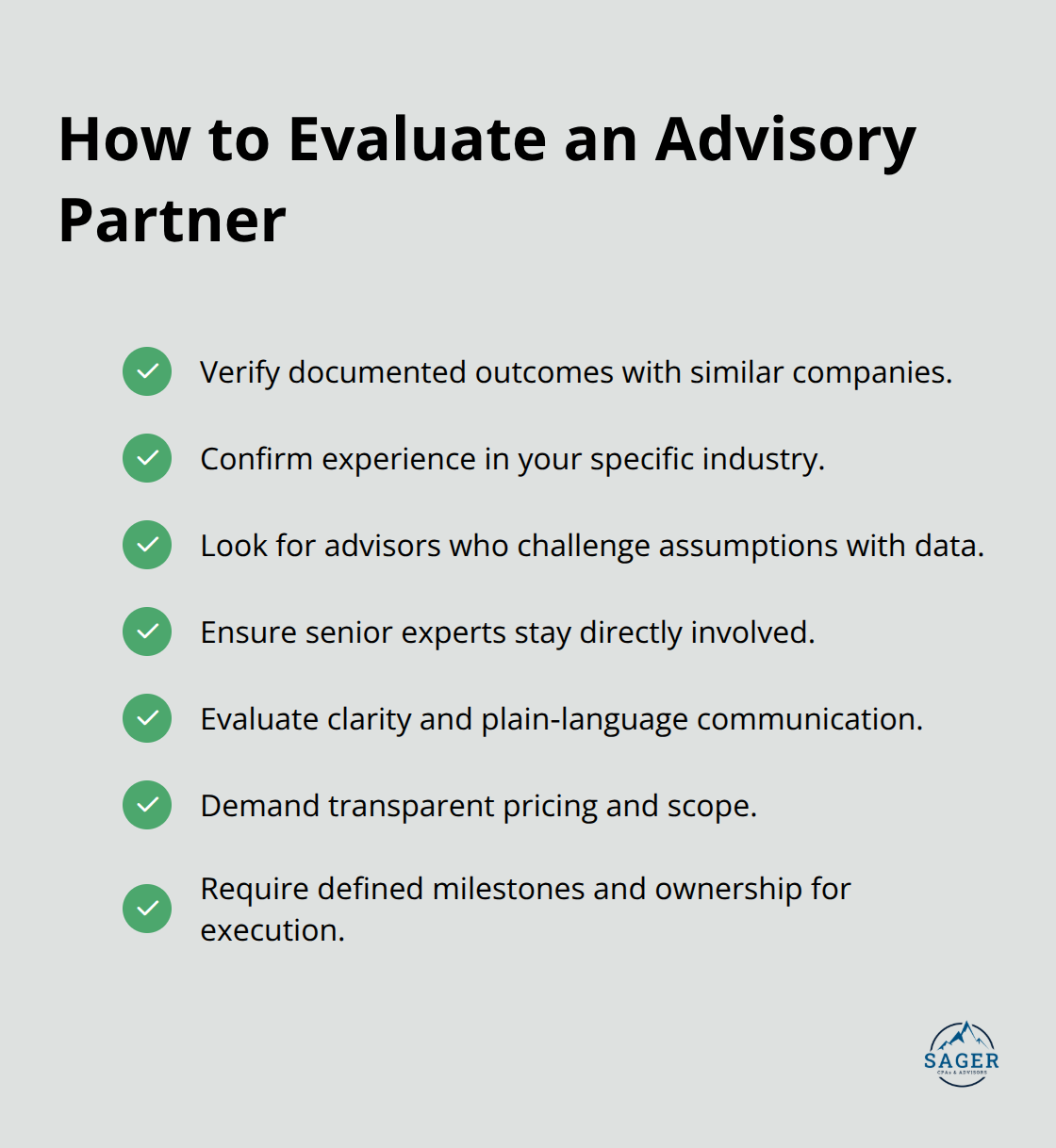
They also clarify their engagement model upfront. Will they work on retainer, project basis, or hourly rates? What does the scope actually include, and what costs extra? Transparency on pricing prevents surprises later and signals whether they respect your time and budget constraints. You should expect advisors to structure engagements around your specific needs rather than force you into standardized packages.
Finally, validate their approach to implementation. Strategic recommendations fail when nobody owns execution. The best advisors don’t just hand you a report and disappear. They build accountability into the engagement by defining clear milestones, assigning owners for each initiative, and tracking progress over time. Ask them how they measure success and what happens if you don’t hit targets. An advisor who avoids these conversations is selling recommendations, not results.
Corporate advisory services transform how businesses make decisions, but only when you commit to the partnership. The real value emerges from sustained collaboration that keeps strategy aligned with execution as your business evolves. Companies that engage advisors early gain competitive advantage because they move faster, avoid costly mistakes, and scale more efficiently than competitors operating without external perspective.
Year one typically focuses on fixing immediate problems-cost reduction, operational efficiency, or strategic clarity on a major decision. Year two and beyond shift toward building systems and capabilities that sustain growth without constant external input. You invest in organizational maturity that eventually reduces your need for outside support because your internal team develops the discipline and frameworks to think strategically (rather than paying for ongoing dependency).
Schedule a consultation with an advisor who understands your specific challenges and can articulate how they’d approach your situation. We at Sager CPA offer expert financial management and strategic advisory services tailored to your business, and we’re ready to create a personalized strategy that addresses your specific growth challenges and financial priorities.




Phone: (208) 939-6029
Email: info@sager.cpa
Privacy Policy | Terms and Conditions | Powered by Cajabra
At Sager CPAs & Advisors, we understand that you want a partner and an advocate who will provide you with proactive solutions and ideas.
The problem is you may feel uncertain, overwhelmed, or disorganized about the future of your business or wealth accumulation.
We believe that even the most successful business owners can benefit from professional financial advice and guidance, and everyone deserves to understand their financial situation.
Understanding finances and running a successful business takes time, education, and sometimes the help of professionals. It’s okay not to know everything from the start.
This is why we are passionate about taking time with our clients year round to listen, work through solutions, and provide proactive guidance so that you feel heard, valued, and understood by a team of experts who are invested in your success.
Here’s how we do it:
Schedule a consultation today. And, in the meantime, download our free guide, “5 Conversations You Should Be Having With Your CPA” to understand how tax planning and business strategy both save and make you money.