
Startup Financial Risk Planning: Anticipate and Mitigate for Growth
Anticipate financial risks in your startup with practical strategies to protect cash flow, manage debt, and build sustainable growth.
Stakeholders want to know exactly where your money goes and how your business performs. When financial statements lack clarity, investors hesitate, lenders ask harder questions, and regulators take notice.
At Sager CPA, we’ve seen firsthand how clear financial reporting transforms relationships with stakeholders and strengthens decision-making. This post covers what transparent statements look like, the mistakes that damage trust, and how to fix them.
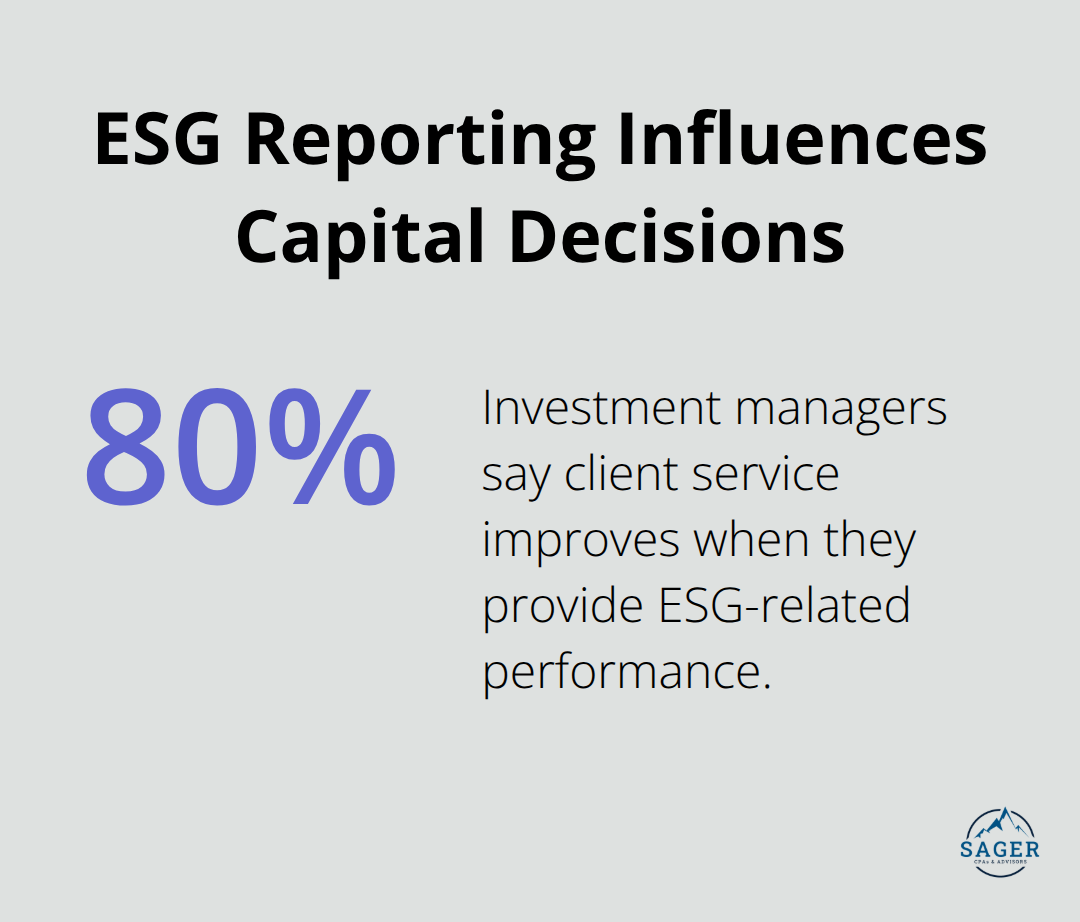
Stakeholders make decisions based on what they see in your financial statements. When those statements are clear and consistent, investors commit capital faster, lenders approve credit lines with better terms, and employees feel secure enough to stay long-term. The alternative is friction at every turn. Businesses that struggle with unclear financial reporting face slower funding rounds, higher borrowing costs, and staff turnover. A study by Deloitte found that almost 80 percent of investment managers agree that they could improve client service by providing performance related to an investment’s ESG. That’s not a minor preference-it’s a dealbreaker for most capital sources.
Investors and lenders don’t have time to decode messy statements. When your balance sheet, income statement, and cash flow statement tell a consistent story without gaps or surprises, decision-makers move forward confidently. Banks reviewing loan applications typically spend 3 to 5 business days on analysis if documentation is complete and transparent. That timeline stretches to weeks when statements require clarification or contain inconsistencies.
Employees also respond to financial transparency. Research from Willis Towers Watson shows that companies with transparent financial communication experience higher engagement scores among staff. People want to work for businesses they understand and trust, and financial clarity signals stability. Vendors and suppliers negotiate better payment terms when they see healthy cash flow statements and consistent profitability metrics. Customers increasingly scrutinize supplier stability before signing long-term contracts, especially in industries where vendor failure creates operational risk.
Delayed or unclear financial disclosures trigger regulatory scrutiny. Clear financial reports make it easier for auditors and regulatory bodies to verify compliance, reducing the risk of costly fines or legal issues. Penalties for late or inaccurate filings range from $100 to $10,000 per violation depending on severity and jurisdiction.
Beyond penalties, weak reporting damages reputation. Once stakeholders lose confidence in your numbers, rebuilding that trust takes years. A company that misses disclosure deadlines or presents conflicting figures faces skepticism on every future filing. Lenders may demand higher interest rates or require additional collateral. Investors reduce valuations. The cost of capital rises, which directly impacts your bottom line.
Inconsistent accounting practices compound trust issues significantly. When your business applies different methods to inventory valuation, revenue recognition, or depreciation from year to year, auditors flag restatements. Restatements undermine credibility and often trigger deeper audits that expose additional issues. These corrections cost time and money while signaling to stakeholders that your financial controls lack rigor. Financial clarity enables businesses to identify the strengths and weaknesses of their financial position and build a clear picture of their financial status. Establishing consistent practices upfront prevents costly corrections later and demonstrates that your organization takes financial accuracy seriously. The next section examines the specific components that make financial statements clear and trustworthy.
Your balance sheet, income statement, and cash flow statement each tell a different part of your financial story, and weaknesses in any one of them damage credibility. The balance sheet shows what you own and owe at a specific moment in time, but it’s only useful if assets are valued consistently and liabilities are complete. Many businesses undervalue inventory or fail to disclose contingent liabilities, which auditors catch immediately. When your balance sheet reconciliation to supporting schedules is incomplete, lenders and investors lose confidence fast.
The income statement reveals whether your business actually makes money, but vague expense categories hide operational problems. Grouping $500,000 in miscellaneous expenses tells stakeholders nothing about whether your cost structure is healthy or bloated. Revenue recognition matters too. If you record sales before control is transferred to the customer, you violate revenue recognition standards and GAAP compliance and invite restatement.
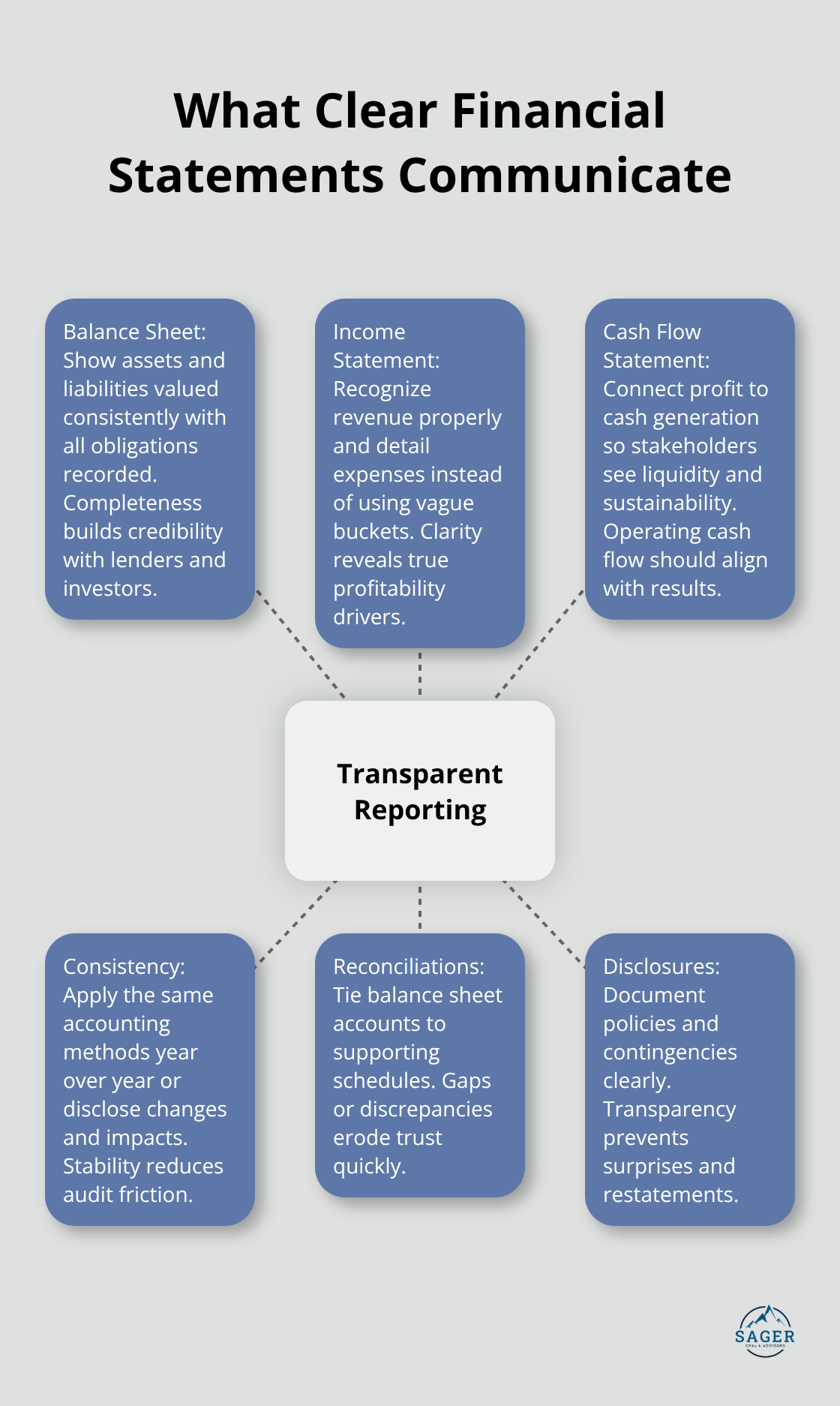
Your balance sheet must reconcile to all supporting schedules without gaps or discrepancies.
The cash flow statement is where many businesses fail most visibly. A profitable income statement means nothing if cash doesn’t actually flow into your business. Stakeholders care about whether you can pay employees, service debt, and fund growth. If your operating cash flow is negative while net income is positive, that disconnect signals accounting quality issues or operational distress. This gap reveals the real health of your operations far better than profit alone.
Apply the same accounting methods year after year unless you have a documented, auditor-approved reason to change. If you switch from FIFO to LIFO inventory valuation or change depreciation methods, you must disclose the change and its financial impact. Most lenders and investors view unexplained accounting changes as red flags. Your depreciation schedules, revenue recognition policies, and reserve calculations should be documented and applied uniformly. This consistency makes audits faster and less expensive because auditors spend less time questioning your methodology.
Consistency also makes trend analysis meaningful. If your gross margin drops 5 percent year-over-year, stakeholders can assess whether it’s a real operational issue or an accounting change. Unclear expense categorization hides the truth about your business. If you bury marketing costs in administrative expenses or mix personal and business spending, your financial statements mislead everyone who reads them. A detailed chart of accounts that separates operating expenses by function provides the transparency that lenders and investors need to make confident decisions. This level of detail also helps you identify where money actually goes and spot inefficiencies in your cost structure.
The mistakes that undermine this clarity are often preventable, yet they appear in financial statements across industries and company sizes.
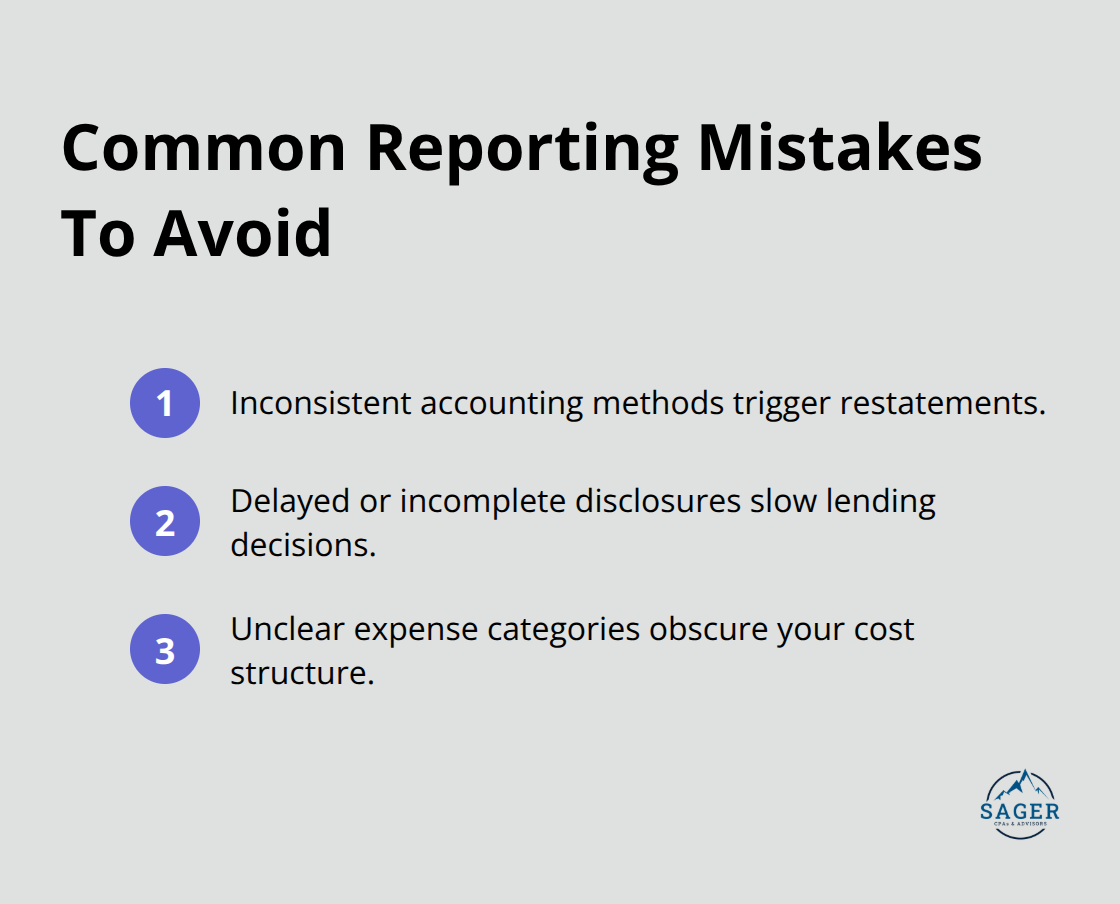
Inconsistent accounting practices rank as the single biggest credibility killer across businesses of all sizes. When you apply different inventory valuation methods year-to-year, shift depreciation schedules without disclosure, or change revenue recognition timing between quarters, auditors flag restatements immediately. These corrections damage trust far more than the original mistake would have. A restatement signals to investors and lenders that your financial controls lack rigor, and once that perception takes hold, every future filing faces skepticism.
The cost compounds quickly. A restatement requires auditor investigation, management time, and often triggers deeper examination of other accounting areas. Lenders may demand higher interest rates or require additional collateral as compensation for perceived risk. Investors reduce valuations. The SEC reported that companies issuing financial restatements experience average stock price declines of 10 to 20 percent.
Prevent this damage by documenting your accounting policies in writing and applying them consistently. Only change methods when you have a legitimate business reason and auditor approval. Your depreciation schedules, reserve calculations, and revenue policies should remain stable unless circumstances genuinely warrant adjustment.
Delayed or incomplete financial disclosures create a different but equally damaging problem. Lenders reviewing loan applications typically spend 3 to 5 business days on analysis when documentation is complete and transparent. Missing schedules, unexplained account balances, or delayed tax filings stretch that timeline to weeks and signal operational chaos. Banks interpret delays as red flags for deeper issues and respond by requesting additional documentation, demanding personal guarantees, or rejecting applications entirely.
Complete your financial statements on schedule and provide all supporting documentation without gaps. This approach accelerates lending decisions and demonstrates that your organization maintains operational discipline. Incomplete disclosures force stakeholders to make conservative assumptions about your business health, which typically results in unfavorable terms or outright rejection.
Unclear expense categorization masks operational reality and prevents stakeholders from assessing your cost structure. If you group $500,000 in miscellaneous expenses without detail, lenders cannot evaluate whether your overhead is reasonable or bloated. This vagueness invites skepticism and forces stakeholders to make conservative assumptions about your business health.
A detailed chart of accounts that separates operating expenses by function, marketing spend, administrative costs, and other categories provides transparency that decision-makers need. This same detail helps you identify inefficiencies internally and spot where money actually flows. When you know exactly what you spend on each function (payroll, rent, supplies, marketing), you can make informed decisions about where to cut costs or invest for growth.
The alternative-lumping everything together-leaves money on the table while damaging your credibility with every stakeholder who reviews your statements.
Clear financial reporting directly impacts your ability to secure capital, retain talent, and make decisions that drive growth. Businesses that invest in transparent statements move faster through funding rounds, negotiate better terms with lenders, and build stakeholder confidence that compounds over time. The alternative-unclear statements, inconsistent practices, and delayed disclosures-costs far more than the effort required to get it right from the start.
We at Sager CPA help businesses build financial clarity through precise accounting, strategic advisory services, and comprehensive tax planning designed specifically for your situation. Rather than treating financial reporting as a compliance checkbox, we work with you to create statements that tell your real story and support better decisions. Our approach combines accurate record-keeping with proactive communication, so you understand your financial position and act on it confidently.
Review your current financial statements and ask whether they answer the questions your stakeholders actually care about. Are your expense categories detailed enough to reveal operational reality? Do your accounting methods stay consistent year-to-year? If gaps exist, contact Sager CPA to create a personalized financial strategy that strengthens your reporting and builds long-term stability.




Phone: (208) 939-6029
Email: info@sager.cpa
Privacy Policy | Terms and Conditions | Powered by Cajabra
At Sager CPAs & Advisors, we understand that you want a partner and an advocate who will provide you with proactive solutions and ideas.
The problem is you may feel uncertain, overwhelmed, or disorganized about the future of your business or wealth accumulation.
We believe that even the most successful business owners can benefit from professional financial advice and guidance, and everyone deserves to understand their financial situation.
Understanding finances and running a successful business takes time, education, and sometimes the help of professionals. It’s okay not to know everything from the start.
This is why we are passionate about taking time with our clients year round to listen, work through solutions, and provide proactive guidance so that you feel heard, valued, and understood by a team of experts who are invested in your success.
Here’s how we do it:
Schedule a consultation today. And, in the meantime, download our free guide, “5 Conversations You Should Be Having With Your CPA” to understand how tax planning and business strategy both save and make you money.