
Startup Financial Risk Planning: Anticipate and Mitigate for Growth
Anticipate financial risks in your startup with practical strategies to protect cash flow, manage debt, and build sustainable growth.
Most startup founders chase growth without a safety net. We at Sager CPA see this pattern constantly: founders skip financial risk management for a startup because they’re focused on scaling fast.
The problem is that financial mistakes catch up quickly. Cash flow crises, tax penalties, and budget overruns can derail even promising companies before they gain traction.
Most startup founders operate under a dangerous assumption: financial discipline slows growth. Founders believe that hiring a CFO, running monthly forecasts, or building tax reserves means money that could go toward product development or marketing. This mindset explains why nearly 90% of startups fail-not because their idea was bad, but because poor financial management and premature scaling destroyed them. Founders chase growth metrics obsessively while ignoring cash runway, tax obligations, and spending controls. The irony is that financial risk management enables sustainable scaling.
A startup with three months of cash runway cannot execute a growth strategy, no matter how talented the team. A company facing unexpected tax penalties loses momentum and credibility with investors. Yet most early-stage teams lack the bandwidth and expertise to build these systems.
Hiring a full-time CFO costs $150,000 to $250,000 annually-money that strains pre-revenue or early-revenue companies. Founders rationalize skipping financial planning because the immediate pain of building systems feels worse than the distant risk of a cash crisis. This is a miscalculation. The cost of financial mistakes compounds quickly.
When a startup misses payroll taxes, the IRS doesn’t negotiate. Penalties and interest accumulate at 5% per month, turning a $50,000 oversight into a $75,000 problem within a year. When cash flow forecasts are absent, founders make hiring and spending decisions based on gut feeling rather than data.
A 2025 study found that startups maintaining liquidity reserves and diversified funding sources significantly outperformed peers during economic downturns. The lesson is straightforward: financial risk management isn’t optional overhead-it’s the foundation that prevents avoidable failure. Founders who underestimate the cost of financial mistakes often discover too late that one bad quarter can trigger a death spiral.
Missed revenue targets combined with uncontrolled burn rate leave no margin for error. One quarter of poor performance exposes every weakness in your financial foundation. The gap between a well-managed startup and one flying blind widens fast, and recovery becomes exponentially harder once momentum stops.
The path forward requires establishing clear financial forecasts, tax planning frameworks, and spending controls before problems emerge. Professional guidance early pays dividends through reduced penalties, preserved cash, and informed decision-making that actually accelerates growth. The next section explores the specific financial risks that kill startups and how to identify them before they threaten your runway.
Cash flow mismanagement tops the list of startup killers because founders often confuse revenue with cash. A startup generating $500,000 in annual revenue can still run out of money in three months if customers don’t pay invoices for 60 days and payroll hits every two weeks. Cash flow problems are the primary culprit. Runway depletion happens silently until it doesn’t-one day you have four months of cash, the next day unexpected customer churn or delayed funding drops you to six weeks.
Most founders discover this crisis too late because they lack real-time cash visibility. Setting up a weekly cash position report takes two hours but prevents catastrophic surprises. Track accounts receivable aging, upcoming payroll, and vendor payments in a single spreadsheet or accounting tool. Know your burn rate down to the dollar and calculate your exact runway weekly, not monthly. If runway drops below three months, cut expenses or accelerate fundraising immediately-waiting for next month’s financials wastes precious weeks.
Tax planning and compliance failures create a second category of preventable disasters. The IRS imposes penalties on unpaid payroll taxes, transforming a $40,000 oversight into a much larger problem. Many startups discover too late that they owe quarterly estimated taxes on corporate profits, creating surprise tax bills that drain already-thin reserves. Sales tax nexus rules vary by state, and ecommerce startups operating across multiple states face complex compliance obligations that trigger audits when missed.
The solution isn’t complicated: establish a tax planning framework before your first revenue dollar arrives. Work with a tax professional to map out quarterly obligations, estimated payments, and compliance deadlines specific to your business structure and location. This proactive approach (rather than reactive scrambling) saves thousands in penalties and preserves cash for growth.
Uncontrolled spending and budget overruns represent the third killer because founders treat expense management as a temporary inconvenience rather than a core operational discipline. Startups typically burn 15-20% more cash than forecasted because discretionary spending compounds-cloud services, contractor fees, marketing experiments, and hiring happen incrementally but accumulate fast. Without monthly budget reviews comparing actual spending to forecast, overspends hide until they’ve consumed your runway cushion.
Implement a monthly close process where you review actual expenses against budget and investigate variances above 10%. Require approval for any new recurring expense and conduct quarterly reviews of vendor contracts to eliminate low-value services. The teams that survive aren’t the ones with perfect forecasts-they’re the ones who monitor actual performance weekly and adjust spending decisions based on real data rather than assumptions made three months prior.
As these three risks compound, they create a cascading effect that threatens your ability to execute any growth strategy. The next section examines how to build a financial risk management strategy that addresses each of these threats before they spiral out of control.
The gap between startups that survive and those that fail often comes down to one thing: founders who act on financial data versus those who ignore it. You need three interconnected systems working together, and they must be operational before your first major growth push.
Start with weekly cash position reports that show exactly how much cash you have, when it runs out, and what’s coming in or going out each week. Use a simple spreadsheet or accounting software like QuickBooks Online or FreshBooks to automate this. The goal isn’t perfection-it’s visibility.
Calculate your cash runway by dividing your current cash balance by your monthly net burn rate, which equals monthly cash expenses minus monthly cash revenue. If you’re burning $30,000 monthly and have $90,000 in the bank, you have three months. Track this number religiously. Most founders discover they’re in crisis mode because they never looked at this number until it was too late.
Your second system addresses taxes directly because the IRS doesn’t care about your growth story. Map out every tax obligation specific to your business structure and location before revenue arrives. If you’re a C-corporation, you owe quarterly estimated taxes equal to 100 percent of your current year tax. If you have employees, payroll taxes are due on a schedule set by your state. If you sell across state lines, sales tax nexus rules apply.
Work with a tax professional to create a quarterly tax calendar showing exactly what’s due and when. Set aside 25-30% of profits immediately into a separate account earmarked for taxes-don’t touch this money for operations. Waiting until April to address taxes costs thousands in penalties and destroys cash reserves you need for growth.
Your third system is a monthly financial close where you compare actual spending to budget within 10 days of month-end. Pull your P&L statement and identify any expense category that exceeded budget by more than 10%, then investigate why. Did you hire earlier than planned? Did a vendor charge more than expected? Did you spend on marketing experiments that didn’t perform?
Make one decision per overage: cut it next month, reallocate budget, or accept it as a one-time cost. This discipline forces conversations about trade-offs instead of letting spending drift. Schedule this review on the same day each month and invite your co-founders so everyone sees the numbers and agrees on adjustments.
Founders who implement these three systems-weekly cash tracking, quarterly tax planning, and monthly budget reviews-report that financial surprises become rare. More importantly, they make faster decisions because they’re working from data instead of assumptions. Your financial foundation becomes the platform that supports every growth decision you make.
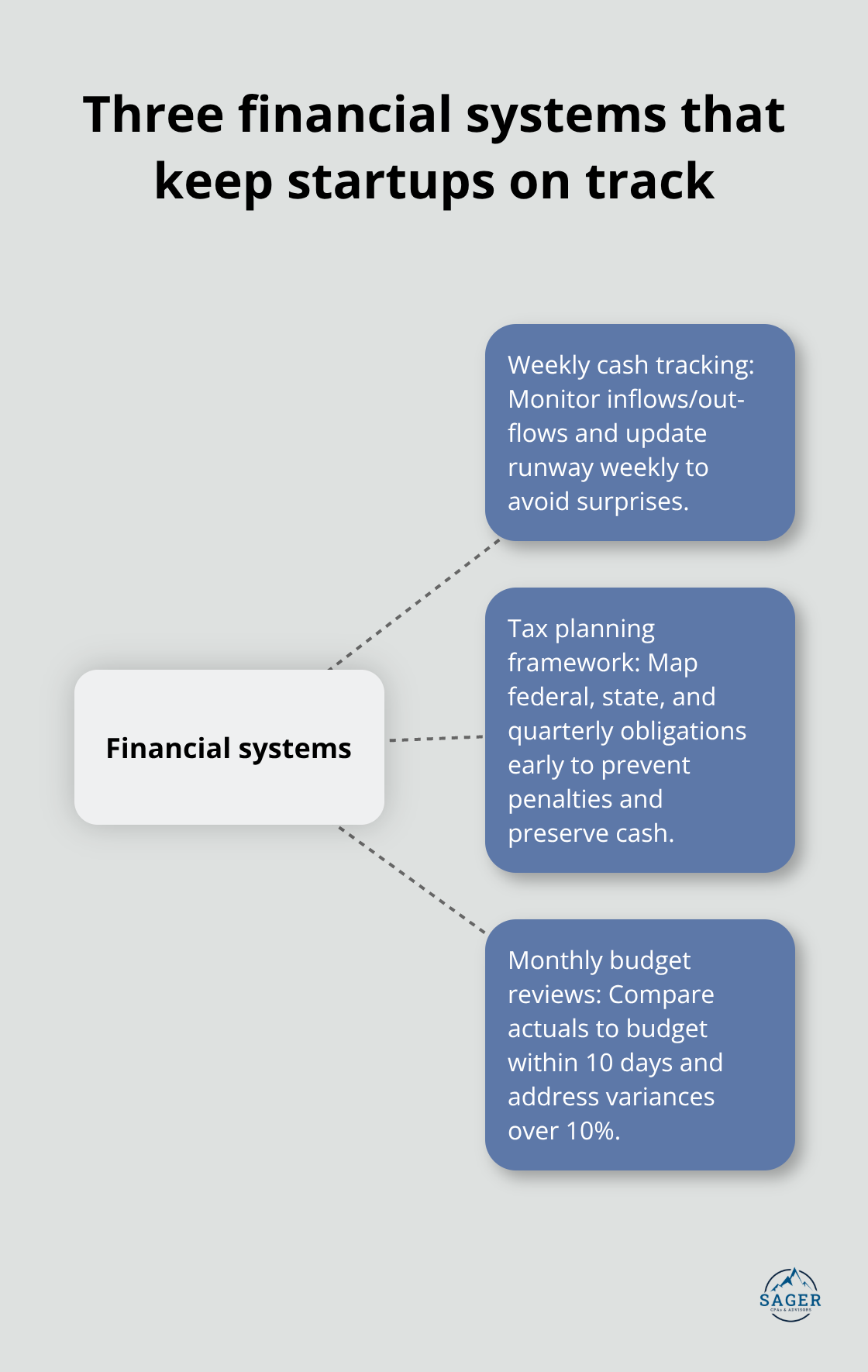
Financial resilience separates startups that scale sustainably from those that collapse under their own weight. The three systems we outlined-weekly cash tracking, tax planning frameworks, and monthly budget reviews-force founders to make decisions based on reality rather than hope. A founder who spots a cash runway problem in week two still has time to cut expenses or accelerate fundraising, while one who discovers it in week eight faces crisis mode with few options.
Professional guidance accelerates financial risk management for startups significantly. A tax professional identifies obligations you’d miss on your own, an accountant spots spending patterns that signal deeper problems, and a financial advisor helps you structure decisions that preserve cash and reduce liabilities. We at Sager CPA work with startups to create personalized financial strategies that align with your specific business model and growth stage-schedule a consultation to build your financial foundation before growth demands exceed your capacity to manage it.
Start today by implementing one system this week. Pick weekly cash tracking first, add tax planning next month, and add budget reviews the month after. Small, consistent actions compound into the financial resilience that enables the growth you’re chasing.




Phone: (208) 939-6029
Email: info@sager.cpa
Privacy Policy | Terms and Conditions | Powered by Cajabra
At Sager CPAs & Advisors, we understand that you want a partner and an advocate who will provide you with proactive solutions and ideas.
The problem is you may feel uncertain, overwhelmed, or disorganized about the future of your business or wealth accumulation.
We believe that even the most successful business owners can benefit from professional financial advice and guidance, and everyone deserves to understand their financial situation.
Understanding finances and running a successful business takes time, education, and sometimes the help of professionals. It’s okay not to know everything from the start.
This is why we are passionate about taking time with our clients year round to listen, work through solutions, and provide proactive guidance so that you feel heard, valued, and understood by a team of experts who are invested in your success.
Here’s how we do it:
Schedule a consultation today. And, in the meantime, download our free guide, “5 Conversations You Should Be Having With Your CPA” to understand how tax planning and business strategy both save and make you money.