
Tax Strategy for Owners: Balancing Personal and Business Goals
Align your tax strategy for owners with business growth. Learn how to balance personal wealth and company goals while minimizing tax liability.
Most business owners focus on maximizing profits without realizing their tax decisions directly shape their personal wealth. At Sager CPA, we’ve seen countless owners leave money on the table because their tax strategy for owners wasn’t aligned with their actual financial goals.
The right approach connects your business structure, income timing, and retirement planning into one cohesive strategy. This blog post shows you how.
Your choice of business structure directly determines how much you pay in taxes and how much wealth you actually keep. An S-corp owner paying themselves a $100,000 salary owes roughly $15,300 in self-employment taxes, while a sole proprietor with the same income pays around $15,300 on the full amount. The difference isn’t just semantics-it’s thousands of dollars annually that either stays in your business or leaves your account. Your business structure affects not just current taxes but also retirement contributions, liability protection, and how easily you can transition ownership later.
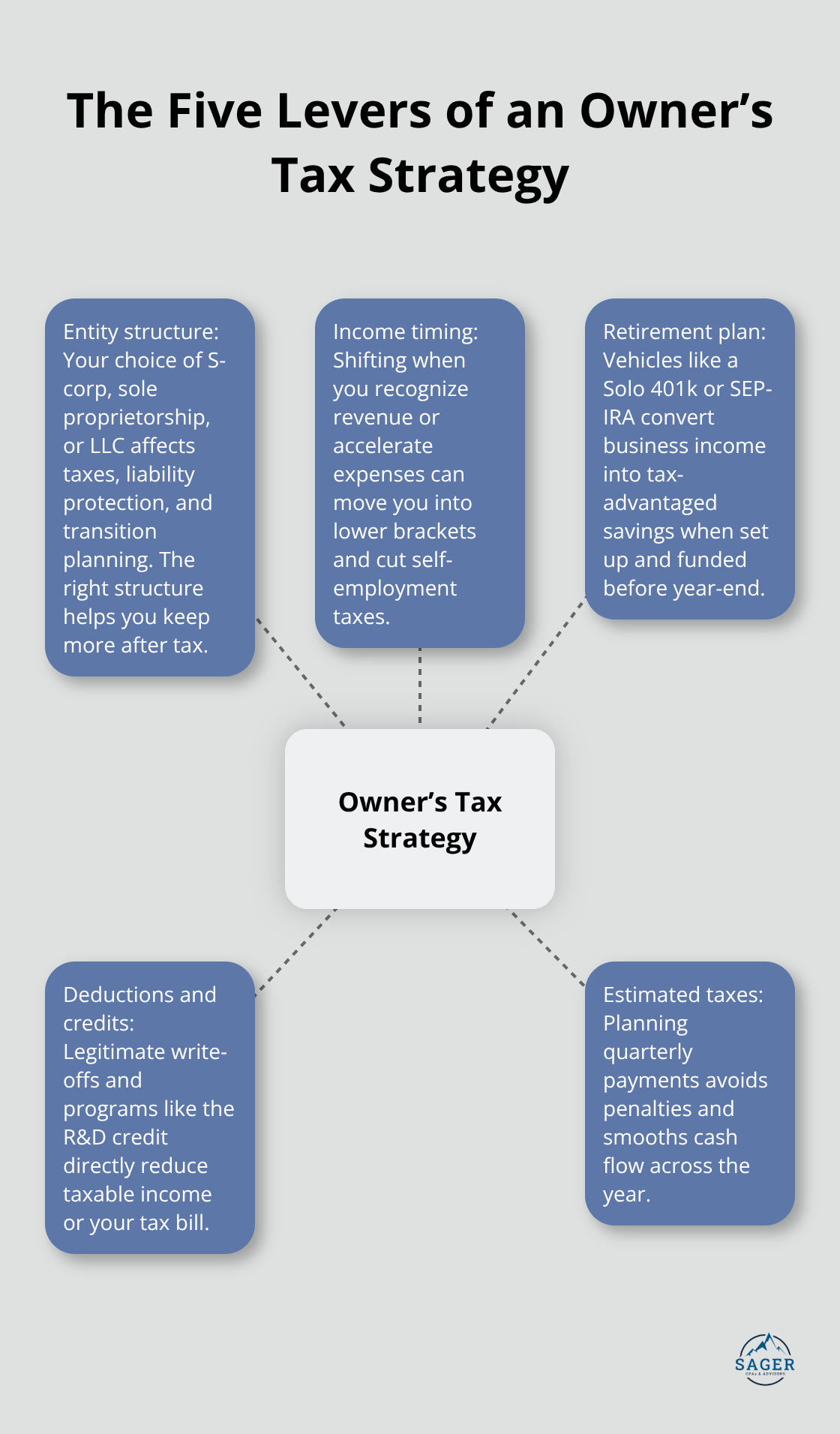
Income timing decisions made in December often determine your tax bill more than anything else you do all year. If you’re a service-based business owner expecting a $50,000 project completion in January, you can defer that invoice to January instead of December and save roughly $12,000–$15,000 in taxes that year. Conversely, you accelerate deductible expenses like equipment purchases or professional development into the current year to reduce your taxable income immediately. Most owners treat this as optional planning, but it’s actually the most controllable lever you have. Track your revenue pipeline monthly so you can spot these opportunities before year-end, not after.
Your retirement savings strategy and your business tax plan must work together, not in isolation. A solo 401k allows you to contribute up to $69,000 annually (as of 2024), but only if your business structure and income support it. An owner earning $80,000 net profit in an S-corp can contribute far more to retirement than a sole proprietor with identical gross revenue, because the entity structure changes how much self-employment tax you owe and therefore how much income remains available. Long-term wealth building requires you to view your business as a tool for funding personal goals, not as a separate financial entity.
Many owners make entity decisions based on outdated advice or incomplete information, then spend years overpaying. The choice you make today affects not just your current tax burden but your ability to build wealth over the next decade. This integration of business structure and personal financial goals determines whether you’re actually building wealth or just earning income-and that distinction matters far more than most owners realize. Understanding how these pieces fit together sets the stage for the strategic planning approaches that actually move the needle on your bottom line.
The difference between an S-corp and a sole proprietorship isn’t theoretical-it’s the difference between keeping $15,000 and losing it to self-employment taxes. S-corp status for business owners with net income above $60,000 works best because the math favors this structure. An S-corp lets you split income into a reasonable W-2 salary and distributions, which dramatically reduces self-employment tax exposure. The IRS requires your salary to be reasonable, typically meaning 40–60% of net profit depending on your industry. A consulting firm owner earning $150,000 net profit might pay themselves a $75,000 salary and take $75,000 in distributions, saving roughly $10,600 in self-employment taxes compared to sole proprietor status. The catch is that S-corp status requires payroll processing and additional tax filings, so factor in $1,500–$3,000 annually for compliance. If your net income stays below $60,000, the administrative burden outweighs the tax savings, and you’re better off staying as a sole proprietor or LLC taxed as a sole proprietor.
Income timing decisions made in November and December determine more of your tax outcome than most owners realize. If you expect a major contract completion or payment in early January, defer the invoice to January and you’ll drop into a lower tax bracket or reduce your self-employment tax burden. Conversely, if you’re sitting on significant deductible expenses-equipment, software licenses, professional development-purchase them before year-end to reduce your 2026 taxable income immediately. The IRS doesn’t care when you spend the money; it cares when you incur the expense. A $20,000 equipment purchase in December reduces your taxable income this year, not next year. Track your revenue pipeline monthly and forecast your year-end income by October so you have time to act. Most owners wait until late December, when opportunities have already passed.
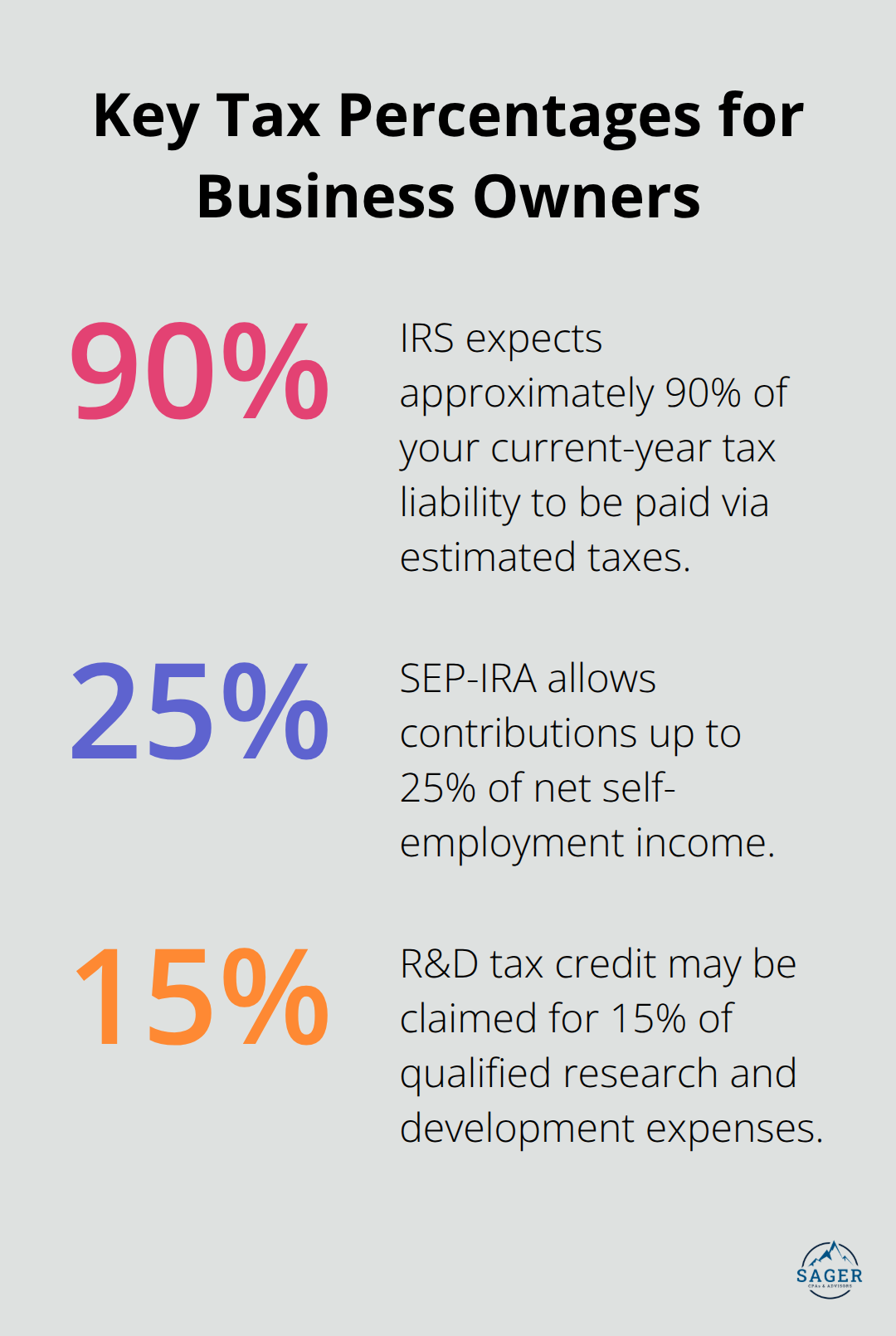
A Solo 401k contribution limits self-employed business owners 2024 at $69,000 annually, but only if your business structure supports it. An S-corp owner can contribute more than a sole proprietor with the same gross revenue because the entity structure changes how much self-employment tax you owe. If you’re self-employed, a SEP-IRA lets you contribute up to 25% of net self-employment income, which for a $100,000 net income means roughly $18,000 annually. That’s $18,000 that doesn’t get taxed this year and compounds tax-free until retirement. The strategy isn’t just about saving for retirement-it’s about reducing your current tax bill while you build wealth.
Choose your retirement plan structure in Q3 or Q4, not January, so you have time to fund it before year-end and capture the current-year tax deduction.
Your business structure and retirement plan work together to maximize tax deductions. An S-corp owner with $150,000 net profit can contribute significantly more to retirement than a sole proprietor earning identical revenue, because the entity structure changes self-employment tax calculations. This means more after-tax income flows into retirement accounts instead of the IRS. The timing of these decisions matters enormously-waiting until January to select a retirement plan means you’ve already lost the current-year deduction opportunity. These strategic choices set the foundation for how you’ll manage quarterly tax obligations and protect your actual profit.
Most business owners claim deductions they shouldn’t and miss deductions they absolutely should. We’ve watched owners waste thousands because they either play it too safe or too aggressive. The IRS allows you to deduct ordinary and necessary business expenses-expenses that directly support revenue generation. Office supplies, software subscriptions, vehicle mileage for business purposes, professional fees, and equipment purchases all qualify. Meals and entertainment now face 50% deductibility limits (with rare exceptions), commuting to your office isn’t deductible, and personal expenses disguised as business expenses trigger audits.
Documentation makes the difference between a deduction and an audit. The IRS requires you to track what you spent, when you spent it, and why it was business-related. A $3,000 equipment purchase without a receipt means zero deduction. A $3,000 equipment purchase with an invoice, date, and business purpose description means full deduction. Track every expense in accounting software like QuickBooks or FreshBooks throughout the year, not in a shoebox in December.
Home office deductions trip up owners because the IRS scrutinizes them heavily. You can claim either the simplified method at $5 per square foot of dedicated office space (up to 300 square feet, so maximum $1,500 annually) or the actual expense method. The actual expense method calculates utilities, rent, insurance, and depreciation based on your office percentage of total home square footage. This approach typically yields larger deductions for owners with dedicated office space, but it requires meticulous documentation of all home-related costs.
Vehicle expenses work similarly: track miles driven for business purposes, note the date and business purpose, and deduct either actual expenses (gas, maintenance, insurance) or the IRS standard mileage rate (67 cents per mile in 2024). Most owners underestimate their mileage and miss thousands in deductions.
Tax credits operate completely differently from deductions, and many owners ignore them entirely. A deduction reduces your taxable income; a credit reduces your actual tax bill dollar-for-dollar. The R&D tax credit allows you to claim 15% of qualified research and development expenses, which for a software company or manufacturer can mean $5,000 to $15,000 annually. The Work Opportunity Tax Credit provides credits for hiring workers from targeted groups, ranging from $1,200 to $9,600 per employee depending on the group.
Equipment purchases may qualify for Section 179 deductions, allowing you to immediately deduct up to $1,160,000 in equipment purchases in 2024 instead of spreading depreciation across multiple years. This matters enormously for cash flow: a $50,000 equipment purchase claimed under Section 179 reduces your 2024 taxable income immediately, lowering your quarterly estimated taxes due in 2025.
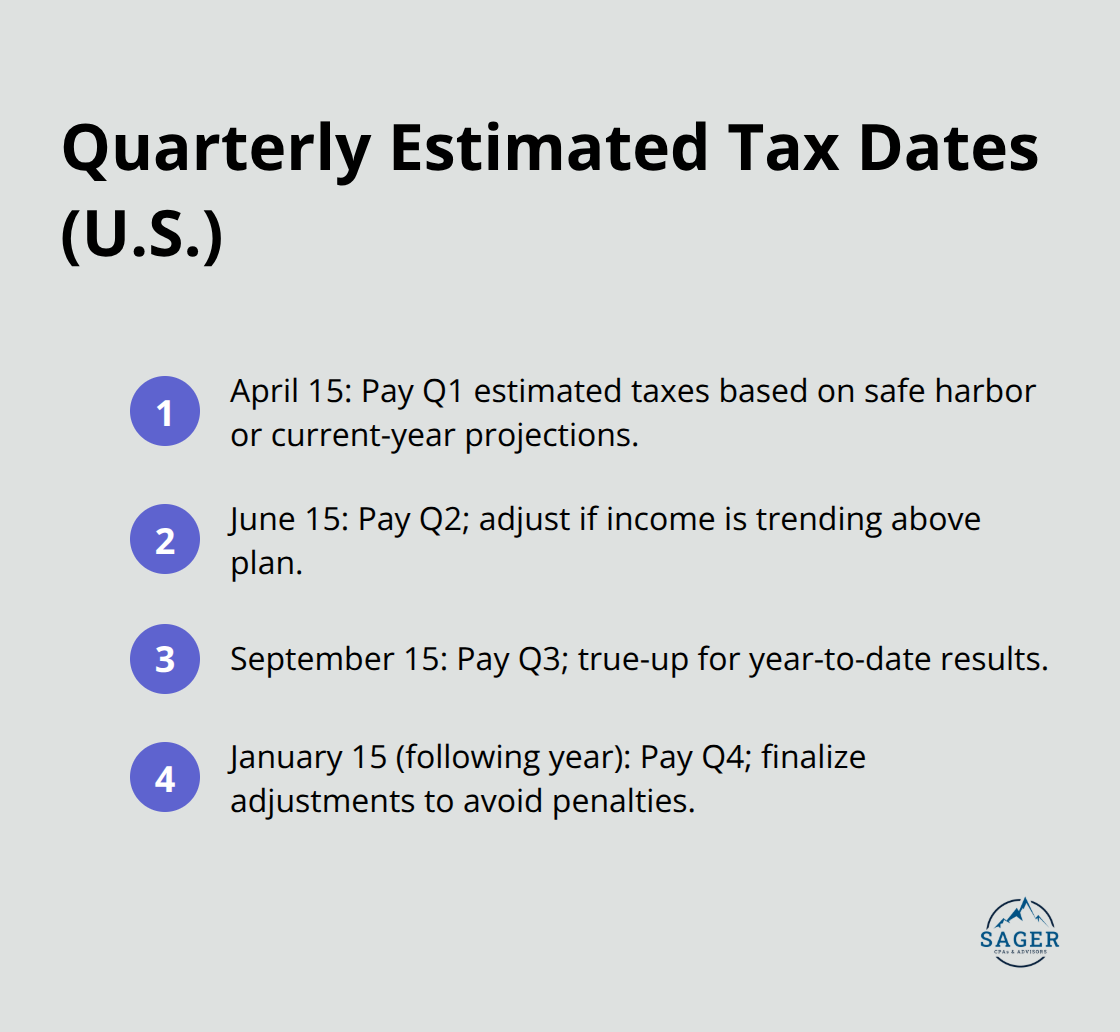
Quarterly estimated taxes are where most owners hemorrhage money through poor planning. If you’re self-employed or a business owner, you owe quarterly estimated taxes on April 15, June 15, September 15, and January 15 of the following year. The IRS expects you to pay approximately 90% of your current-year tax liability across these four payments.
Underpayment penalties apply automatically, even if you ultimately owe nothing when you file your return.
Calculate your estimated taxes based on your previous year’s income, then adjust in September when you can see actual year-to-date results. If you earned $150,000 last year and expect similar income this year, divide your previous year’s total tax liability by four and pay that amount quarterly. If income surges mid-year, increase September and January payments to avoid massive penalties. Most owners base all four quarterly payments on the same amount, then face a January bill when income actually grew.
The tax strategy for owners you implement today determines whether you build wealth or simply earn income. Your business structure, income timing, retirement contributions, and deduction strategy work together as interconnected levers that either amplify your results or undermine them. Most owners leave $10,000 to $50,000 annually on the table because they treat tax planning as an afterthought rather than a core business strategy.
The owners who win make deliberate choices about entity structure in Q3, track their revenue pipeline monthly to spot income timing opportunities, and claim every legitimate deduction and credit they qualify for. These aren’t complicated tactics-they’re disciplined execution that compounds over years. If you’re currently a sole proprietor earning over $60,000 annually, the S-corp math could save you thousands this year, and if you haven’t reviewed your retirement plan structure since you started your business, you’re likely missing significant tax deductions.
We at Sager CPA work with business owners to build tax strategies that align with your actual financial goals, not generic templates. We help you structure your entity correctly, time your income strategically, and maximize legitimate deductions so you keep more of what you earn. Contact us to create a personalized tax strategy built around your specific business and personal goals.




Phone: (208) 939-6029
Email: info@sager.cpa
Privacy Policy | Terms and Conditions | Powered by Cajabra
At Sager CPAs & Advisors, we understand that you want a partner and an advocate who will provide you with proactive solutions and ideas.
The problem is you may feel uncertain, overwhelmed, or disorganized about the future of your business or wealth accumulation.
We believe that even the most successful business owners can benefit from professional financial advice and guidance, and everyone deserves to understand their financial situation.
Understanding finances and running a successful business takes time, education, and sometimes the help of professionals. It’s okay not to know everything from the start.
This is why we are passionate about taking time with our clients year round to listen, work through solutions, and provide proactive guidance so that you feel heard, valued, and understood by a team of experts who are invested in your success.
Here’s how we do it:
Schedule a consultation today. And, in the meantime, download our free guide, “5 Conversations You Should Be Having With Your CPA” to understand how tax planning and business strategy both save and make you money.