
Advisory for Growth Businesses: Strategic Guidance for Scaling
Get strategic guidance for scaling your growth business with actionable insights on planning, funding, and operational excellence.
Most people file taxes the same way every year, missing thousands in savings. Your financial situation is unique, yet standard tax approaches treat everyone identically.
At Sager CPA, we’ve seen how personalized tax strategy plans transform what clients actually owe. This roadmap shows you how to build a strategy that fits your life, not a template.
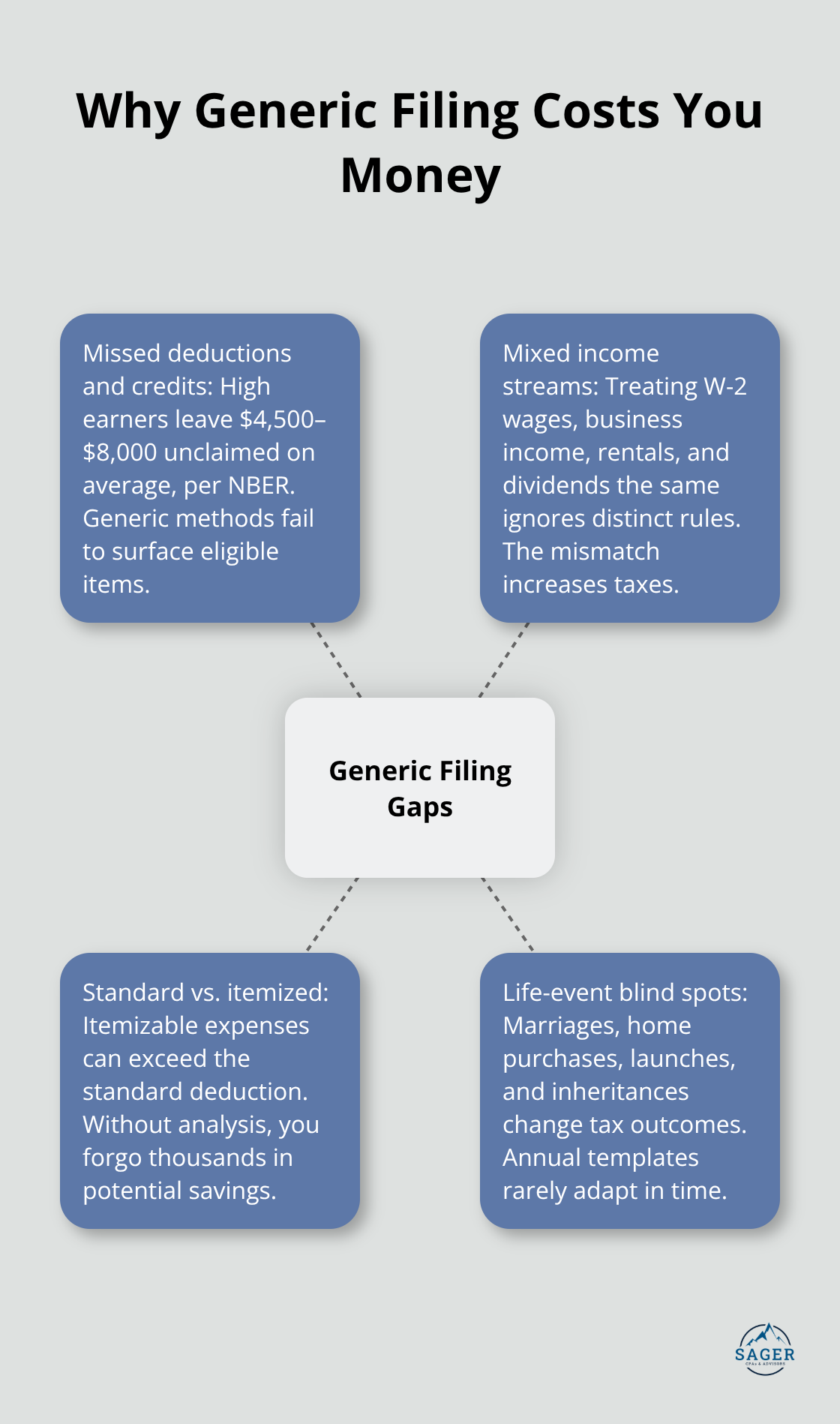
The IRS publishes data showing that high earners leave significant tax savings on the table every year. According to the National Bureau of Economic Research, high earners miss an average of $4,500 to $8,000 in deductions and credits they qualify for but don’t claim. This happens because most people follow generic tax filing methods that apply the same logic to everyone, regardless of income sources, life circumstances, or financial goals. If you earn W-2 income, run a side business, own rental property, and receive investment dividends, a standard approach treats these income streams with the same generic strategy it applies to someone with only a salary.
That fundamental mismatch is where money disappears.
The standard deduction makes sense for many people, but it actively works against high earners. For 2025, the standard deduction is $23,625 for single filers and $31,500 for married couples filing jointly. If your itemized deductions exceed standard deduction threshold, you’re leaving money on the table by not itemizing. High earners often have substantial mortgage interest, charitable contributions, state and local taxes, and business expenses that far exceed the standard deduction threshold. A generic tax approach won’t identify whether itemizing saves you $5,000, $15,000, or $30,000 compared to the standard deduction. Clients often discover they could have saved substantial amounts in prior years simply by switching to itemized deductions that their previous tax preparer never analyzed.
Your income doesn’t come from just one place. If you receive W-2 wages, 1099 contractor income, rental income, capital gains, and business profits, each source has different tax implications and optimization opportunities. A one-size-fits-all approach applies the same withholding strategy to all income, when in reality each source offers distinct planning opportunities. Rental income allows depreciation deductions that W-2 income doesn’t. Contractor income lets you deduct home office expenses and equipment purchases that salaried employees can’t claim. Capital gains have preferential tax rates that don’t apply to ordinary income. Generic tax software or basic tax preparation doesn’t distinguish between these opportunities because it’s designed to process returns, not optimize them. Your situation requires analysis of how each income stream interacts with your overall tax liability and what specific deductions and strategies apply to each one.
Marriage, children, home purchases, business launches, inheritances, or major job changes all trigger different tax consequences. A strategy that worked perfectly last year may create unnecessary tax burden this year if your circumstances shifted. Standard approaches treat each year independently without connecting past decisions to future tax planning. A marriage changes your filing status and introduces spouse income considerations. A home purchase opens access to mortgage interest deductions and property tax deductions. A business launch creates opportunities for retirement plan contributions and business expense deductions that didn’t exist before. Off-the-shelf tax plans can’t adapt to these transitions because they’re built on assumptions that don’t reflect your actual life.
These mismatches between your real situation and generic tax strategies explain why so many high earners overpay. The next section shows what a personalized tax strategy actually includes and how it addresses these gaps.
A personalized tax strategy starts with understanding exactly how much you earn and where it comes from. Each income stream-W-2 wages, self-employment income, rental profits, and investment returns-carries different tax consequences and optimization paths. The IRS tax code sections apply differently depending on your specific income composition. When you have multiple income sources, the interaction between them matters enormously. If you earn $120,000 in W-2 wages and $40,000 in self-employment income, that $40,000 doesn’t simply add on top-it affects your Medicare taxes, your ability to contribute to certain retirement accounts, and potentially your eligibility for various credits. A proper analysis identifies which deductions apply to which income stream and calculates the actual tax impact of each dollar earned. This requires examining your complete financial picture, not just processing a tax return form.
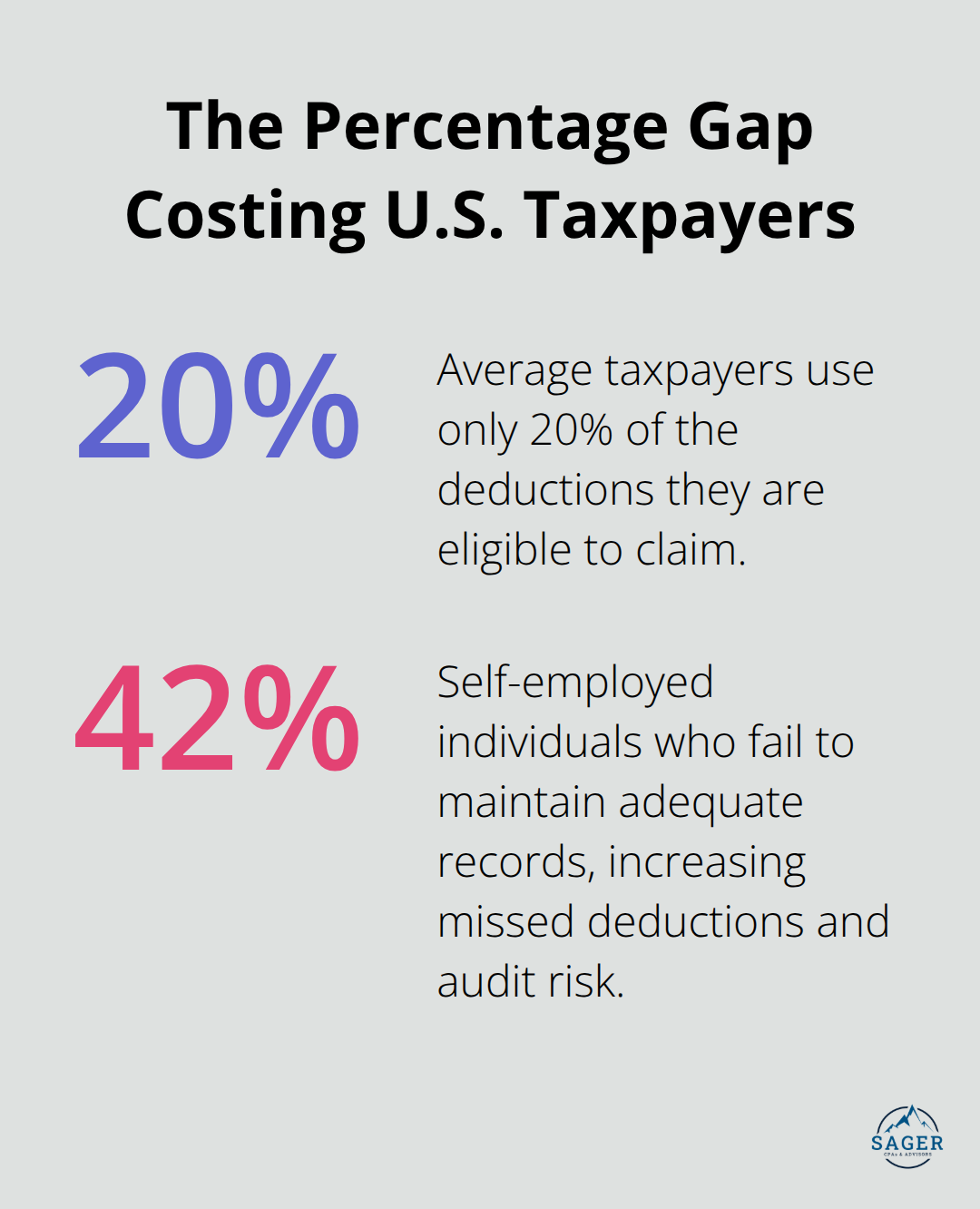
Most people claim far fewer deductions than they qualify for because they don’t know what exists. The Tax Foundation reports that the average taxpayer uses only 20 percent of available deductions they’re eligible to claim. Self-employed individuals can deduct home office space, internet, phone, vehicle mileage, equipment, software subscriptions, and professional development-but only if someone identifies these opportunities in your specific situation.
Rental property owners can deduct depreciation, property management fees, repairs, utilities, and insurance, yet many claim only mortgage interest and property taxes. Investment income holders often miss deductions for investment advisory fees, tax preparation costs, and investment research. The deduction mapping process requires examining your actual receipts, invoices, and financial records against what tax law allows for your situation. Generic tax software asks yes-or-no questions about broad categories, but real optimization requires detailed analysis of what you spent money on and whether it qualifies under current tax rules.
Major financial events demand immediate tax strategy adjustments, not annual afterthoughts. When you marry, your filing status changes, which affects tax brackets, standard deductions, and credits available to you. The IRS allows married couples filing jointly to access different deduction thresholds and income phase-outs than single filers, but this only helps if you plan around it before year-end. A business launch requires decisions about entity structure, retirement plan setup, and quarterly estimated tax payments that you cannot make after December 31st. Selling rental property triggers capital gains taxes that proper planning could have minimized through timing or installment sale treatment. Inheriting assets creates step-up basis opportunities that disappear if you don’t act quickly. These aren’t minor adjustments-they’re structural decisions that determine whether you pay 25 percent or 35 percent on certain income. A real strategy connects your life events to tax planning months in advance, not in April when the year is already finished.
Your income doesn’t come from just one place, and each source interacts with the others in ways that standard approaches miss. W-2 wages, 1099 contractor income, rental income, capital gains, and business profits all have distinct tax implications. A one-size-fits-all approach applies the same withholding strategy to all income, when in reality each source offers distinct planning opportunities. Rental income allows depreciation deductions that W-2 income doesn’t. Contractor income lets you deduct home office expenses and equipment purchases that salaried employees can’t claim. Capital gains have preferential tax rates that don’t apply to ordinary income. Generic tax software or basic tax preparation doesn’t distinguish between these opportunities because it’s designed to process returns, not optimize them. Your situation requires analysis of how each income stream interacts with your overall tax liability and what specific deductions and strategies apply to each one.
These components form the foundation of a strategy that actually reflects your financial reality. The next section walks through how to build this strategy step by step, starting with the financial documentation you need to gather.
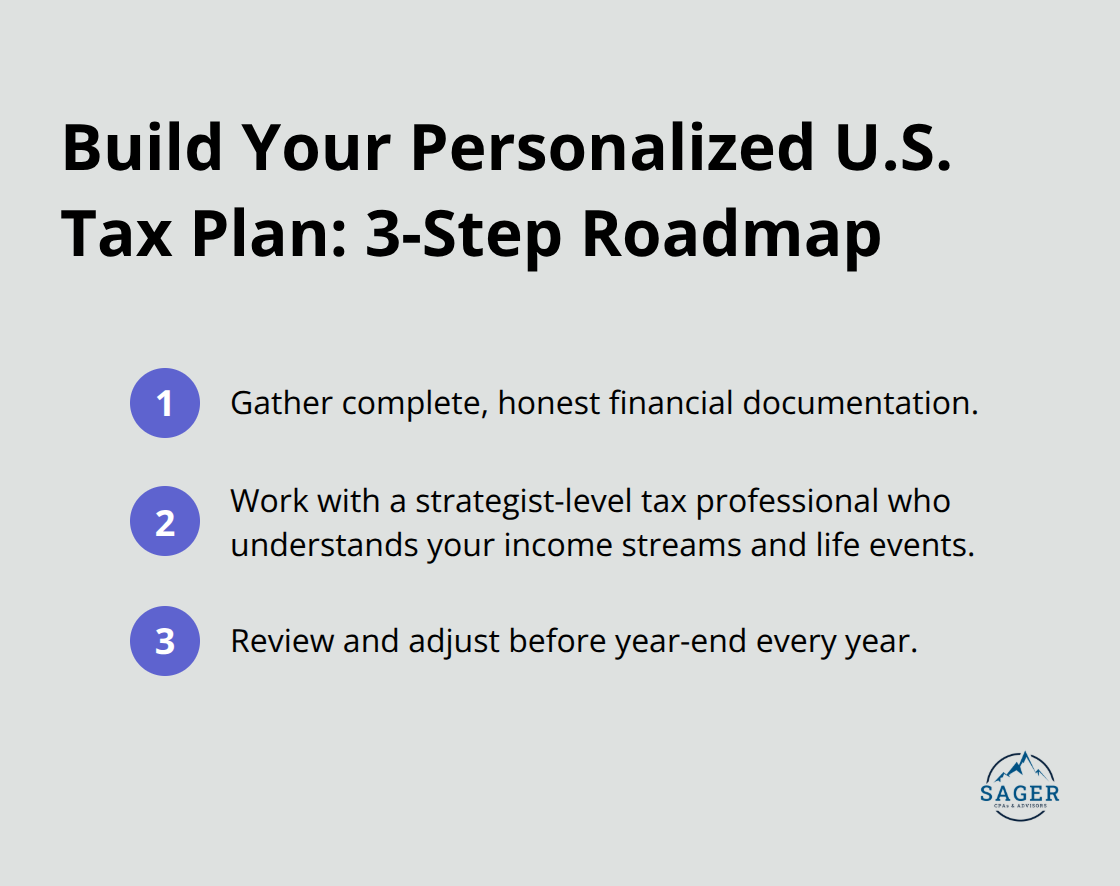
Start a personalized tax strategy with honest financial documentation before any planning happens. Collect your last two years of tax returns, recent pay stubs showing year-to-date income and withholdings, bank statements for all accounts, investment statements showing gains and losses, receipts for business expenses or rental property costs, mortgage statements, and records of any major purchases or sales. The IRS reports that 42 percent of self-employed individuals fail to maintain adequate records, which directly costs them in missed deductions and audit vulnerability.
Without complete documentation, a tax professional works with incomplete information and misses optimization opportunities. Many clients assume they need to organize everything perfectly before meeting with a professional, but that assumption wastes time. Bring disorganized records and let the professional identify what matters. What you absolutely need is everything related to income sources, significant expenses, and life changes from the past year.
If you sold property, received an inheritance, started a business, or experienced major medical expenses, those documents take priority.
A tax professional who understands your specific income streams and life situation transforms generic tax filing into actual strategy. The difference between a preparer who processes returns and a strategist who optimizes them shows up immediately in your bottom line. A strategist asks detailed questions about your business operations, rental property management, investment activity, and upcoming life events rather than simply requesting forms and filing them.
They identify whether you should elect S-corporation status for your business, whether a solo 401k or SEP-IRA better serves your retirement savings, whether you qualify for the Qualified Business Income deduction, and whether timing your income or deductions differently would reduce your tax burden. They also establish a timeline for tax planning decisions throughout the year rather than waiting until March to address December income. This proactive approach (connecting financial decisions to actual tax outcomes, not just completing paperwork) separates real strategy from basic tax preparation.
After your initial strategy is built, annual reviews become non-negotiable because tax law changes, your income shifts, and life circumstances evolve. The Tax Foundation found that tax code changes occur an average of 15 times per year, meaning strategies that worked perfectly last year may be suboptimal this year. Schedule your review before year-end, not after, so adjustments to withholding, estimated payments, or retirement contributions actually happen in time to matter.
Tax law changes frequently enough that what worked last year may cost you money this year. Your income likely shifted, your family situation may have changed, and new deductions or credits may apply to your circumstances. A professional review identifies these shifts and adjusts your strategy accordingly (rather than assuming last year’s approach still works). This annual adjustment habit prevents overpayment and captures opportunities that emerge throughout the year.
Personalized tax strategy plans deliver measurable results that generic approaches cannot match. The clients we work with at Sager CPA consistently recover thousands in tax savings by moving beyond standard filing methods to strategies built around their actual income, deductions, and life circumstances. These aren’t theoretical savings-they’re real money that stays in your pocket instead of going to the IRS.
DIY tax filing and basic tax preparation software treat your situation like everyone else’s situation. They process forms and produce returns, but they don’t optimize your tax position. A tax professional who understands your specific income streams, business structure, rental properties, and upcoming life events identifies opportunities that software misses entirely (the difference between filing your taxes and strategizing your taxes shows up in your bottom line year after year).
We at Sager CPA help individuals and businesses create customized action plans that reduce tax liabilities while building long-term financial stability. Schedule a consultation to start building your personalized tax strategy today and discover what your actual tax obligation should be.




Privacy Policy | Terms and Conditions | Powered by Cajabra
At Sager CPAs & Advisors, we understand that you want a partner and an advocate who will provide you with proactive solutions and ideas.
The problem is you may feel uncertain, overwhelmed, or disorganized about the future of your business or wealth accumulation.
We believe that even the most successful business owners can benefit from professional financial advice and guidance, and everyone deserves to understand their financial situation.
Understanding finances and running a successful business takes time, education, and sometimes the help of professionals. It’s okay not to know everything from the start.
This is why we are passionate about taking time with our clients year round to listen, work through solutions, and provide proactive guidance so that you feel heard, valued, and understood by a team of experts who are invested in your success.
Here’s how we do it:
Schedule a consultation today. And, in the meantime, download our free guide, “5 Conversations You Should Be Having With Your CPA” to understand how tax planning and business strategy both save and make you money.