
Early-Stage Startup Budgeting: Build a Financial Foundation for Launch
Create a financial foundation for your startup with early-stage budgeting essentials, expense tracking, and funding strategies for launch success.
Selling your business is one of the biggest financial decisions you’ll make as an owner. Exit planning for owners isn’t something to figure out at the last minute-it requires strategy, timing, and clear goals.
At Sager CPA, we’ve helped countless business owners navigate this process and maximize their outcomes. This guide walks you through aligning your exit strategy with what actually matters to your future.
Exit planning means determining how and when you’ll transition ownership of your business while maximizing what you walk away with. This isn’t about vague retirement dreams or someday selling your company. You need a concrete roadmap that connects your business’s current state to your specific financial and lifestyle goals. Research from the Exit Planning Institute shows that business owners who plan their exit in advance typically realize higher valuations than those who rush the process. That’s a meaningful difference-it reflects the value of preparation. Timing matters because preparing your business for sale takes work, and buyers notice when corners were cut. Starting early also gives you time to fix operational gaps, strengthen financial records, and build systems that don’t depend entirely on you.
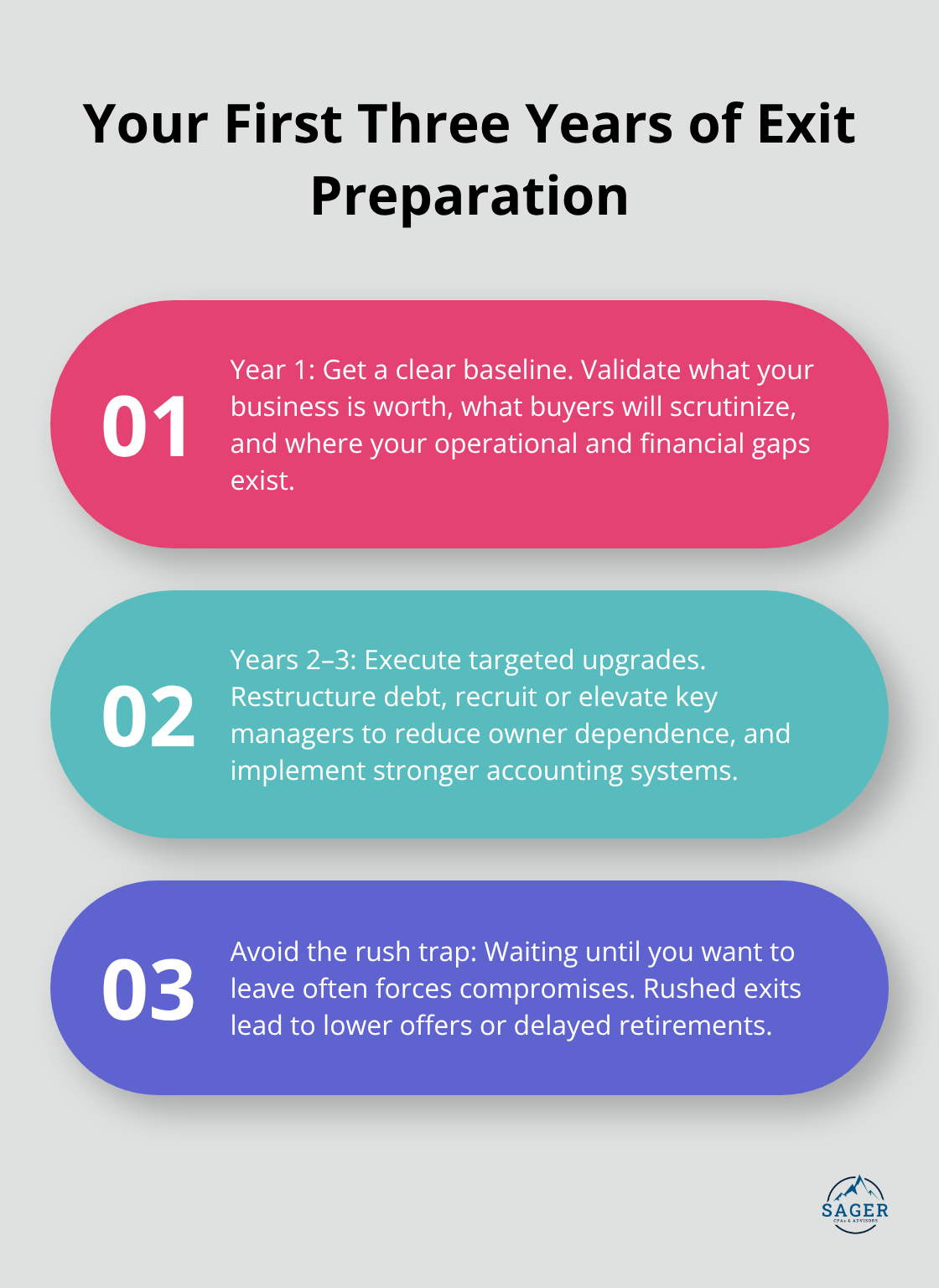
Most business owners underestimate how much time they need to prepare. If you’re thinking about exiting in five years, you should start planning today. The first year focuses on understanding your current position-what your business is actually worth, what buyers will scrutinize, and where your gaps are. Years two and three involve making strategic improvements that increase value. You might restructure debt, hire key management to reduce your role, or implement better accounting systems. You might also realize that your business needs significant work before it’s sale-ready, which means starting sooner gives you options instead of forcing rushed decisions. Owners who wait until they’re ready to leave often discover they’re not ready at all, which leads to either accepting lower offers or delaying retirement.
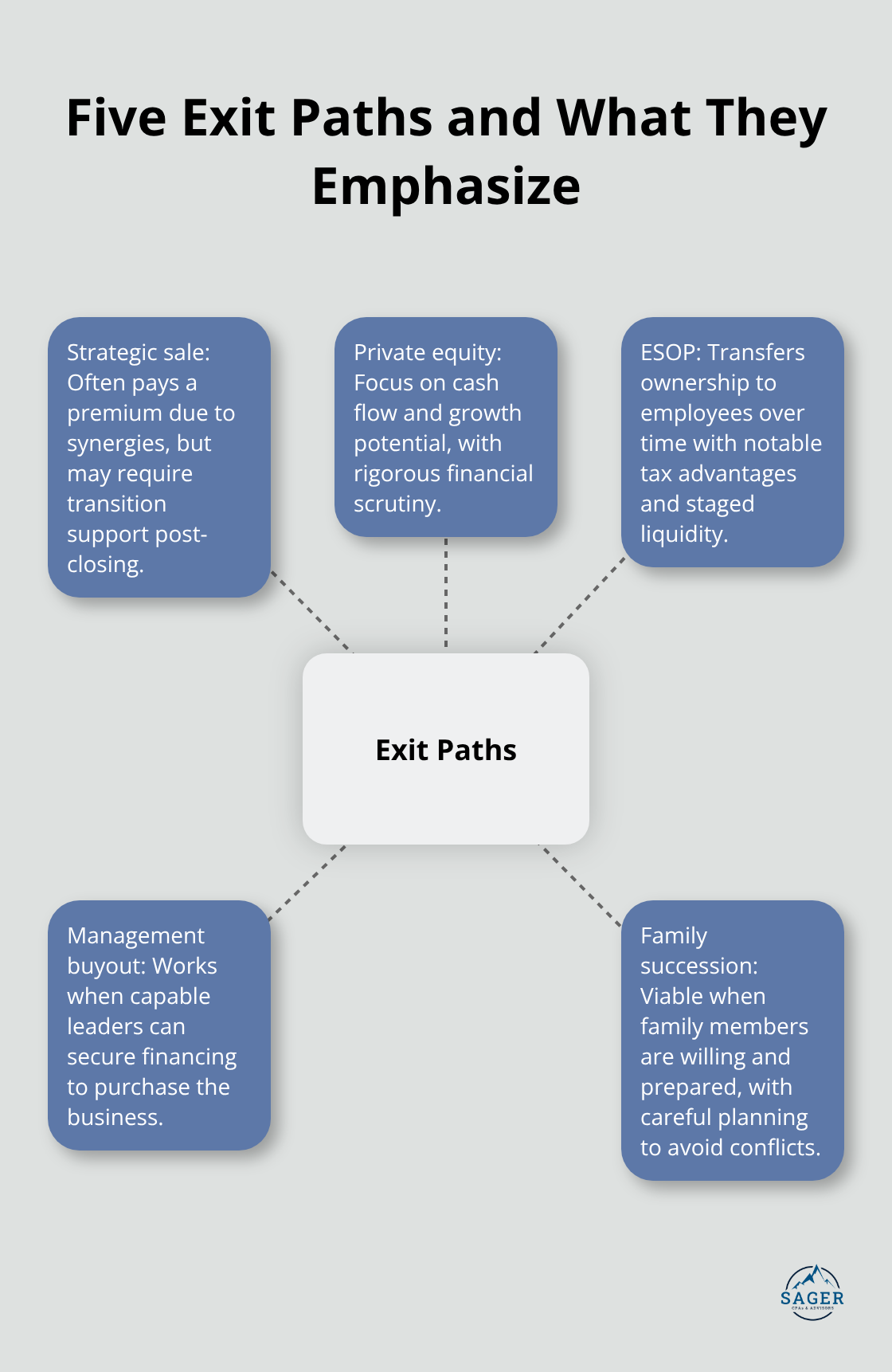
You have multiple ways to leave your business, and each has different implications for your taxes, timeline, and personal involvement afterward. A direct sale to a buyer-whether a strategic buyer in your industry or a financial buyer like a private equity firm-remains the most common path. Strategic buyers often pay premiums because they see synergies with their existing operations. Private equity buyers care about cash flow and growth potential, so they’ll scrutinize your financials carefully. An employee stock ownership plan transfers ownership to your employees over time while giving you liquidity and significant tax advantages. A management buyout works if you have capable leaders who can secure financing to purchase the business from you. Family succession makes sense if you have family members willing and able to run the business, though it requires careful planning to avoid family conflict and tax complications. Each path has different requirements, timelines, and financial outcomes.
The right exit strategy depends on your specific circumstances, not on what worked for someone else’s business. Your choice affects how much money you receive, when you receive it, and what role you play after the sale. Some owners want a clean break and maximum cash upfront. Others prefer ongoing involvement or want to see their employees benefit from the sale. Your personal goals matter just as much as the financial numbers. The next step involves identifying your financial targets and understanding which exit path actually aligns with what you want your life to look like after you leave the business.
Exit planning means defining what success looks like for you personally, then working backward to figure out how to get there. Your financial targets and lifestyle objectives come first, not second. Start with a specific number: How much money do you need to walk away with after taxes? Only 20 to 30% of businesses that go to market actually sell, leaving most owners without solid options to harvest their wealth. Factor in your desired retirement lifestyle, healthcare costs, and whether you want to leave money for your family or charitable causes. A business owner who thinks they need $2 million often discovers they actually need $3 million when they account for taxes, inflation over a 30-year retirement, and the lifestyle they actually want to live. Write down your number.

Make it specific. If it’s vague, your entire plan becomes vague.
Once you know your target, evaluate which exit path gets you there. A strategic sale might offer the highest valuation but requires you to stay involved for 12 to 24 months post-closing to ensure smooth transition. A private equity buyer might pay less upfront but structure an earnout that could add 20 to 30 percent more if the business hits performance targets in years two and three. An ESOP works well if you want a tax-efficient exit and don’t need all your money immediately, since you can spread the payout over several years. A family succession only makes sense if your family members actually want to run the business and have the capability to do so, not because it feels like the right thing to do.
Your timeline directly influences which path works. If you need your money in two years, a strategic sale is realistic. A family succession typically requires five to seven years minimum. Build your timeline backward from your target exit year. If you want to exit in five years, determine what needs to happen in year four, year three, year two, and starting right now in year one. Most owners need 18 to 24 months just to get their financial records and operations clean enough for buyer scrutiny. Add another 12 to 18 months for actual sale negotiations and closing. This means your real preparation window is much shorter than you think.
Different exit paths deliver different results at different timelines. You need to understand exactly what each path delivers in real dollars and real timing before you commit to one direction. Stress-testing scenarios reveals which path actually aligns with your financial goals and your personal goals. This analysis shows you whether you can hit your number through a strategic sale, whether an earnout structure makes sense for your situation, or whether you need to pursue a different path entirely. The numbers tell you what’s actually possible, not what you hope might happen.
Your timeline and financial targets now point toward specific exit paths. The next step involves preparing your business to execute that path successfully, which means strengthening your financial records and operations so buyers take you seriously.
Buyers scrutinize financial records and operational systems before they commit to any purchase. The difference between a business that sells quickly at full asking price and one that sits on the market for months comes down to preparation. Most owners underestimate how much work this takes, which is why starting 18 to 24 months before your target exit date matters so much.
Your financial records need to be accurate, complete, and easy to verify. Buyers want to see three years of audited or reviewed financial statements, clean tax returns with no red flags, and documentation that supports every number on your income statement. If your bookkeeping has been loose or inconsistent, you’ll spend months getting it audit-ready, which delays everything else.
Implement cloud-based accounting software that tracks expenses in real time and separates personal and business spending completely. Get your accounts receivable under control by collecting outstanding invoices aggressively. Document your customer contracts, vendor agreements, and employee arrangements in writing so buyers see a stable, documented operation rather than a handshake business.
Your operational systems matter just as much as your financial records. Buyers want to understand exactly how your business generates revenue and manages costs. Create an operations manual that documents your key processes, decision-making authority, and quality control procedures.
If your business depends heavily on your personal relationships or your direct involvement, buyers will discount the valuation significantly because they see risk. Reduce that risk by documenting how work actually gets done and proving that capable team members can execute without you.
Increasing what your business is worth before sale requires specific, measurable actions. Research shows that documented management teams and recurring revenue streams command higher valuations than owner-dependent businesses.
Start by diversifying your customer base if you have concentration risk (meaning one or two customers represent more than 20 percent of revenue). Buyers see concentration as a major risk and will reduce their offer accordingly. Improve your gross margins by renegotiating supplier contracts or raising prices where your market position allows it. Reduce your operating expenses by eliminating unprofitable services or customers that consume resources without delivering adequate revenue.
Invest in key hires that reduce your personal workload and prove the business functions without you. If your business has debt, work toward paying down high-interest obligations before sale. Buyers often assume debt will be repaid from business cash flow, which reduces what they’re willing to pay. Clean balance sheets command better valuations.
Different exit paths trigger different tax consequences. A direct sale to a strategic buyer might generate immediate capital gains taxes on the full sale price. An ESOP structure can defer taxes if you reinvest proceeds into qualified securities. An earnout arrangement spreads gain recognition across multiple years, potentially keeping you in lower tax brackets.
Professional guidance helps you model these scenarios and identify the structure that minimizes your tax liability while hitting your financial goals. The wrong structure can cost you hundreds of thousands of dollars, so this analysis needs to happen during your planning phase, not after you’ve already committed to a buyer.
Exit planning for owners requires clarity, preparation, and professional guidance working together. Your financial targets come first, your exit path flows from those targets, and your timeline determines what’s actually possible. The owners who walk away satisfied started planning years earlier, strengthened their financial records, reduced their personal dependence on the business, and structured their exit for tax efficiency.
Write down your specific financial target and your desired exit year, then identify which exit path aligns with both numbers. Assess your current position honestly: Do your financial records withstand buyer scrutiny? Does your business function without you? Are your customer relationships documented or dependent on personal relationships? These questions reveal exactly where you need to focus your preparation efforts.
Tax implications, valuation methodology, deal structure, and timing all interact in ways that significantly impact your outcome, which is why you shouldn’t navigate this alone. We at Sager CPA help business owners model different scenarios, identify which exit path delivers your financial goals, and structure your transaction for maximum tax efficiency. Schedule a consultation with us to create a personalized exit strategy that actually works for your situation.




Phone: (208) 939-6029
Email: info@sager.cpa
Privacy Policy | Terms and Conditions | Powered by Cajabra
At Sager CPAs & Advisors, we understand that you want a partner and an advocate who will provide you with proactive solutions and ideas.
The problem is you may feel uncertain, overwhelmed, or disorganized about the future of your business or wealth accumulation.
We believe that even the most successful business owners can benefit from professional financial advice and guidance, and everyone deserves to understand their financial situation.
Understanding finances and running a successful business takes time, education, and sometimes the help of professionals. It’s okay not to know everything from the start.
This is why we are passionate about taking time with our clients year round to listen, work through solutions, and provide proactive guidance so that you feel heard, valued, and understood by a team of experts who are invested in your success.
Here’s how we do it:
Schedule a consultation today. And, in the meantime, download our free guide, “5 Conversations You Should Be Having With Your CPA” to understand how tax planning and business strategy both save and make you money.