
Early-Stage Startup Budgeting: Build a Financial Foundation for Launch
Create a financial foundation for your startup with early-stage budgeting essentials, expense tracking, and funding strategies for launch success.
Most early-stage startups fail not because of a bad idea, but because they run out of money. Early-stage startup budgeting is the difference between a launch that gains traction and one that stalls before takeoff.
At Sager CPA, we’ve seen firsthand how a solid financial foundation changes everything. This guide walks you through the budget categories, cash flow planning, and common mistakes that derail new ventures.
Payroll typically consumes 60 to 70 percent of an early-stage startup’s budget, and this is where most founders make their first mistake: they hire too fast. About one-third of new business owners admit to underestimating monthly expenses, according to industry research, and aggressive hiring is the culprit. We recommend a counterintuitive approach-hire slowly and grow staffing aligned with revenue milestones, not ambition. If you’re pre-revenue, you don’t need a full team. Start with a founder or two, then add a fractional CFO or outsourced accountant to handle finances without the fixed cost of a full-time employee. Once you hit a revenue milestone, bring on your first full-time hire. This staged approach preserves runway and reduces the psychological and reputational risk of layoffs if growth stalls.
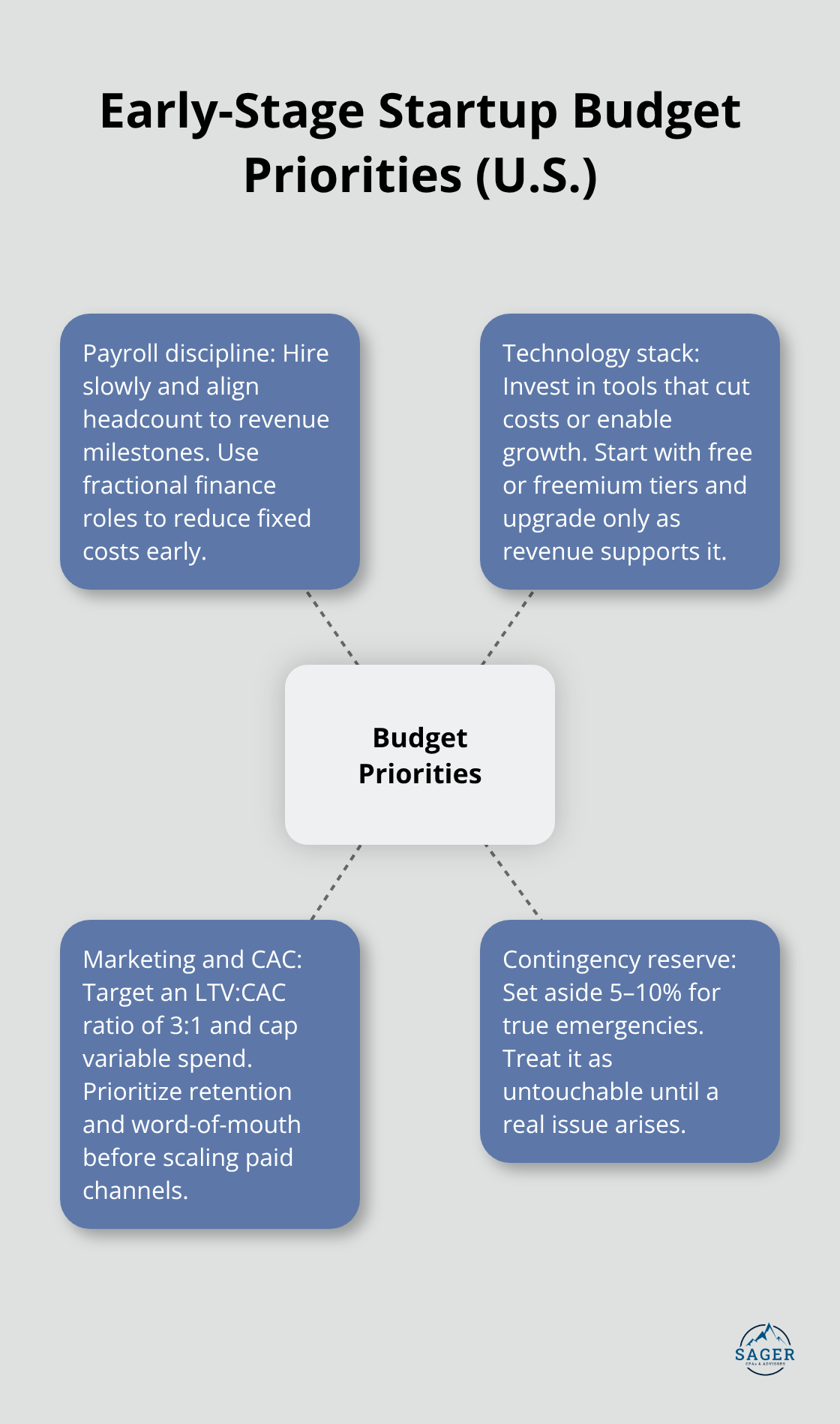
Your tech stack directly impacts how efficiently you operate and how quickly you can scale. Prioritize tools that reduce costs or enable growth: accounting software, project management platforms, and customer relationship management systems. Use free or freemium versions initially and upgrade only when revenue allows. Quality accounting software prevents costly errors later and keeps your books organized for investor due diligence. The right tools compound your efficiency without inflating fixed costs early on.
This is where startups often overspend without discipline. Target a customer acquisition cost to customer lifetime value ratio of 3:1, meaning you spend one dollar to acquire a customer worth three dollars in lifetime value. Forbes notes that startups often spend 5 to 7 times more to acquire a new client than to retain one, so front-load spending on retention and word-of-mouth before scaling paid channels. Set spending caps on variable costs like advertising and travel, and measure every dollar’s return before committing more.
Set aside 5 to 10 percent of your total budget as a contingency reserve for legal issues, compliance problems, or vendor emergencies. This prevents ad-hoc, expensive fixes that drain runway faster than planned expenses. Track your burn rate monthly, your operating cash flow, and your runway in a spreadsheet or accounting tool. Runway is straightforward: divide your available cash by your monthly burn rate to see how many months you have left. If you have six months of runway and you’re not yet profitable, you need to either cut expenses, accelerate revenue, or raise capital.
Most startups run out of money not because their idea failed, but because they didn’t monitor these numbers closely enough. The next section shows you how to build realistic revenue projections and construct a cash flow statement that keeps you accountable to your actual financial position.
Revenue projections separate founders who understand their business from those guessing. Most early-stage startups use top-down forecasting, starting with a market size and claiming they’ll capture a percentage of it. This approach fails because it ignores unit economics and actual customer acquisition patterns. Instead, build projections from real variables: how many customers your sales team closes per month, at what price, with what churn rate. If you’re pre-revenue, start with pilot customers or letters of intent from potential buyers. Document the exact assumptions behind every number-cost per customer acquisition, average deal size, sales cycle length, and retention rate. When you pitch to investors or lenders, they’ll ask how you arrived at these figures, and vague answers destroy credibility.
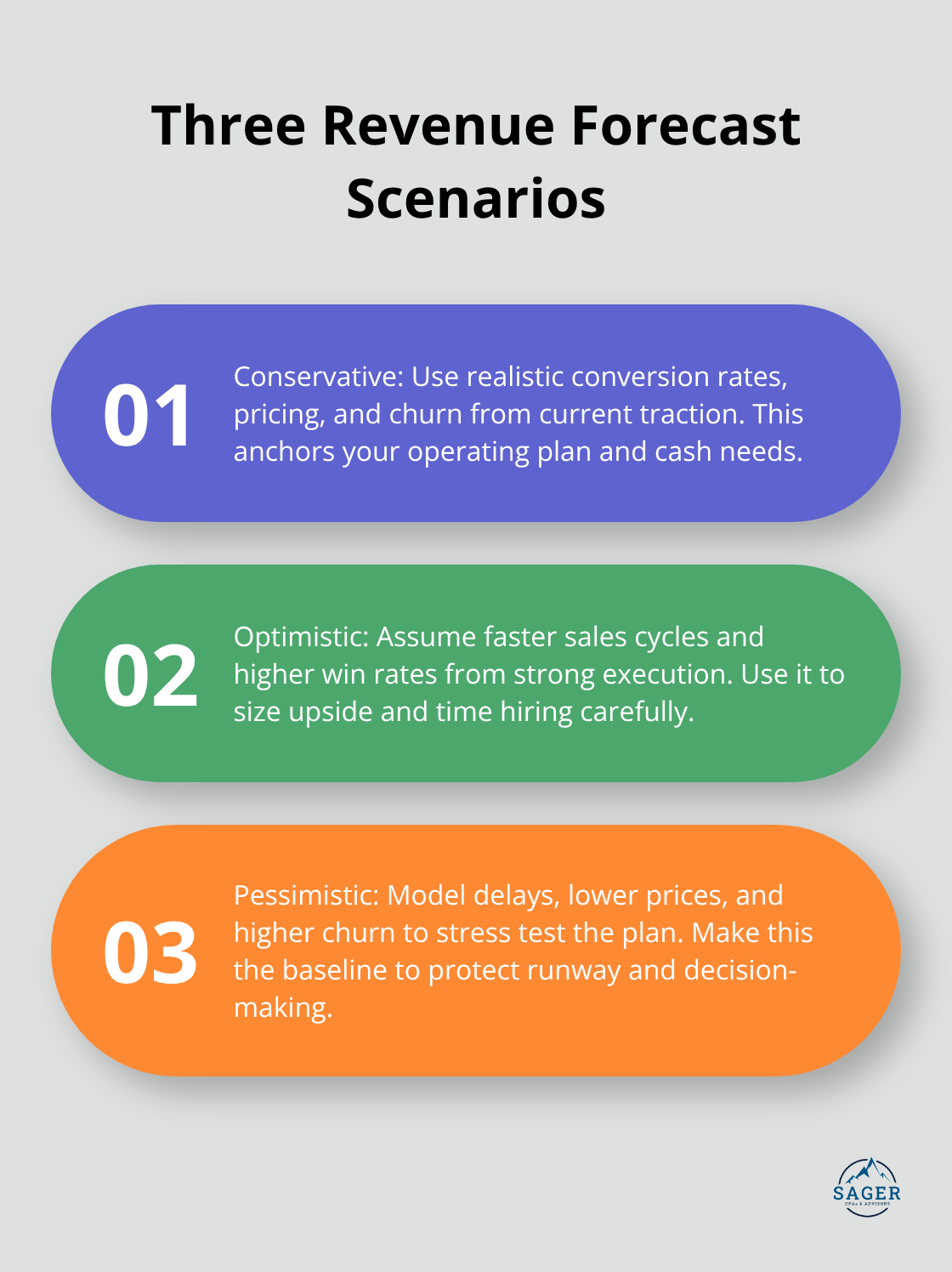
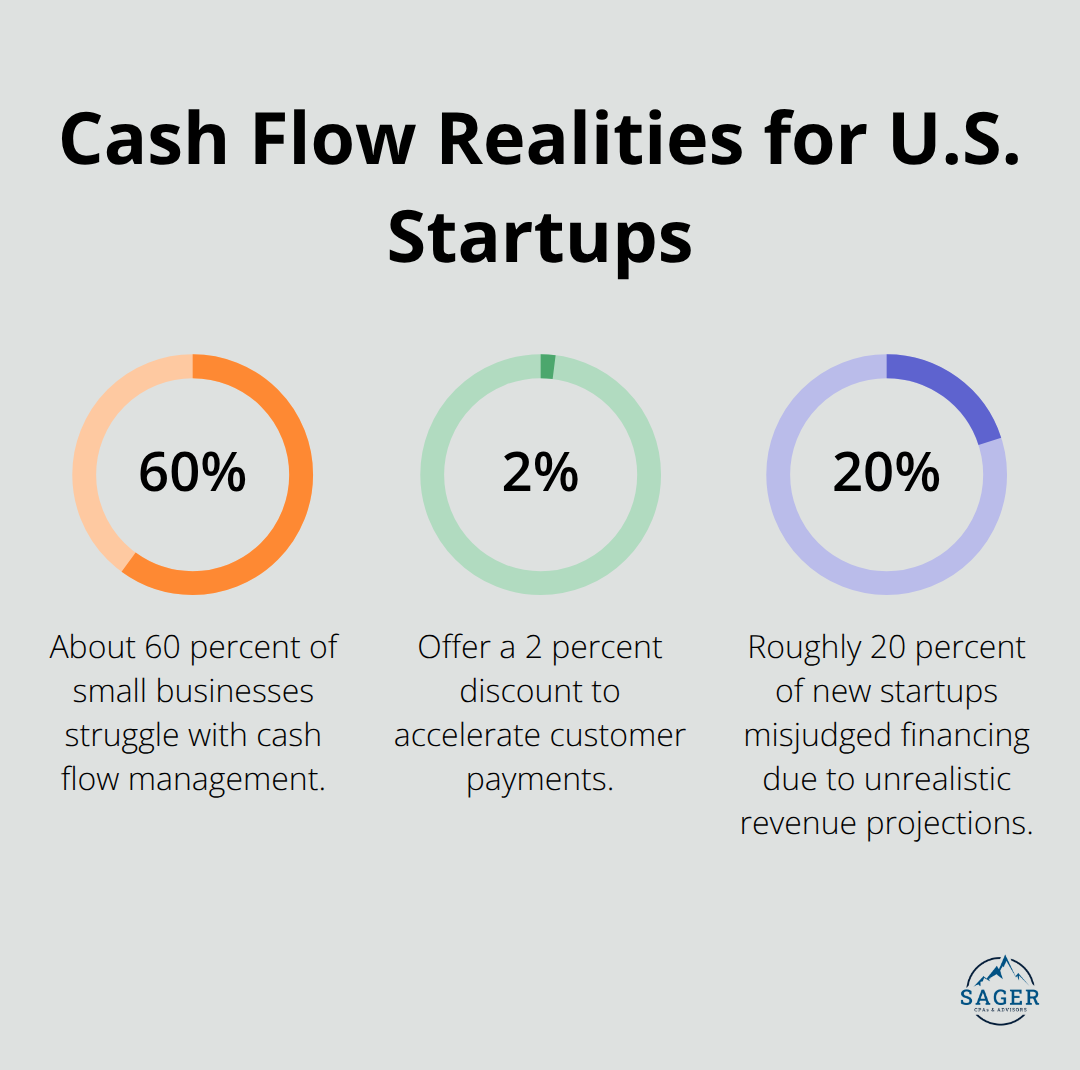
Roughly 20 percent of new startups realize they didn’t have enough financing because their revenue projections were divorced from reality. Your first-year forecast should model three scenarios: conservative (your best guess), optimistic (everything works), and pessimistic (key initiatives fail). The pessimistic case becomes your planning baseline because it shows how long you can operate if revenue disappoints.
Your 12-month cash flow statement is where projections meet reality. This isn’t a profit and loss statement-those measure revenue minus expenses on paper. Cash flow tracks actual money moving in and out, and timing matters enormously. You might book a customer for $10,000 in January but not receive payment until April, which means your January cash position doesn’t improve until April. Build your statement month by month with three sections: cash inflows (customer payments, investor funding, loans), cash outflows (salaries, rent, software, marketing spend), and ending cash balance.
About 60 percent of small businesses struggle with cash flow management according to PYMNTS, often because they confuse profit with cash. A profitable company can still run out of money if customers pay slowly while vendors demand quick payment. Set payment terms strategically: offer a 2 percent discount for customers who pay upfront or annually, which accelerates inflow and reduces collection efforts. Negotiate longer payment terms with vendors-common payment terms range from 14 to 90 days-so you preserve cash longer.
Once you have this statement built, calculate your burn rate by dividing your current cash balance by the net burn rate. If you have $100,000 in the bank and spend $15,000 monthly, your runway is roughly six months. This number forces difficult decisions: either you must reach profitability, reduce expenses, or secure additional funding before cash runs out. Track these core metrics monthly and reforecast quarterly as actual results come in. Your assumptions will change, and outdated projections become dangerous.
The gap between what you project and what actually happens reveals whether your business model works. This is where most startups discover their first real problem: the numbers don’t match reality. The next section shows you the mistakes that cause this disconnect and how to avoid them.
The gap between what you budget and what actually happens reveals the real health of your startup. Most founders make three predictable mistakes that drain runway faster than poor revenue: they underestimate how much operations actually cost, they ignore the unexpected expenses that always arrive, and they build a budget then forget to look at it again. The U.S. Chamber of Commerce reports that 82 percent of small businesses fail due to cash flow issues, and nearly every failure traces back to one of these three mistakes. You can avoid this trap with specificity, ruthlessness, and discipline.
When you list your monthly operating costs, you miss things. About one-third of new business owners admit to underestimating monthly expenses, and the pattern is consistent: founders account for obvious costs like salaries, rent, and software but overlook the dozens of smaller recurring charges that compound monthly. You might budget $500 for software tools, but then add Slack, GitHub, Figma, accounting software, email hosting, video conferencing, and design tools-suddenly you hit $2,000 monthly. Insurance, legal retainers, accounting support, and compliance filings add another $1,500. These aren’t luxuries; they’re operational necessities that most founders discover after the money is already spent.
Build your budget line by line with actual vendor quotes and contract terms, not estimates. Call your landlord for exact rent. Get quotes from your insurance broker. Log into existing software accounts and add up what you actually pay. Then add 15 percent more because something you haven’t thought of will appear before next quarter. This isn’t pessimism; it’s accounting for reality.
You set aside a 5 to 10 percent contingency reserve, but then you treat it as extra operating budget and spend it within two months. This is catastrophic because unplanned expenses always arrive. Your server crashes and recovery costs $3,000. A contractor misses a deadline and you need emergency help. Tax compliance requires an unexpected payment. A key vendor raises prices mid-contract. These aren’t hypothetical; they’re standard.
Protect your contingency reserve with the same discipline you’d use to protect payroll. Make it a separate account if necessary, and require explicit approval from your co-founder or board before touching it. The companies that survive the longest treat contingency money as untouchable until an actual emergency forces the decision.
Your 12-month cash flow statement becomes obsolete the moment revenue or expenses deviate from projections. Most founders build a budget, then never look at it again until they run out of money. This is negligent. Monthly budget reviews give you the information you need to make confident decisions, improve cash flow, and identify growth opportunities. Set a calendar reminder for the first of every month to compare actual spending against budget, line by line. If you budgeted $8,000 for marketing and spent $12,000, investigate why before you spend another dollar. If revenue came in at half your projection, cut discretionary spending immediately.
This isn’t complicated, but it requires discipline. Spend one hour monthly reviewing your cash balance, your burn rate, and your runway. If runway has shrunk from eight months to five months, you need to act now, not in three months when the problem becomes critical. Tools like spreadsheets or accounting software make this simple, but the real requirement is showing up every month and actually doing the work.
Early-stage startup budgeting separates founders who build sustainable businesses from those who burn through capital and vanish. The three core practices we’ve covered-categorizing expenses ruthlessly, projecting revenue from real data, and reviewing your numbers monthly-form the foundation that keeps startups alive through their first three years. Your budget is a living document that you must update constantly as actual spending and revenue deviate from projections.
The companies that survive longest obsess over cash position and know their burn rate, runway, and path to profitability or the next funding milestone (they protect contingency reserves, negotiate payment terms with discipline, and hire slowly). These practices aren’t glamorous, but they work because they force you to make decisions based on reality rather than hope. When actual spending deviates from projections, you investigate and adjust immediately instead of hoping the problem resolves itself.
Start your early stage startup budgeting effort simply: list your fixed costs, estimate variable costs with a 15 percent buffer, project conservative revenue based on real customer conversations, and build a 12-month cash flow statement. We at Sager CPA work with founders who want to move beyond guesswork and build financial clarity into their operations. Schedule a consultation with us to create a personalized financial strategy that supports your startup’s growth and keeps you accountable to your actual financial position.




Phone: (208) 939-6029
Email: info@sager.cpa
Privacy Policy | Terms and Conditions | Powered by Cajabra
At Sager CPAs & Advisors, we understand that you want a partner and an advocate who will provide you with proactive solutions and ideas.
The problem is you may feel uncertain, overwhelmed, or disorganized about the future of your business or wealth accumulation.
We believe that even the most successful business owners can benefit from professional financial advice and guidance, and everyone deserves to understand their financial situation.
Understanding finances and running a successful business takes time, education, and sometimes the help of professionals. It’s okay not to know everything from the start.
This is why we are passionate about taking time with our clients year round to listen, work through solutions, and provide proactive guidance so that you feel heard, valued, and understood by a team of experts who are invested in your success.
Here’s how we do it:
Schedule a consultation today. And, in the meantime, download our free guide, “5 Conversations You Should Be Having With Your CPA” to understand how tax planning and business strategy both save and make you money.