
Startup Financial Risk Planning: Anticipate and Mitigate for Growth
Anticipate financial risks in your startup with practical strategies to protect cash flow, manage debt, and build sustainable growth.
A financial management master’s degree can transform your career trajectory, but selecting the right program requires careful consideration of multiple factors.
At Sager CPA, we’ve guided countless professionals through this decision. The right choice depends on your career goals, program structure, and financial circumstances.
Your financial management master’s degree should align with a specific career outcome, not just general ambition. Financial Analyst positions median around $101,350 annually according to the Bureau of Labor Statistics, while Financial Managers earn approximately $161,700. These roles demand different skill sets. A Financial Analyst needs strong quantitative abilities and investment analysis expertise, whereas a Financial Manager requires broader operational and strategic knowledge. Before enrolling, identify which role matches your interests and earning potential. Research actual job postings in your target industry to understand what employers seek. Look at required certifications too-many financial roles expect CMA or CFA credentials, which some master’s programs integrate directly into their curriculum while others leave you to pursue separately.
Your undergraduate degree likely has gaps relative to what a master’s program expects. MIT Sloan’s MFin program explicitly requires linear algebra, multivariable calculus, probability, and statistics as prerequisites. If your background lacks these quantitative foundations, some programs will accept you with remedial coursework, while others reject applicants outright. BU Metropolitan College’s MS in Financial Management emphasizes programming skills in Excel, R, and Python-competencies many career-switchers lack entirely. Audit your current abilities honestly. If you’ve spent five years in marketing and want to move into corporate finance, your skills gap is significant. If you’re already in accounting and want to specialize in investment management, your transition is smoother. This self-assessment directly influences which programs accept you and how much foundational work you’ll need.
The cost of your degree must justify the salary increase you’ll actually achieve. The average cost of a Master’s degree is $51,740 in a public school. A two-year program at a private school costs roughly $60,000 before living expenses. GMAC data shows MSF graduates start at a median of $85,000 yearly. That’s a five to seven year payback period before your degree generates net positive returns.
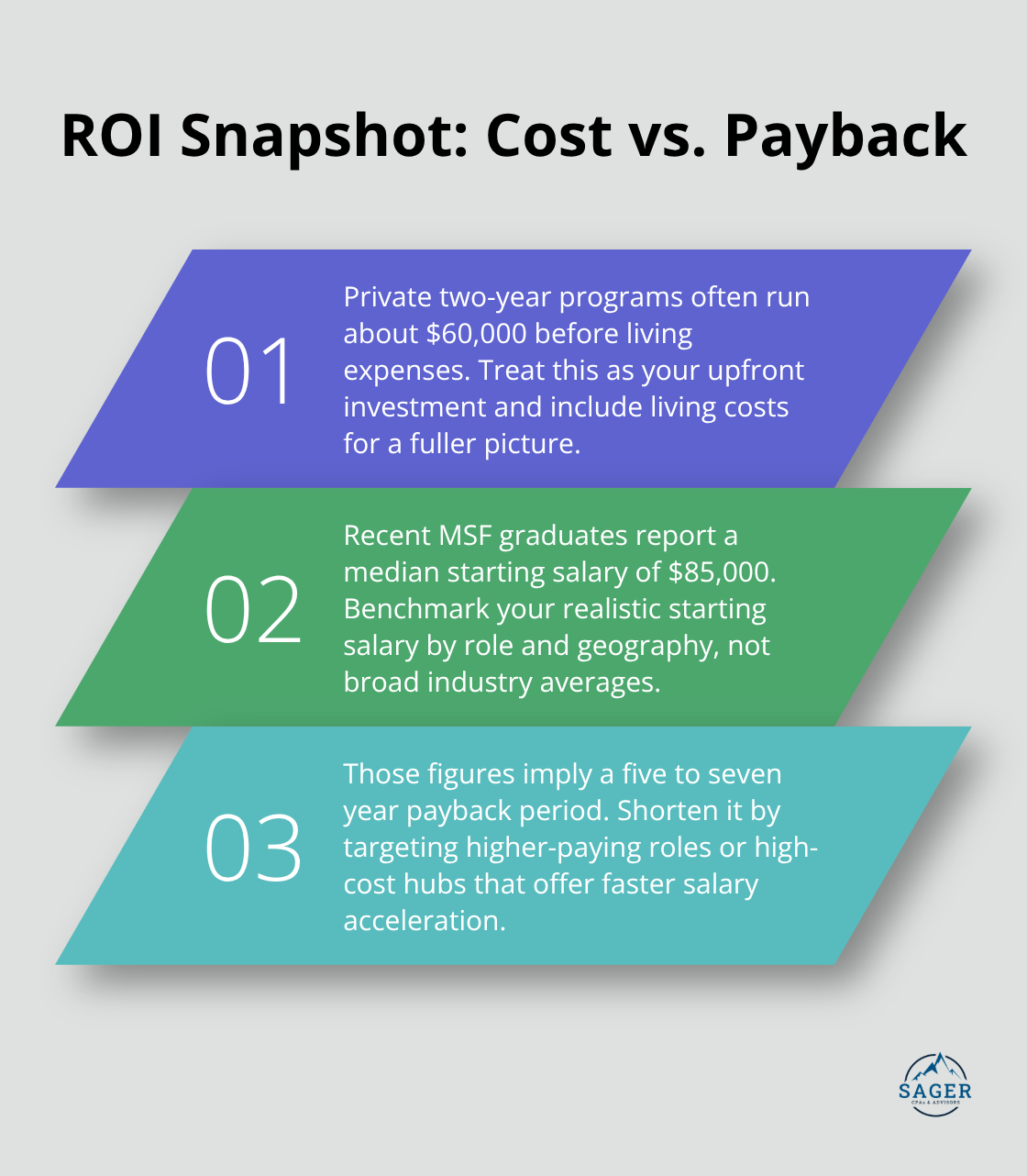
However, if you target Investment Manager roles, starting salaries reach $115,000 nationally and $210,323 in New York City according to Pace’s salary benchmarks. Geography matters enormously. Programs in major financial hubs like New York or Boston position you for higher starting salaries that offset tuition costs faster than programs in secondary markets. Compare specific program outcomes, not industry averages. Schools publish employment data and salary ranges for their graduates-demand to see actual numbers before committing.
With your career goals and financial picture clarified, the next step involves examining how different program structures and specializations align with your timeline and learning preferences.
The structure of your master’s program directly impacts your ability to complete it while working and earning income during school. MIT Sloan’s MFin program runs approximately 12 months full-time with an intensive summer component, designed for applicants who can dedicate themselves entirely to coursework. BU Metropolitan College’s MS in Financial Management offers a different path: you can complete the 32-unit degree in 8 to 16 months depending on how many courses you take per term, with the flexibility to study online or on campus and start in Fall, Spring, or Summer. This matters tremendously if you’re currently employed. Full-time status demands higher upfront payment but can reduce long-term costs, while a part-time online structure lets you maintain your salary and build experience simultaneously. However, full-time programs create cohort bonds and networking opportunities that part-time students miss.

The Financial Times 2025 rankings show that top pre-experience programs like ESCP, Skema, and Tsinghua all run 10 to 16 months, suggesting employers value the intensity and focus that full-time study provides.
Your decision between full-time and part-time study depends on whether you prioritize speed and networking or flexibility and continued income. Full-time programs compress your education into one intensive year, which accelerates your entry into higher-paying roles. Part-time online programs stretch across 18 to 24 months but allow you to stay employed and test whether you actually enjoy finance work before committing fully. Online formats have become standard-most programs now offer fully online or hybrid delivery with synchronous and asynchronous options. This flexibility matters if you live outside major financial hubs or have family obligations. However, programs in New York City or Boston provide proximity to major financial employers and internship opportunities that remote students cannot access. Consider your current employment situation carefully. If you’re earning $50,000 annually and can afford to pause work, full-time study makes financial sense. If you’re earning $80,000 and have dependents, part-time online study becomes the only realistic option.
Your specialization choice matters far more than the program’s brand name because it shapes which employers recruit you. BU Metropolitan College offers concentrations in Artificial Intelligence Applications, International Finance, Investment Analysis, and Sustainability-each attracts different recruiters. If you select AI Applications, fintech companies and large banks building algorithmic trading systems will target you. If you select Investment Analysis, asset management firms and hedge funds become your primary employers. MIT Sloan and schools like Pace offer specializations in Corporate Finance, Investment Management, Financial Risk Management, and Financial Operations and Technology. Investment Management graduates earn $115,000 nationally starting, while Financial Risk Management specialists enter compliance and regulatory roles earning closer to $88,000 to $102,000. The $27,000 gap reflects real market demand differences.
Research which specializations your target employers actually hire for-check LinkedIn job postings and company career pages. Some programs integrate CFA Program Candidate Body of Knowledge directly into coursework, like BU Metropolitan College does, which accelerates your path toward CFA certification if that matters for your target role. Others leave certification entirely to you. A school can be AACSB-accredited and still offer weak investment management courses if that’s not their focus area. Verify that your specialization of choice has recent graduate employment data showing strong placement rates in your target industry.
Accreditation through AACSB or ACBSP signals program quality and ensures that schools meet rigorous educational standards. However, accreditation alone doesn’t guarantee specialization strength. Compare core courses across programs you’re considering. Most programs cover financial analysis, investment management, and risk management as foundations. Advanced offerings vary significantly-some schools emphasize derivatives and fixed income securities, while others focus on data analytics and enterprise valuation. BU Metropolitan College includes courses on mergers and acquisitions, derivative securities, and ESG investing, reflecting current market priorities. MIT Sloan emphasizes data-driven finance and Python proficiency as core competencies. These curriculum differences directly affect which skills you develop and which employers value your degree. Request detailed course syllabi from programs you’re seriously considering. Look for courses that match your specialization and target industry. A program with excellent corporate finance courses but weak investment analysis offerings won’t serve you well if you want to work in asset management.
With your program structure and specialization aligned to your career path, the next critical factor involves understanding how cost, location, and support services will shape your actual experience and post-graduation success.
Your master’s degree cost varies wildly depending on program format and school type, but the real number that matters is what you’ll earn afterward minus what you spent. Public universities average around $9,800 per year in graduate tuition, while private nonprofit schools run $29,931 annually. BU Metropolitan College’s MS in Financial Management costs between $25,452 and $28,956 for the full part-time degree, or roughly $70,872 to $78,987 if you enroll full-time across multiple terms. MIT Sloan’s MFin program costs significantly more but delivers graduates earning $115,000 starting in Investment Management roles. The Financial Times 2025 rankings show that top programs like Tsinghua University deliver starting salaries around $225,947, creating a one to two year payback period despite higher tuition. Programs ranked lower on value-for-money still produce graduates earning $101,451 to $158,536 depending on specialization and location. Calculate your specific payback period by taking program cost, dividing by the salary increase you’ll actually receive, then comparing that timeline against staying in your current role.
Most financial aid comes through scholarships, fellowships, and grants rather than loans. Explore each school’s financial aid guide and external scholarship opportunities before assuming you’ll borrow heavily. Some programs offer CFA exam scholarships directly, which saves $1,000 to $1,500 per exam attempt. STEM-designated programs like BU’s MS in Financial Management provide Optional Practical Training advantages for international students, potentially extending work authorization by 24 months beyond standard OPT periods. This matters enormously if visa status affects your job prospects or salary negotiation power.
Location determines both your starting salary and your networking trajectory far more than most candidates realize. Programs in New York City and Boston position graduates for 40 to 60 percent higher starting salaries than identical programs in secondary markets. Pace’s salary benchmarks show Corporate Finance MBA graduates earn $107,000 nationally but $161,825 in New York City-a $54,825 gap that compounds over your career.
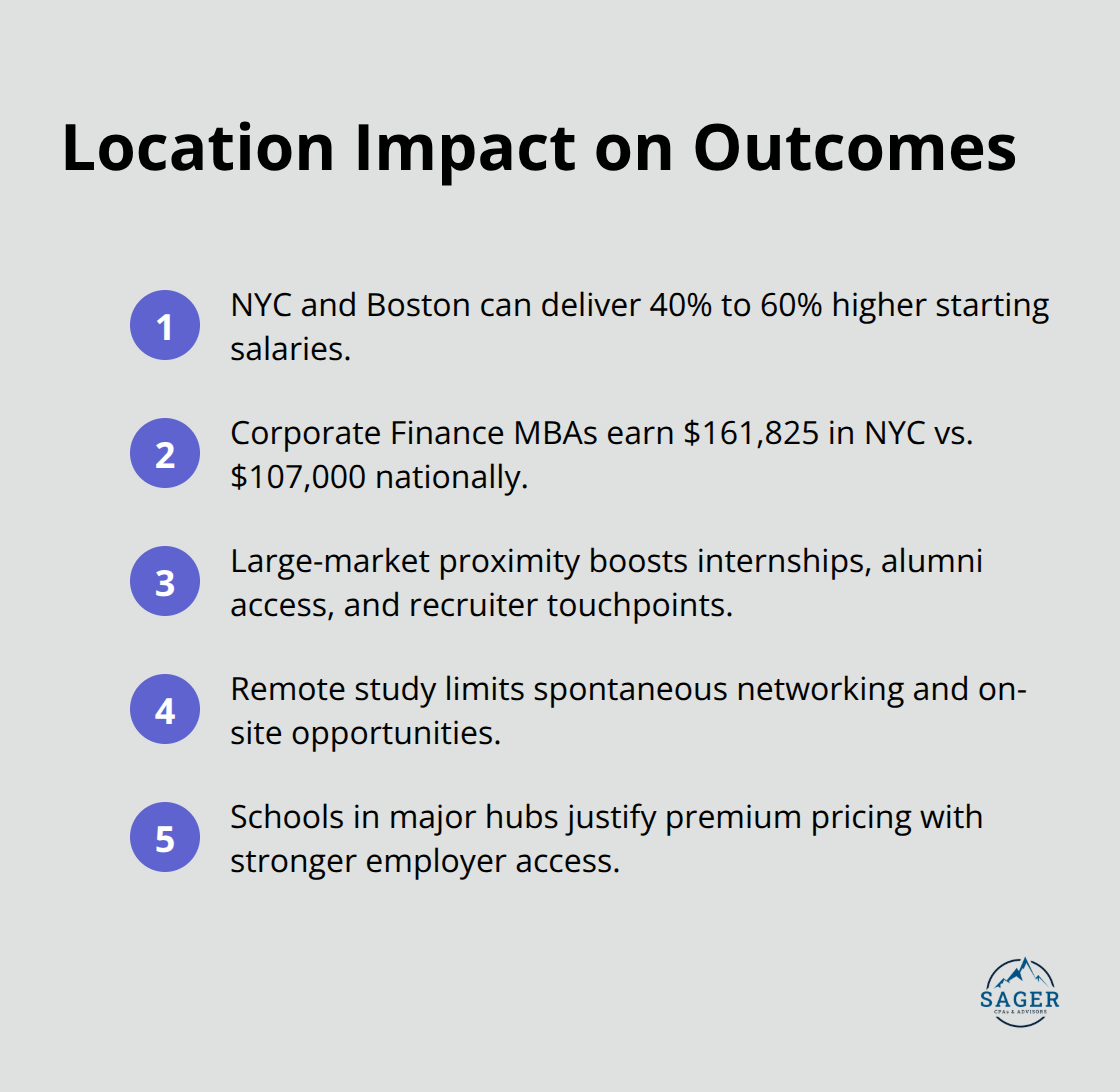
Online flexibility matters if you cannot relocate, but proximity to major financial employers creates internship opportunities, alumni networks, and recruiter relationships that remote students simply cannot access. BU Metropolitan College and MIT Sloan both emphasize their location advantages and access to major employers, which justifies their premium positioning. If you attend school remotely from a smaller city, you’ll graduate without the regional network that accelerates advancement into senior roles.
Career services quality separates programs that produce employed graduates from programs that produce credentialed ones. Demand transparent employment outcome data from schools you’re considering-specifically the percentage of graduates employed within six months, their starting salaries by role, and which employers actually recruit from that program. BU MET highlights access to BU Center for Career Development and program-specific career development resources, while MIT Sloan emphasizes the Admissions Committee’s evaluation of candidates who can collaborate effectively and contribute to cohort strength. Networking matters because finance roles often fill through personal relationships before they appear on job boards. Full-time cohort-based programs create these relationships naturally through shared coursework and projects. Part-time online programs require intentional networking effort-attending alumni events, joining professional associations like the CFA Institute, and actively building relationships with classmates. Some schools facilitate this better than others through alumni networks and industry partnerships. Ask prospective programs how many alumni work at your target employers and what formal mechanisms exist to connect students with professionals in your target specialization.
Selecting a financial management master’s degree comes down to three concrete decisions: which career role you’re targeting, which program structure fits your life, and whether the financial payback justifies the cost. Your target role determines everything else-a Financial Analyst needs different skills than a Financial Manager, and those differences cascade through specialization choice, program intensity, and location strategy. If you’re earning $50,000 and can afford to pause work, a full-time program in a major financial hub delivers the fastest return. If you’re earning $80,000 with family obligations, a part-time online program lets you test your commitment while maintaining income stability.
Start your application process by requesting employment outcome data from three to five programs that match your specialization and format preferences. Demand actual numbers: percentage employed within six months, starting salaries by role, and which employers recruit from that program. Compare these outcomes against your current salary and the program’s total cost, then calculate your personal payback period. Assess whether the program’s location and network align with your target employers, since a Boston program might not serve you well if you’re targeting fintech roles in San Francisco.
Consider how professional development continues after graduation, since many programs integrate CFA preparation or other certifications that your career advancement depends on completing. We at Sager CPA work with finance professionals navigating career transitions and credential planning, and we recommend discussing your financial strategy with an advisor before committing to a program. Your master’s degree is one piece of your financial trajectory, not the entire picture.




Phone: (208) 939-6029
Email: info@sager.cpa
Privacy Policy | Terms and Conditions | Powered by Cajabra
At Sager CPAs & Advisors, we understand that you want a partner and an advocate who will provide you with proactive solutions and ideas.
The problem is you may feel uncertain, overwhelmed, or disorganized about the future of your business or wealth accumulation.
We believe that even the most successful business owners can benefit from professional financial advice and guidance, and everyone deserves to understand their financial situation.
Understanding finances and running a successful business takes time, education, and sometimes the help of professionals. It’s okay not to know everything from the start.
This is why we are passionate about taking time with our clients year round to listen, work through solutions, and provide proactive guidance so that you feel heard, valued, and understood by a team of experts who are invested in your success.
Here’s how we do it:
Schedule a consultation today. And, in the meantime, download our free guide, “5 Conversations You Should Be Having With Your CPA” to understand how tax planning and business strategy both save and make you money.