
Startup Financial Risk Planning: Anticipate and Mitigate for Growth
Anticipate financial risks in your startup with practical strategies to protect cash flow, manage debt, and build sustainable growth.
Small business owners often operate without the financial clarity they need to make confident decisions. At Sager CPA, we’ve seen firsthand how business advisory insights transform growth trajectories for SMBs.
This guide covers the strategic and financial moves that separate thriving businesses from those stuck in survival mode. You’ll learn concrete tactics for planning, cash flow management, and avoiding costly mistakes.
Most SMBs skip the planning phase because it feels disconnected from immediate survival. That’s backwards. Without a clear plan anchored to real market data, you’re essentially guessing on which opportunities matter. Business owners who realize too late that their goals weren’t tied to what customers actually want or what their financials could support often face unnecessary setbacks. The first step is brutal honesty: assess your current position against what the market demands. Don’t set revenue targets in a vacuum. Instead, map your goals against concrete market signals-customer demand trends, competitor pricing, supply chain realities, and your actual cash position. A retail owner targeting 25% growth without examining inventory turnover rates or seasonal cash flow patterns will hit a wall. The market doesn’t reward ambitious guesses; it rewards owners who understand where demand exists and allocate resources accordingly.
Once your goals reflect market reality, the next move is creating a roadmap that breaks growth into measurable milestones tied to specific actions and timelines. Too many business owners keep strategy in their heads or in vague annual plans. Write it down with concrete checkpoints. If your goal is to expand into a new geographic market, don’t just note that down. Define the financial threshold for entry, the marketing channels you’ll test first, the hiring timeline, and the revenue trigger that signals go or no-go. Track progress using metrics that connect directly to profitability and cash flow, not vanity metrics. Revenue growth rate, customer retention rate, and average order value matter because they show whether your growth is sustainable or just burns cash. One law firm tracked time spent on different case types and discovered their highest-margin work was being underpriced while resource-draining cases consumed disproportionate capacity. That single insight from diagnostic analytics guided their pricing restructure and delivered a 40% revenue increase in six months. Your key performance indicators must reflect your actual business model, not generic benchmarks.
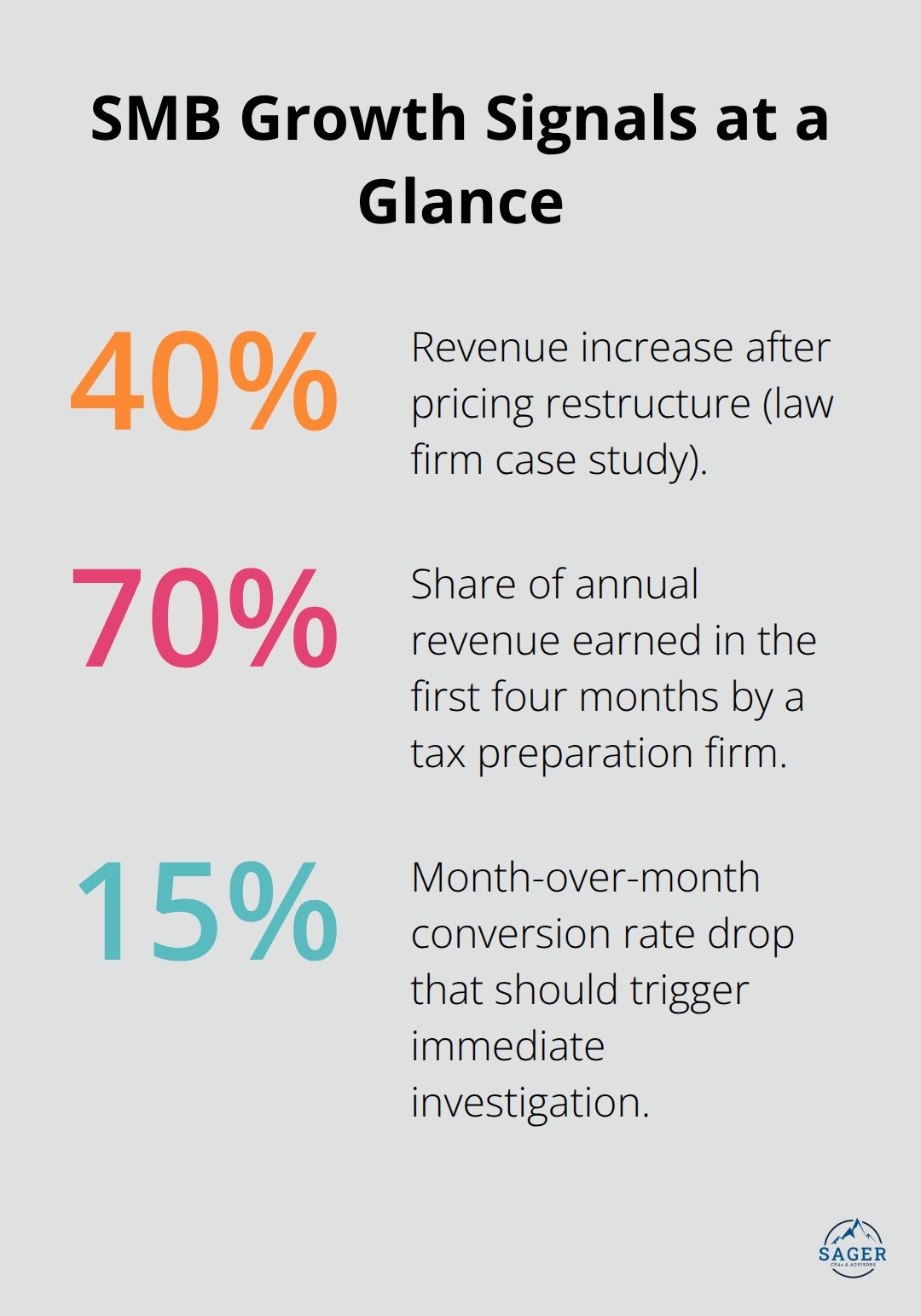
The metrics you choose determine where you focus energy and capital. Many SMBs measure website traffic or social media followers when they should measure conversion rates and customer lifetime value. If you invest in digital campaigns, track cost per acquisition and return on ad spend, not just impressions. Real-time analytics let you respond to market shifts immediately rather than wait for quarterly reviews. A restaurant owner using predictive analytics on reservation and delivery data can adjust staffing and inventory based on actual demand patterns rather than historical averages, reducing both waste and stockouts. The data itself isn’t the win-actionable insights are. Avoid analysis paralysis by combining data with business context and focusing on metrics that directly guide operational decisions. If your conversion rate drops 15% month-over-month, that’s a signal to investigate immediately, not a statistic to file away. Your roadmap should include monthly check-ins on these metrics and clear decision rules: if metric X falls below threshold Y, you execute plan B. This discipline separates SMBs that sustain growth from those that drift.
Strong metrics reveal performance, but they don’t tell the complete story without financial context. Your cash position, profit margins, and working capital efficiency determine whether you can actually fund the growth your metrics suggest is possible. A business showing strong revenue growth but deteriorating cash flow faces a different set of decisions than one with modest growth and healthy cash reserves. This is where financial management becomes the foundation for everything else. The next section covers how to optimize your finances so your growth strategy doesn’t outpace your ability to execute it.
Your metrics might look strong, but profit tells a different story if you don’t understand where cash actually flows through your business. Most SMBs operate with incomplete visibility into their cost structure, which means they make pricing and growth decisions without knowing their true margins. Business owners often discover their highest-revenue products are actually their lowest-margin ones, or that administrative overhead has crept up to unsustainable levels.
Start with every cost category in your business, then rank them by impact. For a service business, labor costs typically consume 40-60% of revenue, but the breakdown matters enormously. One law firm tracked time allocation across case types and found their highest-margin work was underpriced while resource-draining cases consumed disproportionate capacity. That diagnostic analysis drove a pricing restructure that delivered 40% revenue growth in six months without increasing headcount.
For a retail operation, the equation shifts: inventory carrying costs, shrinkage, and seasonal markdowns often hide 15-25% of gross margin. Pull your last 12 months of data and categorize every expense by whether it scales with revenue or stays fixed. This distinction is critical because fixed costs create leverage once you exceed your breakeven point, but they also create risk if revenue drops.
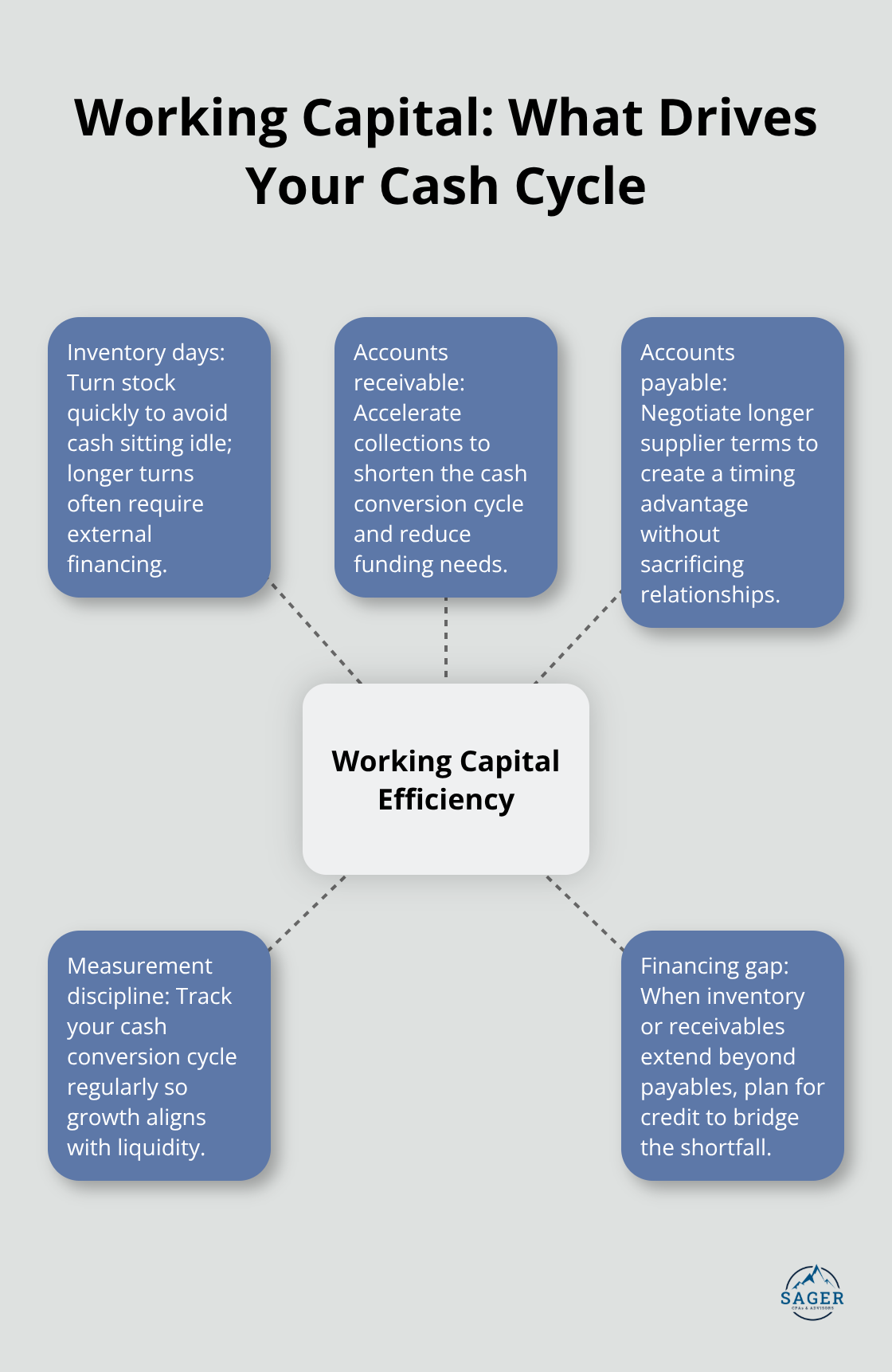
Your working capital efficiency determines whether growth actually funds itself or requires constant cash injections. Revenue growth that outpaces cash generation is a trap, not a success. If you’re growing 30% annually but your cash position hasn’t improved, you’re financing growth through debt or depleting reserves.
Calculate your cash conversion cycle by measuring how long cash sits in inventory, how long customers take to pay, and how long you can defer paying suppliers. A manufacturing business with 60-day payment terms from suppliers and 45-day payment terms from customers has a natural cash advantage if inventory turns every 30 days. But if inventory sits for 60 days, that business needs external financing to cover the gap. E-commerce businesses face the opposite problem: they often pay suppliers before customers pay them, which means growth accelerates cash burn.
Seasonal businesses face their own complexity. A tax preparation firm generates 70% of annual revenue in the first four months of the year, which means cash pools in spring but depletes by fall. Forecasting this pattern prevents the owner from overspending in summer and facing a cash crunch in November.
Use your historical data to model revenue month-by-month for the next 18 months, then map payroll, rent, and variable costs against that timeline. Identify the months where cash position is tightest and plan accordingly, whether that means securing a line of credit, negotiating extended payment terms with suppliers, or adjusting hiring timing. The forecast itself isn’t the value; using it to make decisions is. If your forecast shows a cash trough in August but you’re planning a major marketing spend in July, that’s a conflict you need to resolve before it becomes a crisis.
Strong financial visibility reveals where you actually stand, but it only matters if you act on what the numbers tell you. Most owners collect data and never translate it into operational changes. Your cost structure, working capital position, and seasonal patterns should directly shape your growth strategy, hiring decisions, and capital allocation. When you understand these financial realities, you can identify which obstacles actually threaten your business and which ones you can overcome with the right systems and controls.
Most SMB owners operate without real visibility into their financial position, which means they make critical decisions based on incomplete or outdated information. The gap between what you think is happening and what’s actually happening in your business creates compounding problems. You might believe your margins are healthy when they’re actually eroding, or you might hold back on hiring when cash flow could support it.
This disconnect between perception and reality is where SMBs stumble hardest. When you lack clarity on your true cost structure, working capital position, and seasonal patterns, you inevitably make suboptimal decisions on pricing, growth timing, and resource allocation. One service business owner discovered their highest-revenue client was actually their lowest-margin one only after they tracked time allocation by customer. That delayed insight cost them months of misdirected strategy that pulled energy away from what actually moved the needle.
Without advisory support, most owners rely on gut feel and historical patterns, neither of which account for changing market conditions or hidden inefficiencies in operations. To gain visibility and support growth, focus on key financial metrics like cash flow, revenue growth rate, and profit margins. This approach works until it doesn’t, and the failure often arrives suddenly when cash runs dry or growth stalls unexpectedly.
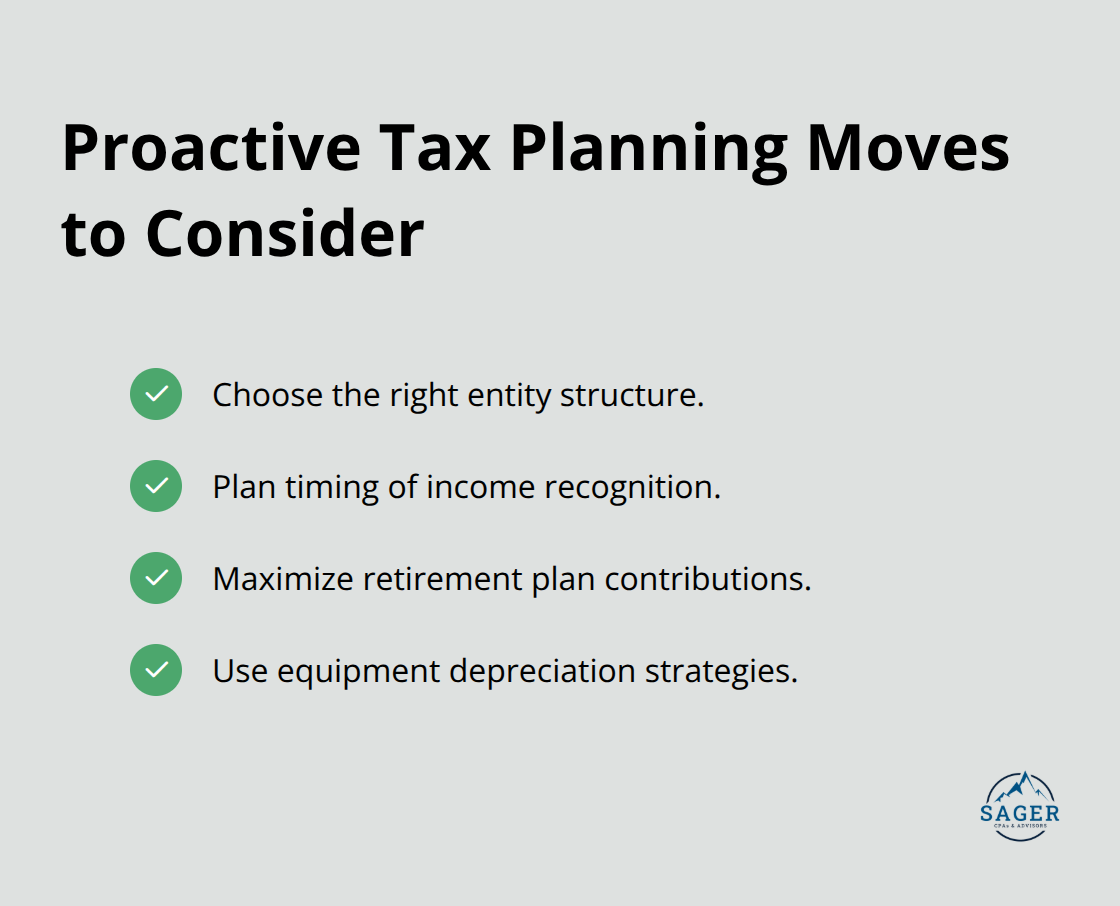
Tax planning opportunities disappear quietly when you’re not looking for them. Most SMBs file taxes reactively, paying whatever is owed based on the previous year’s structure, rather than structuring their business to minimize liabilities. A contractor operating as a sole proprietor might pay substantially more in self-employment taxes than if they’d established an S-corp structure, but that decision requires advance planning, not year-end scrambling.
Entity selection, timing of income recognition, retirement plan contributions, and equipment depreciation strategies all offer real savings-but only if you plan for them before the year ends. The difference between proactive tax strategy and reactive filing often amounts to thousands of dollars in unnecessary tax burden. Most owners don’t realize these opportunities exist until they’ve already missed the window to implement them.
Scaling without proper systems and controls creates friction that compounds as you grow. A business that manually tracks inventory on spreadsheets can survive at $500K revenue but will collapse under its own weight at $2M. The owner doesn’t realize the systems gap until growth stalls because staff spends hours on manual processes instead of serving customers.
At that point, retrofitting systems costs far more than building them in from the start. SMBs that scale successfully build financial controls, delegation frameworks, and operational documentation as they grow, not after problems emerge. The difference between a business that sustains growth and one that hits a ceiling often comes down to whether the owner invested in proper systems before they became desperately needed. Proper systems and controls transform growth from a source of chaos into a manageable expansion that actually improves operational efficiency.
The gap between struggling SMBs and those that thrive consistently comes down to one factor: access to business advisory insights that transform how owners make decisions. Most SMB owners lack the bandwidth to implement strategic planning, financial analysis, and operational design alone while managing daily operations and serving customers. This is where business advisory services become the difference between incremental progress and meaningful transformation.
At Sager CPA, we work with SMB owners to translate financial data into actionable strategy and help you understand your true cost structure, identify tax planning opportunities before they disappear, and build systems that support growth without creating chaos. Our approach combines precise accounting with strategic guidance tailored to your specific business model and goals. Rather than generic advice, you receive customized action plans grounded in your actual financial position and market realities.
Schedule a consultation with Sager CPA and Advisors to assess where your business stands financially and identify the highest-impact moves for your situation. We’ll help you create a personalized financial strategy that addresses your immediate challenges while building the foundation for long-term stability. Your growth doesn’t have to feel chaotic or risky.




Phone: (208) 939-6029
Email: info@sager.cpa
Privacy Policy | Terms and Conditions | Powered by Cajabra
At Sager CPAs & Advisors, we understand that you want a partner and an advocate who will provide you with proactive solutions and ideas.
The problem is you may feel uncertain, overwhelmed, or disorganized about the future of your business or wealth accumulation.
We believe that even the most successful business owners can benefit from professional financial advice and guidance, and everyone deserves to understand their financial situation.
Understanding finances and running a successful business takes time, education, and sometimes the help of professionals. It’s okay not to know everything from the start.
This is why we are passionate about taking time with our clients year round to listen, work through solutions, and provide proactive guidance so that you feel heard, valued, and understood by a team of experts who are invested in your success.
Here’s how we do it:
Schedule a consultation today. And, in the meantime, download our free guide, “5 Conversations You Should Be Having With Your CPA” to understand how tax planning and business strategy both save and make you money.