
Startup Financial Risk Planning: Anticipate and Mitigate for Growth
Anticipate financial risks in your startup with practical strategies to protect cash flow, manage debt, and build sustainable growth.
Most business owners know they need a strategy, but few understand what actually makes one work.
At Sager CPA, we’ve seen countless companies struggle because they skip the fundamentals. A business level strategy isn’t about fancy planning-it’s about understanding your market, knowing your strengths, and executing with discipline.
This guide walks you through the three core steps that separate thriving businesses from those that drift.
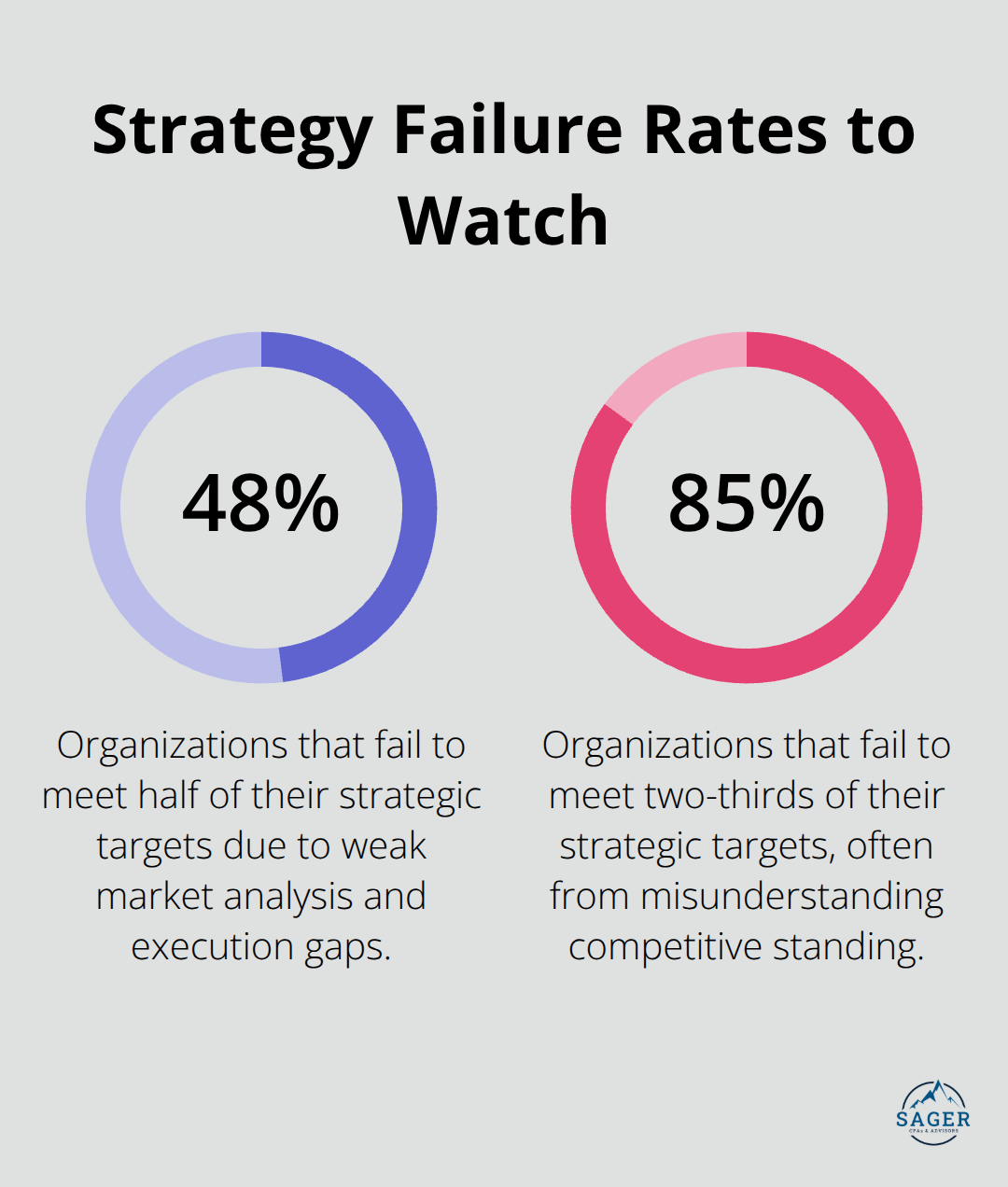
Understanding your market isn’t optional-it’s the foundation that prevents strategy from becoming expensive guesswork. Start by identifying who actually buys from you and who doesn’t. Most companies waste time analyzing broad market trends when they should focus on their specific customer segments. Research shows that 48% of organizations fail to meet half of their strategic targets, and weak market analysis is often the culprit.
You need concrete data about your target customers: their pain points, purchasing frequency, average deal size, and switching costs. If you sell to businesses, find out how many potential customers exist in your addressable market and what percentage you currently capture. For consumer products, segment your audience by geography, income, and buying behavior rather than relying on demographic generalizations. Pull actual transaction data, conduct customer interviews, and analyze competitor pricing in your specific niches. Talk to ten customers this week and ask what problems keep them up at night instead of spending weeks in meetings debating what you think customers want.
Your competitive position reveals whether you can charge premium prices or must compete on cost. Map out your direct competitors and identify exactly how they differ from you: their price points, product features, service speed, and customer experience quality. A Bridges Business Consultancy study found that 85% of organizations fail to meet two-thirds of their strategic targets, often because they misunderstood their competitive standing.
You’re either cheaper, better, faster, or solving a problem competitors ignore. If you’re not clearly winning in at least one of these areas, you’re stuck in the middle-and that’s a losing position. Examine where competitors have gaps. Maybe they serve large enterprise clients and ignore small businesses, or they’re slow to innovate while customers demand new features. This gap is your opportunity.
Assess your internal capabilities honestly: can you actually execute on the advantage you’ve identified, or are you claiming differentiation you can’t deliver? Your competitive advantage only matters if it’s real and defensible.
Internal assessment separates realistic strategy from wishful thinking. Identify what your business genuinely does better than competitors-not what you’d like to be good at, but what actually works today. This might be your team’s technical expertise, your distribution network, your brand reputation, or your cost structure. Quantify these strengths: if you claim operational efficiency, show the data on production costs, waste rates, or delivery times compared to industry benchmarks.
Weaknesses are equally important and harder to admit. Maybe your sales team lacks industry experience, your technology is outdated, your customer service response time lags competitors, or you lack capital for growth investments. A realistic assessment of weaknesses prevents you from building strategy on capabilities you don’t possess.
Some weaknesses you can fix quickly-hiring talent or upgrading systems-while others require years of investment. Others you can’t fix at all, which means your strategy must work around them rather than depend on them. This honest inventory of strengths and weaknesses, combined with your market and competitive analysis, shows you exactly what opportunities you can realistically pursue. With this foundation in place, you’re ready to translate market realities into clear strategic direction.
Your market analysis revealed what’s actually happening in your business environment. Now you translate those findings into specific, measurable objectives that guide every decision your team makes. This is where strategy stops being abstract and becomes actionable. Most companies fail here because they confuse aspirational statements with real targets. Saying you want to grow revenue is not a strategy-saying you’ll capture an additional 12% market share in your primary segment by Q4 through targeted account-based marketing is a strategy. The difference matters enormously.
Set objectives that answer three questions: what exactly are you trying to achieve, how will you measure success, and by when. Your objectives should tie directly to what you learned about your competitive position and internal capabilities. If your analysis showed you compete on speed and service quality rather than price, your objectives should reflect investments in faster delivery and customer experience improvements-not cost reduction initiatives.
Companies that pursue more than five major strategic priorities typically execute none of them well. Instead, identify the two or three areas where progress would create the most competitive advantage. If you’re in a niche market with high switching costs, focus objectives on deepening customer relationships and expanding wallet share. If you’re in a crowded market where customers easily switch, focus on customer acquisition and retention metrics.
Your objectives must also connect directly to your company values and vision. If your vision includes building a sustainable business that attracts quality talent, but your only objective is maximizing short-term revenue, you’ve created internal conflict. Employees won’t commit to strategy that contradicts stated values. Instead, ensure objectives reinforce what you actually stand for.
Your competitive advantage isn’t a vague claim-it’s the specific reason customers choose you over alternatives and would hesitate to switch. From your competitive analysis, you identified where you win: maybe you’re faster at implementation, your product has features competitors lack, you serve a customer segment nobody else targets effectively, or your cost structure lets you price lower while maintaining margins.
Pick one primary advantage and build strategy around making it stronger and harder to copy. A company claiming to compete on innovation, quality, and price simultaneously has no real competitive advantage. Instead, invest relentlessly in the one area where you’re genuinely differentiated. If you’re the low-cost provider, optimize your entire operation around cost efficiency.
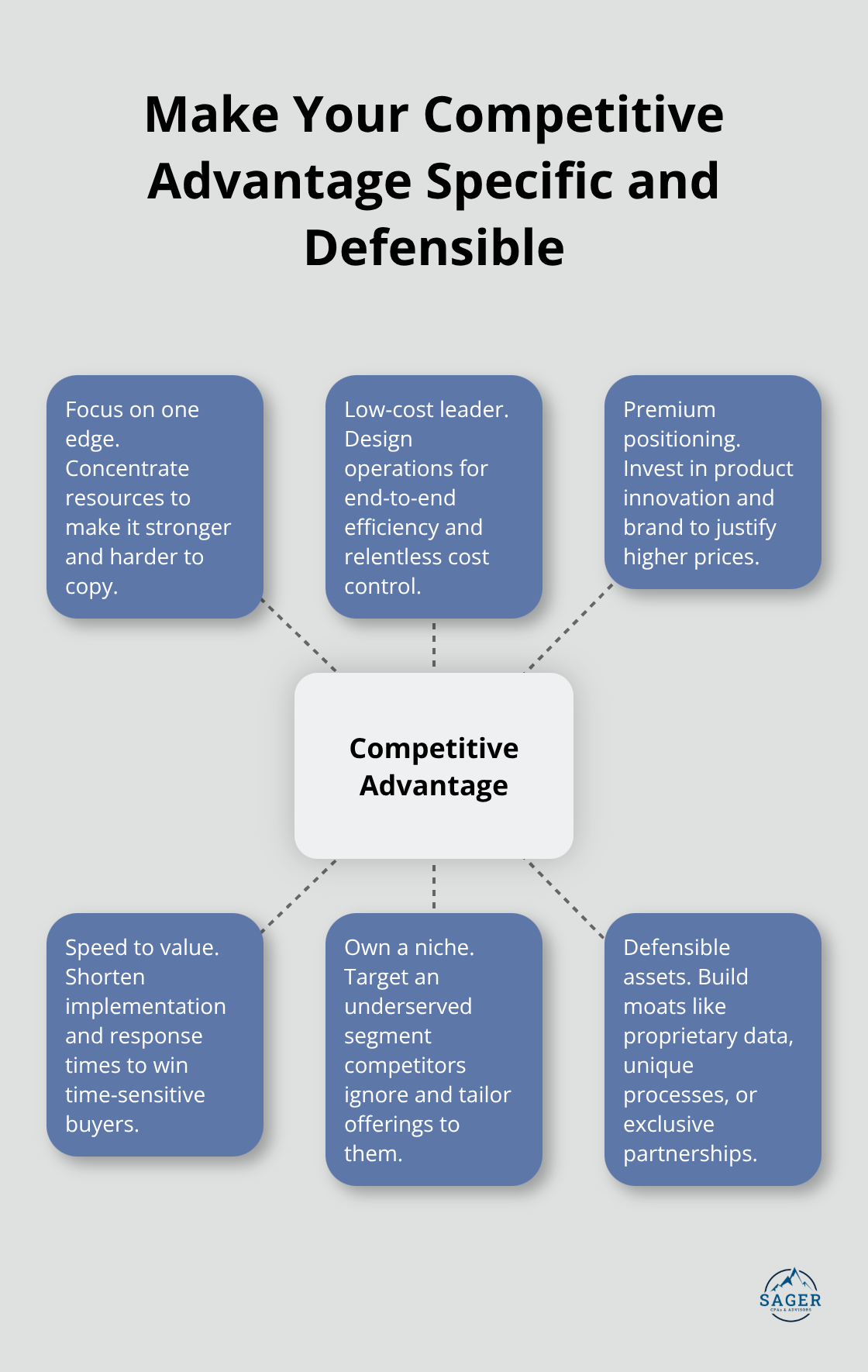
If you’re the premium option, invest in product development and brand building rather than competing on price.
Your competitive advantage should be visible in how you allocate resources, where you hire talent, and which customers you pursue. If you claim differentiation but allocate resources like a cost leader, your strategy lacks coherence. The best competitive advantages resist replication because they depend on capabilities, relationships, or scale you’ve built over time. A unique manufacturing process, proprietary customer data, a highly trained sales team, or exclusive distribution partnerships create durable advantages. Generic advantages like being customer-focused or innovative are easily copied because they describe what every company claims to do, not what makes you different.
Your vision and values aren’t decorative statements-they’re the constraints that determine which opportunities you can realistically pursue. A company that values work-life balance can’t execute a strategy requiring constant travel and 60-hour weeks. A business built on premium positioning can’t suddenly compete on price without destroying brand equity and confusing customers. A team with deep technical expertise shouldn’t pursue strategies requiring sales-heavy execution if you lack that capability.
Misalignment between strategy and values sabotages execution. Companies pursue growth strategies that contradict their operating model or values, then wonder why results fall short. Aligning your strategy and business development isn’t about being noble-it’s about being realistic. If your team is risk-averse and your company culture rewards stability, a strategy requiring rapid innovation and pivoting will generate internal resistance that undermines performance.
Instead, choose strategies your organization can actually commit to and sustain. This doesn’t mean never changing. It means being intentional about which values and capabilities you’re willing to invest in developing. If your current team can’t execute your chosen strategy, you either need to hire people with different skills or choose a different strategy. Most companies underestimate how much their current culture, capabilities, and values constrain strategic options. Working within those constraints rather than fighting them produces better results faster.
With clear objectives, a defensible competitive advantage, and alignment between strategy and organizational reality, you’ve established your strategic direction. The next step moves from planning to action: translating these strategic choices into concrete execution plans that your team can implement and measure.
Strategy lives on paper until your team executes it. This is where most companies stumble. You’ve identified your market opportunity and set clear objectives, but translating those into daily work that moves the needle requires structure and discipline. Start by breaking down strategic objectives into concrete actions with specific owners and deadlines. If your objective is to capture 12% additional market share in a target segment, the actions might include launching a targeted account-based marketing campaign by month two, hiring two new sales specialists by month one, and developing customized product packages for that segment by month three. Each action needs a single owner accountable for completion, not a committee. Assign a sales leader to own the new customer acquisition target, a product manager to own feature development, and a marketing director to own campaign execution. Vague ownership produces vague results.
Set monthly milestones that show progress toward annual objectives rather than waiting until year-end to measure results. If you’re launching a new product line and your annual goal is $500,000 in revenue, establish monthly targets starting at $30,000 in month one and scaling to $60,000 by month six. Monthly milestones create accountability and surface problems early enough to fix them.
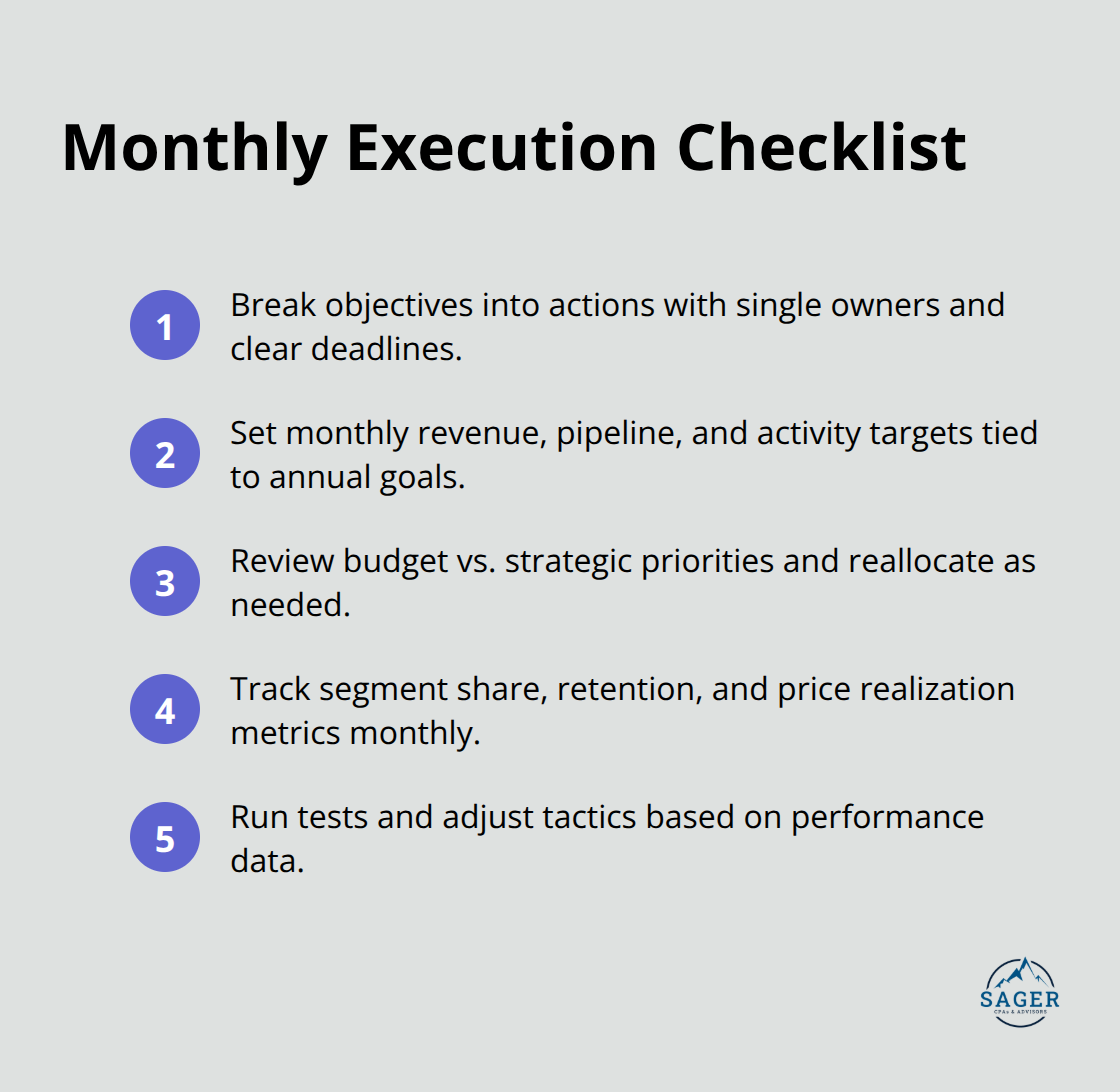
This approach prevents strategy from becoming a document that sits on a shelf while your team operates without clear direction.
Resource allocation reveals your actual priorities regardless of what strategy documents claim. Companies often fund legacy business units at historical levels while underfunding new strategic initiatives, then wonder why strategy fails. If your competitive advantage requires faster product innovation, you must allocate capital and talent to R&D before funding incremental improvements to existing products. Audit your current budget allocation against your stated strategic priorities. If you’re pursuing a premium positioning strategy but spending 40% of marketing budget on discount promotions, your resource allocation contradicts your strategy. Reallocate ruthlessly. Redirect resources from activities that support old strategy to activities that support new strategy. This creates internal friction because people lose resources and responsibilities, but this friction is necessary. Track actual spending against planned allocation monthly. Many companies approve budgets aligned with strategy, then spend money on whatever feels urgent that week. Monthly reviews prevent this drift.
Finally, establish performance metrics that reveal whether strategy is working or failing. Revenue growth alone tells you nothing about strategy execution because revenue can grow from maintaining existing customers at old margins or from executing new strategy at better margins. Instead, track metrics specific to each strategic objective. If your objective involves market share growth in a new segment, track the percentage of revenue from that segment monthly. If your objective is improving customer retention, track retention rates by customer cohort. If your objective is building a premium brand, track price realization and willingness to pay through customer surveys and win-loss analysis.
Review these metrics monthly with your leadership team and adjust execution when metrics fall short. Adjustment means changing tactics, not abandoning strategy after two months of disappointing results. If your account-based marketing campaign underperforms, test different messaging, expand the target account list, or increase sales follow-up. If product development falls behind schedule, add resources or reduce scope. If customer acquisition costs exceed projections, adjust your pricing or refine targeting. Strategy execution is an iterative process where monthly data guides tactical adjustments that keep you on track toward annual objectives.
An effective business level strategy requires disciplined execution, honest measurement, and willingness to adjust when reality diverges from your projections. Companies that actually win treat strategy as an ongoing process, not an annual exercise-they review performance monthly, adjust tactics quarterly, and revisit strategic direction annually as market conditions shift. This rhythm keeps strategy connected to reality rather than letting it become outdated the moment circumstances change.
Your competitive advantage erodes over time as competitors copy what works, your market shifts as customer needs evolve, and your internal capabilities improve or atrophy depending on how you invest in talent and systems. Start with the fundamentals: conduct honest market analysis, assess your competitive position without self-deception, identify what you actually do better than competitors, and build strategy around making that advantage stronger. Set clear objectives tied to measurable outcomes, allocate resources to match your stated priorities, and track monthly metrics that reveal whether execution is working.
We at Sager CPA help businesses translate strategy into financial clarity and sustainable growth through customized action plans and proactive financial management. Schedule a consultation to develop a personalized financial strategy that supports your business objectives and keeps your organization moving forward with confidence.




Phone: (208) 939-6029
Email: info@sager.cpa
Privacy Policy | Terms and Conditions | Powered by Cajabra
At Sager CPAs & Advisors, we understand that you want a partner and an advocate who will provide you with proactive solutions and ideas.
The problem is you may feel uncertain, overwhelmed, or disorganized about the future of your business or wealth accumulation.
We believe that even the most successful business owners can benefit from professional financial advice and guidance, and everyone deserves to understand their financial situation.
Understanding finances and running a successful business takes time, education, and sometimes the help of professionals. It’s okay not to know everything from the start.
This is why we are passionate about taking time with our clients year round to listen, work through solutions, and provide proactive guidance so that you feel heard, valued, and understood by a team of experts who are invested in your success.
Here’s how we do it:
Schedule a consultation today. And, in the meantime, download our free guide, “5 Conversations You Should Be Having With Your CPA” to understand how tax planning and business strategy both save and make you money.