
Business Strategy Template for Success
Create a business strategy template that drives measurable growth. Learn practical frameworks to align goals, manage resources, and execute with clarity.
Most business owners skip the planning stage and jump straight into execution. That’s a mistake we see repeatedly at Sager CPA, and it costs companies thousands in wasted resources and missed opportunities.
Business planning and strategy aren’t just documents to file away. They’re the roadmap that determines whether your company grows profitably or struggles to stay competitive.
Companies with formal strategic plans outperform their competitors significantly. Research from Harvard Business School Online shows that strategy formulation-documenting your direction, allocating resources, and validating goals with measurable KPIs-separates thriving businesses from those that plateau or fail. When you skip planning, you operate blind. You don’t know which activities drive revenue, where your money goes, or whether you move toward profitability or away from it.
Most business owners discover cash flow problems only after damage occurs. They thought they were profitable until their numbers told a different story. Those problems almost always trace back to decisions made without a clear plan. Strategic planning forces you to answer hard questions upfront: What problem does your business solve? Who exactly pays for that solution? How much will it cost to serve them? Without answers, you gamble with your company’s future.
Most business failures don’t happen because owners lack talent or work ethic. They happen because owners make decisions in a vacuum. Companies that operate without documented financial projections miss warning signs until it’s too late. You might grow revenue while your margins shrink, or you might spend on activities that produce zero customers. Planning exposes these disconnects before they become fatal.
When you establish clear financial milestones and review them monthly, you catch problems in weeks instead of months. You also gain credibility with lenders and investors who want proof that you understand your business model. A documented plan shows you’ve done the work. The second major mistake is treating planning as a one-time event.
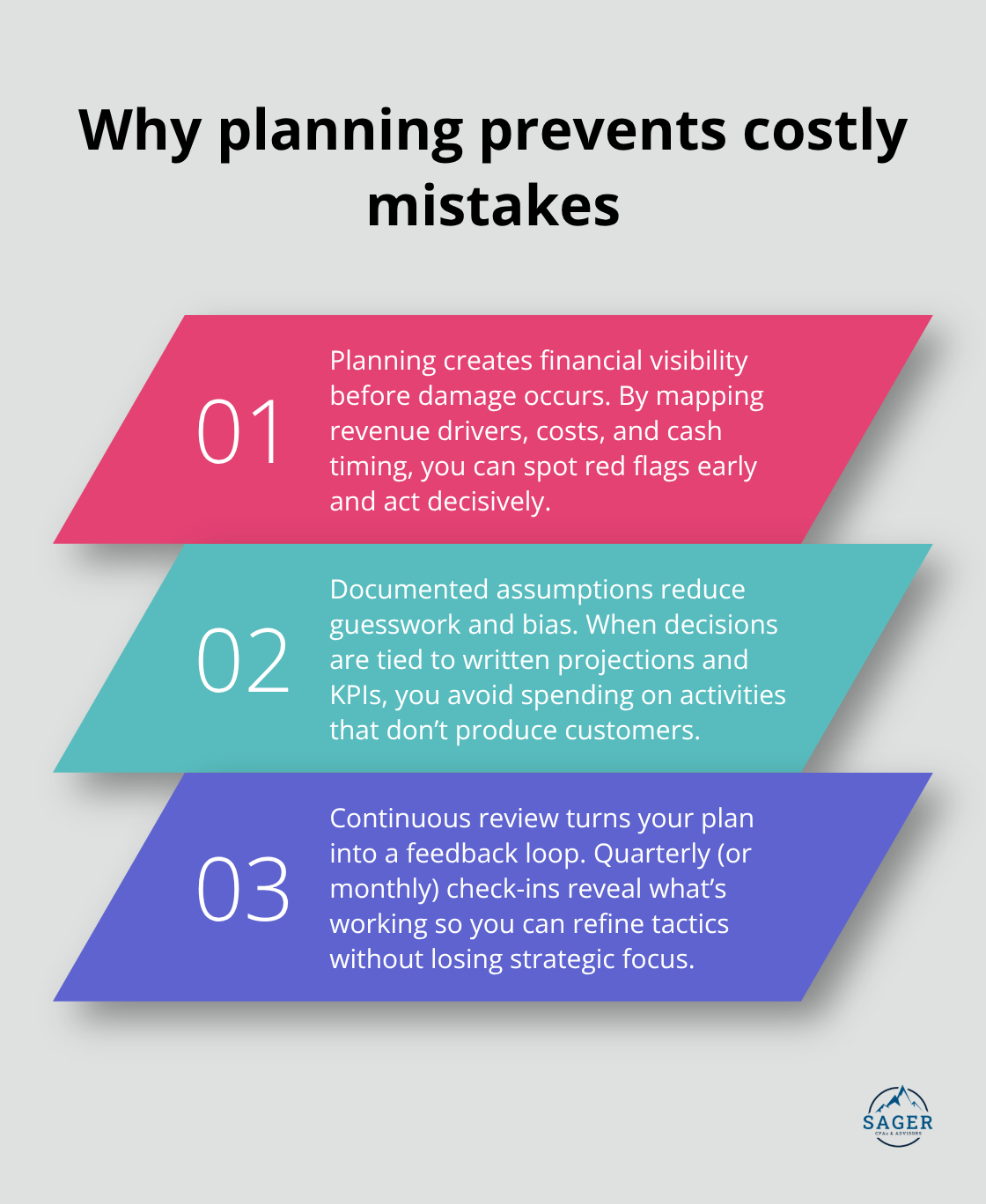
Strategy isn’t something you finish and file away. Harvard Business School Online emphasizes that the best strategies emerge through continual refinement. You should review your plan quarterly at minimum, comparing actual results against projections and adjusting your tactics based on what the market tells you. Companies that review performance monthly versus annually catch market shifts three times faster.
Long-term stability requires more than hope. It requires knowing your numbers, understanding your competitive position, and making decisions based on data rather than intuition. When you establish realistic financial projections with monthly detail for the first year, you create a baseline for measuring performance. You know what success looks like. You know when you’re off track. This clarity eliminates the paralysis that comes from uncertainty.
Strategic planning also forces alignment across your organization. Research cited by Harvard Business Review found that employees often lack clear understanding of their company’s strategy. That means most of your team works without a clear sense of direction or priorities. When you document your strategy and communicate it consistently, your team stops working at cross-purposes and starts moving toward shared goals. That alignment multiplies your effectiveness and builds organizational capability that makes future planning easier and faster.
The planning process itself-gathering input from your leadership team, analyzing your market, and setting measurable goals-transforms how your organization operates. With this foundation in place, you’re ready to move beyond strategy and into the specific components that make a business plan actually work.
A strong business plan answers three questions that most owners avoid: Where exactly do you compete, what numbers prove you’ll succeed, and how will you know if you’re winning? Business owners often discover their plans were missing critical details, and those gaps cost them thousands in misaligned spending and lost opportunities.
Market positioning refers to the ability to influence consumer perception regarding a brand or product relative to competitors. It’s the specific answer to why customers choose you over competitors who offer similar products or services. Start by identifying your direct competitors and mapping what they do well and where they fall short. Then articulate exactly how you’re different in terms that matter to paying customers.
A company selling accounting software might compete on price, but if your real advantage is faster implementation and better customer support, state that explicitly. Customers don’t care about your superiority unless you connect it to something they actually value. Document your target customer with precise demographics: annual revenue if they’re businesses, location, industry type, and the specific problems they face. Generic descriptions like “small business owners” tell you nothing. Narrow it down. Are you serving restaurants with under $2 million in revenue in the Southeast, or tech startups in major metros seeking rapid scaling? This precision shapes everything that follows, from your marketing spend to your pricing strategy.
Financial projections separate serious business plans from wishful thinking. Many owners project 30 percent revenue growth without explaining which activities will generate those customers or what that growth costs to achieve. Your first-year projections need monthly detail, not annual estimates. Monthly breakdowns reveal cash flow problems that annual numbers hide.
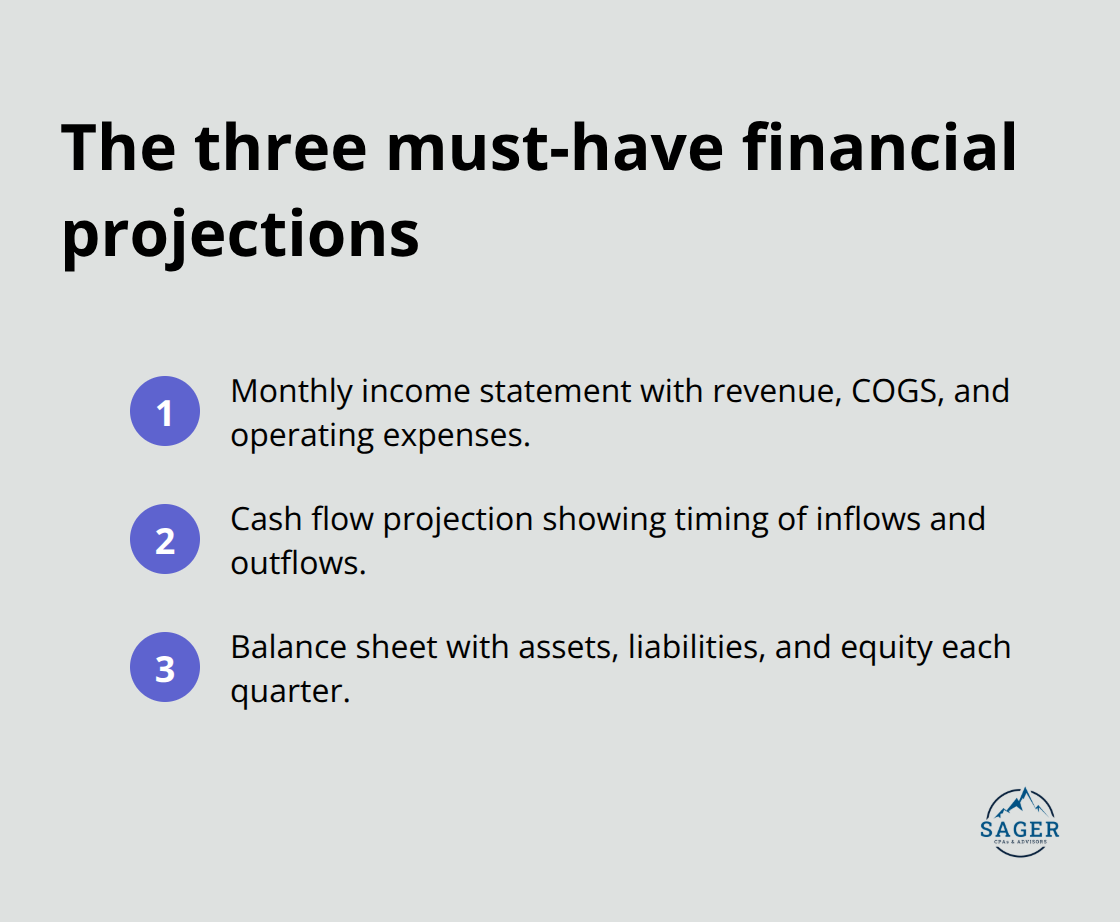
You might show annual profitability while burning cash in specific months when expenses spike or customer payments lag. Include three components: a monthly income statement showing revenue minus direct costs and operating expenses, a cash flow projection tracking when money actually arrives and leaves your account, and a balance sheet showing assets, liabilities, and equity at quarter-end.
Link each revenue projection to specific marketing or sales activities with realistic conversion rates. If you project selling 100 units monthly, explain how many leads that requires based on your historical close rate, what that costs in marketing spend, and whether your team can handle that volume. Financial projections without that logic are fiction.
Set quarterly milestones beyond revenue targets. Measure customer acquisition cost, customer lifetime value, gross margin percentage, and cash reserves. These metrics expose problems faster than revenue alone. A company growing revenue while customer acquisition costs climb heads toward collapse. Monthly reviews of these numbers against projections let you catch deviations within weeks and adjust tactics before damage accumulates.
With your market position defined, your financial planning grounded in reality, and your metrics established, you now face the challenge that separates plans from results: making sure your entire organization actually executes against what you’ve documented.
Your business plan sits on a shelf while your team operates as if it doesn’t exist. That’s the reality at most companies, and it’s why documented plans fail to deliver results. Owners invest time and resources into planning, then fail to translate that plan into daily decisions and actions. The disconnect between strategy and execution is where most businesses lose money. You need more than a plan. You need systems that force alignment, create accountability, and adapt when reality diverges from projections.
The most critical step happens after you finish writing your plan: communicate it in ways that actually change how your team works. Start by translating your strategy into specific quarterly goals that cascade down to individual roles. Generic statements like “increase revenue by 20 percent” mean nothing to a customer service representative or operations manager. They need to understand what that 20 percent means for their department and what they personally own.
If your goal is 20 percent revenue growth through three channels, assign specific targets to the person leading each channel. That salesperson owns a 15 percent increase in enterprise deals. That marketing manager owns a 10 percent lift in qualified leads from content marketing. Now they have something concrete to work toward. Research from McKinsey found that companies with explicit, cascaded goals experience 30 percent higher execution rates than those without.

Document these goals in a shared system everyone can access, not buried in email or stored in a spreadsheet only the owner sees. Monthly check-ins against these goals force conversations about what’s working and what’s not. When actual results fall short of projections, you identify the cause quickly: Did the sales team miss because pipeline dried up, or did conversion rates drop? Did marketing miss because campaigns underperformed, or because leads went to a competitor? That specificity lets you adjust tactics instead of hoping things improve next month.
Your financial projections assumed you’d acquire customers at a specific cost. Three months in, your actual acquisition cost runs 40 percent higher. Most owners ignore this signal and assume it will improve. That’s how small problems become catastrophic. Instead, treat variance from projections as data worth investigating.
Did your conversion rates drop because your sales team changed their process? Did customer acquisition cost climb because your marketing channels shifted? Did you spend money on activities that produced zero customers? Monthly financial reviews comparing actual results to your projections expose these disconnects within weeks. We recommend reviewing your variance monthly with whoever owns those results.
Ask three questions: What caused this variance? Is this temporary or structural? Do we adjust our plan? Some variance is noise. A slow month in sales might recover next month. But consistent underperformance signals a flaw in your assumptions or execution. When acquisition costs run 40 percent higher for three straight months, your plan assumed wrong customer behavior or your sales process isn’t working. You need to fix it now, not hope it resolves itself.
Market conditions shift. Competitors launch new products. Customer preferences change. Your plan assumed stability that doesn’t exist. The mistake most owners make is abandoning their plan entirely when conditions change, then creating a new plan from scratch. That wastes months and demoralizes your team.
Instead, treat your plan as a living document with scheduled review and adjustment cycles. Conduct a formal strategy review quarterly. Examine what changed in your market, what you learned from execution, and what adjustments make sense. Did a new competitor emerge that changes your positioning? Adjust your competitive advantage statement and messaging. Did customer acquisition cost rise faster than projected? Recalculate your growth timeline and adjust hiring plans. Did a market segment respond better than expected? Allocate more resources to that segment.
These adjustments keep your plan relevant without abandoning the foundation. Your team stays aligned because the core direction remains stable while tactics evolve. Companies that review and adjust quarterly outpace those that operate on annual planning cycles. They catch market shifts faster and reallocate resources before competitors do.
Effective business planning and strategy separates companies that grow profitably from those that burn through cash and miss opportunities. The owners who win aren’t smarter or luckier-they document their market position, build realistic financial projections, and review performance monthly against those projections. They communicate their strategy to their team so everyone works toward the same goals, and they treat their plan as a living document that adapts when market conditions shift.
Most businesses that struggle skip planning or create a plan and never look at it again. They operate without knowing their numbers, spend money on activities that produce zero customers, and discover cash flow problems only after damage occurs. Your plan gives you a baseline to measure against and forces you to make decisions based on data instead of guessing.
If you’re ready to move from planning to execution, contact Sager CPA to translate your strategy into financial clarity and actionable results. We help you build realistic projections, establish metrics that expose problems early, and create the financial foundation that supports sustainable growth.




Phone: (208) 939-6029
Email: info@sager.cpa
Privacy Policy | Terms and Conditions | Powered by Cajabra
At Sager CPAs & Advisors, we understand that you want a partner and an advocate who will provide you with proactive solutions and ideas.
The problem is you may feel uncertain, overwhelmed, or disorganized about the future of your business or wealth accumulation.
We believe that even the most successful business owners can benefit from professional financial advice and guidance, and everyone deserves to understand their financial situation.
Understanding finances and running a successful business takes time, education, and sometimes the help of professionals. It’s okay not to know everything from the start.
This is why we are passionate about taking time with our clients year round to listen, work through solutions, and provide proactive guidance so that you feel heard, valued, and understood by a team of experts who are invested in your success.
Here’s how we do it:
Schedule a consultation today. And, in the meantime, download our free guide, “5 Conversations You Should Be Having With Your CPA” to understand how tax planning and business strategy both save and make you money.