
Real Estate Tax Strategies For Smarter Investments And Compliance
Maximize your real estate investments with proven tax strategies that boost returns and ensure full compliance with regulations.
Real estate investors leave thousands on the table every year by overlooking basic tax strategies. The difference between a mediocre return and an exceptional one often comes down to how you structure your investments and handle your taxes.
At Sager CPA, we’ve helped countless investors identify deductions they missed, optimize their entity structure, and legally minimize their tax burden. This guide walks you through the real estate tax strategies that actually move the needle for your portfolio.
Most real estate investors focus on the obvious deductions-mortgage interest, property taxes, and repairs. But the real money sits in deductions they overlook entirely. Depreciation stands out as the single most powerful tool available to you, and most investors leave it on the table.
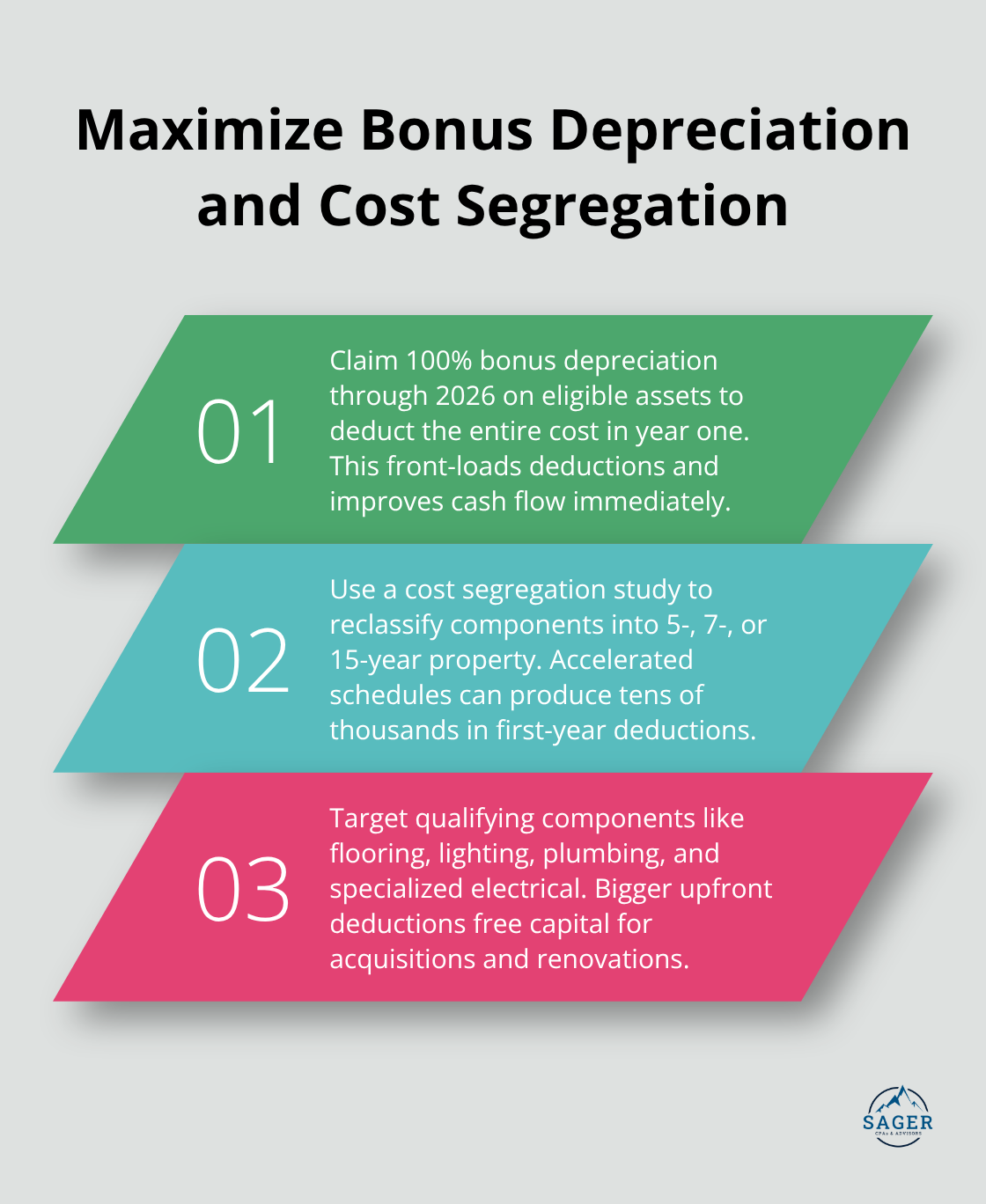
Under current IRS rules, you can claim 100% bonus depreciation through 2026. This means you deduct the entire cost of eligible assets in the year you acquire them rather than spreading deductions across decades. This applies to land improvements, parking lots, landscaping, and interior improvements in commercial buildings.
A cost segregation study identifies which components of your property qualify for shorter depreciation periods-5, 7, or 15 years instead of the standard 27.5 or 39 years. This reclassification alone can generate tens of thousands in additional first-year deductions. Flooring, lighting, plumbing, and specialized electrical systems often qualify for accelerated recovery periods that most investors never claim. The upfront deductions significantly improve your after-tax cash flow, freeing capital for additional acquisitions or renovations.
Without a cost segregation study, you leave money on the table year after year.
Utilities that you pay directly-water, electricity, gas, trash, internet, cable-are fully deductible, including common-area utilities in multifamily properties. If you self-manage your properties, tenant screening costs and advertising expenses count as deductible business expenses. Online listings, yard signs, direct mail, and website development all qualify.
The business portion of your internet and cell phone bills can be deducted if you allocate them consistently. If 15 hours per week involve property management on a 40-hour internet bill, approximately 38% of that bill is deductible. Property management fees are deductible whether you hire a third party or handle it yourself. HOA dues for rental properties are fully deductible against rental income.
Legal fees and court costs tied to evictions are deductible. Insurance premiums for rental property coverage are completely deductible. If you hire family members to assist with maintenance-your children helping with landscaping or repairs-those wages are deductible if you maintain detailed logs of hours and tasks. Equipment rentals for maintenance tools or transport count as business expenses.
Professional memberships, software subscriptions, and cloud tools used for property management are deductible. Casualty losses from fires or disasters are deductible to the extent insurance doesn’t cover them. The key is documentation: track everything, maintain receipts, and allocate expenses consistently year to year.
Your entity structure and how you organize your business directly impact which deductions you can claim and how much tax you actually owe. The right structure can amplify these deductions and create additional tax savings opportunities that go far beyond individual expense write-offs.
Your choice of entity structure determines not only which deductions you can claim but also your overall tax rate, liability protection, and cash flow. An LLC taxed as a sole proprietorship works fine for a single rental property, but it creates unnecessary tax drag once you scale. An S-Corp reduces self-employment taxes significantly but requires more compliance. A partnership or multi-member LLC offers flexibility but introduces complexity in profit allocation and basis tracking. Most real estate investors choose poorly because they focus on liability protection first and taxes second. That’s backwards. The right business structure can save you $5,000 to $15,000 annually on a portfolio generating $100,000 in taxable income.
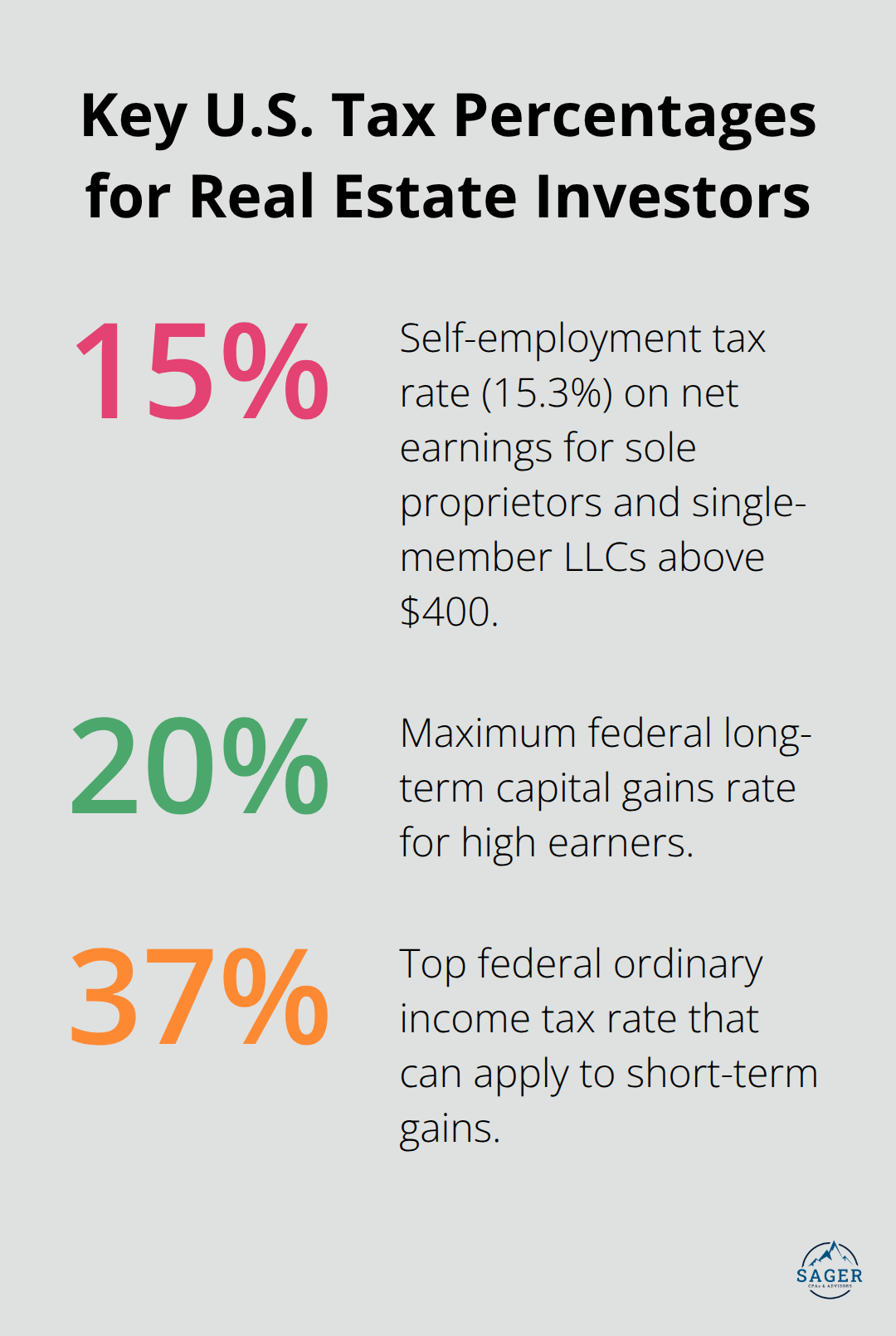
Self-employment tax is the hidden cost most investors ignore. As a sole proprietor or single-member LLC, you pay 15.3% in self-employment tax on net rental income above $400. An S-Corp lets you split income into reasonable salary and distributions. If you take $60,000 as salary and $40,000 as a distribution, you pay self-employment tax only on the $60,000, not the full $100,000. That saves roughly $6,120 annually. The IRS scrutinizes unreasonably low salaries, so you need professional guidance to set the right split.
A tax professional can model this for your specific situation and keep you compliant. Once your portfolio generates $75,000 or more in annual income, an S-Corp election typically pays for itself through tax savings alone.
Partnership structures and multi-member LLCs offer different advantages. A partnership allows each partner to allocate profits and losses according to their ownership agreement, not strictly by ownership percentage. This flexibility works well when partners contribute different amounts of capital or effort. However, partnerships require federal tax returns and state filings that cost more to prepare and maintain. Basis tracking becomes critical because losses can only reduce income to the extent of your basis in the partnership. If you invest $50,000 and the partnership generates a $75,000 loss, you can only claim $50,000 that year. The remaining $25,000 suspends until you contribute more capital or have passive income. This complexity requires quarterly monitoring and careful documentation, especially when investors exit or new partners join.
Timing your entity election matters far more than most investors realize. If you elect S-Corp status mid-year, you face payroll complications and partial-year self-employment calculations. January 1st elections avoid these headaches. If you plan a significant acquisition or renovation project, the timing of bonus depreciation claims and cost segregation deductions interacts with your entity structure. An S-Corp with suspended losses from prior years cannot use those losses to offset current ordinary income, but an LLC taxed as a partnership can, depending on passive activity rules. A tax advisor can evaluate your structure against your projected income and planned transactions before year-end and prevent costly mistakes. Many investors wait until tax season to consider this, but the optimal windows close long before then. Your entity structure and the timing of your transactions work together to either amplify or diminish the deductions available to you, which means capital gains treatment and long-term wealth strategies require equally careful planning.
The moment you sell an investment property, the IRS wants its cut. How much depends entirely on how long you held the property and whether you use a 1031 exchange to defer the tax bill altogether. Most investors treat this as an afterthought, calculating gains only when closing approaches. That’s a costly mistake. The difference between short-term and long-term capital gains rates can swing your after-tax proceeds by 30% or more, and a 1031 exchange can eliminate the tax bill entirely in the year of sale. These decisions shape your entire exit strategy and determine whether you reinvest profits or watch them disappear into taxes.
Hold a property for more than one year and your gains qualify for long-term capital gains rates, which max out at 20% for high earners. Sell within one year and you pay ordinary income tax rates, which can reach 37% federally plus state income tax. On a $200,000 gain, that difference amounts to $34,000 or more in additional taxes. The IRS also watches for dealer status, which reclassifies your gains as ordinary income regardless of holding period if you actively buy and sell properties. Maintaining detailed records of your investment intent, the frequency of sales, and your business activities protects you here. A single property held for rental income rarely triggers dealer status, but investors flipping multiple properties annually face serious scrutiny. If you’re uncertain whether your activities cross into dealer territory, consult a tax professional before your next sale.
A 1031 exchange, governed by IRS rules, allows you to defer all federal capital gains taxes by reinvesting sale proceeds into like-kind real property. The replacement property must equal or exceed the value of the property you sold, and you must reinvest all proceeds to defer the entire gain. You have 45 calendar days to identify replacement properties and 180 calendar days to close on them. These deadlines are absolute; missing either one disqualifies the exchange and triggers immediate tax liability. You must use a Qualified Intermediary to hold the sale proceeds, and you cannot personally touch the money between sale and purchase.
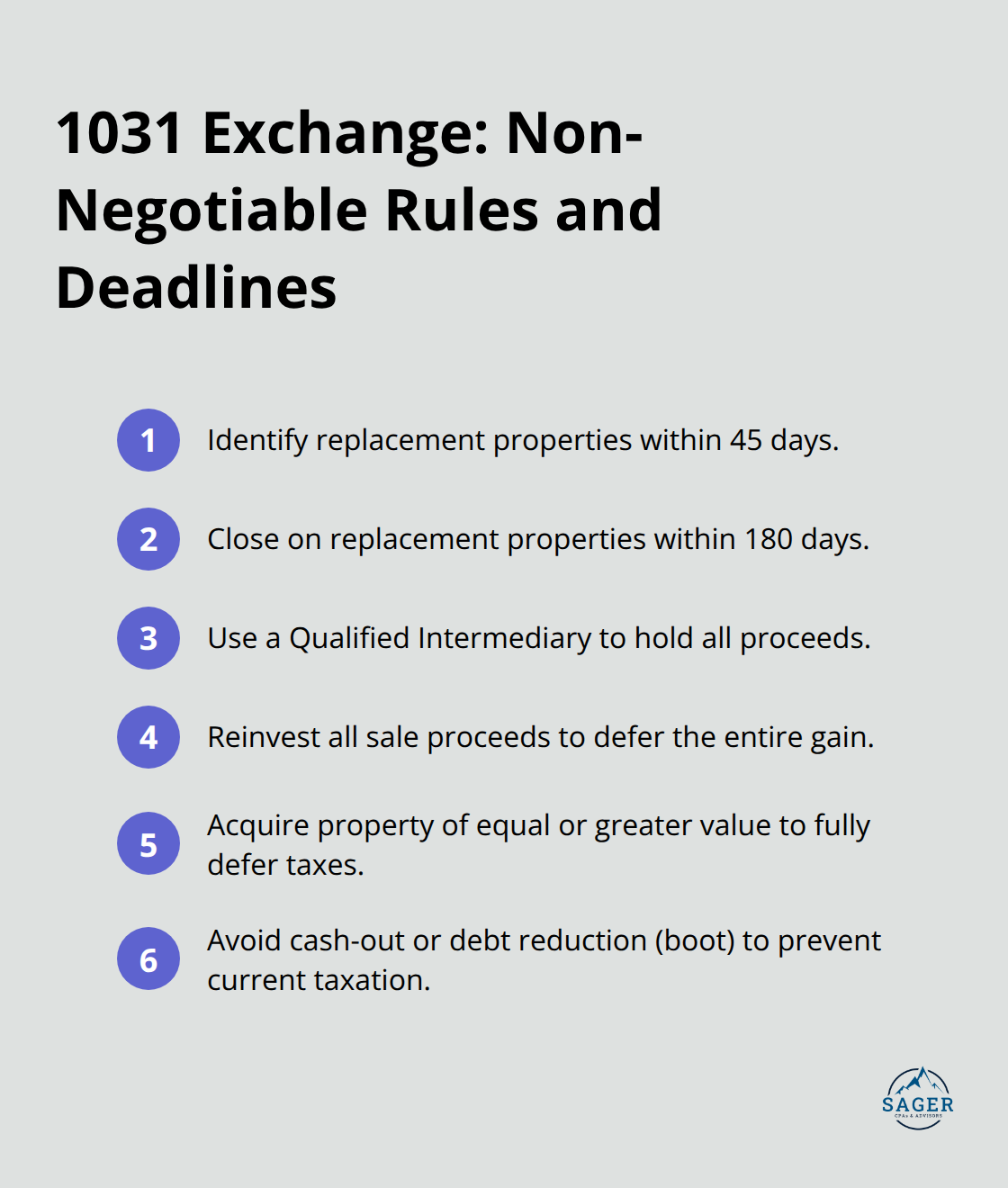
Any cash left over or debt reduction counts as boot, which is taxable in the year of the exchange. If you sell a property with $500,000 in debt and purchase one with only $300,000 in debt, that $200,000 difference becomes taxable income. Debt structure matters enormously in exchange planning. A 1031 exchange preserves step-up basis benefits for your heirs as well. When you die holding investment property, your heirs inherit it at fair market value on your death date, wiping out all accumulated gains. A 1031 exchange defers taxes but doesn’t eliminate them, so this step-up benefit remains intact for your estate.
Documentation is non-negotiable for compliance. You need written identification of replacement properties within 45 days, closing statements proving you acquired them, and evidence that your Qualified Intermediary held all proceeds. The IRS audits 1031 exchanges regularly because timing violations and improper debt handling are common mistakes. State rules add another layer of complexity; some states impose their own requirements beyond federal rules. Timing your sale to align with your entity structure, managing debt carefully, and selecting replacement properties strategically transforms a 1031 exchange from a simple deferral into a wealth-building tool that accelerates portfolio growth across decades.
Real estate tax strategies separate investors who build wealth from those who watch profits disappear into unnecessary taxes. The deductions you claim, the entity structure you choose, and how you handle capital gains determine whether your portfolio thrives or stagnates. Most investors focus on finding deals and managing properties while ignoring the tax side entirely, which costs them tens of thousands annually.
Tax planning happens before you buy, not after you sell. Bonus depreciation and cost segregation studies generate massive first-year deductions that improve cash flow immediately, while your business structure directly impacts self-employment taxes and which deductions you can claim. A 1031 exchange can eliminate capital gains taxes entirely if you plan it correctly, but missing a deadline or mishandling debt structure triggers immediate tax liability.
Professional guidance matters because the rules change constantly and state requirements add complexity beyond federal law. We at Sager CPA help investors optimize their real estate tax strategies through customized planning tailored to your portfolio and goals, so schedule a consultation with us to create a personalized financial strategy that protects your returns and accelerates your wealth building.




Privacy Policy | Terms and Conditions | Powered by Cajabra
At Sager CPAs & Advisors, we understand that you want a partner and an advocate who will provide you with proactive solutions and ideas.
The problem is you may feel uncertain, overwhelmed, or disorganized about the future of your business or wealth accumulation.
We believe that even the most successful business owners can benefit from professional financial advice and guidance, and everyone deserves to understand their financial situation.
Understanding finances and running a successful business takes time, education, and sometimes the help of professionals. It’s okay not to know everything from the start.
This is why we are passionate about taking time with our clients year round to listen, work through solutions, and provide proactive guidance so that you feel heard, valued, and understood by a team of experts who are invested in your success.
Here’s how we do it:
Schedule a consultation today. And, in the meantime, download our free guide, “5 Conversations You Should Be Having With Your CPA” to understand how tax planning and business strategy both save and make you money.