
Startups Cash Flow Solutions: Stabilize Revenue and Reinvest Wisely
Stabilize your startup's cash flow with proven solutions to manage revenue, cut costs, and reinvest for growth.
Startups face a brutal reality: irregular revenue and unpredictable expenses can kill even the best business ideas. We at Sager CPA have seen countless founders struggle with cash flow management, watching their growth stall because they couldn’t stabilize their finances.
This guide covers practical startups cash flow solutions that actually work. You’ll learn how to smooth out revenue swings, collect payments faster, and reinvest your profits strategically.
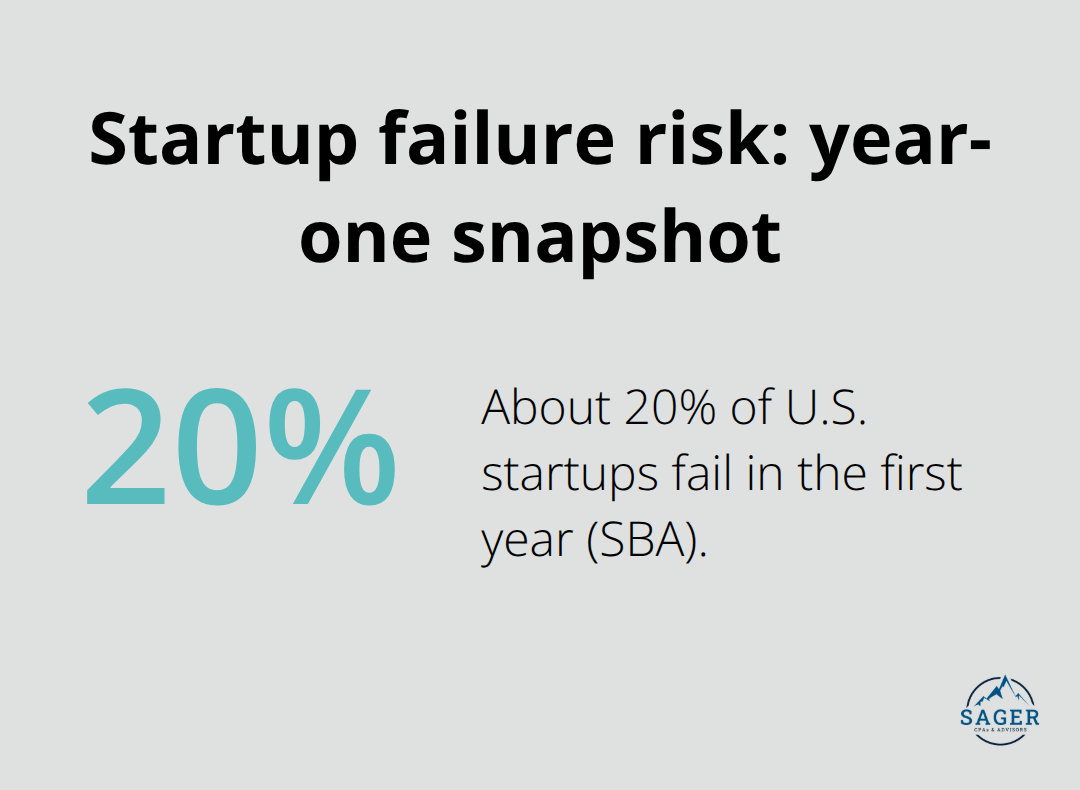
Most startups don’t fail because their product is bad. They fail because they run out of money. According to the U.S. Small Business Administration, about 20% of startups fail within the first year, and cash flow problems rank among the top reasons. A startup with strong sales can still collapse if cash doesn’t arrive when bills are due.
Irregular revenue streams create the perfect storm. A SaaS company lands a major client in month one, then waits sixty days for payment while paying salaries and hosting fees every month. A consulting firm experiences feast-or-famine months where Q1 brings three contracts and Q2 brings none. E-commerce businesses face similar chaos when seasonal demand spikes in November and December, then flatlines in January. These aren’t theoretical problems-they happen to real founders who execute well in every other area.
The financial damage compounds quickly. Cash flow management forces startups to make desperate decisions: taking on high-interest debt, delaying payroll, cutting corners on product quality, or abandoning growth opportunities because cash reserves run dry. A startup with $100,000 in annual revenue but inconsistent monthly deposits might hold only $8,000 in the bank some months, making it impossible to hire a developer or run a marketing campaign when the opportunity appears.
This directly stalls growth. Founders spend energy firefighting cash problems instead of building the business. They can’t invest in automation, hire talented people, or test new markets because they manage cash day-to-day. The opportunity cost becomes enormous-founders miss windows to scale because they lack the financial cushion to act.
The most common pitfall we see is founders treating cash flow as an accounting problem rather than a business problem. They don’t track when money actually enters and leaves the business. They confuse profit with cash (a critical distinction that trips up most early-stage founders).
A startup might be profitable on paper while experiencing negative cash flow in reality because customers pay in ninety days while suppliers demand payment in thirty. Without visibility into actual cash timing, founders make blind decisions about spending and growth. This visibility gap leads directly to the revenue stabilization strategies that separate thriving startups from those that struggle.
Stop treating revenue like a surprise. Subscription and retainer models eliminate the guessing game because money arrives predictably. A SaaS company that converts customers to annual plans instead of monthly contracts instantly knows what cash will land in the bank for the next twelve months. A consulting firm that shifts from project work to retainer clients creates baseline revenue that covers fixed costs regardless of new deal velocity. This isn’t just better accounting-it’s better business.
Companies with predictable revenue hire confidently, plan marketing budgets, and invest in product improvements without panic. If you currently operate on project-based pricing, start offering annual contracts with a discount compared to monthly rates. Most clients accept this trade because they lock in pricing. You capture cash upfront or in predictable chunks, which solves the core problem. Even a 30% shift from projects to retainers transforms your financial stability dramatically.
Payment timing matters as much as the contract model. Invoicing delays directly drain cash reserves. If you invoice after delivering work instead of before, you’ve already paid salaries and expenses while waiting for customer payment. Change this immediately: invoice upon completion or delivery, not weeks later.
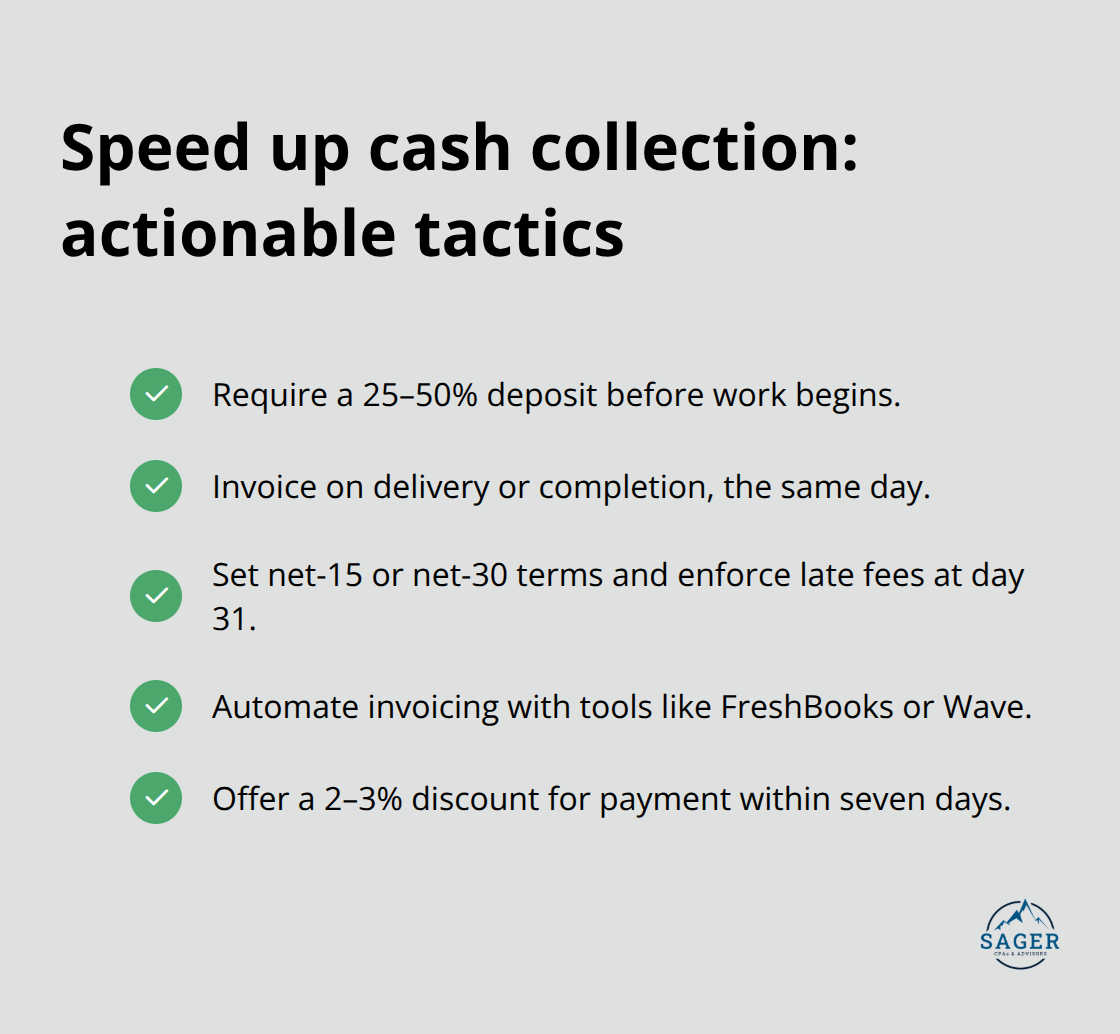
Require deposits for new clients-typically 25-50% of project value-before work begins. Use automated invoicing tools like FreshBooks or Wave to send invoices the same day work finishes, reducing the days between completion and payment. Set clear payment terms and enforce them. Offering net-30 terms but accepting payment whenever customers feel like paying destroys your cash flow. We recommend net-15 or net-30 at most for early-stage startups, with automatic late fees starting at day thirty-one. This sounds harsh but it works. When customers know money is due in two weeks with consequences, they prioritize your invoice.
Consider offering a 2-3% discount for payment within seven days. The discount costs less than the interest you’d pay on a line of credit, and you get cash immediately instead of waiting.
Financial reserves separate startups that survive downturns from those that collapse. When revenue spikes in a strong month, resist the urge to spend every dollar. Instead, calculate your average monthly operating expenses and multiply by three. That’s your target reserve.
If monthly costs run $15,000, try to keep $45,000 in a separate business savings account. Once you hit that target, you can spend on growth. This buffer lets you weather a slow month without panic, hire someone mid-month if an opportunity appears, or invest in marketing without destroying cash flow. Track this religiously-don’t let reserves drift into operational spending.
Most startups fail during their second or third year, not the first, because early success makes founders complacent about reserves. They spend reserves on expansion, then a client churns or a deal falls through and cash vanishes. The startups that thrive maintain discipline around reserves even when growth feels urgent. This foundation of financial stability positions you to make smart reinvestment decisions that actually accelerate growth instead of jeopardizing it.
Not all growth spending is equal. We at Sager CPA see startups waste thousands monthly on tools, services, and initiatives that generate zero measurable return. The difference between startups that scale efficiently and those that burn cash comes down to ruthless clarity about what spending actually moves the needle. Your financial reserves exist to fund growth, but only growth that compounds over time.
Start by identifying which spending directly generates revenue or reduces costs that prevent revenue. A SaaS startup spending $2,000 monthly on a sales tool that closes deals worth $50,000 should absolutely make that investment. A consulting firm paying $500 monthly for project management software that saves ten hours weekly (roughly $1,000 in billable time) gets immediate positive return. These decisions are straightforward because the math is obvious.
The dangerous spending happens in the gray area: the $3,000 monthly marketing platform that might improve lead quality, the $1,500 design tool that could enhance product perception, the $2,000 coaching service that might accelerate founder learning. These create the illusion of progress without clear financial impact. Startups must separate the two categories completely.
Fund activities with proven revenue impact aggressively. Treat everything else as discretionary spending that only happens after you’ve hit your three-month reserve target and revenue is genuinely stable. This means no vanity spending, no nice-to-have tools, no experiments without a success metric defined upfront. The discipline sounds brutal but it’s what separates startups that scale from those that plateau.
Track the actual reinvestment return on every dollar spent by assigning a specific metric to each investment before you spend the money. A paid advertising campaign must have a defined cost-per-acquisition target and customer lifetime value. A new hire must have a revenue-generation or cost-saving goal tied to their role. Marketing initiatives must identify exactly how they’ll be measured: new leads generated, conversion rate improvement, customer acquisition cost reduction.
Without this framework upfront, you’ll spend money hoping it works rather than knowing it works. Review performance monthly against these targets. Kill spending that misses targets within sixty days. This isn’t about being ruthless with people but ruthless with capital allocation.
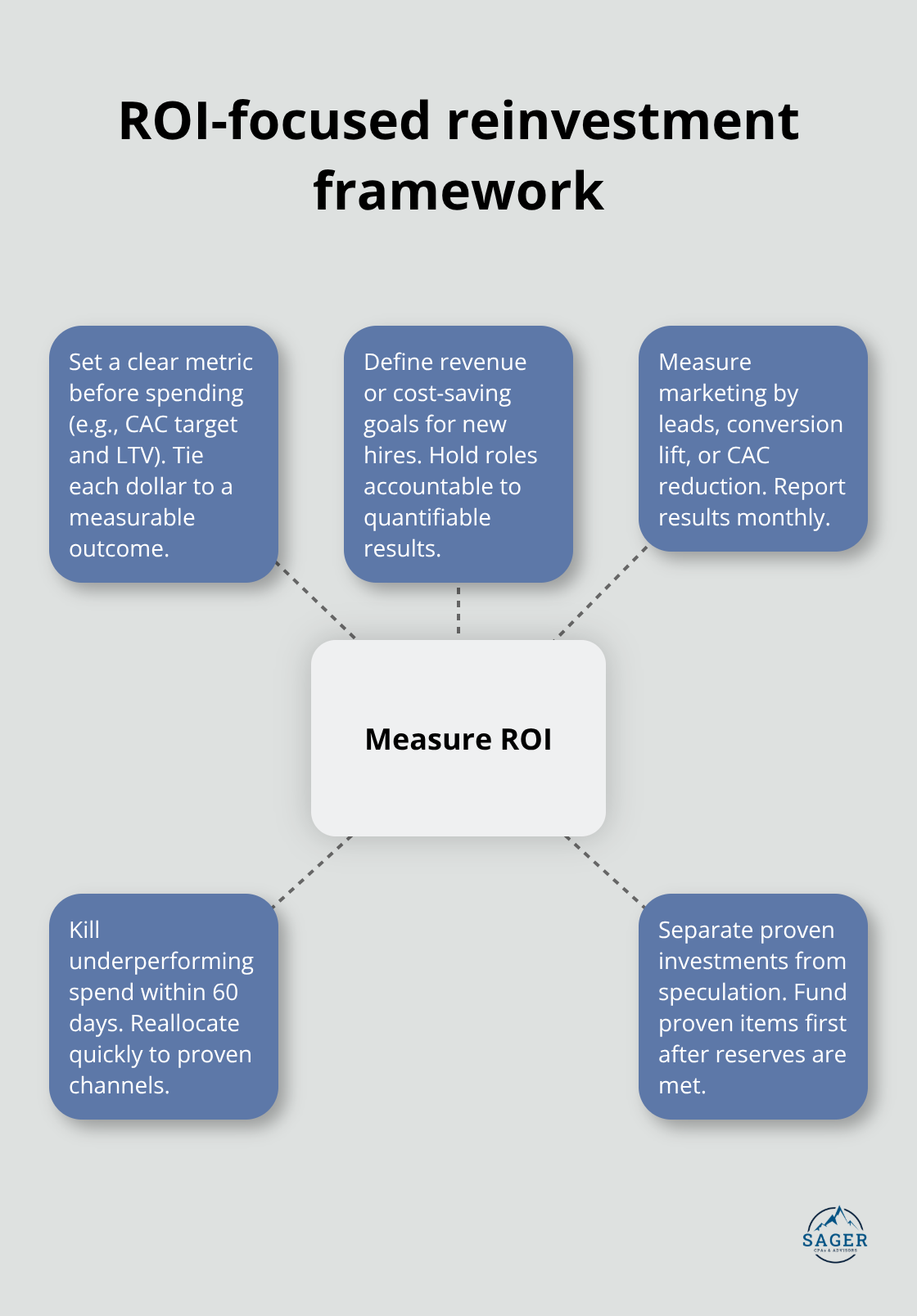
When a tool, service, or initiative underperforms, redirect that money to what’s working.
A startup that reinvests 40% of profits into proven high-return activities while maintaining 60% as reserves grows faster than one spending 80% on scattered initiatives. The math is brutal but consistent across every successful startup. This ratio protects your business during inevitable downturns while funding activities that actually accelerate growth. Maintain this discipline even when growth feels urgent and opportunities appear constantly. The startups that thrive make calculated bets on proven channels rather than spreading capital across untested experiments.
Startup cash flow solutions require three fundamental actions: stabilize revenue through predictable models, collect payments faster, and reinvest strategically in what works. The startups that survive and scale execute all three consistently, not perfectly. You don’t need flawless execution from day one-you need discipline around cash timing, ruthless clarity about spending, and the financial reserves to weather inevitable downturns.
Shift revenue toward subscription or retainer models wherever possible. Implement payment collection systems that reduce days-to-cash. Build a three-month operating expense reserve and protect it fiercely. Then track every dollar you reinvest and measure its actual impact on revenue or cost reduction, killing spending that misses targets within sixty days.
Most founders understand these principles intellectually but struggle with implementation. The gap between knowing what to do and actually doing it is where startups fail. We at Sager CPA work with founders to create customized financial strategies that transform cash flow from a constant source of stress into a competitive advantage. Schedule a consultation with Sager CPA to build your personalized startup cash flow solutions and get clarity on your financial position.




Phone: (208) 939-6029
Email: info@sager.cpa
Privacy Policy | Terms and Conditions | Powered by Cajabra
At Sager CPAs & Advisors, we understand that you want a partner and an advocate who will provide you with proactive solutions and ideas.
The problem is you may feel uncertain, overwhelmed, or disorganized about the future of your business or wealth accumulation.
We believe that even the most successful business owners can benefit from professional financial advice and guidance, and everyone deserves to understand their financial situation.
Understanding finances and running a successful business takes time, education, and sometimes the help of professionals. It’s okay not to know everything from the start.
This is why we are passionate about taking time with our clients year round to listen, work through solutions, and provide proactive guidance so that you feel heard, valued, and understood by a team of experts who are invested in your success.
Here’s how we do it:
Schedule a consultation today. And, in the meantime, download our free guide, “5 Conversations You Should Be Having With Your CPA” to understand how tax planning and business strategy both save and make you money.