
How to Create a Social Media Marketing Strategy for Small Business
Build a social media marketing strategy for small business that drives real engagement and grows your customer base
Small business owners often struggle with social media because they lack a clear plan. Without direction, posting feels random and results stay flat.
At Sager CPA, we’ve seen firsthand how a solid social media marketing strategy for small business transforms online presence and drives real growth. This guide walks you through the exact steps to build one.
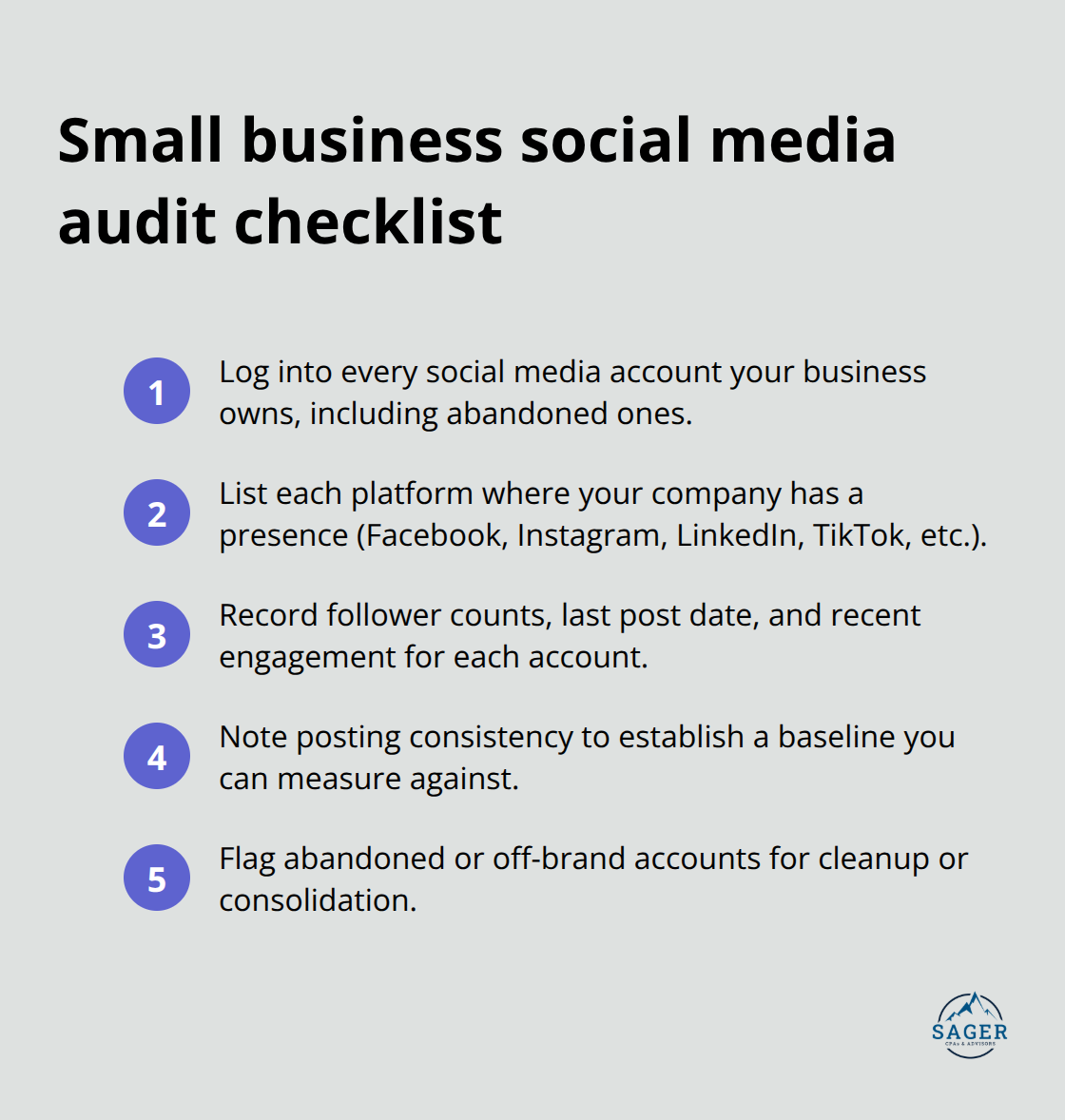
Before launching into social media, you need to understand what you already own. Most small business owners skip this step and wonder why their efforts go nowhere. Log into every social media account your business owns, even the abandoned ones. Check Facebook, Instagram, LinkedIn, TikTok, and any other platform where your company has a presence. Write down your current follower counts, when you last posted, and how many people engaged with your content. This baseline matters because you cannot improve what you do not measure. If you have posted sporadically for six months with three likes per post, that tells you something different than zero followers and no posts.
In 2026, there are around 5.66 billion active social media users worldwide, which means your audience exists-you just need to find them and understand where they spend time.
Identifying your target audience requires more than guessing. Use the analytics already built into each platform. Facebook Insights, Instagram Analytics, and LinkedIn analytics reveal your current followers’ age, location, gender, and interests. Even if you have few followers now, this data points toward who finds you relevant. Cross-reference this with Google Analytics to see which social platforms send traffic to your website and what those visitors do. If you sell accounting or tax services to small business owners, LinkedIn likely matters more than TikTok, but if you sell consumer products, Instagram and Facebook performance will show you exactly where your customers congregate. Create two or three buyer personas based on this data-give them names and specific characteristics like Marketing Manager Molly or Operations Owner Oscar. This human approach prevents you from writing vague content that speaks to no one. Test your assumptions by looking at which of your competitors’ posts attract the most comments and shares. Their audience often overlaps with yours, and their winning content shows what resonates in your market.
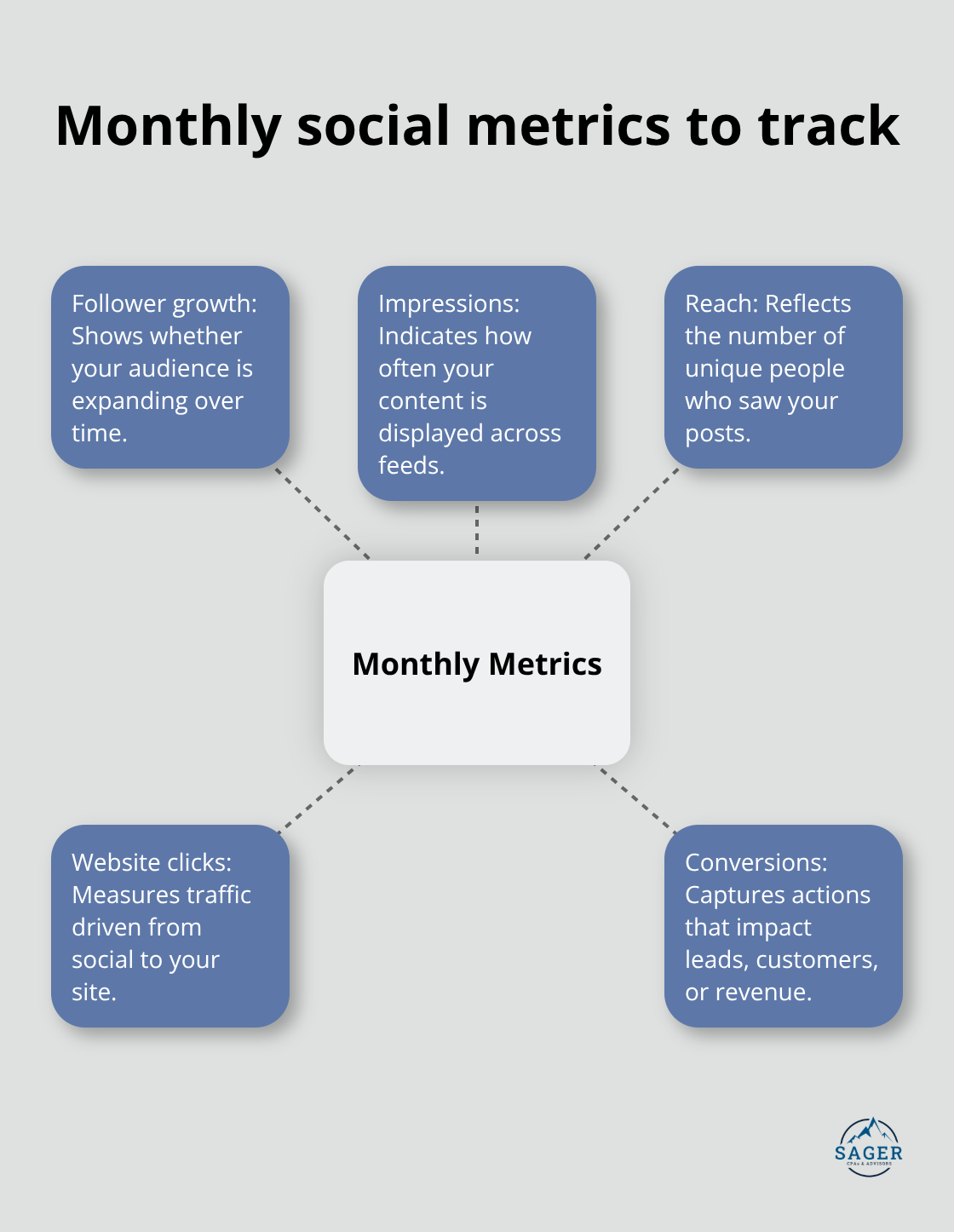
Vague goals like grow your following or increase engagement guarantee failure. Instead, set SMART goals anchored to your business outcomes. If you currently have 200 followers and want to reach 240 followers in six months, that is specific and achievable. If your website receives 50 clicks from social media per month and you want 100 clicks in three months, you have a concrete target. Tie these social goals to what actually matters for your business-leads generated, customers acquired, or revenue influenced. Choose three to five key performance indicators to track monthly: follower growth, impressions, reach, website clicks, and conversions. Avoid tracking everything at once because overwhelm kills consistency. Pick the metrics that connect directly to your business goals, then measure them the same way every month so you can spot trends. Realistic expectations matter too. If you post three times per week on Instagram, try to gain roughly ten to twenty followers per week as you improve, not hundreds overnight.
With your current position mapped and your goals set, you can now move forward with confidence. The next step involves selecting the right platforms and building content that actually resonates with your audience.
Not all social media platforms deserve your time. The mistake most small business owners make is spreading themselves across every platform hoping something sticks. Facebook has 2.9 billion monthly active users, but that does not mean Facebook is right for your business. About 71 percent of US adults use Facebook regularly, which sounds impressive until you realize your target customer might spend zero minutes there. LinkedIn reaches over 1 billion users, yet 89 percent of marketers use it specifically for lead generation in B2B spaces. If you sell tax planning services to small business owners, LinkedIn belongs on your priority list.
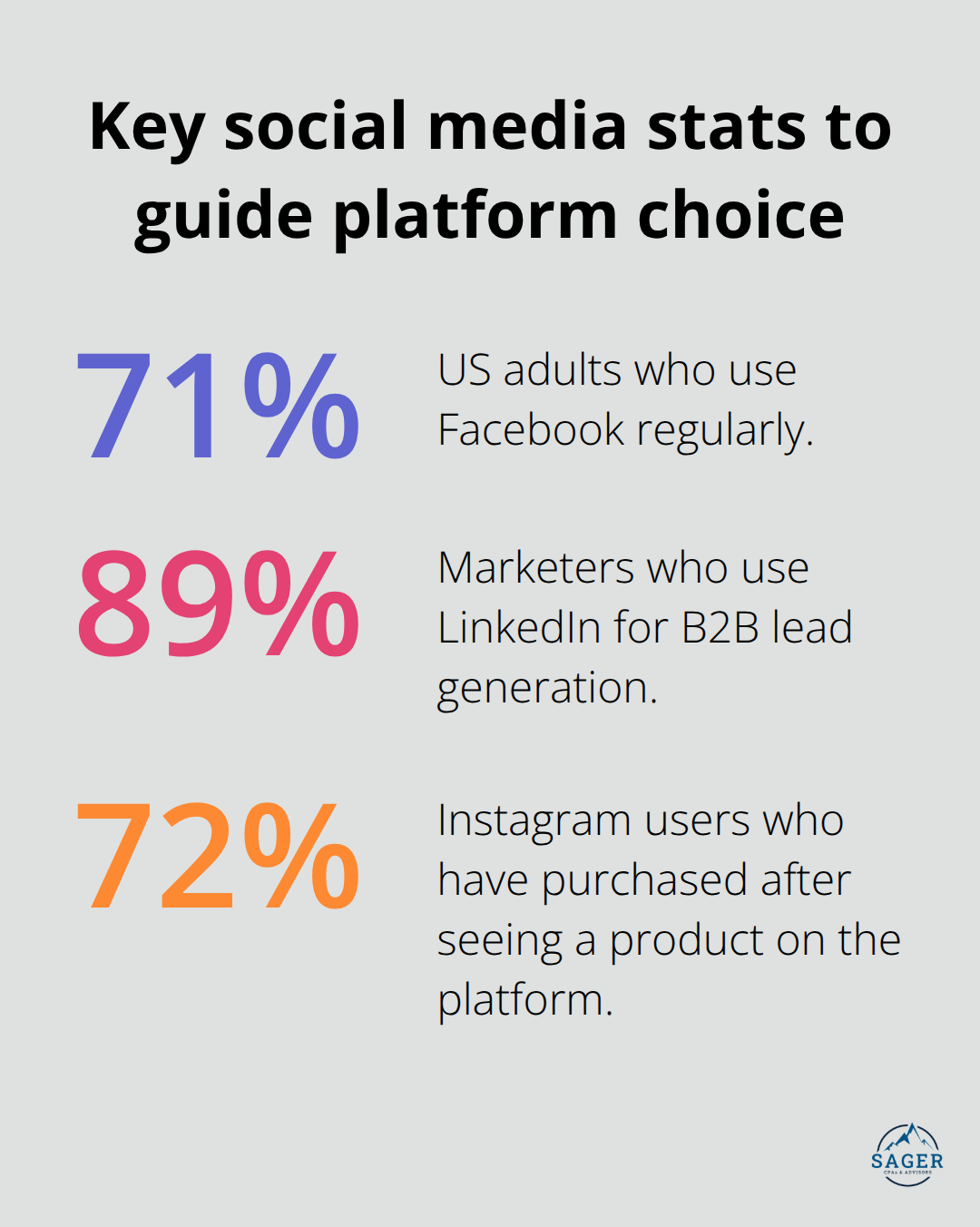
If you sell consumer products, Instagram and TikTok matter more because 72 percent of Instagram users report buying products after seeing them on the platform, and 50 percent have purchased after viewing Stories.
Start with one to three platforms where your audience actually spends time, not where you think they should be. Go back to the buyer personas you created in the previous section. Does Marketing Manager Molly check TikTok during her workday or LinkedIn? Does Operations Owner Oscar scroll Instagram at lunch or does he read industry news on X? Your platform choices should follow your audience, not your preferences. Test your assumptions by spending one week observing where your top five competitors post most frequently and where their content generates the most engagement. Their analytics reveal which platforms convert for your industry. This approach saves you months of wasted effort.
Content without a schedule is just chaos dressed up as strategy. Create a posting calendar covering the next four to eight weeks using whatever tool you actually use daily, whether that is a spreadsheet, Airtable, Notion, or a dedicated scheduling platform like Buffer or Later. Assign specific content to specific dates and platforms. Instagram performs best with three to five posts per week plus Stories and Reels. LinkedIn works with two to three posts weekly. Facebook typically handles three to five posts per week. TikTok demands two to four posts weekly. Pinterest requires five or more pins per week because pins drive traffic for months, not just days.
Post when your audience is most active, which your platform analytics already tell you. Do not guess. If your Instagram analytics show peak engagement happens Tuesday through Thursday between 11 a.m. and 1 p.m., schedule your best content for those windows. This data-driven approach eliminates the guesswork that wastes posting slots on low-traffic times.
Build your content around three to five pillars so you never run dry on ideas. Educational content teaches your audience something useful. Entertaining content keeps feeds fresh and shareable. User-generated content builds community. Promotional content drives conversions. Thought leadership positions you as an expert. Mix these throughout your month so your feed feels valuable, not salesy.
High-quality visuals dominate every platform now. Use Canva to create professional posts quickly even if design is not your strength. Canva offers templates for social media across formats like Instagram Reels, Stories, Facebook ads, and pins. Drag-and-drop editing means no design experience required. Consistent branding across all posts builds recognition, so customize Canva templates with your colors, fonts, and logos.
Video content outperforms static images across every platform, so prioritize Reels on Instagram, Shorts on YouTube, and Stories everywhere. Keep videos under 60 seconds for maximum engagement. One practical approach is repurposing existing content to reduce workload. Turn a blog post into an infographic. Slice a longer video into five short clips for Reels. Convert a customer testimonial into a carousel post. This multiplies your effort without multiplying your hours.
With your platforms selected and your content strategy mapped out, the real work begins. The next step involves building genuine community engagement and measuring what actually works for your business.
Community engagement on social media separates businesses that grow from those that stagnate. When someone comments on your post or sends you a message, that person actively shows interest in what you offer. Ignoring them sends the opposite message. Set a specific time each day-perhaps 9 a.m. and 4 p.m.-to check and respond to every comment and message. This consistency compounds over time.
According to Salesforce research, 48 percent of customers prefer learning about small businesses through social media, which means your responsiveness directly influences purchasing decisions. Answer questions directly, acknowledge compliments genuinely, and address complaints publicly when possible. If someone raises a legitimate concern in the comments, respond thoughtfully to demonstrate integrity and often convert critics into advocates.
Use platform analytics to identify which content types generate the most comments and questions, then produce more of that content. If educational posts about tax deductions spark 30 comments while promotional posts generate three, you know exactly what your audience wants to see. This pattern reveals what resonates in your market and where to focus your effort.
Measuring what actually works matters far more than posting frequently. Log into each platform’s native analytics monthly and track follower growth, impressions, reach, clicks to your website, and conversions. Most small business owners check these numbers sporadically and feel confused because they lack a baseline. Instead, record your metrics in a simple spreadsheet on the first day of each month so you can spot trends over three to six months.
Instagram Insights, Facebook Insights, and LinkedIn Analytics are free and built directly into the platforms, so use them before paying for external tools. After three months of data, you will see which posts drive actual business results. If a particular post type generates website clicks consistently, schedule more of that content. If a specific posting time attracts more engagement, post during that window every week.
Test one change at a time so you know what caused the improvement. Change your posting time and your content topic simultaneously, and you cannot identify which variable moved the needle. This disciplined approach prevents wasted effort on changes that do not actually improve results.
Use scheduling tools like Buffer or Later to maintain consistency without daily manual posting, but stay engaged with real-time comments and messages. Automation handles the posting schedule; your team handles the human interaction that actually builds community and drives conversions.
Your social media marketing strategy for small business succeeds when you audit your current position, select platforms where your audience actually spends time, and measure results monthly. The businesses that win on social media post strategically and track performance consistently, not randomly and hope for results. Consistency compounds over time-if you gain ten followers per week for six months, that becomes 240 new followers, and if you convert one website visitor into a customer weekly, that totals fifty customers annually from social media alone.
Platforms change and algorithms shift, so review your strategy quarterly and test new content formats and posting times as they emerge. What works today might need refinement in three months, and this flexibility keeps your efforts relevant and effective. Start with one to three platforms, post on a schedule, respond to your community within 24 hours, and measure results monthly rather than trying to master every platform at once.
Managing finances alongside social media marketing feels overwhelming for many small business owners who juggle multiple priorities. We at Sager CPA help small business owners clarify their financial picture so they can make confident decisions about where to invest time and money. Schedule a consultation to create a personalized financial strategy that supports your business goals.




Phone: (208) 939-6029
Email: info@sager.cpa
Privacy Policy | Terms and Conditions | Powered by Cajabra
At Sager CPAs & Advisors, we understand that you want a partner and an advocate who will provide you with proactive solutions and ideas.
The problem is you may feel uncertain, overwhelmed, or disorganized about the future of your business or wealth accumulation.
We believe that even the most successful business owners can benefit from professional financial advice and guidance, and everyone deserves to understand their financial situation.
Understanding finances and running a successful business takes time, education, and sometimes the help of professionals. It’s okay not to know everything from the start.
This is why we are passionate about taking time with our clients year round to listen, work through solutions, and provide proactive guidance so that you feel heard, valued, and understood by a team of experts who are invested in your success.
Here’s how we do it:
Schedule a consultation today. And, in the meantime, download our free guide, “5 Conversations You Should Be Having With Your CPA” to understand how tax planning and business strategy both save and make you money.