
Startup Funding Planning: Secure Capital and Scale
Plan your startup funding strategy with proven tactics to secure capital, avoid common pitfalls, and scale faster than competitors.
Many business owners invest heavily in growth initiatives, yet their strategy and business development efforts work against each other instead of in sync. This misalignment drains resources, slows progress, and leaves money on the table.
At Sager CPA, we’ve seen firsthand how companies transform when strategy and execution move in the same direction. This guide shows you how to build that alignment and accelerate sustainable growth.
Strategy without execution sits on a shelf collecting dust. Business development without strategy becomes a team chasing every opportunity that appears. Companies treating these as separate functions hemorrhage resources constantly. When your leadership team sets a five-year growth target but your business development team pursues partnerships outside that vision, you fund conflicting priorities. This disconnect shows up in your P&L as wasted time, failed partnerships, and revenue that never materializes. The companies that win treat strategy as a filter for every business development decision, eliminating noise and concentrating effort where it counts.
A clear strategy answers where you will win? Without that answer, business development becomes reactive. Your team evaluates partnerships, markets, and deals based on gut feeling rather than strategic fit. One manufacturing client faced three potential distribution partners simultaneously. Without a documented strategy, the team nearly signed with the first partner offering the highest volume. That partner operated in a market segment the company had explicitly decided to avoid. A strategy statement that specified target customer profiles and geographic priorities made the decision obvious within days.
Strategy doesn’t limit opportunity; it accelerates decision-making by eliminating low-probability bets. When your business development team knows exactly what customer types generate the highest lifetime value and which markets align with your capabilities, they stop wasting cycles on deals that drain margins or require constant discounting.
Misalignment between strategy and business development causes organizations to miss strategic targets. One scenario plays out repeatedly: strategy identifies a target market, but business development (measured on deal volume alone) pursues higher-margin deals in adjacent markets. Suddenly the company has presence in five markets instead of dominating two. Sales and marketing spend fragments across geographies. Operations struggles to serve diverse customer needs. The company becomes competent nowhere.
This fragmentation doesn’t stem from incompetence; it happens because incentive structures and decision-making authority don’t flow from a shared strategic vision. When business development leaders report to different stakeholders than your strategy owner, or when compensation rewards volume over strategic fit, misalignment becomes inevitable. The cost appears as inefficient marketing spend, sales cycles that stretch longer than they should, and customer acquisition costs that climb steadily while growth stalls.
Your compensation structure either reinforces or undermines strategic alignment. A business development leader measured solely on deal count will sign partnerships that contradict your strategy. A sales team compensated on revenue volume will discount aggressively in low-priority markets. These behaviors aren’t character flaws; they’re rational responses to misaligned incentives. The fix requires connecting compensation directly to strategic outcomes. If your strategy targets a specific customer segment, tie business development bonuses to deals within that segment. If you’ve committed to geographic focus, measure success by market penetration in those regions, not total deal volume.
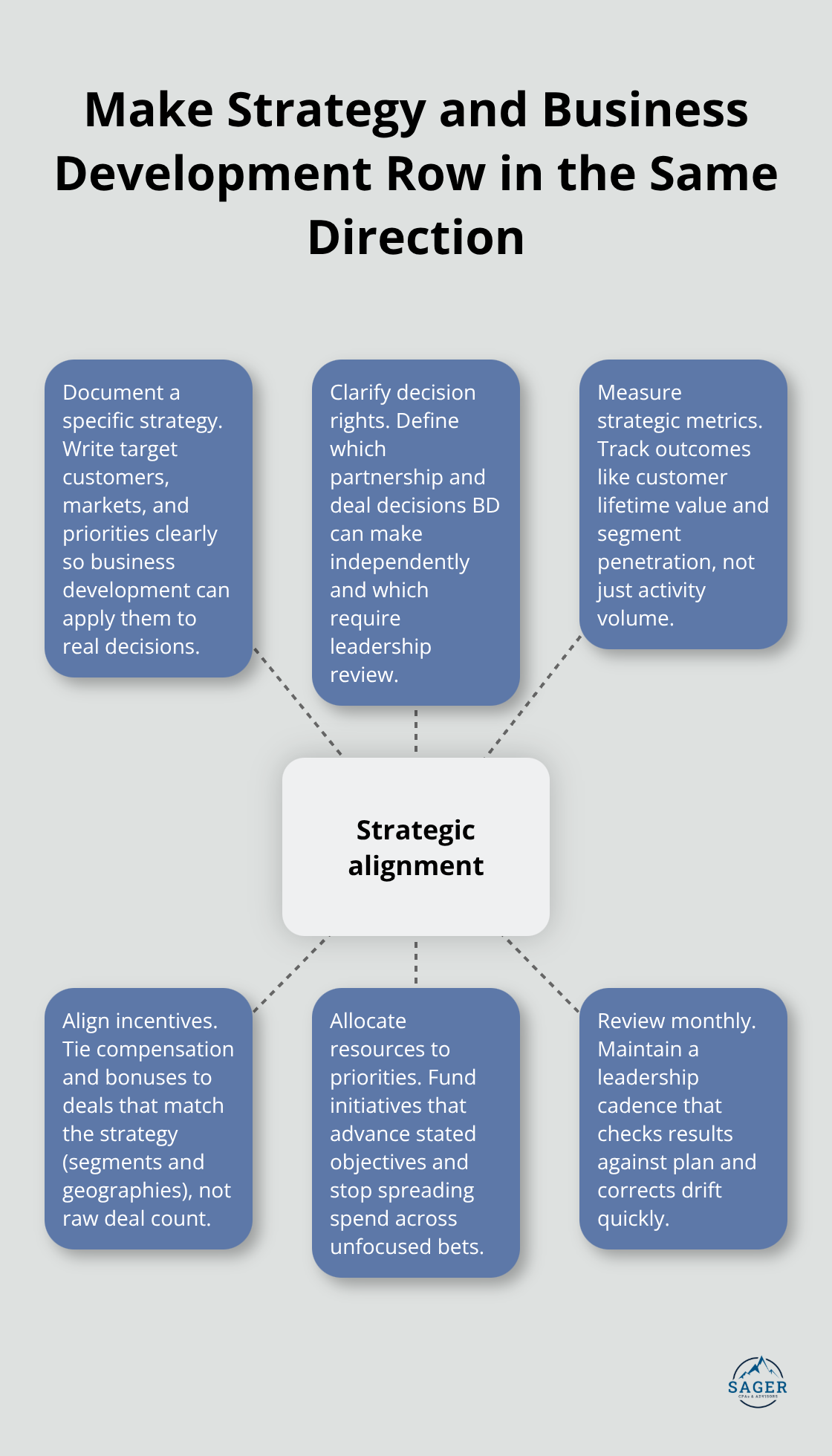
Strategy and business development stop working against each other when they share the same definition of success. This alignment requires three concrete actions: first, document your strategy with enough specificity that business development can apply it to real decisions; second, establish clear decision-making authority so business development leaders can act without constant escalation; third, measure progress against strategic metrics, not just activity metrics. When these elements align, your business development team becomes a strategic asset rather than a cost center pursuing random opportunities. The next section shows how to build that cohesive growth plan.
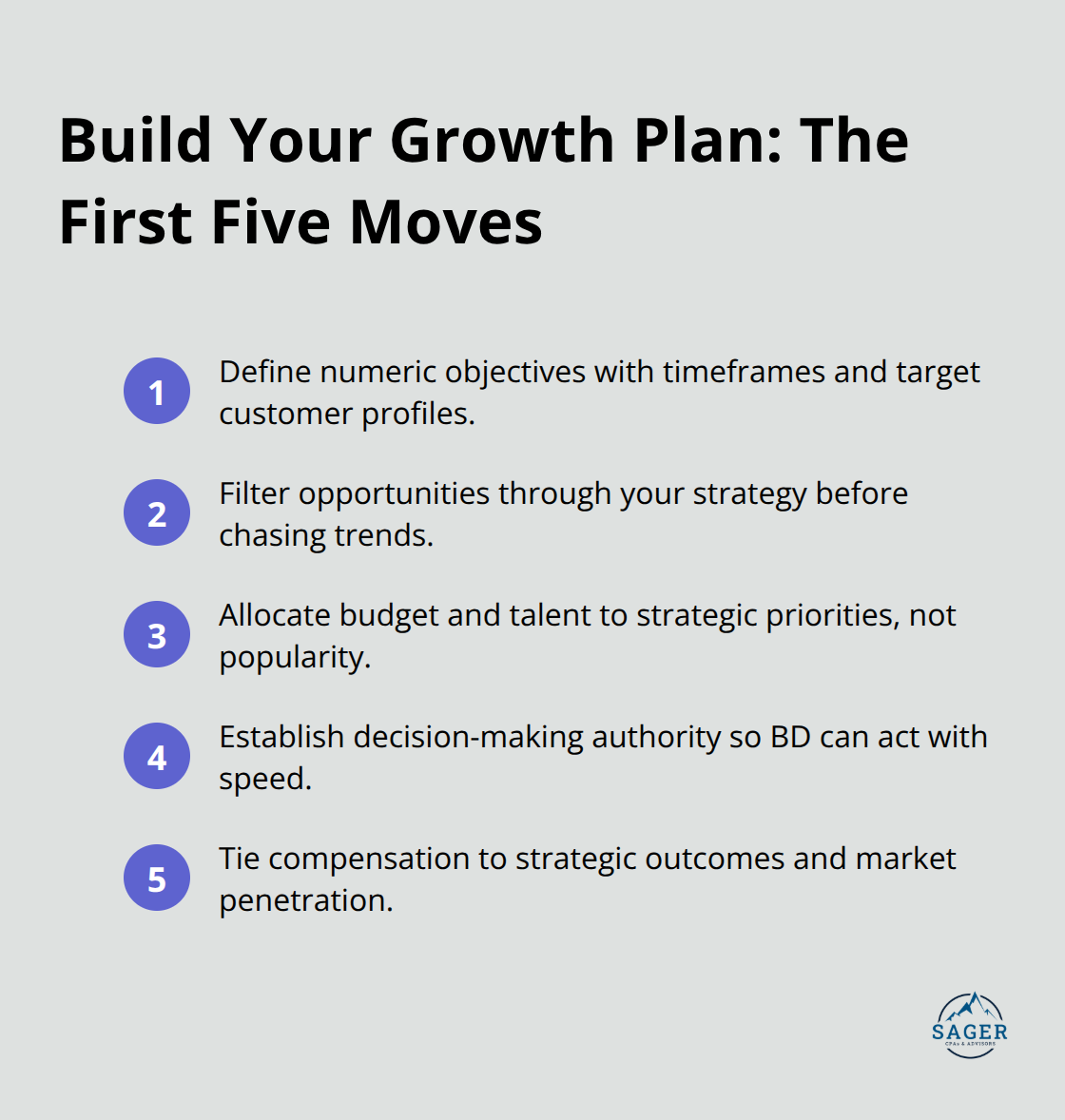
Your core business objectives need numbers attached. Instead of saying you want to grow revenue, specify that you will reach $5 million in annual revenue within three years, targeting customers in the manufacturing sector with annual budgets above $500,000. This specificity transforms strategy from decoration into a working tool. When you define objectives this way, business development knows exactly which prospects to pursue and which to pass.
A software company shifted from transactional sales to long-term partnerships and set a goal to increase customer lifetime value within eighteen months. That single metric changed how their entire business development team operated, shifting focus from volume deals to deeper client relationships. Without this precision, your team interprets strategy differently depending on who you ask. One person thinks growth means entering three new markets. Another thinks it means doubling revenue in existing markets. These conflicting interpretations waste months and resources before anyone notices the misalignment.
Market opportunity identification must start with your strategic filter, not industry trends. Trending markets often attract competitors who have no business being there, which drives prices down and margins to zero. Instead, identify opportunities that align with your existing strengths and customer relationships.
If your strategy focuses on serving healthcare organizations, evaluate opportunities based on whether they serve that sector, whether your team has relevant expertise, and whether they leverage relationships you already own. One manufacturing firm received partnership proposals from three different channel partners in the same quarter. Without strategic filtering, they might have pursued all three.
Instead, their strategy specified they would only expand through partners serving their core geographic markets and customer verticals. Two proposals fell away immediately. The third partner aligned perfectly with their objectives and became a strategic asset rather than another administrative burden.
Resource allocation to strategic priorities becomes a popularity contest where the loudest voices get funding without clear direction. Instead, tie every resource decision to your stated objectives. If your strategy prioritizes customer retention over new customer acquisition, allocate more resources to customer success and fewer to lead generation. If you commit to geographic expansion, concentrate resources in those specific regions rather than spreading thinly across five markets.
Your budget decisions should reflect your priorities directly. When strategy and resource allocation disconnect, teams default to the easiest work or the work that generates immediate revenue, abandoning the harder strategic initiatives that build long-term value.
Business development leaders need authority to act on strategy without constant escalation. When every partnership decision requires approval from multiple stakeholders, your team loses speed and momentum. Define which decisions business development can make independently based on strategic fit, and which decisions require leadership review. This clarity prevents bottlenecks while maintaining strategic control. A clear decision framework (tied to deal size, customer type, or market geography) lets your team move fast on opportunities that align with strategy and escalate only the exceptions.
Your compensation structure either reinforces or undermines strategic alignment. A business development leader measured solely on deal count will sign partnerships that contradict your strategy. A sales team compensated on revenue volume will discount aggressively in low-priority markets. These behaviors aren’t character flaws; they’re rational responses to misaligned incentives. The fix requires connecting compensation directly to strategic outcomes. If your strategy targets a specific customer segment, tie business development bonuses to deals within that segment. If you’ve committed to geographic focus, measure success by market penetration in those regions, not total deal volume. When compensation rewards strategic behavior, your team naturally pursues the right opportunities.
With your growth plan built on specificity, strategic filtering, and aligned resources, you’re ready to measure whether your efforts actually move the needle. The next section shows how to track progress and adjust course when reality diverges from your plan.
Measuring whether your strategy and business development efforts produce real results requires metrics that connect directly to your objectives, not vanity numbers that obscure underperformance. Many companies track activity metrics like meetings held or proposals sent, then wonder why revenue stalls despite apparent busyness. The companies that actually grow establish metrics tied to their stated strategy, track them consistently, and adjust when reality diverges from the plan. This means abandoning the metrics that feel comfortable and adopting ones that reveal whether you’re winning in your chosen markets.
Your key performance indicators must track progress toward your strategic objectives, not activity that feels productive. If your strategy targets a specific customer segment, measure how many customers you acquire in that segment and what their lifetime value looks like compared to customers outside your target. If you committed to geographic expansion into three regions, measure revenue penetration in those regions separately from your legacy markets, showing exactly which expansion efforts generate returns and which drain resources.
A manufacturing company set a strategic objective to increase customer lifetime value, but their sales team continued measuring success by quarterly revenue, which incentivized discounting to win deals that contradicted the strategy. Once they shifted their primary metric to customer lifetime value and measured quarterly revenue only for customers acquired within their target segment, the team’s behavior changed immediately. Revenue from strategic customers climbed 34% within twelve months while total deal volume decreased by 18%, proving that fewer, better-aligned deals generated superior results.
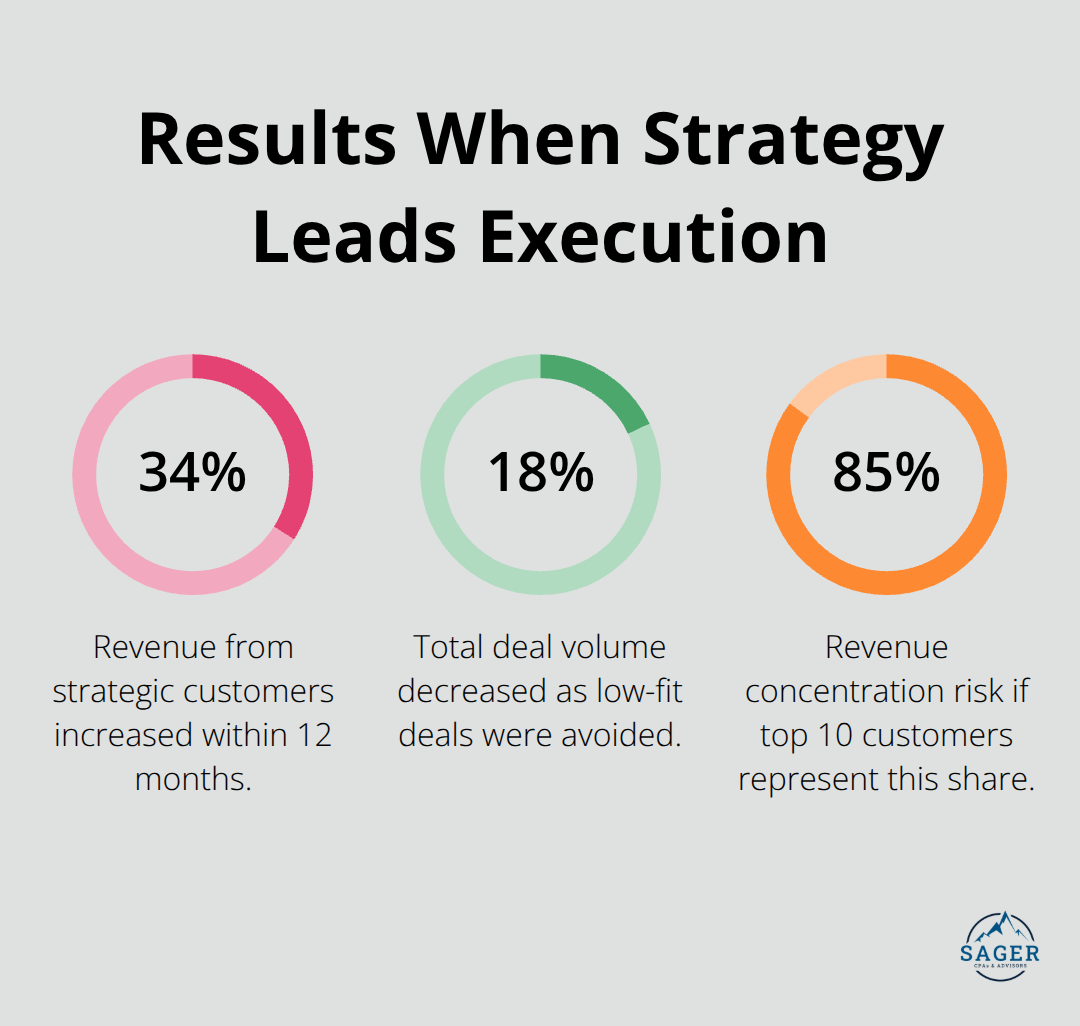
Revenue per customer in your target segment reveals whether business development pursues the right opportunities. Customer acquisition cost for strategic versus non-strategic customers exposes which partnerships and channels waste your marketing budget. Time to close for deals within your strategic focus area compared to tangential opportunities shows whether your team encounters friction pursuing the right business. Concentration of revenue among your top customers indicates whether your strategy actually creates the customer relationships you intended or whether you remain dependent on a handful of accounts. If your top ten customers represent 85% of revenue, your strategy hasn’t achieved the diversification you claimed to pursue.
Quarterly reviews happen too infrequently when market conditions shift monthly. Establish a monthly rhythm where your leadership team reviews strategic metrics against plan, identifies variance, and discusses what caused the gap. This isn’t a compliance exercise; it’s the mechanism that keeps strategy from becoming decoration. A monthly review of revenue by customer segment, new customer acquisition in your target market, and customer lifetime value trends reveals problems while you can still correct course.
One B2B services company tracked quarterly results and discovered in month nine that their business development team had drifted into adjacent markets that offered easier sales but lower margins. A monthly review would have caught this drift in month two, allowing immediate correction. Your team should know within thirty days whether the quarter’s activity aligns with strategy or whether adjustments are needed.
Strategy isn’t sacred; results are. When your metrics show that a strategic initiative isn’t producing expected returns after a reasonable timeframe, change it rather than defend it. A software company committed to serving mid-market healthcare organizations but discovered after six months that their customer acquisition cost for that segment was significantly higher than for smaller healthcare practices, which they’d initially dismissed as below their target size. The data forced a conversation: either increase resources to make mid-market penetration work, or adjust the strategy to acknowledge that their competitive advantage lay with smaller practices.
Changing the strategy felt like failure until they calculated the revenue impact of pursuing the right target. Revenue growth accelerated in year two after they aligned their strategy with market reality rather than defending their original assumptions. This requires separating strategic pivots from operational adjustments. Operational adjustments happen monthly when metrics show a tactic isn’t working: a partner isn’t delivering promised results, a market isn’t responding as expected, a customer segment is churning faster than anticipated. Strategic pivots happen less frequently, but they happen when consistent data over several months shows that your fundamental assumptions about where you can win were wrong. A metric that misses plan once might reflect seasonal variation or a single lost deal. A metric that misses plan for three consecutive months reflects a problem that demands investigation and change.
Alignment between strategy and business development isn’t a one-time project that you complete and forget. It’s the operating system that determines whether your company grows sustainably or burns resources chasing disconnected opportunities. Companies that win establish clear strategic direction, filter every business development decision through that lens, and measure progress against metrics that matter.
The path forward requires three concrete steps: document your strategy with enough specificity that your business development team can apply it to real decisions without constant interpretation; align your metrics, compensation, and resource allocation to reinforce that strategy rather than undermine it; establish a monthly rhythm where leadership reviews results against plan and adjusts when reality diverges from assumptions. These steps sound straightforward, but most companies skip them because they require discipline and honest conversation about what’s actually working versus what feels comfortable. Professional guidance accelerates this process significantly.
At Sager CPA, we work with business owners to connect financial reality to strategic decisions and transform strategy and business development from competing functions into coordinated engines of growth. Schedule a consultation to create a personalized financial strategy that aligns your growth objectives with the metrics that actually predict success.




Phone: (208) 939-6029
Email: info@sager.cpa
Privacy Policy | Terms and Conditions | Powered by Cajabra
At Sager CPAs & Advisors, we understand that you want a partner and an advocate who will provide you with proactive solutions and ideas.
The problem is you may feel uncertain, overwhelmed, or disorganized about the future of your business or wealth accumulation.
We believe that even the most successful business owners can benefit from professional financial advice and guidance, and everyone deserves to understand their financial situation.
Understanding finances and running a successful business takes time, education, and sometimes the help of professionals. It’s okay not to know everything from the start.
This is why we are passionate about taking time with our clients year round to listen, work through solutions, and provide proactive guidance so that you feel heard, valued, and understood by a team of experts who are invested in your success.
Here’s how we do it:
Schedule a consultation today. And, in the meantime, download our free guide, “5 Conversations You Should Be Having With Your CPA” to understand how tax planning and business strategy both save and make you money.