
Startup Financial Risk Planning: Anticipate and Mitigate for Growth
Anticipate financial risks in your startup with practical strategies to protect cash flow, manage debt, and build sustainable growth.
Picking the right business strategy consulting firm can make or break your company’s future. The wrong choice wastes money and time, while the right partner accelerates growth and solves real problems.
At Sager CPA, we’ve seen businesses struggle because they didn’t know what to look for. This guide cuts through the noise and shows you exactly how to evaluate your options.
The consulting market splits into three distinct models, each with different strengths and weaknesses. Understanding these categories helps you avoid hiring the wrong type of firm for your actual problem. The largest firms, including McKinsey, BCG, and Bain, operate as general management consultants with broad capabilities across industries and functions. McKinsey employs roughly 40,000 people across 130+ offices worldwide, while BCG and Bain maintain similarly massive global footprints. These firms excel at high-level strategy and can mobilize resources quickly, but they staff projects heavily with junior analysts rather than senior partners. Most budgeted hours on large-firm engagements go to analysts and consultants, not experienced partners.
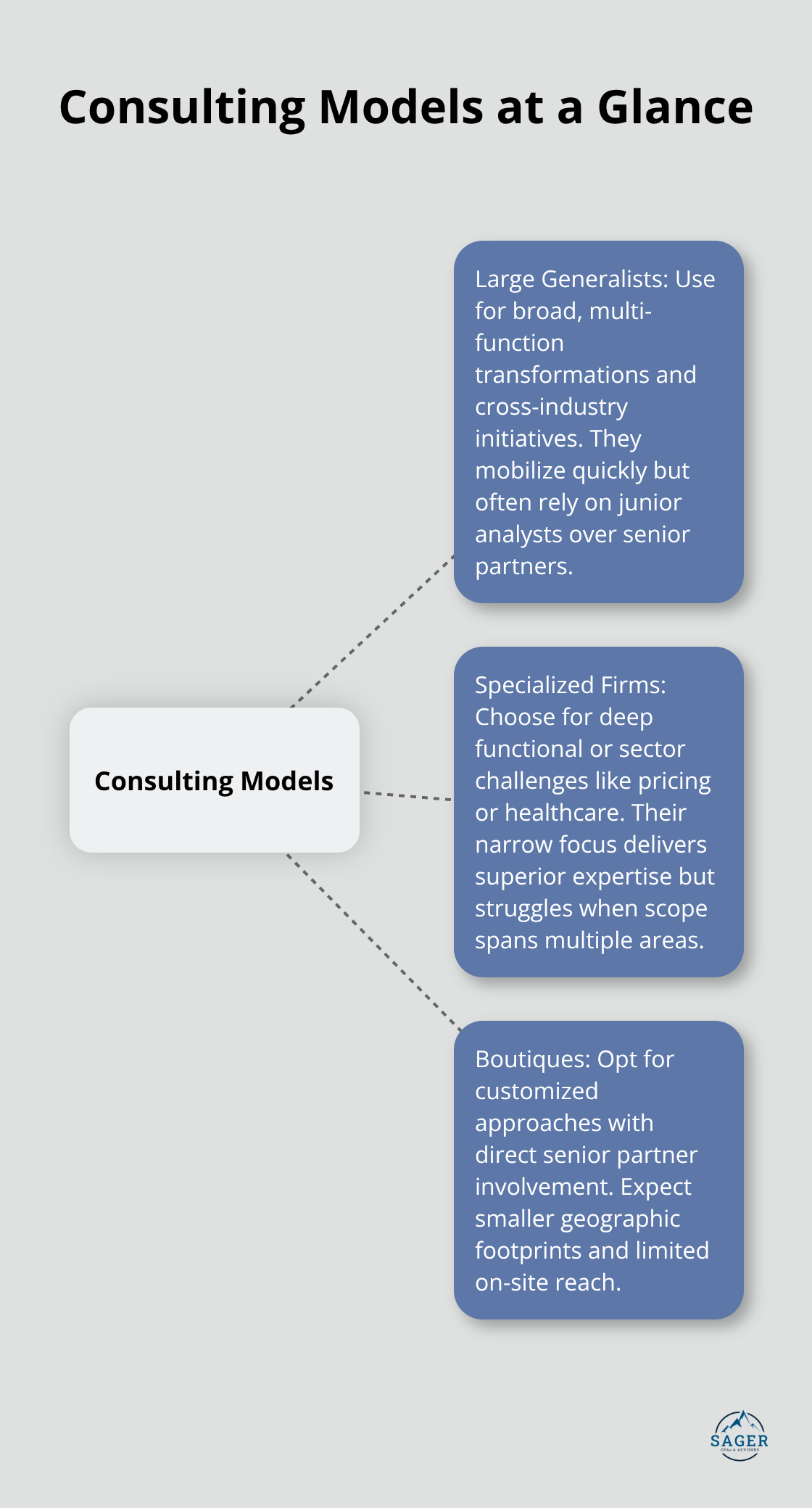
This matters because you pay premium rates but receive junior-level execution on critical work. Large firms also tend to apply their standard frameworks to every problem, which works for some situations but creates risk when your business needs a tailored approach.
Specialized industry consultants occupy the opposite end of the spectrum. Firms like Putnam Associates focus exclusively on life sciences and healthcare, while Simon-Kucher specializes purely in pricing strategy. These firms develop deep functional or sectoral expertise that general consultants simply cannot match. If your challenge sits within their narrow focus, they outperform larger competitors because the entire team understands your industry’s specific dynamics, regulations, and competitive pressures. However, if your problem spans multiple functions or industries, a specialized firm will struggle or decline the work.
The middle ground belongs to boutique and niche firms that maintain broader scope than specialists but operate far smaller than the giants. Firms like Advancy, which employs around 300 people, offer pure strategy work with lower travel expectations and more relaxed cultures than MBB firms. Clarkston Consulting focuses on life sciences, consumer products, and retail while maintaining roughly 350 employees, and clients report stronger satisfaction and better work-life balance compared to large-firm experiences. These mid-sized shops involve senior partners involvement in client work rather than hiding them behind layers of analysts. The trade-off is geographic reach-Advancy and similar firms operate from fewer locations, which matters if you need on-site presence regularly.
Your choice depends entirely on what you solve. Select large generalists for broad transformation spanning multiple functions or industries. Select specialized firms for deep functional work like pricing strategy or healthcare finance. Select boutiques when you value senior involvement, collaborative culture, and a customized approach over global reach. Once you identify which model fits your situation, the next step involves evaluating the specific factors that separate strong firms from weak ones within that category.
Narrowing your consulting choice down to the right model solves half the problem. The other half involves evaluating whether a specific firm actually possesses the expertise it claims and whether its approach matches your needs. Too many companies hire consultants based on reputation alone, then discover mid-project that the assigned team lacks relevant experience or that the firm’s standard methodology doesn’t fit the situation. The cost of this mistake runs deep: wasted budget, delayed timelines, internal frustration, and a failed project that damages credibility with your leadership team.
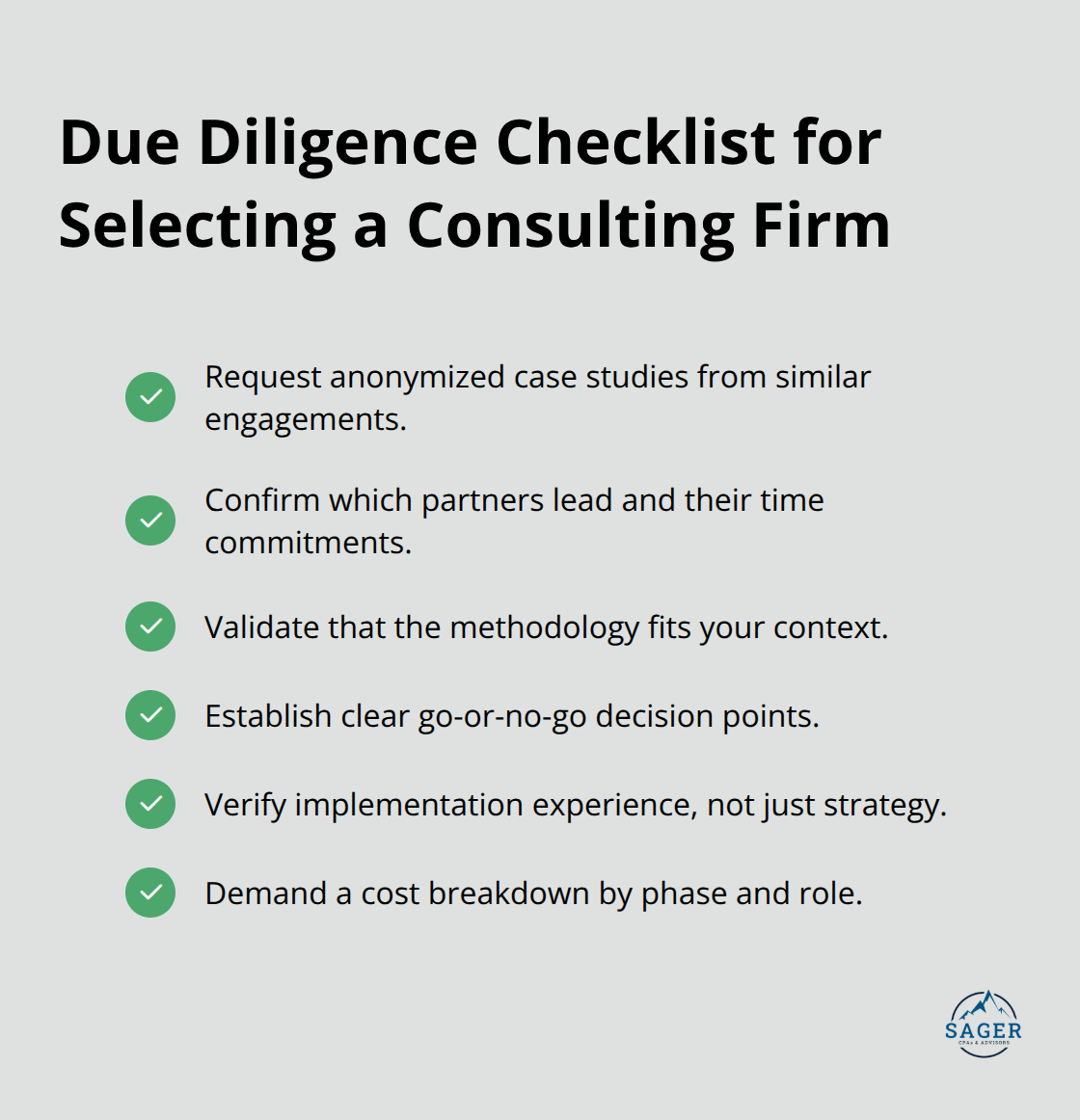
Start by verifying the firm’s actual expertise in your specific challenge, not just their general industry presence. Request anonymized case studies from similar engagements, then scrutinize the details. What was the client’s starting position? What obstacles did the team encounter? What measurable outcomes resulted? Generic case studies that describe only the approach and results without context signal a firm that recycles the same template across different problems.
Demand specificity about team composition too. Large firms often showcase senior partner names in proposals, then staff the project with junior consultants you’ll never meet. Ask explicitly which partners will lead the work, what percentage of their time they’ll dedicate to your project, and who owns accountability for results. If a firm hesitates to answer these questions directly, that hesitation tells you everything. The top firms, including McKinsey and Bain, maintain strong track records partly because they assign experienced people to client work, not because they’re the only smart people in the industry. Boutique firms often outperform larger competitors on this dimension because their smaller size forces them to involve senior partners directly in engagements.
A firm’s stated approach reveals how it will solve your problem. Some consulting shops rely heavily on a single proprietary framework they apply to every situation, while others build custom methodologies around your specific context. Neither approach is universally correct, but the fit between their method and your challenge determines whether you’ll receive real answers or a predetermined solution.
Request a detailed breakdown of how they propose to structure the engagement. Ask how they’ll involve your leadership team in each phase. The best firms embed your people in the discovery process rather than treating them as passive recipients of recommendations. They also establish clear go-or-no-go decision points so you can adjust course if new information changes your priorities.
If a firm proposes a rigid timeline with minimal flexibility for your input, that’s a warning sign. Consulting projects that ignore client feedback rarely produce adoption, and adoption is what transforms recommendations into actual business results.
Verify whether the firm has experience with implementation, not just strategy development. A firm that hands off a beautiful strategy document and walks away leaves you responsible for the hardest part-the work that actually changes how your organization operates.
Most consulting proposals quote a flat fee or daily rate without showing where money actually flows during the project. This opacity creates risk. A firm quoting 1,000 billable hours at $200 per hour sounds clear until you realize that 800 of those hours involve junior analysts while only 200 involve senior partners. You’re paying premium rates for junior-level work.
Demand a cost breakdown by phase and resource level. What portion of the budget goes to senior involvement versus analyst time? How much covers research and analysis versus client meetings and facilitation? Which deliverables justify the highest costs? A firm willing to itemize this detail demonstrates confidence in its value proposition. Compare proposals not just on total price but on ROI and staffing composition. A more expensive firm that assigns experienced partners to your work often delivers better returns than a cheaper firm that relies on junior staff. Price matters, but fit and capability matter more.
The next critical step involves assessing whether the firm’s culture and communication style align with how your organization actually works.
The gap between choosing a consulting firm and choosing the right one often comes down to three avoidable errors that appear repeatedly. Companies hire consultants based on reputation, then discover mid-project that the firm’s culture clashes with their organization, that deliverables remain undefined, or that the assigned team lacks the promised expertise. A 2025 analysis of consulting failures showed that a misfit consulting partner causes delays, erodes internal trust, inflates budgets through scope creep, and derails promising projects entirely. The NHS Test & Trace scandal involving Deloitte serves as a cautionary example of how brand reputation alone fails to guarantee execution capability or alignment with client needs. Each of these three mistakes compounds the others, turning what should be a partnership into a source of frustration and wasted resources.
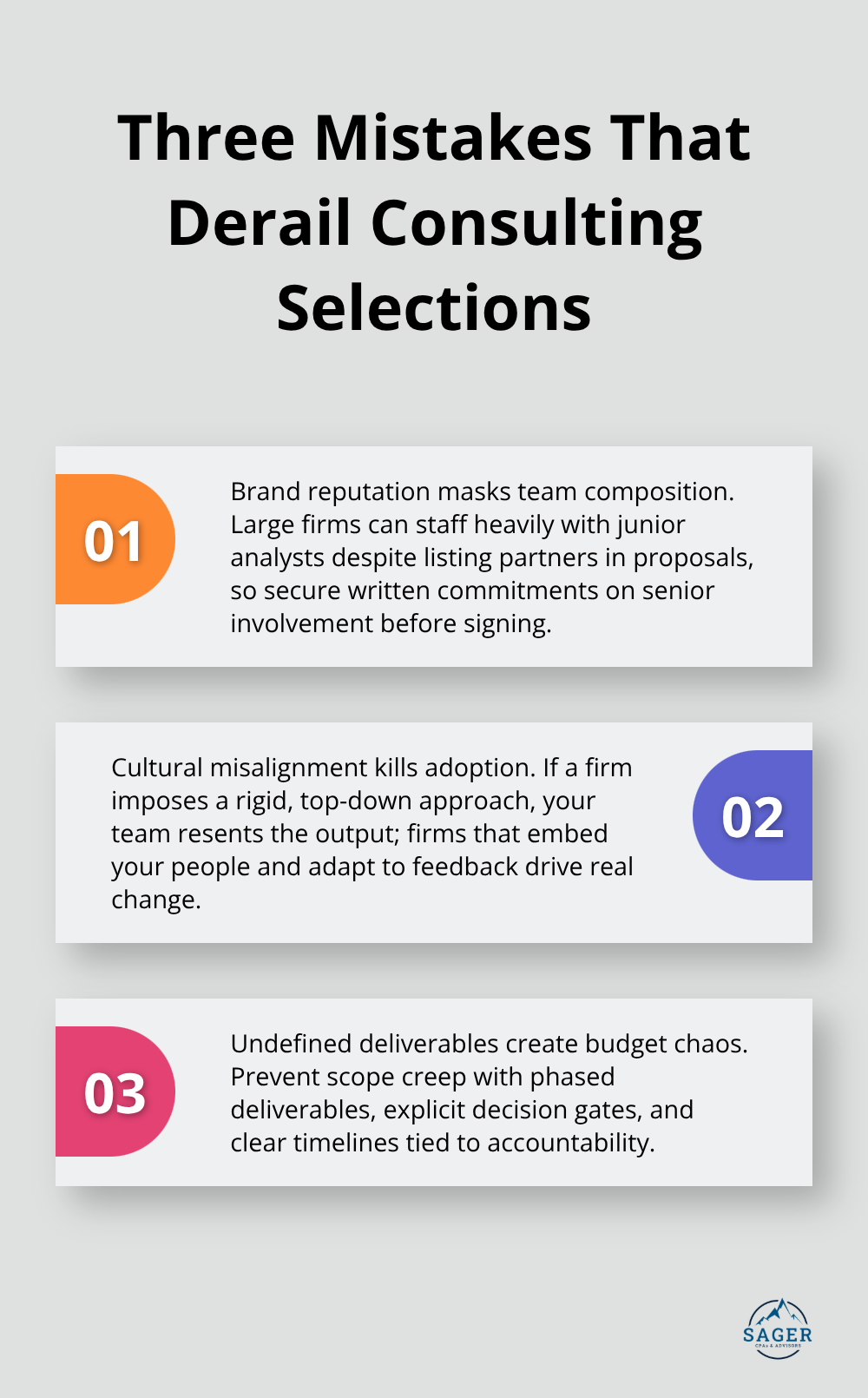
The largest consulting firms trade on their names, and that reputation often obscures what actually happens on your project. McKinsey, BCG, and Bain attract clients partly because of their prestige, but prestige does not guarantee that the partners listed in your proposal will spend meaningful time on your work. Large firms staff projects with heavy analyst involvement specifically because it allows them to scale revenue without scaling senior partner capacity. You see the partner name in the sales materials, then discover during kickoff that a consultant three levels junior will lead your daily work.
Demand explicit commitments about senior partner involvement before you sign anything. Ask for written confirmation of which partners own accountability, what percentage of their time they dedicate to your project, and how often they will participate in client meetings. If a firm hesitates to provide these specifics in writing, that hesitation signals they plan minimal senior involvement. Boutique firms like Advancy and Clarkston Consulting avoid this problem structurally because their smaller size forces senior partners into client work, not behind layers of analysts. When you evaluate proposals, compare staffing plans directly. A firm proposing 1,000 billable hours split 800 analyst hours and 200 senior partner hours delivers fundamentally different work than a firm proposing 400 analyst hours and 600 senior partner hours, even at the same total price.
Cultural misfit between consulting firm and client organization undermines adoption of recommendations. A firm that treats your leadership as passive recipients rather than active participants in problem-solving creates distance that prevents real change. Some consulting shops impose rigid methodologies without flexibility for your input, deliver recommendations in a top-down manner, and then exit without supporting implementation. Others embed your people in discovery, establish regular leadership touchpoints, and adjust course when new information emerges.
The difference determines whether your team embraces recommendations or resents them as disconnected from reality. During your evaluation process, assess how the firm responds to scope questions and feedback during the proposal phase. Do they listen and adapt, or do they defend their standard approach? Request references that specifically address collaboration style and cultural fit, not just project outcomes. Ask former clients whether the firm was easy to work with, whether it adapted to their pace and processes, and whether leadership adoption actually occurred. A firm with strong case study results but poor cultural fit will deliver recommendations your organization ignores.
Undefined deliverables and scope creep in consulting engagements drain budgets and internal resources without clear boundaries. Before you sign, require a phased cost breakdown with explicit deliverables for each step. What specific outputs does discovery phase produce? What does strategy development include? What does implementation support entail? Which phase justifies the highest costs?
A firm confident in its value proposition will itemize these details without resistance. Establish clear decision points between phases where you can assess results and adjust direction if priorities shift. This approach prevents you from paying for work you never wanted and ensures the firm stays accountable to measurable outputs rather than billable hours. Timeline clarity matters equally. Consulting projects that lack defined deadlines for deliverables often extend indefinitely, consuming budget and internal resources without clear endpoint. Specify when each deliverable is due, who reviews and approves it, and what happens if timelines slip.
Fit matters far more than prestige when you select business strategy consulting firms. A smaller boutique with deep expertise in your industry and a collaborative culture often outperforms a global giant whose standard methodology doesn’t match your challenge, while a large generalist firm makes sense when your problem spans multiple functions or industries and requires mobilizing resources across geographies. The critical step involves matching your actual problem to the right model, then rigorously evaluating whether the specific firm you’re considering can deliver on its promises.
Before you commit to any consulting engagement, clarify your financial position and strategic priorities. Understanding your current financial health, cash flow constraints, and growth targets helps you evaluate whether a consulting firm’s recommendations align with what your business can actually execute. If you need help assessing your financial foundation or developing a strategic plan that consulting recommendations can build upon, schedule a consultation with Sager CPA to create a personalized financial strategy.
The right consulting partner combined with solid financial planning accelerates growth far more effectively than either approach alone. Business strategy consulting firms deliver maximum value when they align with your organization’s capabilities and financial realities. We at Sager CPA stand ready to help you build that foundation.




Phone: (208) 939-6029
Email: info@sager.cpa
Privacy Policy | Terms and Conditions | Powered by Cajabra
At Sager CPAs & Advisors, we understand that you want a partner and an advocate who will provide you with proactive solutions and ideas.
The problem is you may feel uncertain, overwhelmed, or disorganized about the future of your business or wealth accumulation.
We believe that even the most successful business owners can benefit from professional financial advice and guidance, and everyone deserves to understand their financial situation.
Understanding finances and running a successful business takes time, education, and sometimes the help of professionals. It’s okay not to know everything from the start.
This is why we are passionate about taking time with our clients year round to listen, work through solutions, and provide proactive guidance so that you feel heard, valued, and understood by a team of experts who are invested in your success.
Here’s how we do it:
Schedule a consultation today. And, in the meantime, download our free guide, “5 Conversations You Should Be Having With Your CPA” to understand how tax planning and business strategy both save and make you money.