
Startup Funding Planning: Secure Capital and Scale
Plan your startup funding strategy with proven tactics to secure capital, avoid common pitfalls, and scale faster than competitors.
Small business owners leave thousands of dollars on the table every year by missing deductions they’re entitled to claim. At Sager CPA, we’ve helped countless business owners identify tax savings they didn’t know existed.
This guide walks you through the most valuable small business tax deductions for 2024, from home office write-offs to equipment purchases. You’ll learn exactly what you can deduct and how to document it properly for the IRS.
The home office deduction ranks among the easiest tax breaks to claim, yet most small business owners either skip it or calculate it incorrectly. The IRS allows you to deduct a percentage of your home expenses based on the square footage used exclusively for business. If you use 200 square feet of your 2,000-square-foot home for business, you can deduct 10% of eligible home expenses. Document the square footage precisely, take photos showing business-only use, and keep receipts for all home expenses you plan to claim.

Common deductible expenses include internet and phone bills (the business portion only), office furniture, equipment, supplies, property taxes, mortgage interest, utilities, homeowners insurance, and home repairs or maintenance. Painting your office counts; replacing your roof covers the entire home but you deduct only your percentage. Mortgage principal is never deductible, and neither are personal items like a television or general household furniture unrelated to work.
Two methods exist for claiming the home office deduction. The simplified method costs $5 per square foot (up to 300 square feet maximum), which works well for smaller offices-a 150-square-foot office yields a $750 annual deduction with zero paperwork beyond basic calculations. The regular method demands more effort but typically produces larger deductions. You calculate the percentage of your home used for business, then apply that percentage to mortgage interest, property taxes, utilities, insurance, repairs, and depreciation.
A home used 20% for business means you deduct 20% of these expenses annually. This approach works best if your home expenses are substantial; a homeowner with $15,000 in annual eligible expenses on a 20% business-use office deducts $3,000 versus $900 under the simplified method. Many business owners overlook that utilities, internet, and insurance premiums represent the largest deductible home expenses. A homeowner paying $200 monthly for electricity, $80 for internet, and $150 for homeowners insurance on a 15% business-use office deducts approximately $7,920 annually across these three categories alone.
Property taxes amplify this advantage significantly-a homeowner in a higher-tax state paying $6,000 yearly in property taxes deducts $900 to $1,200 depending on business use percentage. Maintain one folder for mortgage statements, property tax bills, insurance invoices, and utility statements. Track repairs and maintenance with photos and receipts-a $500 roof inspection, $800 HVAC maintenance, or $1,200 plumbing repair all qualify partially based on your business percentage.
File Form 8829 with your tax return to claim the regular method; the simplified method requires no special form, just a worksheet. If you switch methods in future years, the IRS requires consistency unless you have a valid reason to change. Once you claim home office depreciation recapture under the regular method, you may owe capital gains tax on that depreciated amount when you sell your home. This depreciation recapture makes the simplified method attractive for many owners who plan to sell within ten years. Calculate both methods before filing to see which delivers larger tax savings, then stick with that approach consistently.
The IRS requires exclusive and regular business use-your home office cannot double as a guest bedroom. The depreciation calculation on your home itself is complex and can trigger capital gains tax when you sell, so consult a tax professional before claiming it on Form 8829. Most home-based business owners benefit from the regular method if they’ve owned their home for years with substantial mortgage interest and property tax payments.
Vehicle and travel expenses represent another major category of deductions that many business owners underutilize.
The standard mileage rate for business driving in 2024 is 70 cents per mile for self-employed and business use, according to the IRS. This single number determines whether you should track actual expenses or use the simpler mileage method. Most small business owners benefit from the mileage approach because it requires minimal documentation-just a mileage log showing dates, destinations, and business purposes. If you drove 15,000 business miles last year, you deduct $10,500 with zero receipts beyond your odometer readings.
The mileage method works exceptionally well for service providers, consultants, and sales professionals who drive frequently but have modest vehicle expenses. However, this method fails if you own an expensive vehicle or financed it recently. A business owner driving a leased luxury vehicle with high monthly payments should calculate actual expenses instead.
The actual expense method requires you to track every cost: gas, insurance, maintenance, repairs, registration, and depreciation. You divide total vehicle expenses by total miles driven, then multiply by business miles. A vehicle costing $8,000 annually to operate that you drive 20,000 miles with 16,000 business miles yields a $6,400 deduction-substantially higher than the mileage method for that scenario. Compare both methods for your specific vehicle before filing, as most business owners underestimate their actual expenses and default to mileage, which often costs them hundreds in lost deductions.
Business meals present a different challenge because the IRS allows only 50 percent deductibility on standard meals, according to IRS Publication 463. A $100 lunch meeting with a client yields only a $50 deduction. However, meals during business travel where you stay overnight away from your tax home become 100 percent deductible, not 50 percent. A consultant traveling to a conference three states away can deduct every meal expense at full value, including breakfast, lunch, and dinner.
The number 100% seems to be not appropriate for this chart. Please use a different chart type.
This distinction matters enormously for traveling professionals. You must document meals with receipts showing the date, amount, location, attendees, and business purpose. The IRS scrutinizes meal deductions heavily, so vague entries like groceries or coffee shops without context trigger audits.
Entertainment expenses follow stricter rules than meals. Client entertainment-golf outings, theater tickets, or dinners-became largely non-deductible after 2017, though certain exceptions exist for meals. Meals directly preceding or following business discussions still qualify. You should never mix personal vacation days with business travel on the same trip; allocate expenses carefully. A five-day trip with two personal days means you deduct only the three business days’ lodging, airfare, and meals.
Parking fees and tolls are fully deductible even under the mileage method since they don’t count as mileage. You should maintain a dedicated folder for all receipts, credit card statements, and mileage logs to support these deductions during an IRS examination. Equipment and technology purchases offer yet another avenue for substantial tax savings that many business owners overlook.
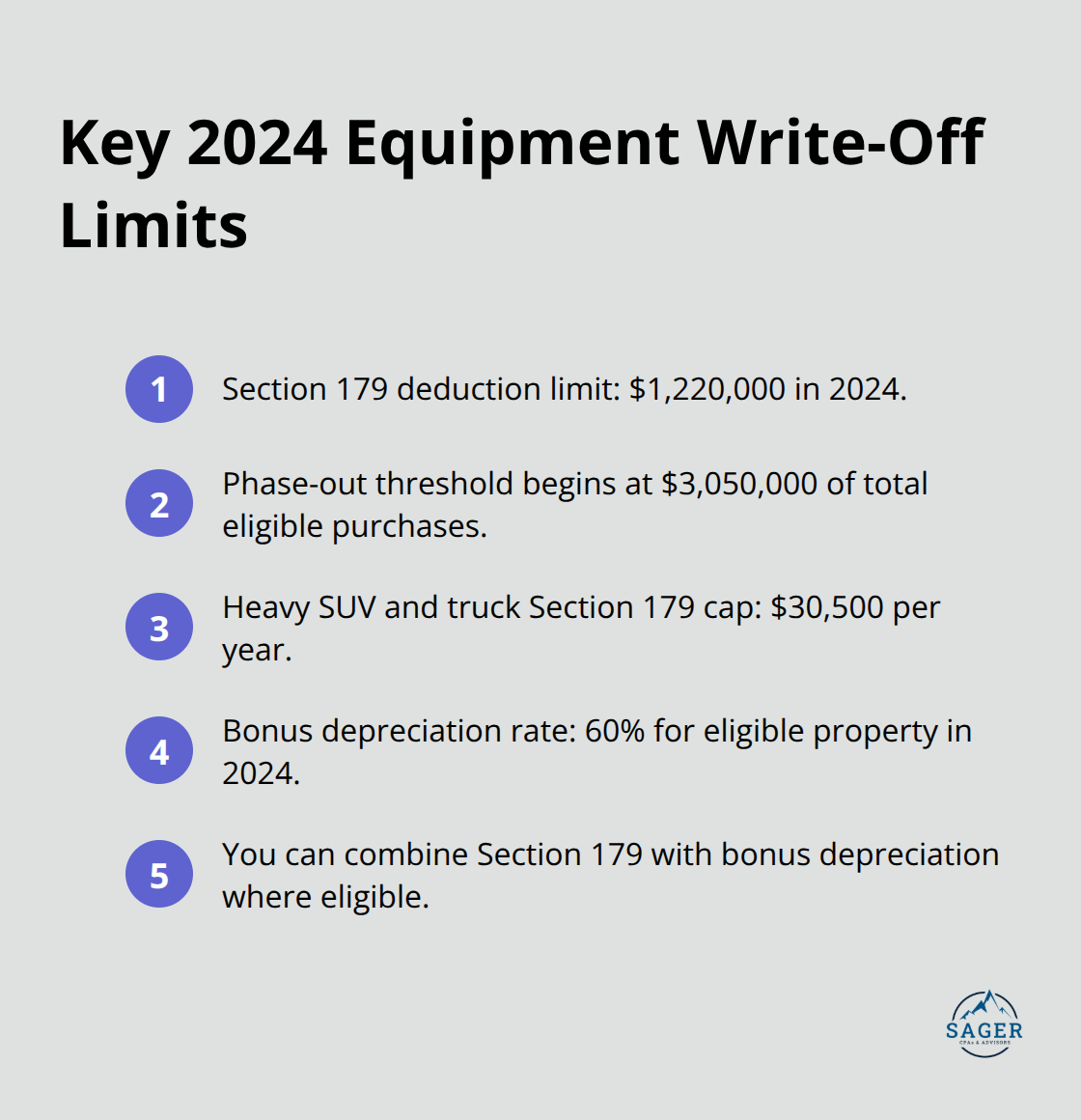
Most small business owners treat equipment purchases as one-time expenses rather than multi-year tax advantages, costing them thousands in missed deductions. Section 179 expensing allows you to deduct up to $1,220,000 in eligible property placed in service during 2024. You can write off the full cost of computers, machinery, furniture, vehicles, and equipment in year one instead of depreciating them over five to seven years. A consulting firm purchasing $50,000 in new computers and office furniture can deduct the entire amount immediately, reducing taxable income by $50,000. If your business nets $200,000 annually, this deduction drops your taxable income to $150,000, saving approximately $15,000 in federal taxes at the 22 percent bracket.
The catch is that Section 179 phases out dollar-for-dollar once your total property purchases exceed $3,050,000 in 2024, so tracking your equipment acquisitions matters significantly. Heavy SUVs and trucks face a $30,500 annual deduction cap under Section 179, which trips up many contractors and service providers who assume they can write off a $60,000 vehicle immediately. Bonus depreciation provides an alternative path, allowing a 60 percent deduction on eligible property in 2024, which you can combine with Section 179 where applicable.
Software subscriptions, cloud services, and technology expenses deserve monthly attention rather than annual review. Monthly SaaS subscriptions like accounting software, project management tools, email hosting, and design platforms are fully deductible as ordinary business expenses under IRS guidelines. A business paying $200 monthly for accounting software, $150 for project management, $80 for email hosting, and $100 for design tools deducts $5,280 annually across these four categories alone.
Most business owners fail to centralize these expenses, missing them entirely because they’re scattered across different credit cards and payment platforms. Create a spreadsheet documenting every subscription with monthly costs and business purpose, then review quarterly to eliminate redundant tools. This simple practice often uncovers $500 to $2,000 in annual waste from forgotten or duplicate subscriptions.
Professional services including accounting, tax preparation, bookkeeping, and legal fees are fully deductible when directly related to operating your business. Accounting fees for tax planning, bookkeeping, and business structure consultation qualify completely. Legal fees for business formation, contract review, employment matters, and liability protection are deductible, but legal fees to acquire assets or fight personal matters are not.
A business owner paying $3,000 for a CPA to prepare taxes, $2,000 for bookkeeping services, and $1,500 for legal review of client contracts deducts $6,500 against business income. The mistake most owners make is treating professional services as optional expenses rather than investments that directly reduce taxable income dollar-for-dollar. These three categories-Section 179 equipment deductions, software subscriptions, and professional service fees-often total $15,000 to $40,000 annually for mid-sized businesses, yet remain the most underutilized deductions available to you.
The difference between a small business owner who claims every available deduction and one who misses thousands comes down to organization and awareness. You’ve now seen how home office calculations, vehicle expenses, and equipment purchases combine to create substantial tax savings. Most business owners leave money on the table simply because they don’t track these opportunities systematically throughout the year.
Documentation separates successful deduction claims from rejected ones during an IRS examination. The IRS requires receipts, invoices, and supporting records for every deduction you claim-for mileage, maintain a log showing dates, destinations, and business purposes; for home office expenses, keep mortgage statements, property tax bills, utility invoices, and repair receipts organized by category; for equipment and professional services, retain purchase invoices and service agreements. Missing documentation doesn’t just cost you the deduction; it can trigger penalties and interest on unpaid taxes.
Small business tax deductions for 2024 represent real money in your pocket, but only when claimed correctly. The complexity of depreciation rules, Section 179 limits, and documentation requirements makes professional guidance invaluable. Schedule a consultation with Sager CPA to review your specific situation and create a personalized tax strategy that works for your business.



Phone: (208) 939-6029
Email: info@sager.cpa
Privacy Policy | Terms and Conditions | Powered by Cajabra
At Sager CPAs & Advisors, we understand that you want a partner and an advocate who will provide you with proactive solutions and ideas.
The problem is you may feel uncertain, overwhelmed, or disorganized about the future of your business or wealth accumulation.
We believe that even the most successful business owners can benefit from professional financial advice and guidance, and everyone deserves to understand their financial situation.
Understanding finances and running a successful business takes time, education, and sometimes the help of professionals. It’s okay not to know everything from the start.
This is why we are passionate about taking time with our clients year round to listen, work through solutions, and provide proactive guidance so that you feel heard, valued, and understood by a team of experts who are invested in your success.
Here’s how we do it:
Schedule a consultation today. And, in the meantime, download our free guide, “5 Conversations You Should Be Having With Your CPA” to understand how tax planning and business strategy both save and make you money.