
Advisory for Growth Businesses: Strategic Guidance for Scaling
Get strategic guidance for scaling your growth business with actionable insights on planning, funding, and operational excellence.
Growing companies face a unique challenge: the financial strategies that worked at startup stage won’t carry you through rapid expansion. At Sager CPA, we’ve seen countless businesses stumble because they didn’t adapt their approach to scaling.
Advisory for growth businesses isn’t a luxury-it’s the difference between controlled expansion and financial chaos. The right guidance helps you avoid costly mistakes while identifying opportunities you’d otherwise miss.
The financial complexity that arrives with scaling is not incremental-it’s exponential. When revenue doubles or triples, your cash flow forecasting, tax structure, and capital allocation demands shift fundamentally. Harvard Business School Professor Shikhar Ghosh’s research shows U.S. companies fail at more than 50% after five years and over 70% after ten years, with a significant portion of those failures occurring between $2 million and $10 million in revenue. This is the zone where founder bottlenecks collide with outdated financial systems.
Most growth-stage businesses operate with spreadsheets and accounting practices designed for a company one-third their size. A 13-week rolling cash flow forecast updated weekly represents the minimum practice for scaling businesses, yet fewer than 40% of mid-market companies maintain this discipline. Without clean, current financial data-if reporting consistently runs more than two weeks behind-you cannot scale effectively because decisions rest on stale information.
The cost of poor financial visibility is severe: companies that lack reliable unit economics (fully-loaded cost, customer acquisition cost by channel, and lifetime value) often accelerate growth that deepens losses rather than creates value. If your customer acquisition cost exceeds lifetime value, rapid expansion simply loses money faster. This mistake compounds quickly as you add customers, staff, and infrastructure.
External advisors bring specialized expertise that generalized accounting cannot provide. They identify which revenue segments actually generate profit, flag cash conversion bottlenecks before they become crises, and model the capital requirements for your specific expansion path. Geographic expansion, service line extensions, and strategic hiring each demand different financial architectures, and most founders lack the bandwidth to model these scenarios rigorously while running day-to-day operations.
Growing businesses leak cash through structural inefficiencies they cannot see from inside the operation. Your payroll processing might consume 12 hours weekly that could redirect to strategy; your invoicing cycle might stretch 45 days when 20 is achievable; your tax position might carry unnecessary liabilities because no one mapped your corporate structure against your actual growth trajectory. McKinsey research shows the highest performers in specialized roles can be up to 800 times more productive than average, yet most scaling companies hire incrementally rather than strategically, adding headcount without the financial leverage to justify it.
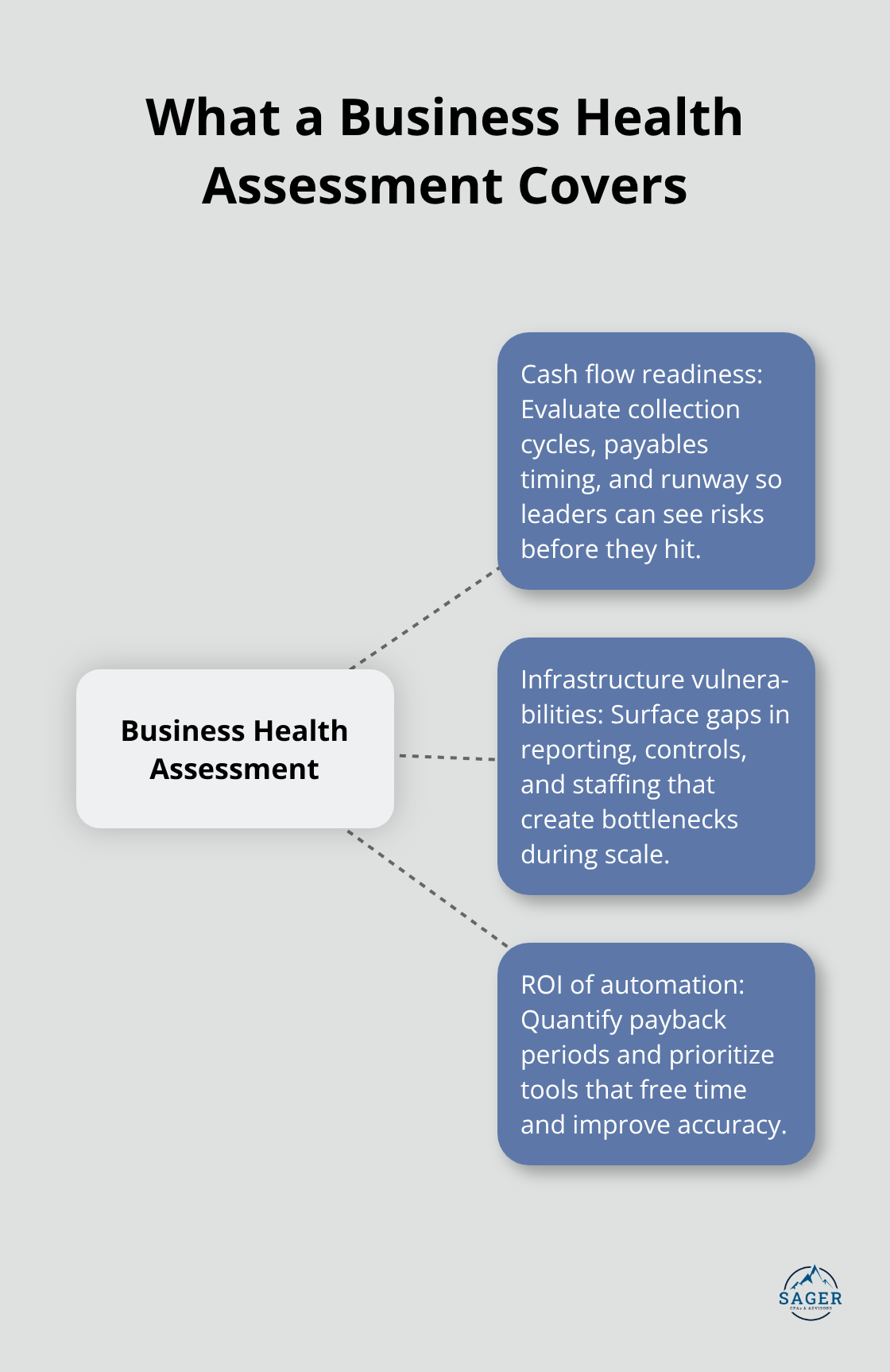
An external advisor conducts a Business Health Assessment that evaluates cash flow readiness, identifies vulnerabilities in your financial infrastructure, and quantifies the ROI of automation investments before you commit resources. They ask uncomfortable questions: Is your gross margin consistent across customer segments? Are you tracking employee utilization rates? What happens to your cash position if one major customer leaves? These questions surface decisions that founder instinct alone cannot answer.
The advisory relationship works best when positioned early-around $2 million in revenue or when founder time becomes visibly constrained. At that inflection point, external guidance translates ambition into a sustainable strategy with clear capital planning and a practical roadmap for the next phase. The financial decisions you make now determine whether your expansion accelerates profitably or stalls under its own weight. With the right financial foundation in place, you can move forward to building the systems and processes that actually support sustainable growth.
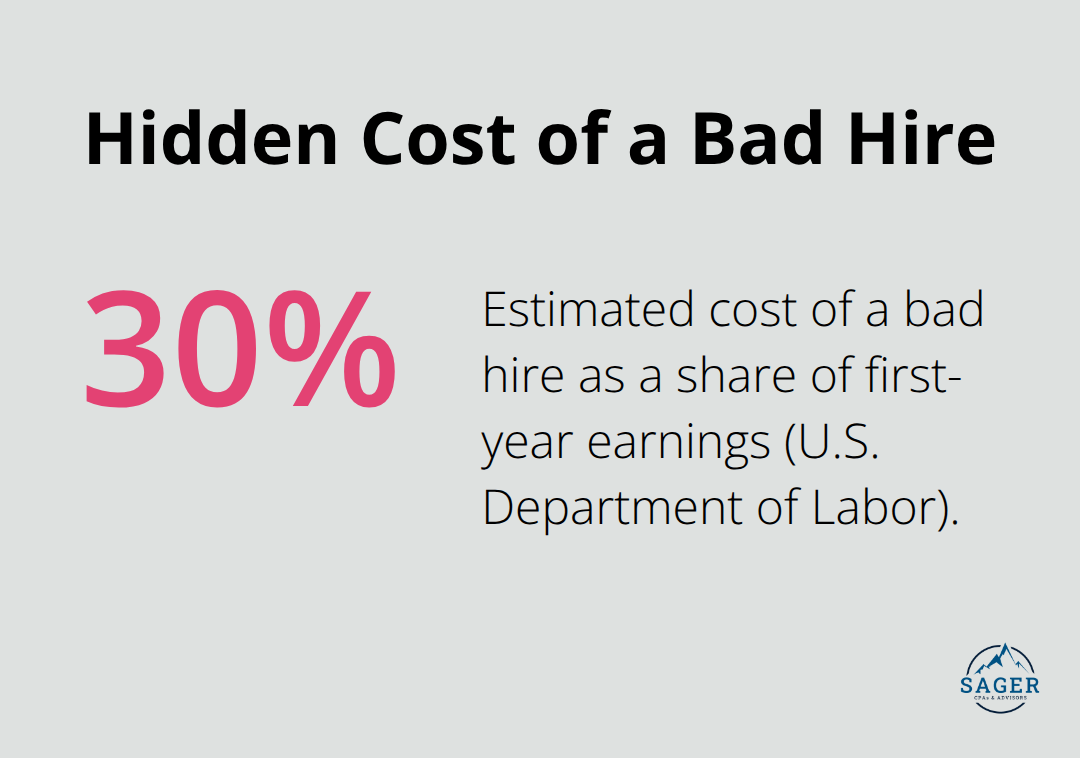
Rapid expansion demands a cash flow forecast that updates weekly, not monthly. Most growing companies discover too late that their cash position deteriorates faster than their profit statement suggests. The U.S. Department of Labor notes that a bad hire costs roughly 30% of that hire’s first-year earnings, yet most scaling businesses add headcount without modeling the cash impact across payroll, benefits, and equipment. When you add staff to support growth, your cash outflows accelerate immediately while revenue from new capacity takes weeks or months to materialize.
This timing mismatch is where companies run out of money despite appearing profitable on paper. A 13-week rolling cash flow forecast updated every Friday accounts for customer payment cycles, payroll cycles, and capital expenditures tied to your expansion plan. The forecast should model three scenarios: base case, optimistic, and stressed. The stressed scenario assumes your largest customer delays payment by 30 days or one major deal falls through.
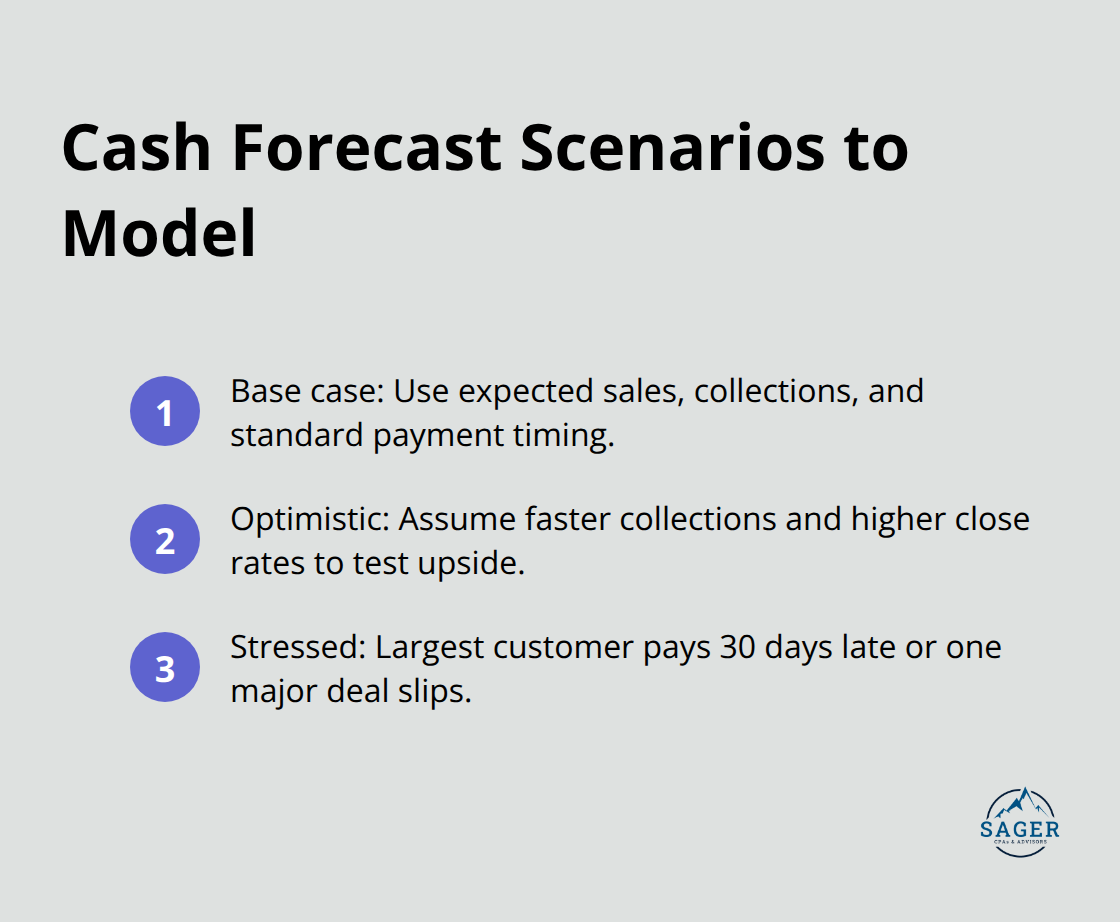
This discipline prevents founder surprises and ensures you secure financing before cash becomes tight, not after.
Geographic expansion and service line extensions each carry different cash profiles. Opening a new office requires upfront infrastructure investment that produces no revenue for 60 to 90 days; adding a new service line requires hiring specialists before you have paying customers. Model these timelines explicitly, then secure a line of credit or other financing before you need it. Most lenders move slowly, and waiting until cash is low forces you into expensive emergency financing.
Your capital structure during scaling determines whether growth strengthens or weakens your business. Many founders view growth capital as purely debt or equity, but the optimal path usually combines both. Debt is cheaper than equity and preserves ownership, but it requires consistent cash flow to service. If your cash conversion cycle stretches beyond 60 days, aggressive debt financing creates risk. Equity dilutes ownership but provides a buffer if expansion takes longer than planned.
The tax implications of scaling operations are often misunderstood because corporate structure, state nexus, and payroll tax obligations shift as you expand. Adding employees in a new state triggers payroll tax registration, unemployment insurance, and potentially state income tax withholding. If you expand geographically, sales tax nexus rules determine whether you must collect and remit sales tax in new states. A service line extension might trigger different tax treatment depending on whether the service is taxable or tax-exempt in your jurisdiction.
These details sound minor until you face an unexpected tax bill because nobody mapped your corporate structure against your expansion. A tax planning conversation at the start of any major expansion models the full-year tax impact and identifies opportunities to structure the expansion tax-efficiently. The cost of that conversation is trivial compared to the cost of correcting tax mistakes after the fact. With your cash flow and capital structure aligned to your expansion timeline, you can now focus on the systems and processes that actually support sustainable growth at scale.
The transition from founder-driven operations to systematized processes separates companies that scale profitably from those that collapse under growth. Most scaling failures stem not from market problems but from operational infrastructure that cannot handle increased transaction volume, complexity, or team size. Your financial controls must tighten precisely when growth pressure tempts you to loosen them.
Implement a monthly financial close that completes within five business days, not three weeks. This process helps you reconcile your accounts, update your financial statements, and ensure that your books are accurate. This requires standardized chart of account structures, documented reconciliation procedures, and assigned ownership for each account category. When your close takes 20 days, decision-making lags reality by weeks, and you cannot respond to cash threats or profit margin shifts quickly enough.
Automation is not optional at scale; it is the only way to maintain accuracy while freeing your team for strategic work. Payroll processing, invoice generation, and expense categorization should run through dedicated software with minimal manual intervention. The U.S. Department of Labor data shows a bad hire costs roughly 30 percent of first-year earnings, yet most scaling companies waste far more capital through inefficient processes that consume management time without generating revenue.
Automate payroll processing and benefits administration to eliminate the administrative drag that consumes 10 to 15 hours weekly at most growing companies. Implement real-time expense tracking connected to your general ledger so spending decisions rest on current data, not month-old reports. Set up automated reconciliations for bank accounts and credit cards to catch discrepancies daily rather than discovering them during the monthly close.
Accountability structures fail when they are not connected to financial reality. Assign P&L responsibility to individual business units, service lines, or geographic regions so leaders own the consequences of their decisions. Track gross margin by customer segment and by employee to identify which parts of your operation actually generate profit.
This level of granularity demands that your chart of accounts reflects your business structure, not just tax requirements. If you cannot answer within 24 hours whether your service line in the Northeast is profitable, your accounting structure is too aggregated. Most scaling companies operate with reporting that runs one to three weeks behind actual transactions, which means your team makes decisions on stale data while cash flow surprises hit without warning.
Implement a daily cash position report that shows current bank balances, upcoming payables, and expected customer payments so nothing catches you off guard. Businesses that regularly monitor cash flow are often better prepared to manage operational costs, respond to market changes, and avoid financial disruptions.
This requires discipline and the willingness to confront uncomfortable truths about customer profitability. Some customers generate revenue but destroy margins through excessive support demands or extended payment cycles (30, 45, or even 60 days). Financial controls expose these realities so you can either restructure the relationship or exit it deliberately rather than discover years later that you built a business around unprofitable customers.
Scaling a business demands financial discipline that most founders cannot provide alone. The companies that expand profitably invested in advisory for growth businesses before complexity overwhelmed their internal team. This is not about hiring more accountants; it is about accessing specialized expertise that identifies which decisions create value and which drain cash.
Most scaling businesses fail not because the market rejected their product but because financial infrastructure collapsed under growth. You cannot outrun bad unit economics, and you cannot hide from cash flow reality. The businesses that scale sustainably measure what matters, automate what is repetitive, and make decisions based on current data rather than founder intuition. Your cash flow forecast must update weekly, your financial controls must tighten as growth accelerates, and your capital structure must align with your specific expansion plan.
We at Sager CPA work with growth-stage businesses to build the financial foundation that supports expansion without the constant threat of running out of cash or discovering margin problems too late. Schedule a consultation with Sager CPA to create a personalized financial strategy tailored to your expansion timeline and capital requirements. The cost of that conversation is negligible compared to the cost of scaling without a financial roadmap.




Privacy Policy | Terms and Conditions | Powered by Cajabra
At Sager CPAs & Advisors, we understand that you want a partner and an advocate who will provide you with proactive solutions and ideas.
The problem is you may feel uncertain, overwhelmed, or disorganized about the future of your business or wealth accumulation.
We believe that even the most successful business owners can benefit from professional financial advice and guidance, and everyone deserves to understand their financial situation.
Understanding finances and running a successful business takes time, education, and sometimes the help of professionals. It’s okay not to know everything from the start.
This is why we are passionate about taking time with our clients year round to listen, work through solutions, and provide proactive guidance so that you feel heard, valued, and understood by a team of experts who are invested in your success.
Here’s how we do it:
Schedule a consultation today. And, in the meantime, download our free guide, “5 Conversations You Should Be Having With Your CPA” to understand how tax planning and business strategy both save and make you money.