
Tax Planning Efficiency: Streamline Your Tax Strategy for Better Outcomes
Streamline your tax strategy with proven planning efficiency methods. Reduce tax liability and optimize deductions for better financial outcomes.
Your company collects data every day. Yet most of that information sits unused, buried in spreadsheets and dashboards.
At Sager CPA, we see this problem constantly. The gap between data collection and strategic action is where most businesses lose competitive advantage. Business advisory services close that gap by transforming raw numbers into decisions that actually move your company forward.
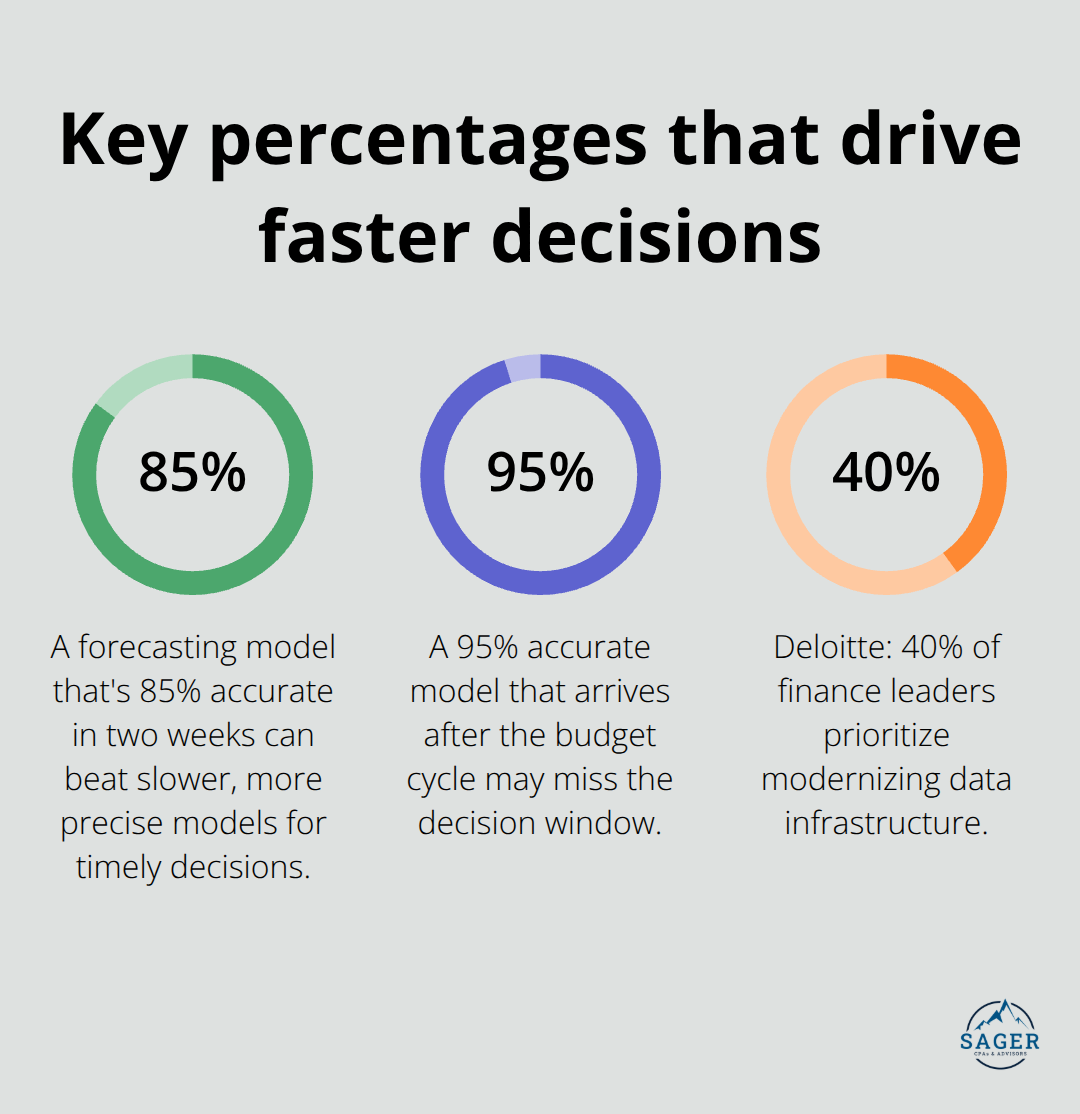
Most companies collect massive amounts of data but struggle to act on it. A 2021 Deloitte CFO survey found that 40% of finance leaders cite modernizing data infrastructure as a priority, yet only a fraction translate that data into decisions. The issue isn’t data scarcity. Organizations now generate financial metrics, operational reports, forecasting models, and benchmarking insights constantly. The real bottleneck is that data alone doesn’t automatically improve business outcomes. Your accounting systems, CRM platforms, and financial dashboards produce numbers, but those numbers rarely connect to the strategic questions that matter: Should we expand into a new market? Which customer segments are most profitable? Where are we bleeding money? Without a deliberate process to answer these questions, data becomes noise instead of direction.
Most organizations ask the wrong question. They ask, “What does the data show?” when they should ask, “What should we do next?” This distinction matters enormously. Your finance team can tell you that revenue dropped 8% in Q3, but that’s descriptive-it documents what happened. Strategic advisory moves beyond description to direction. It interprets what that 8% decline signals about market conditions, customer behavior, or operational inefficiency, then frames recommendations around your specific situation. Without this interpretive layer, data sits in reports that no one acts on. Teams operate in silos: data analysts produce dashboards, accountants generate reports, and decision-makers still rely on intuition because they don’t trust or understand the numbers presented to them. Companies with sophisticated analytics tools and talented data teams often produce insights that executives ignore because those insights lack connection to business goals or fail to demand action.
The disconnect between data teams and decision-makers is structural. Data professionals focus on accuracy and completeness; they want to validate inputs and ensure systems are reliable. Business leaders focus on speed and clarity; they need to know what to decide by Friday. These priorities clash. A data team might spend weeks perfecting a forecast model while the decision-maker needs a directional answer today. Worse, technical language-regression coefficients, statistical significance, data governance frameworks-creates a translation barrier. When your CFO or operations leader can’t quickly grasp what an analysis means for their budget or strategy, they default to gut feel.
Strategic advisors act as interpreters and translators. They take complex financial and operational data, frame it around your business objectives, and deliver recommendations with clear next steps. They understand both the technical rigor required to trust data and the business context needed to act on it. This alignment between data interpretation and strategic decision-making separates companies that hoard data from companies that weaponize it for competitive advantage. The advisor’s role is to connect what the numbers reveal to what your organization should do about it-and to present that connection in language that drives action rather than confusion.
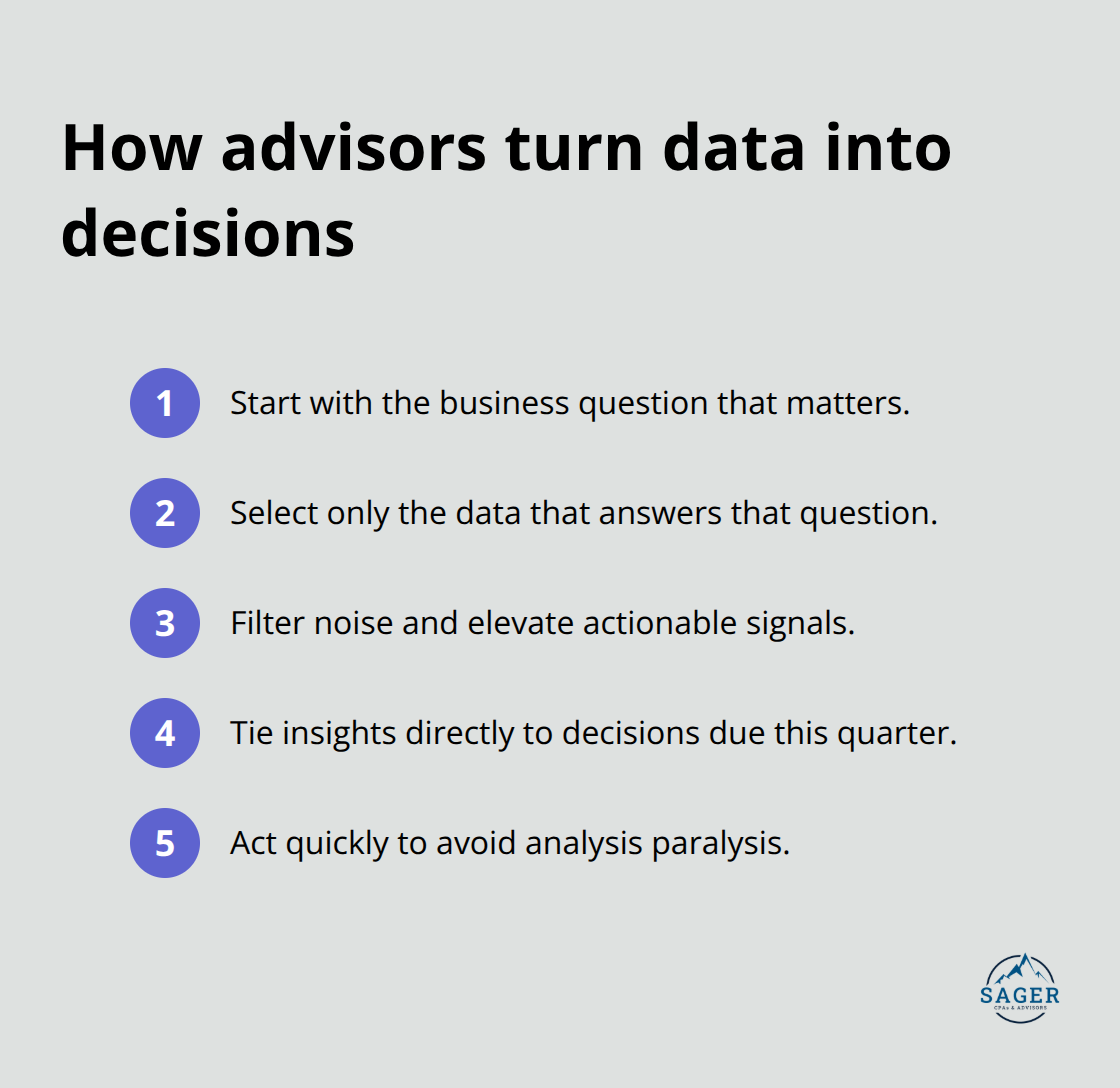
Strategic advisors work backward from your business objectives, not forward from your data. This approach matters because most companies treat data analysis as a technical exercise: they build dashboards, generate reports, and hope someone reads them. That approach fails consistently. Instead, advisors start with the question your organization actually needs answered. Are you losing market share to competitors? Should you raise prices or cut costs? Which customer segments drive profitability? Once the question becomes clear, advisors determine which data points matter and which ones distract. They ignore noise, focus on signal, and connect findings directly to decisions you face this quarter. This discipline prevents analysis paralysis. McKinsey research shows that intensive users of customer analytics are 23 times more likely to outperform peers in new customer acquisition.
Those companies didn’t achieve that edge through better data collection; they achieved it by asking sharper questions and acting faster on answers.
Financial data without business context is worthless. You might know your gross margin improved 2.3 percentage points, but that number only matters if it connects to a strategic priority like expanding into higher-margin product lines or reducing cost of goods sold. Strong advisory practices link every metric directly to your business goals. If your goal is to increase customer lifetime value, advisors identify which operational metrics predict that outcome, then track those metrics obsessively. If your goal is to improve cash flow, they distinguish between vanity metrics and cash-generation drivers. This alignment prevents your finance team from optimizing the wrong things.
Technical teams often want more time to validate assumptions and stress-test models. Business leaders need directional accuracy today. The best advisory practices acknowledge this tension and resolve it by delivering good-enough insights fast rather than perfect insights late. A forecasting model that’s 85% accurate in two weeks beats a 95% accurate model that arrives after your budget cycle closes. Advisors frame recommendations around confidence levels and time horizons, so decision-makers understand the risk.
They present three scenarios-conservative, base case, optimistic-rather than false precision. This approach respects both the rigor of data and the urgency of business. Companies that wait for perfect information lose competitive advantage to rivals who act on timely insights. The cost of being wrong and correcting course quickly often falls below the cost of delay.
Generic benchmarks and off-the-shelf templates fail because they ignore your competitive position, market conditions, and risk tolerance. Advisors structure recommendations around your specific situation instead. When you implement action plans grounded in your actual numbers and your actual goals, adoption rates climb because teams understand why the changes matter. Your finance team executes faster. Your operations leaders trust the direction. Your board sees results that connect directly to the priorities you set at the start of the year. This alignment transforms advisory from a compliance exercise into a competitive weapon.
The real test of advisory value isn’t the quality of analysis-it’s whether your organization acts on it. Advisors who understand both the technical rigor required to trust data and the business context needed to move forward separate companies that hoard information from companies that weaponize it. They take complex financial and operational data, frame it around your business objectives, and deliver recommendations with clear next steps. They act as interpreters and translators between your data teams and your decision-makers, closing the gap that typically exists between what numbers reveal and what your organization does about it. This connection between insight and action determines whether advisory accelerates your growth or simply produces another stack of reports that gather dust.
Companies that treat advisory insights as directives rather than suggestions see measurable financial gains within quarters, not years. Netflix invested heavily in data analytics to inform content decisions, and the payoff was substantial: the company used viewing patterns, demographic data, and cast appeal signals to greenlight House of Cards, a show that became a flagship franchise driving subscriber growth and premium pricing power. The decision wasn’t made on gut instinct or industry trends; it was grounded in structured analysis of what their data revealed about audience preferences. Netflix continues this practice today, and competitors who rely on traditional development instincts consistently lose market share to their data-informed approach.
The lesson applies directly to your business: advisory services that connect data to specific decisions drive competitive advantage, not just operational efficiency. McKinsey found that companies using intensive customer analytics are 23 times more likely to outperform peers in new customer acquisition. Those aren’t marginal improvements; they’re transformational. Coca-Cola demonstrates similar discipline across product development and marketing. The company analyzes consumer trends across 200+ countries to guide which products to launch, how to optimize supply chains, and where to invest marketing dollars. Their targeted advertising campaigns achieve four times higher click-through rates than non-targeted ads, a concrete metric that justifies the investment in analytics infrastructure.
Coca-Cola’s social listening operations monitor product mentions and images across their 108 million Facebook fans, 3.4 million Twitter followers, and 2.8 million Instagram followers, converting raw engagement data into product insights and marketing decisions that move revenue. Uber built demand-supply matching algorithms that create geographic temperature maps of rider and driver activity, optimizing pickup times and reducing wait costs in real time. That capability exists because advisory-level thinking embedded data interpretation into core operations, not relegated it to quarterly reporting cycles.
The pattern across successful companies is consistent: they ask specific questions, identify which data answers those questions, and act decisively on findings. In regulated industries like banking and insurance, advisory services grounded in data governance deliver risk reduction that directly impacts profitability. SAS-based analytics platforms enable these institutions to handle sensitive customer data securely while maintaining compliance, turning regulatory requirements from cost centers into competitive differentiators. Companies that implement advisory recommendations tied to specific financial or operational goals within 90 days show measurable results, while organizations that treat advisory as a one-time engagement rarely sustain momentum.
The difference lies in structure. Effective advisory establishes decision frameworks before analysis begins, assigns accountability for implementation, and tracks whether actions produce the expected financial outcomes. Manufacturing firms reduce material waste by 12 to 18 percent when they implement supply chain recommendations grounded in cost data. Professional services firms increase billing realization by 6 to 10 percent when they act on utilization analytics that identify where time is underpriced or underutilized. Retail operations cut inventory carrying costs by 8 to 15 percent when they shift from intuition-based purchasing to demand forecasting backed by transaction and seasonal data.
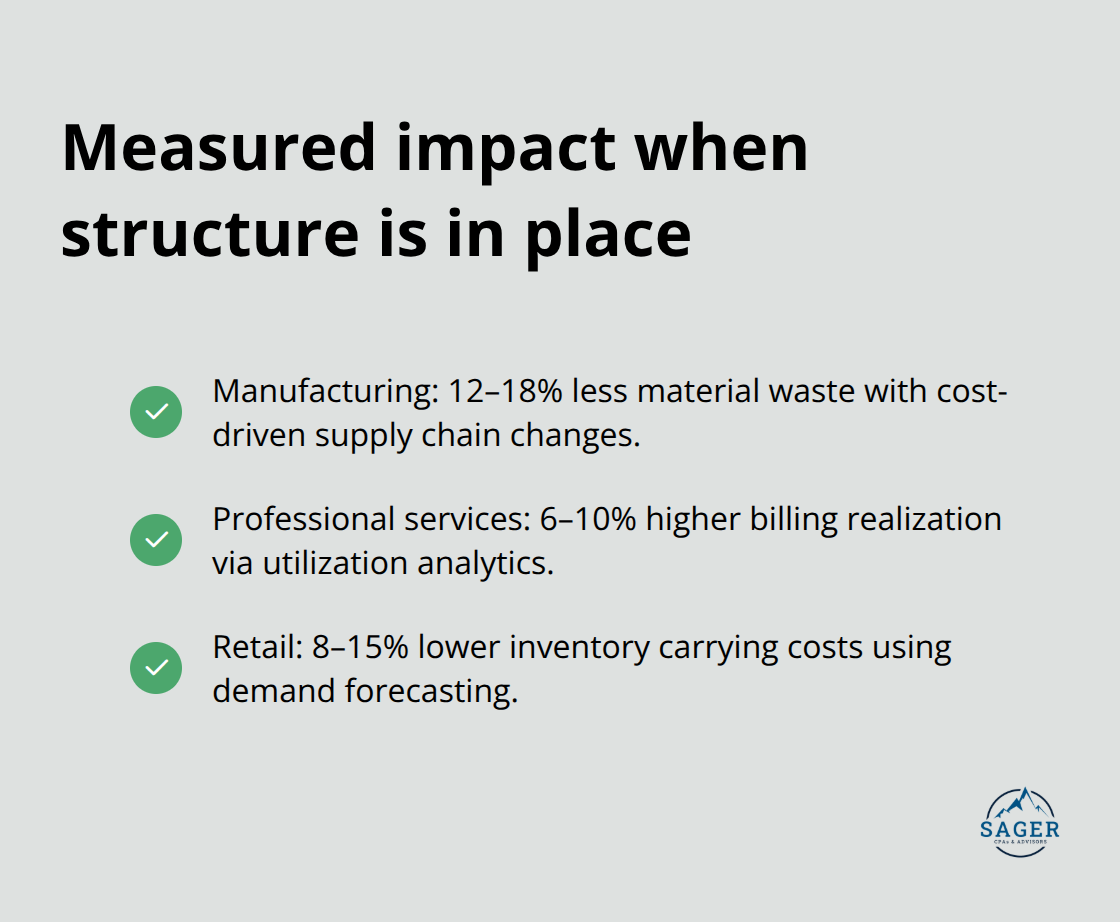
These aren’t theoretical improvements; they’re concrete results that flow directly to cash flow and profitability.
Your data has value only when it drives decisions. Companies sitting on spreadsheets and dashboards filled with financial metrics, operational reports, and forecasting models miss the competitive advantage those numbers could deliver. The gap between data collection and strategic action is where most businesses lose ground to faster-moving competitors, and business advisory services close that gap by translating what your numbers reveal into what your organization should do about it.
The right advisory partnership accelerates growth because advisors work backward from your business goals, not forward from your data. They ask the questions that matter to your strategy, identify which metrics answer those questions, and frame recommendations around your specific situation. They connect your finance team to your decision-makers, eliminate technical jargon that creates confusion, and establish decision frameworks that stick. When advisory recommendations link directly to your priorities and come with clear next steps, your teams execute faster and results follow within quarters, not years.
The transformation from data hoarding to data weaponization starts with a single conversation. Schedule a consultation with Sager CPA to discuss your financial challenges and explore how strategic advisory can accelerate your growth.




Phone: (208) 939-6029
Email: info@sager.cpa
Privacy Policy | Terms and Conditions | Powered by Cajabra
At Sager CPAs & Advisors, we understand that you want a partner and an advocate who will provide you with proactive solutions and ideas.
The problem is you may feel uncertain, overwhelmed, or disorganized about the future of your business or wealth accumulation.
We believe that even the most successful business owners can benefit from professional financial advice and guidance, and everyone deserves to understand their financial situation.
Understanding finances and running a successful business takes time, education, and sometimes the help of professionals. It’s okay not to know everything from the start.
This is why we are passionate about taking time with our clients year round to listen, work through solutions, and provide proactive guidance so that you feel heard, valued, and understood by a team of experts who are invested in your success.
Here’s how we do it:
Schedule a consultation today. And, in the meantime, download our free guide, “5 Conversations You Should Be Having With Your CPA” to understand how tax planning and business strategy both save and make you money.