
What Is Business Strategy Definition?
Learn what business strategy definition means and how it drives company growth and competitive advantage in your market
Most business owners confuse strategy with day-to-day operations. A business strategy definition goes far deeper-it’s your roadmap for competitive advantage and long-term growth.
At Sager CPA, we’ve seen firsthand how companies with clear strategies outperform those without them. This guide breaks down what strategy actually means and how to build one that works.
Strategy represents the fundamental difference between knowing where you want to go and having a realistic plan to get there. Most business owners conflate strategy with their annual budget or marketing plan, but strategy operates on a different level entirely. It’s the master framework that guides how you allocate resources, make decisions, and position yourself against competitors over the next three to five years. Without it, even brilliant tactical moves fail to compound into sustainable growth.
Your strategy rests on three distinct components working together. First, you need a clear vision that defines what success looks like for your business and where you’ll compete in the market. This isn’t vague mission-statement language; it’s specific enough to guide resource allocation.
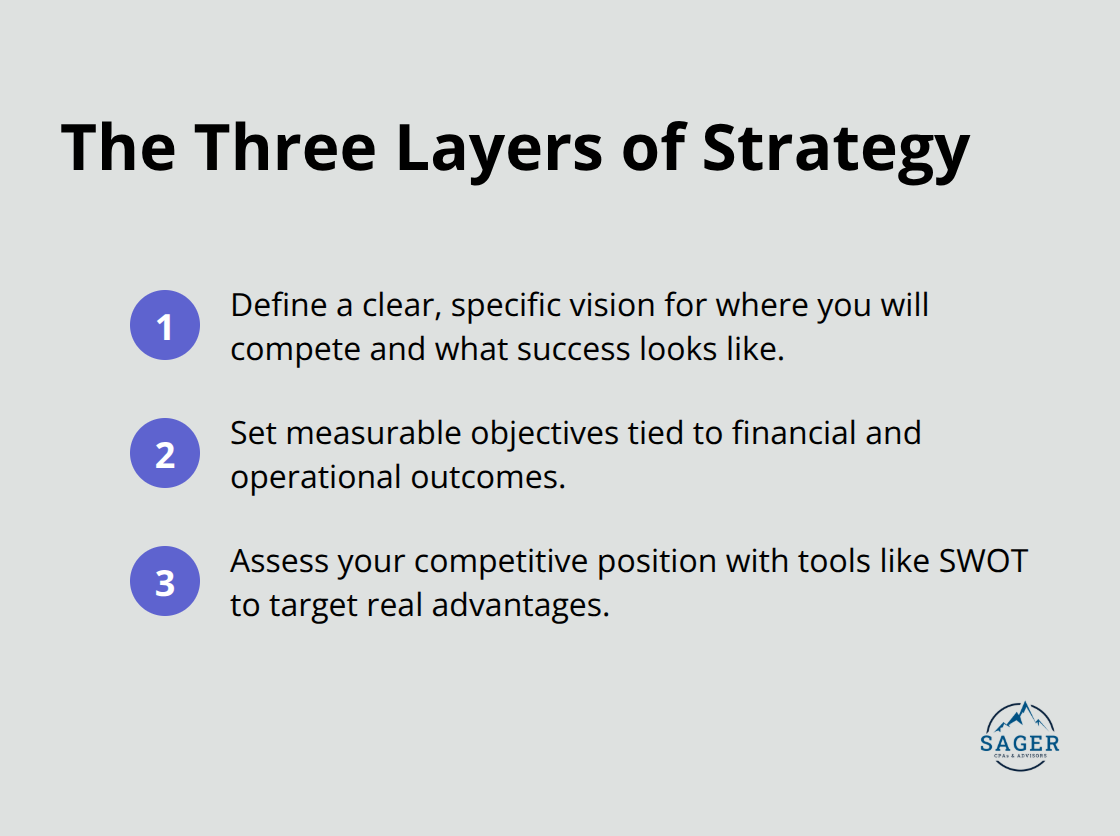
Second, you establish measurable objectives tied to financial and operational outcomes-revenue targets, market share gains, customer retention rates. Third, you conduct a genuine assessment of your competitive position through tools like SWOT analysis, which identifies where you actually have advantages versus where competitors outflank you. Companies that skip this assessment waste resources chasing markets they can’t win.
Strategy and tactics serve completely different functions, yet most businesses treat them as interchangeable. Tactics are the specific actions your sales team, marketing department, or operations group execute daily. Strategy is the overarching direction that determines which tactics matter and which ones waste money. A company can execute brilliant tactics-viral marketing campaigns, aggressive discounting, innovative product launches-and still fail if those tactics don’t serve a coherent strategy. Conversely, a solid strategy with mediocre tactics still compounds over time.
General George S. Patton Jr. captured this perfectly: good tactics can save even the worst strategy, but bad tactics will destroy even the best strategy. This means your team needs both, but strategy must come first. You decide the game you’re playing before you decide how to win individual matches. The order matters more than most leaders realize.
Your strategy determines where your money, time, and talent actually go. Without a clear strategic framework, departments compete for resources based on noise and politics rather than what moves the needle. A marketing team might push for a massive digital campaign while operations needs investment in systems. Finance might argue for cost-cutting while sales wants to hire aggressively. Strategy answers these conflicts by establishing which investments support your competitive position and which ones don’t.
This is where many businesses stumble. They have a strategy document that sits in a drawer while actual resource decisions follow a different logic entirely. The strategy that shapes your budget, hiring, and capital allocation is your real strategy-not the one written on paper. Alignment between what you say matters and where you actually spend money separates companies that execute from those that merely plan.
A well-defined strategy creates clarity across your organization, but only if your team understands how their work connects to it. Each department needs to translate the overall strategy into specific objectives and actions that roll up to company-wide goals. Your sales team should know which customer segments matter most. Your operations team should understand which efficiency gains support your competitive advantage. Your finance team should track metrics that reveal whether the strategy is working.
This translation from strategy to execution is where most plans fail. The strategy itself might be sound, but without clear departmental alignment and measurable progress tracking, it remains theoretical. The next section explores how to build this alignment and establish the frameworks that turn strategy from a planning exercise into a living, breathing guide for your business.
Most businesses collect frameworks like decorations and never use them. Porter’s Five Forces sounds impressive in a boardroom, but it won’t help you allocate your next dollar. SWOT analysis becomes a checkbox exercise where teams list generic threats and call it strategy. The Balanced Scorecard approach offers real value when implemented correctly, but most companies abandon it after the first quarter when results don’t match projections. The problem isn’t the frameworks themselves-it’s treating them as strategy rather than tools that support strategy.
Porter’s Five Forces are used to identify and analyze the forces that shape the competitive nature and intensity of a market or industry. The analysis works best when you apply it to a specific market segment you’re actually competing in, not your entire industry. A regional accounting firm analyzing the market for tax services to manufacturing companies would examine how much power their clients have to negotiate fees, whether alternative services like outsourced CFO platforms threaten traditional tax work, and what barriers prevent new competitors from entering that niche. Too many companies conduct a generic Five Forces analysis for their entire industry, which produces insights so broad they’re worthless.
SWOT analysis identifies your strengths, weaknesses, opportunities, and threats, but the real work happens after you complete it. Most teams list obvious strengths like a strong brand or experienced team, then shelve the analysis. The valuable SWOT focuses on asymmetries-areas where your competitors have structural advantages you can’t match, and conversely, blind spots they have that you can exploit. If every competitor in your market has similar technology, that’s not a strength differentiator. If they all rely on a supplier with capacity constraints but you’ve invested in redundancy, that’s a real advantage worth building strategy around.
The Balanced Scorecard is a strategic planning and management system that organizations use to focus on strategy and improve performance. Companies that succeed with this approach establish specific metrics for each perspective tied directly to their strategic objectives. A software company pursuing a market expansion strategy might track new customer acquisition rates in the customer perspective, average onboarding time in internal processes, employee certifications in learning and growth, and revenue from new markets in financial results.
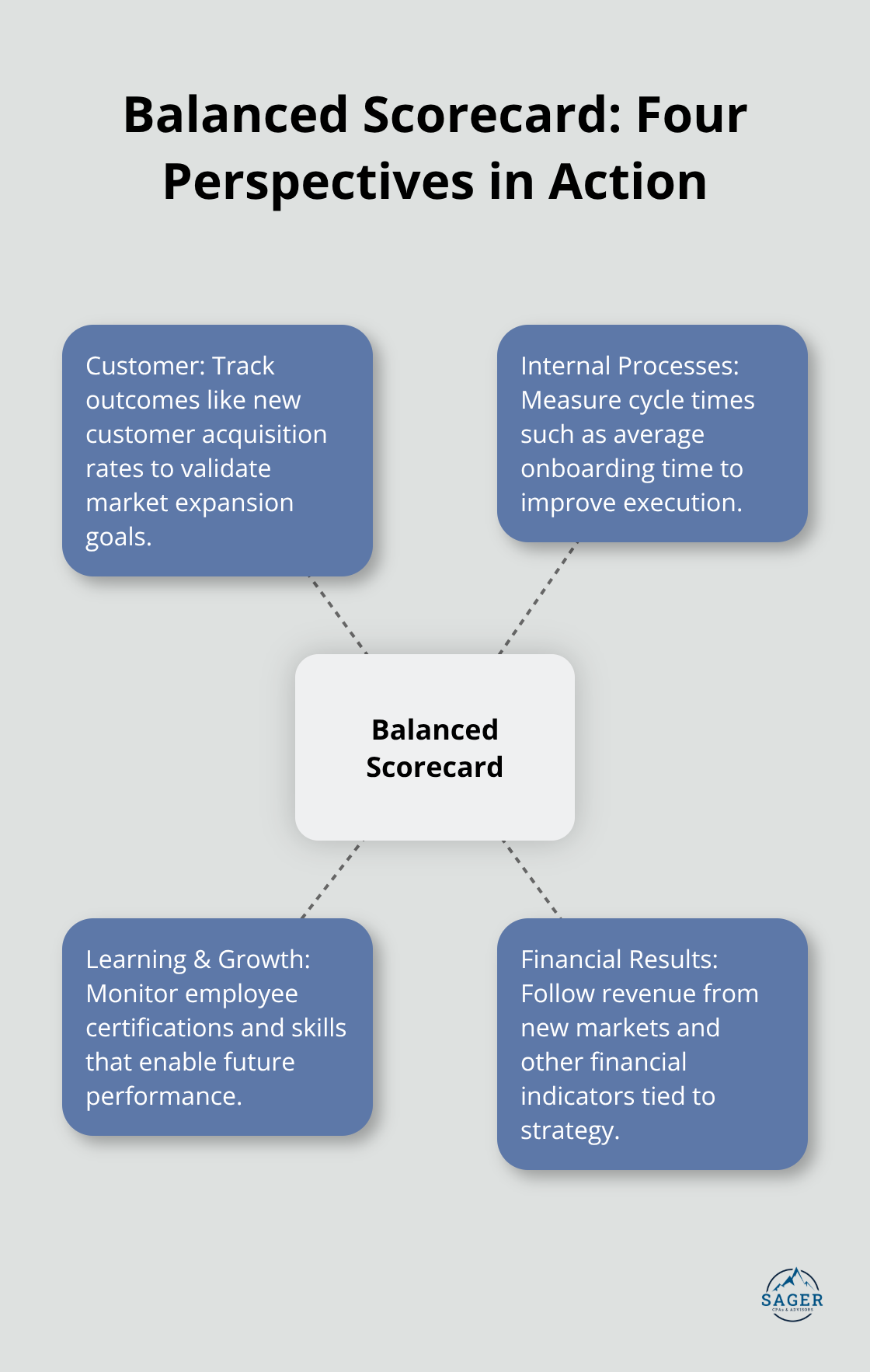
This interconnected view prevents the common mistake of optimizing one metric while others deteriorate. The framework fails when teams treat each perspective independently or when metrics become disconnected from the actual strategy driving the business.
These three frameworks share a common weakness: they produce insights only if your organization actually uses them to make decisions. Most companies treat frameworks as one-time planning exercises rather than ongoing tools that inform resource allocation and priority-setting. The frameworks that drive results become embedded in how you evaluate opportunities, assess competitive threats, and allocate capital. Your leadership team references them in quarterly reviews. Your department heads use them to justify budget requests. Your finance team tracks metrics that flow directly from framework insights. When frameworks remain separate from your actual decision-making process, they add complexity without value. The next section explores how to move from selecting the right framework to executing a strategy that your team understands and acts on every single day.
Strategy means nothing without execution, and execution fails without clarity on three fronts: where you stand today, what winning looks like, and how your organization will get there. Most businesses skip the first part entirely. They write a strategy document based on assumptions about their market position rather than facts. Business owners often spend months on strategic planning only to realize their assessment of competitive advantage was built on outdated information.
Start by examining your actual market position, not the one you wish you had. Pull your last two years of financial statements and identify which customer segments, products, or services generated the most profit, not just revenue. Many companies discover their most profitable work comes from unexpected places because they’ve never analyzed profitability by segment. Interview your top ten customers and ask them why they chose you over competitors and what would make them leave. Their answers reveal what strategy should protect and what needs improvement.
Assess whether your cost structure actually supports your competitive positioning. If you claim to compete on premium quality but your cost per unit ranks in the bottom quartile for your industry, that’s a strategic misalignment that will eventually destroy margins.
Once you understand where you stand, establish objectives that are specific enough to guide decisions but realistic given your resources and market conditions. Vague targets like “increase revenue” or “improve efficiency” mean nothing. Instead, define targets tied to your competitive advantage.
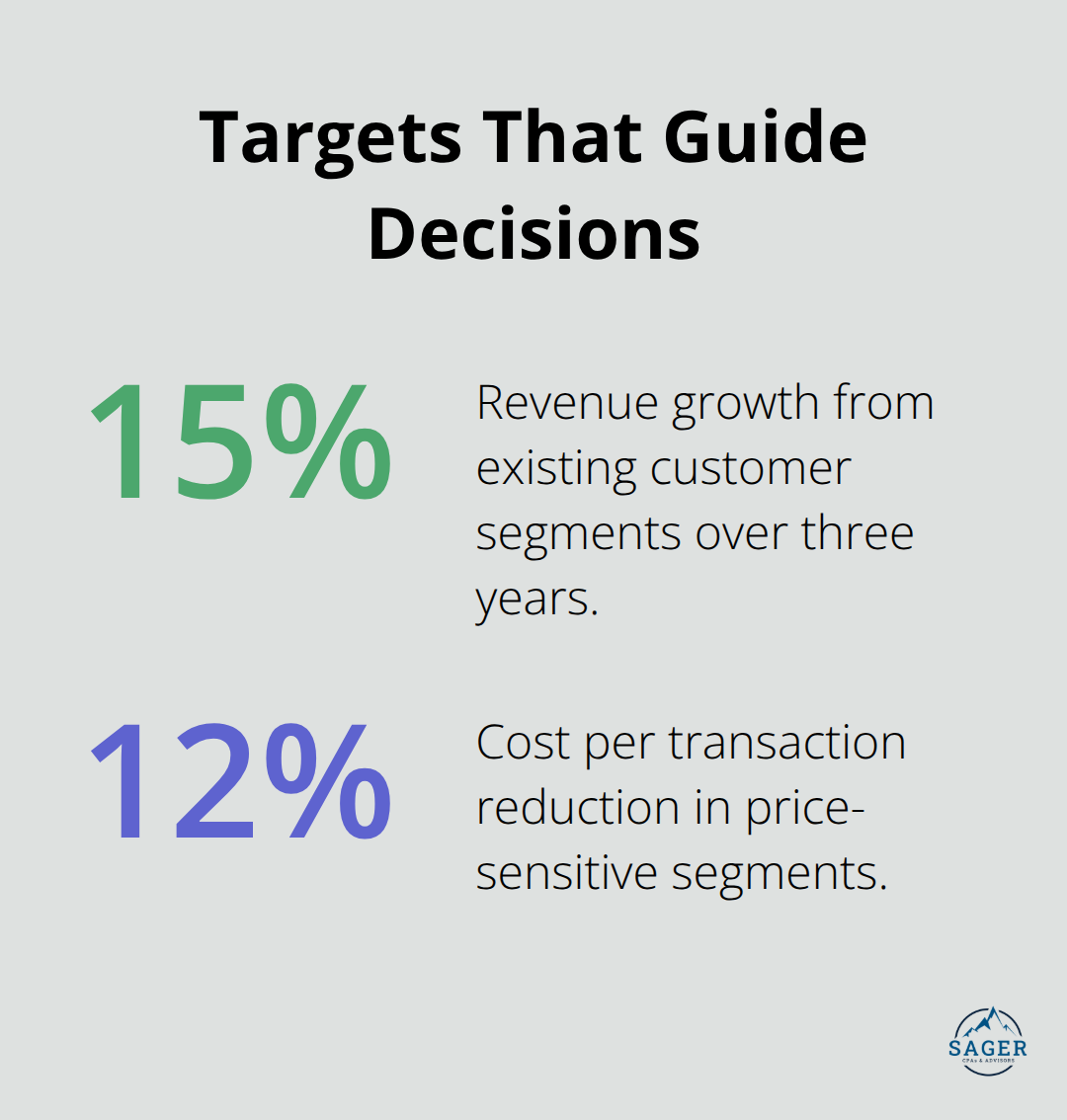
If you compete by serving niche markets with superior service, your objective might be to grow revenue from existing customer segments by 15 percent over three years while maintaining a net promoter score above 70. If you pursue cost leadership, your target might be to reduce cost per transaction by 12 percent while growing market share in price-sensitive segments.
These objectives then cascade into departmental goals with measurable key performance indicators that show progress monthly or quarterly. Your sales team tracks new customer acquisition in target segments. Your operations team monitors cost reduction initiatives and their impact on margins. Your finance team measures whether capital investments generate the return the strategy promised.
Research from management consulting firms shows organizations with five or fewer strategic objectives execute at roughly double the rate of those with ten or more. Prioritization forces trade-offs, and trade-offs create clarity.
Align your team and resource allocation with these objectives by making the connection explicit. When you hire, promote, or allocate budget, explain how that decision supports your strategic objectives. When you cancel a project or initiative, explain what strategic priority it conflicts with.
This transparency prevents the common situation where stated strategy diverges from actual strategy reflected in spending and staffing decisions. Your real strategy lives in your budget, your hiring decisions, and your capital allocation-not in a document that sits in a drawer. The companies that execute strategy at the highest level treat resource decisions as strategic decisions, not administrative ones.
Track whether your actual spending patterns match your stated priorities. If your strategy emphasizes customer retention but you allocate most of your budget to customer acquisition, you’ve identified a misalignment that will undermine results. The same applies to staffing: if your strategy requires operational excellence but your best people work in functions unrelated to that objective, you’ve created a structural barrier to execution.
Business strategy definition ultimately means creating a realistic plan that guides resource allocation, shapes competitive positioning, and compounds over time. Without it, your organization executes tactics in isolation rather than building toward sustainable advantage. The frameworks and assessment methods covered in this guide work only when your leadership team commits to using them as decision-making tools, not planning exercises that sit forgotten in a drawer.
Assess your actual market position by analyzing which customer segments and products generate real profit, not just revenue. Interview your best customers about why they chose you and what would make them leave. Then establish three to five specific objectives tied directly to your competitive advantage, cascade those into departmental goals with measurable KPIs, and align your budget and hiring decisions to match your stated priorities.
We at Sager CPA help businesses strengthen their strategy by connecting financial clarity to strategic decision-making. Our team reveals which segments drive profitability, where cost structures misalign with competitive positioning, and how to allocate capital toward objectives that matter. Schedule a consultation with us to create a personalized financial strategy that supports your competitive advantage and long-term growth.




Phone: (208) 939-6029
Email: info@sager.cpa
Privacy Policy | Terms and Conditions | Powered by Cajabra
At Sager CPAs & Advisors, we understand that you want a partner and an advocate who will provide you with proactive solutions and ideas.
The problem is you may feel uncertain, overwhelmed, or disorganized about the future of your business or wealth accumulation.
We believe that even the most successful business owners can benefit from professional financial advice and guidance, and everyone deserves to understand their financial situation.
Understanding finances and running a successful business takes time, education, and sometimes the help of professionals. It’s okay not to know everything from the start.
This is why we are passionate about taking time with our clients year round to listen, work through solutions, and provide proactive guidance so that you feel heard, valued, and understood by a team of experts who are invested in your success.
Here’s how we do it:
Schedule a consultation today. And, in the meantime, download our free guide, “5 Conversations You Should Be Having With Your CPA” to understand how tax planning and business strategy both save and make you money.