
How to Align Business Strategy with Your Career Goals
Align your business strategy with career goals to build a meaningful, sustainable professional path that matches your values and ambitions.
Your business strategy and career goals don’t have to pull in opposite directions. When they’re misaligned, you waste energy fighting against your own organization instead of growing within it.
At Sager CPA, we’ve seen professionals thrive when their personal ambitions match where their company is headed. This guide walks you through the practical steps to make that alignment happen.
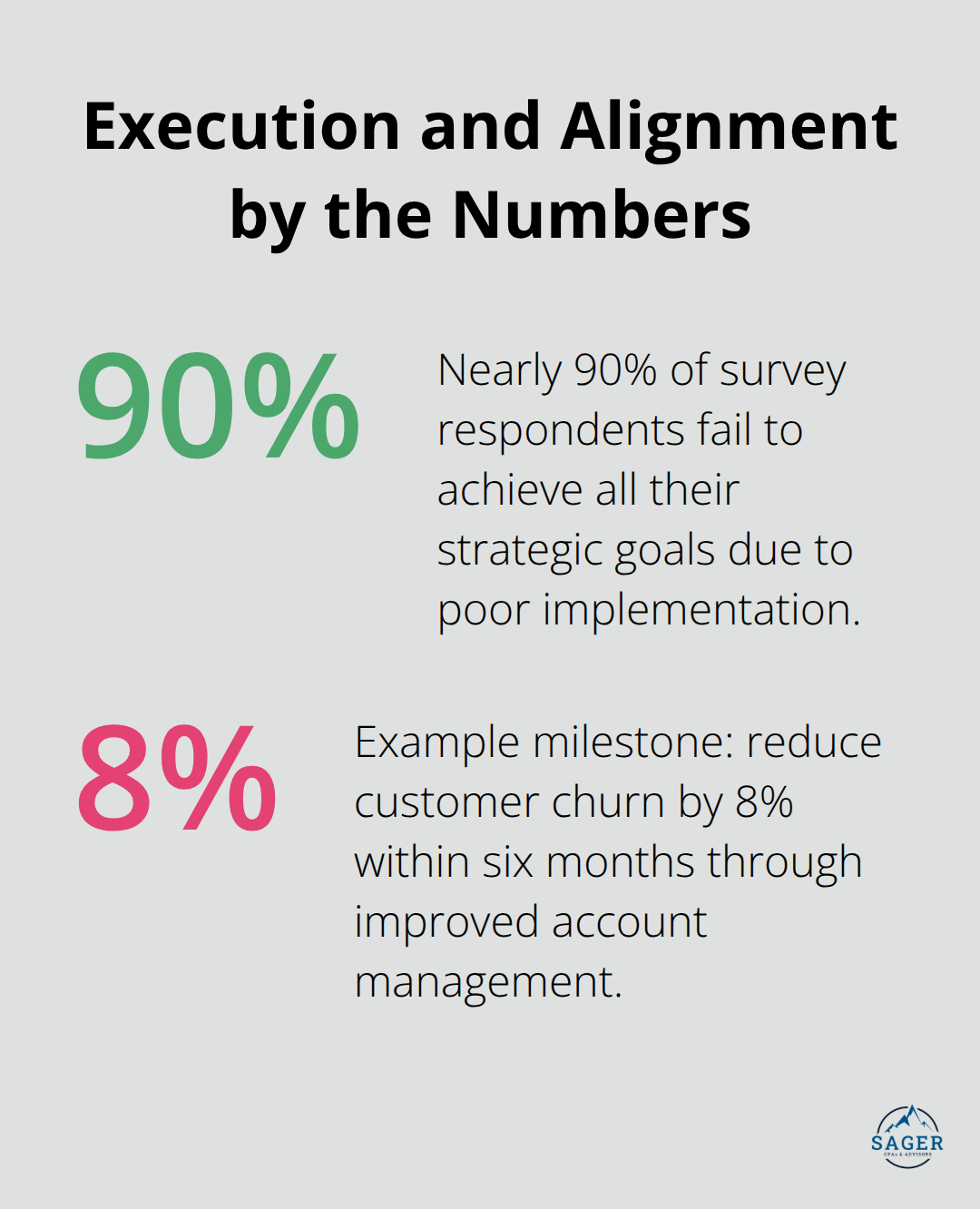
Alignment between your career goals and business strategy isn’t a soft HR concept-it’s the difference between moving forward and spinning your wheels. An Economist study found that nearly 90% of survey respondents from around the world fail to achieve all their strategic goals because they don’t implement well. That failure cascades down through the organization. When employees don’t understand where the company is headed or how their work contributes to that direction, they make decisions that work against company priorities.
You end up duplicating effort, pursuing conflicting objectives, and burning out faster because you’re not aligned with what actually matters. The practical consequence is this: if your personal growth targets don’t connect to what your organization is trying to accomplish, you’re essentially working against your own advancement. Your manager won’t advocate for your promotion if your achievements don’t support the company’s key initiatives. You won’t get access to the resources, training, or opportunities that accelerate careers because those investments go toward people driving business outcomes.
Most companies have strategy documents gathering dust while employees operate on outdated assumptions about priorities. You need to find out what your leadership actually believes matters right now. Schedule a direct conversation with your manager or, if possible, your CEO or COO to understand the near-term business objectives. Ask specific questions: What are the top two or three things the company must accomplish this year? Which customer segments or revenue streams get the most attention? What capabilities or skills does the organization need to build? Then translate those answers into your own development plan. If your company is scaling operations, investing in digital transformation, or entering new markets, your career path should point toward expertise in those areas. This isn’t about being opportunistic-it’s about building skills that have genuine value inside your organization because they solve real problems leadership cares about solving. A practical test: can you explain your company’s strategy to someone outside the organization in two or three sentences? If you can’t, you haven’t pushed hard enough to understand it.
When your work doesn’t support business strategy, several things happen simultaneously. Resources that could fund your development go to initiatives with clearer business connections. Your contributions get overlooked because they don’t map to what leadership measures. You accumulate skills and experiences that matter less to your employer’s future, which limits your advancement within that organization. This creates a frustrating cycle where you feel undervalued while your employer sees you as unfocused. The solution isn’t to abandon your personal goals-it’s to reframe them against company direction. If you want to move into leadership, show how you’ll develop people or drive execution on strategic priorities. If you want to specialize in a particular function, connect that specialization to a gap the company needs to fill. Your manager should help you see these connections, but if they don’t, you have to make them explicit. Document how your projects and development goals support company objectives. Track metrics that show your impact on business outcomes, not just activity. This creates a clear line of sight between what you’re doing and what matters-and positions you to take the next step in your career development.
The gap between what you think you’re good at and what your organization actually needs is where most career stagnation happens. You need a brutally honest assessment of your current capabilities against what your company’s strategy demands.
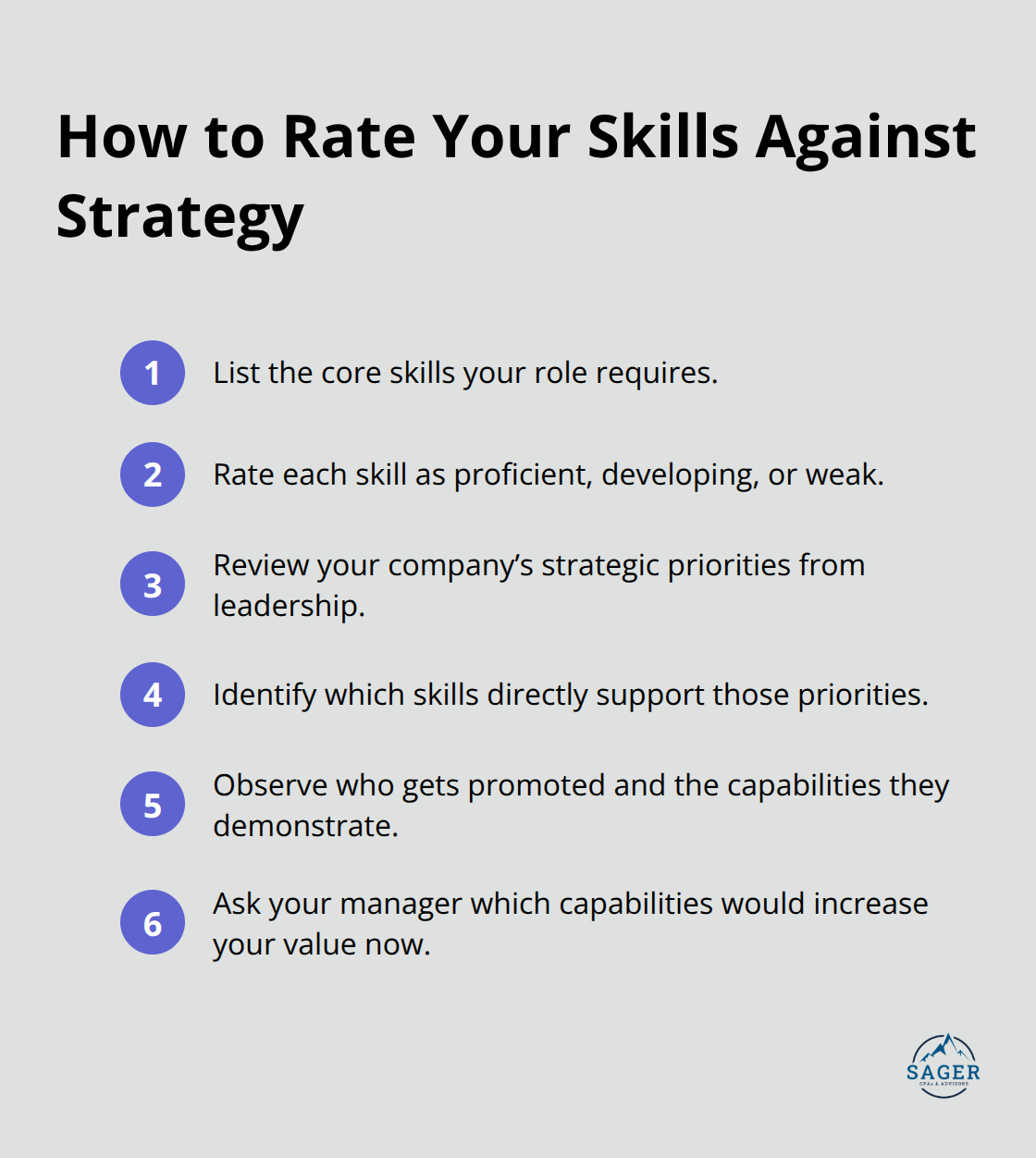
Start by listing the core skills your role requires, then rate yourself on each one using a simple scale: proficient, developing, or weak. Don’t inflate your ratings. Next, review your company’s strategic priorities from that conversation you had with leadership. Identify which skills directly support those priorities.
If your company invests heavily in digital transformation but you’re weak in data analytics, that’s a gap worth addressing immediately. If customer retention ranks as the top priority and your communication skills need work, that matters. The skills that matter are the ones leadership actually invests in and measures.
Look at who gets promoted in your organization. What capabilities do those people have? What projects do they lead? That’s your real skill roadmap. Ask your manager directly which capabilities would make you more valuable to the company’s current direction. Most managers will tell you if you ask specifically rather than generally.
You need to know exactly how your current work maps to business outcomes. Pull together the projects you completed in the last year and document what each one accomplished in terms the business understands. Did it reduce costs, improve customer satisfaction, accelerate a product launch, or support market expansion? Quantify the impact wherever possible.
If you improved a process, what time or cost savings resulted? If you led a team initiative, what business metric improved? Most professionals can’t answer these questions because they focus on activity rather than results. Your manager probably can’t either unless you make it explicit.
This assessment reveals your actual value within the organization right now. You might discover that your strongest contributions don’t align with strategic priorities, which explains why you haven’t advanced as quickly as you expected. Or you might find that you’re already supporting critical initiatives but haven’t made that visible to decision-makers. The visibility gap is often the real problem.
Document your impact clearly and share it with your manager and other leaders who influence opportunities. This gives you a baseline for what comes next and positions you to identify exactly which skills and experiences you need to build. With this assessment complete, you’re ready to create a concrete action plan that bridges the gap between where you stand today and where your organization needs you to go.
Now that you understand where your company is headed and where you stand today, you need a concrete action plan that connects the two. This isn’t about vague aspirations or annual goals that get forgotten by February. You need specific milestones tied to business outcomes, relationships with people who control opportunities, and a system for tracking whether your efforts actually move you forward.
Start with your company’s strategic priorities and convert them into your own development targets. If the company focuses on improving customer retention and you want to move into a leadership role, your milestones should include projects that directly address retention challenges. Lead a customer feedback initiative, implement a retention improvement process, or mentor team members on customer relationship skills. Each milestone needs a measurable outcome that matters to the business.
Instead of a vague goal like “develop leadership skills,” set a specific target: reduce customer churn by 8% through improved account management practices within six months. This approach accomplishes two things at once. It builds capabilities you actually need for advancement while solving problems your company actively cares about solving.
The relationships you build matter far more than most professionals realize. Your manager influences immediate opportunities, but your manager’s peers, your skip-level leader, and functional heads across the organization control access to high-impact projects, sponsorship for promotion, and visibility during succession planning.
Identify three to five key decision-makers in your organization whose support would accelerate your goals. These aren’t people you network with casually at company events. You need structured conversations where you discuss your development plan and ask directly how you can contribute to their priorities.
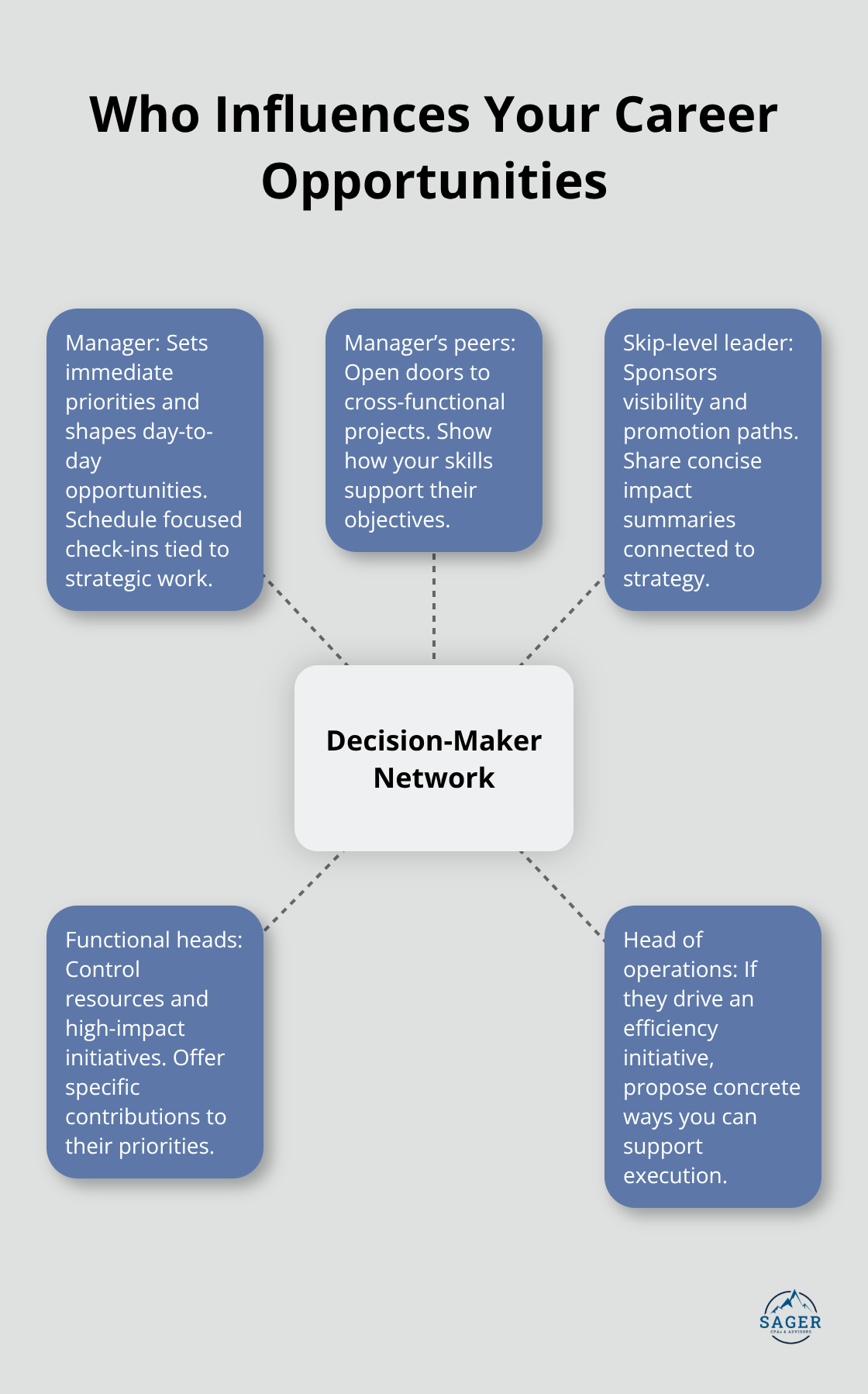
If you’re targeting a leadership role and the head of operations drives a major efficiency initiative, ask how you can support that work. Offer specific contributions rather than asking for generic mentorship. People respond to concrete proposals.
Schedule quarterly check-ins with your manager to review progress against your milestones and adjust based on what’s working. Most professionals wait until annual reviews to discuss career progress, which means six to twelve months of effort might move you in the wrong direction. Quarterly reviews let you catch misalignment early.
Document what you’ve accomplished, the business impact it created, and how it connects to your development goals. Track specific metrics that show your contribution to strategic outcomes, not just activity completed. If you led a process improvement, document the time saved or cost reduction. If you completed a training program, track how it improved your performance on work that matters to the business. Share this documentation with your manager and with leaders who see your work. This creates a clear record of your value and your alignment with company direction, which becomes essential when promotion or opportunity decisions get made.
As your company’s strategy evolves, your milestones need to evolve with it. If leadership announces a new market focus or shifts investment priorities, your action plan should shift too. Rigidity kills careers because it means you’re pursuing skills or experiences that no longer matter to the organization.
Build flexibility into your plan with quarterly reviews that ask whether your milestones still support current business priorities. If they don’t, adjust immediately rather than spending months on work that’s become less relevant. This ongoing recalibration is what separates people who advance from people who plateau.
Aligning your business strategy and career goals requires three concrete actions. First, talk directly with leadership about near-term priorities and translate those priorities into your own development targets. Second, assess your current position honestly by rating your skills against what the business needs and documenting the impact you already create. Third, build an action plan with specific milestones, relationships with decision-makers who control opportunities, and quarterly reviews to track progress as strategy shifts.
The payoff for maintaining this alignment proves substantial. You stop wasting energy on work that doesn’t matter to your organization, your contributions become visible to people who influence promotions, and you build skills that solve real problems leadership cares about. You advance faster because you work with your organization rather than against it, and you create clarity about what success looks like and how you’ll reach it. This eliminates the frustration of feeling undervalued while your employer sees you as unfocused.
Start this week by scheduling a conversation with your manager about your company’s top strategic priorities for the next year and which capabilities would make you more valuable to those initiatives. Document one project you completed recently and quantify its business impact, then identify one key decision-maker whose support would accelerate your goals and schedule a conversation about how you can contribute to their priorities. If you’re managing finances alongside your business strategy and career development, we at Sager CPA help individuals and businesses create customized action plans that connect financial decisions to long-term goals-schedule a consultation with Sager CPA to develop a personalized financial strategy that supports your overall advancement and stability.




Phone: (208) 939-6029
Email: info@sager.cpa
Privacy Policy | Terms and Conditions | Powered by Cajabra
At Sager CPAs & Advisors, we understand that you want a partner and an advocate who will provide you with proactive solutions and ideas.
The problem is you may feel uncertain, overwhelmed, or disorganized about the future of your business or wealth accumulation.
We believe that even the most successful business owners can benefit from professional financial advice and guidance, and everyone deserves to understand their financial situation.
Understanding finances and running a successful business takes time, education, and sometimes the help of professionals. It’s okay not to know everything from the start.
This is why we are passionate about taking time with our clients year round to listen, work through solutions, and provide proactive guidance so that you feel heard, valued, and understood by a team of experts who are invested in your success.
Here’s how we do it:
Schedule a consultation today. And, in the meantime, download our free guide, “5 Conversations You Should Be Having With Your CPA” to understand how tax planning and business strategy both save and make you money.