
How to Build a Winning Digital Business Strategy
Build a winning digital business strategy with proven tactics, market analysis, and actionable steps to drive growth and competitive advantage.
Most businesses fail at digital strategy because they skip the fundamentals. They chase trends instead of understanding their market, pick tools randomly, and spend money without measuring results.
At Sager CPA, we’ve seen what separates thriving digital businesses from struggling ones. The difference comes down to a clear, structured approach that covers market analysis, the right technology, and a marketing plan tied to real numbers.
Understanding your market means looking at real data, not assumptions. Start by analyzing what’s actually happening in your industry right now. Organizations prioritizing digital advancements see higher profitability and revenue growth, but only if those advancements align with genuine market conditions. Pull industry reports, competitor earnings calls, and customer reviews to identify patterns. What problems do customers complain about repeatedly? What solutions are competitors launching? What pricing strategies work? Spend two weeks collecting this information before you make any technology decisions. Many businesses skip this step and waste months building features nobody wants.
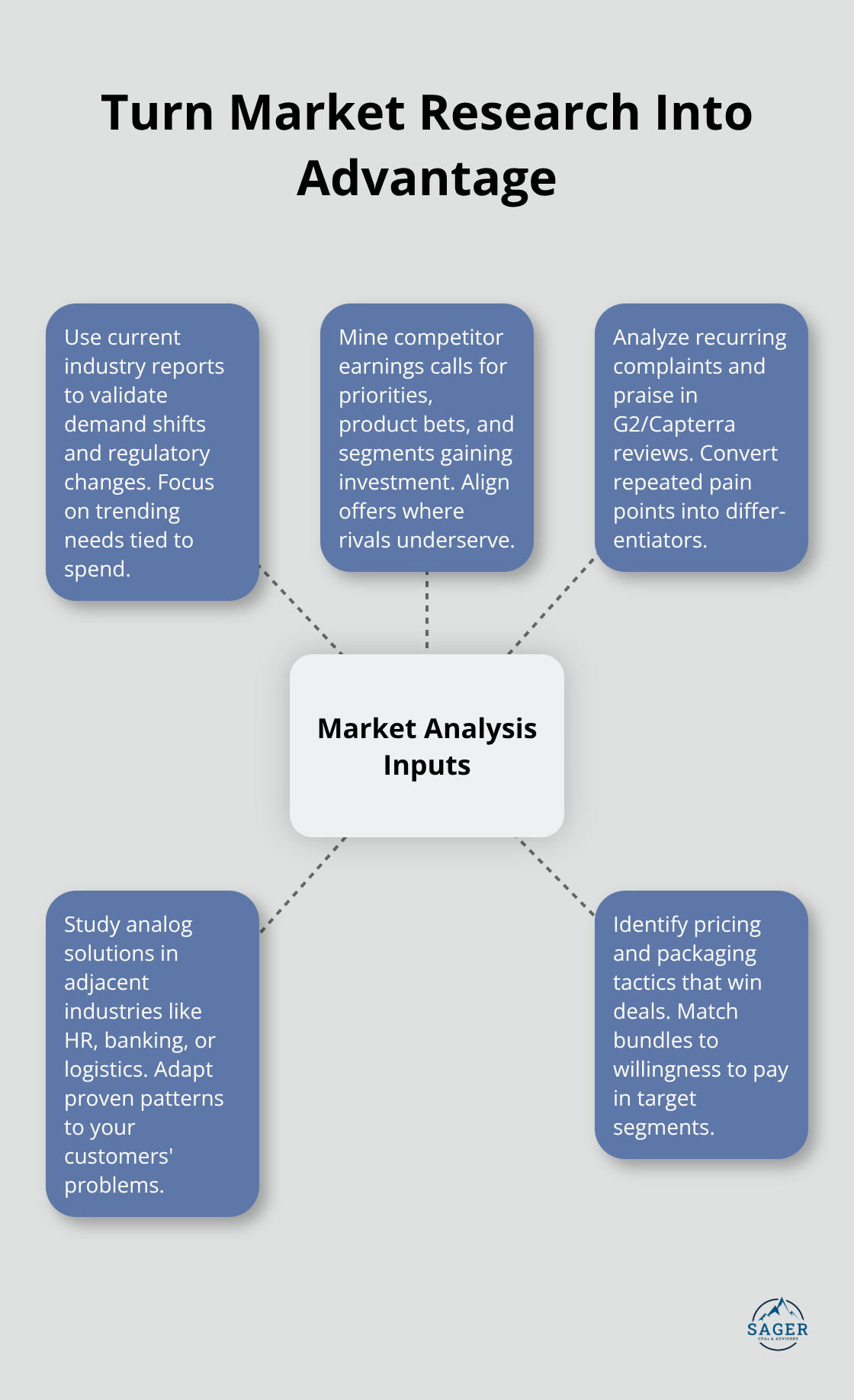
Your industry trends reveal what customers will pay for and what gaps exist. Look at companies in adjacent industries too-they often solve problems your customers face using different approaches. If you sell accounting software, study how HR platforms handle compliance or how banking apps manage security. These insights often translate across industries and give you competitive advantages your direct competitors haven’t noticed.
Define your target audience with specificity, not guessing. Instead of saying you serve small businesses, identify which small businesses have the most acute pain points and budget to solve them. Talk to ten of your current customers and ask why they chose you over alternatives-not what they like about your service, but what problem forced them to act. You’ll find patterns. One customer might need faster tax filing because they’re scaling rapidly. Another might need compliance help because they’re entering new markets. These aren’t the same customer, and they need different messaging, different features, and different sales approaches. Map out two or three customer segments with specific characteristics: their revenue size, industry, growth stage, and the exact problem keeping them awake at night. When you target vaguely, your marketing budget spreads thin and reaches nobody effectively. When you target precisely, every dollar works harder. This is where many digital strategies fail-companies build for everyone and appeal to nobody.
Competitor analysis isn’t about copying them. It’s about finding the gaps they leave open. Competitor analysis helps you learn from businesses competing for your potential customers and identify gaps in underserved market segments. Create a spreadsheet comparing the top five competitors across pricing, features, customer service approach, marketing channels, and brand positioning. Look for what they’re not doing. If every competitor focuses on enterprise clients, the mid-market might be underserved. If they all emphasize speed, reliability might be the differentiator customers actually want. Check their customer reviews on G2 or Capterra and read the negative ones-they reveal real pain points. Notice which complaints appear across multiple reviews. Those are opportunities. Your digital strategy should deliberately address what competitors ignore. This focused approach costs less to market because you’re not fighting directly on crowded battlegrounds. You’re competing where competitors are weakest.
You now have three critical pieces of information: what your market actually needs, who has the budget to pay for solutions, and where competitors have left openings. The next step moves beyond understanding into building strategy-selecting the technology and infrastructure that turns these insights into competitive advantage.
The market analysis you completed reveals what customers need and where competitors fall short. Now you must select technology that translates those insights into competitive advantage. Most businesses fail here by buying tools first and figuring out strategy later. They purchase Salesforce because competitors use it, implement data warehouses without clear use cases, and install CRM systems that nobody actually uses. The right approach reverses this sequence: your strategy determines your technology, not the other way around.
If your competitive advantage centers on personalized customer service, you need CRM systems that surface customer history instantly and automate routine inquiries so your team focuses on complex problems. If your advantage comes from faster service delivery, you need workflow automation and real-time dashboards that expose bottlenecks immediately. If differentiation depends on data-driven pricing or product recommendations, you need analytics platforms that feed insights directly into business decisions.
CIOs who align technology with enterprise strategy deliver faster innovation, higher returns, and stronger competitive positions. Start by listing the three to five critical capabilities your strategy requires. A tax preparation firm might prioritize document management, client portal access, and compliance tracking. A consulting firm might emphasize project tracking, resource allocation, and knowledge management. An e-commerce business might focus on demand forecasting, inventory optimization, and personalization.
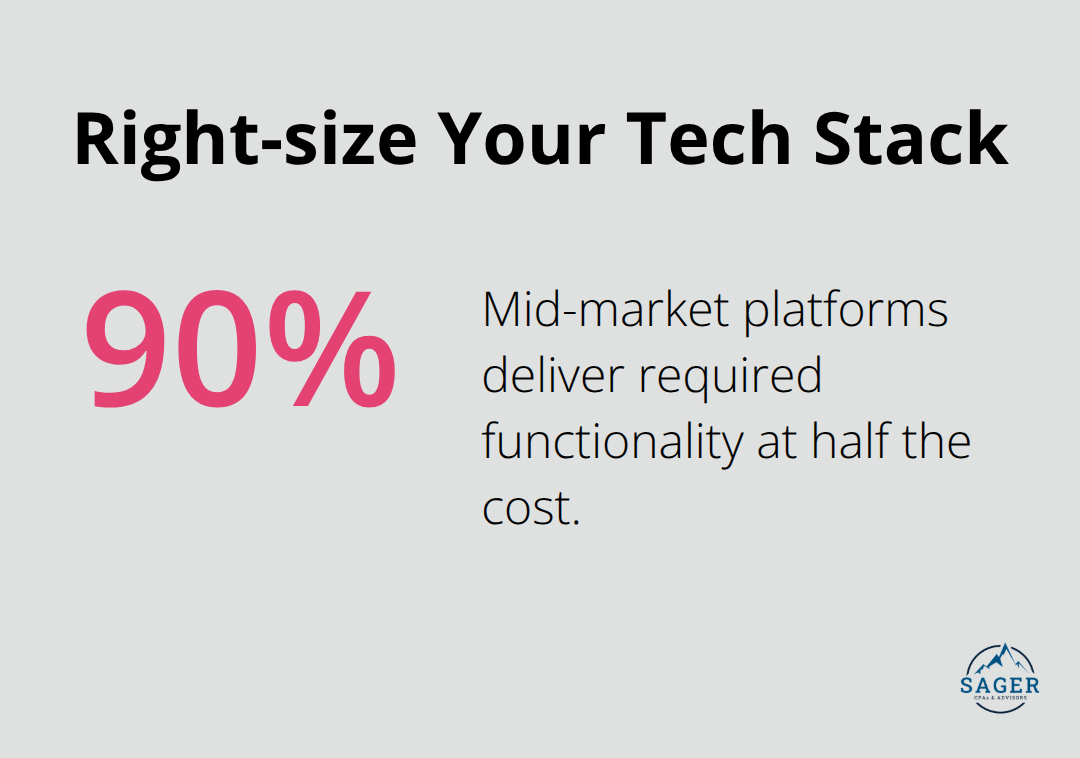
Once you identify these core needs, evaluate tools against functionality, integration capability, security standards, and total cost of ownership. Many companies choose expensive enterprise solutions when mid-market platforms deliver 90 percent of required functionality at half the cost.
Data management and analytics infrastructure determines whether your strategy actually works. You can target the right customers and position correctly, but without tracking what actually happens, you cannot optimize. Start by defining the specific metrics that prove your strategy is working. If your competitive advantage is speed, measure time-to-delivery and compare it against competitors. If it’s customer satisfaction, track Net Promoter Score and resolution rates. If it’s cost efficiency, monitor acquisition cost per customer and lifetime value.
Financial metrics track revenue growth, cost savings, ROI and profit margins, quantifying the financial impact of new digital initiatives. A SaaS company tracks customer acquisition cost, monthly recurring revenue, and churn rate because these numbers determine business viability. A consulting firm tracks project profitability, utilization rates, and client retention because these drive revenue. Once you define metrics, implement systems to capture and report them automatically. Spreadsheets fail because data becomes stale and errors compound. Cloud-based analytics platforms like Tableau or Looker connect directly to operational systems and update dashboards in real time. This matters because you need current information to adjust strategy quickly. If you discover that your target customer segment is not responding to your messaging, you should know within weeks, not months.
Customer relationship management systems bridge strategy and execution by centralizing how your team interacts with prospects and customers. Too many companies treat CRM as a contact database, but that misses the real value. A properly configured CRM captures why customers chose you, what problems they’re trying to solve, and what conversations happened at each stage. This intelligence reveals whether your market positioning is working.
If your CRM shows that customers consistently mention your competitor’s higher price as their main concern, but your messaging emphasizes reliability, you have a positioning problem worth fixing. The CRM should also automate follow-up processes so opportunities don’t slip through gaps. Sales teams that rely on memory or email folders lose deals. Teams with automated workflows and reminders built into CRM systems close more business.
Configure your CRM to track the specific customer journey your strategy assumes. If you’re targeting mid-market companies, your CRM should surface company size, growth trajectory, and budget indicators. If you’re competing on service quality, your CRM should prompt your team to check in proactively and document customer satisfaction.
The technology stack you select should feel invisible to your team. Tools that require excessive manual data entry, frequent reconciliation, or workarounds slow execution and undermine strategy. Test systems with real workflows before committing. Have your sales team run a prospect through your proposed CRM for a week. Have your operations team process actual transactions through your accounting system. Have your marketing team publish content through your proposed platform. This reveals integration gaps and user experience problems that spreadsheet comparisons miss.
Most digital strategies fail not because the strategy is wrong, but because the infrastructure cannot execute it reliably. The systems you’ve now selected form the foundation for your marketing execution. With the right technology in place and metrics defined, you can now build a marketing plan that reaches your target audience and measures results at every stage.
Your market analysis identified who to reach and what they need. Your infrastructure captures and measures results. Now comes execution: putting your message in front of the right people on the channels they actually use, with clear goals tied to revenue. Most digital marketing plans fail because they spread budget across too many channels without clear conversion paths. You cannot be everywhere effectively. Instead, focus on the channels where your target customers actively search for solutions and where you can measure whether they take action.
If you target mid-market accounting firms, LinkedIn and industry forums matter more than TikTok. If you sell to individual consumers, Google search and Facebook conversion ads work better than email alone. Start by auditing where your current customers found you. Check your website analytics to see which channels drive visitors who actually convert to customers. Google Analytics shows which traffic sources produce sales, not just clicks.
If organic search brings qualified leads, invest more heavily in SEO and content that ranks for keywords your customers search for. If paid ads from specific platforms consistently produce customers cheaper than your average customer acquisition cost, double down there. This is not guesswork. The data tells you where your money works.
Content strategy must address what your customers are trying to solve at each stage of their journey. Top-of-funnel content educates prospects about problems they might not know they have. Mid-funnel content shows how your solution compares to alternatives. Bottom-funnel content removes final objections and pushes toward purchase.
A financial services firm might publish educational guides about tax law changes at the top of the funnel, comparison articles about different service models in the middle, and detailed pricing and ROI calculators near the bottom. Each piece serves a specific purpose tied to moving prospects forward. Measure this with conversion metrics, not vanity metrics. Traffic and page views mean nothing if they do not convert.
Track how many visitors from each channel become leads, how many leads become customers, and how much revenue each channel ultimately produces. Set specific goals before you create content or launch ads. Do not say you want more website traffic. Try setting a target of 50 qualified leads per month from organic search at an acquisition cost below $200, or 100 customers per month from paid ads at a cost under $150 per customer.
These numbers force clarity about what actually matters. Once goals are defined, allocate budget proportionally to channels that have historically delivered results and test small amounts in new channels. If email marketing produces customers at $80 per acquisition and paid search produces them at $250, your budget should favor email.
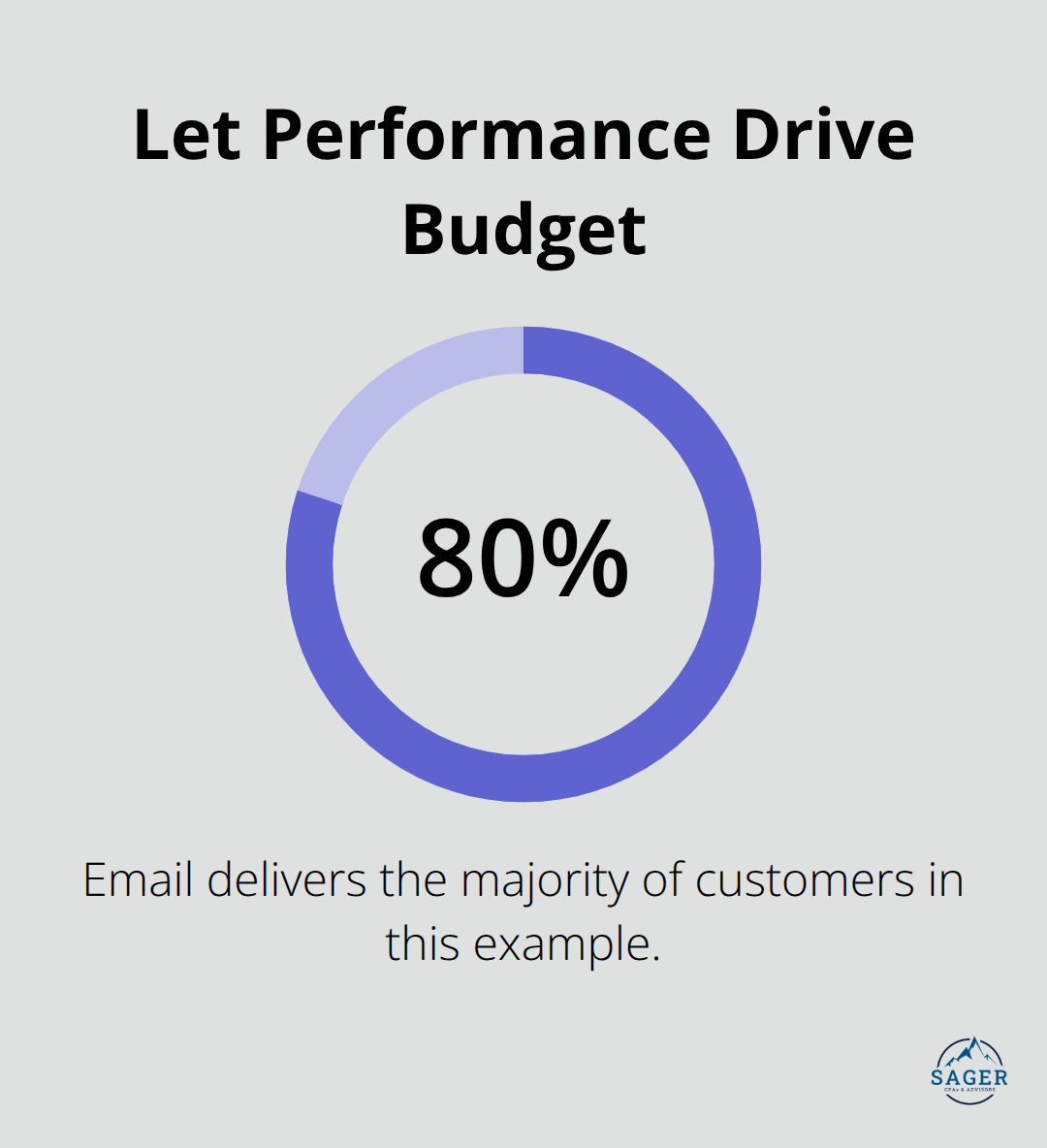
If you have $10,000 monthly marketing budget and email delivers 80 percent of customers, allocate $8,000 to email, $1,500 to paid search, and $500 to test a new channel. This systematic approach prevents the common mistake of equal budget allocation across all channels.
Channels perform differently, and your job is to find where they perform best and concentrate resources there.
Continuously test and adjust based on actual customer acquisition data. The channels that work today may shift as your market evolves and competitors adjust their positioning. Regular measurement reveals these shifts before they damage your results. Your marketing execution now rests on data, not assumptions, and your budget flows to the channels that actually produce revenue.
A winning digital business strategy rests on three foundations you now have in place. You understand your market deeply through analyzing real industry data, identifying specific customer segments, and finding gaps competitors ignore. You’ve built infrastructure that measures what matters, with technology systems and CRM platforms that capture whether your strategy actually works. You’ve created a marketing plan that reaches customers on channels where they convert, with budgets allocated to proven performers.
Companies that align technology with market positioning and track results see higher profitability and faster revenue growth than those that skip these steps. Your competitive advantage strengthens over time because you learn what works and concentrate resources on it while competitors scatter their budgets across untested channels. Markets shift, competitors respond, and customer preferences evolve-the metrics you’ve established reveal these changes quickly so you adjust your approach accordingly.
We at Sager CPA help businesses strengthen their financial strategy and decision-making through expert advisory services. Whether you’re refining your digital business strategy or need guidance on financial planning tied to growth goals, we’re here to support your journey with customized strategies and regular communication that keeps your business moving forward.




Phone: (208) 939-6029
Email: info@sager.cpa
Privacy Policy | Terms and Conditions | Powered by Cajabra
At Sager CPAs & Advisors, we understand that you want a partner and an advocate who will provide you with proactive solutions and ideas.
The problem is you may feel uncertain, overwhelmed, or disorganized about the future of your business or wealth accumulation.
We believe that even the most successful business owners can benefit from professional financial advice and guidance, and everyone deserves to understand their financial situation.
Understanding finances and running a successful business takes time, education, and sometimes the help of professionals. It’s okay not to know everything from the start.
This is why we are passionate about taking time with our clients year round to listen, work through solutions, and provide proactive guidance so that you feel heard, valued, and understood by a team of experts who are invested in your success.
Here’s how we do it:
Schedule a consultation today. And, in the meantime, download our free guide, “5 Conversations You Should Be Having With Your CPA” to understand how tax planning and business strategy both save and make you money.